

Most golfers assume sanctioning is a rubber stamp. An organization signs off, a tournament gets a logo on the banner, and everyone tees it up. The reality of how golf tournaments get sanctioned is far more layered than that. Sanctioning determines which players can compete, which ranking points get awarded, and whether results carry any official weight. For organizers, it shapes every decision from venue selection to format. For players, it affects eligibility, tour membership, and even disciplinary standing. Understanding the full process is not optional. It is the foundation of running or competing in a legitimate event.
Table of Contents
- Key takeaways
- How golf tournaments get sanctioned
- The step-by-step sanctioning process
- Co-sanctioning: what it means and why it matters
- Eligibility, discipline, and what sanctioning actually controls
- Practical advice for tournament organizers
- My perspective on where sanctioning is headed
- Take your amateur game to the next level with Worldamateurgolftour
- FAQ
Key takeaways
| Point | Details |
|---|---|
| Sanctioning is a governance agreement | Approval from a recognized body confirms a tournament's official status and point-awarding authority. |
| Multiple bodies can co-sanction | Co-sanctioned events allow players to earn ranking points across two tours simultaneously from one event. |
| Organizers must follow strict formats | Applications, site approvals, round structures, and calendar coordination are all required steps. |
| Player eligibility stays separate | Disciplinary rules and membership status are governed independently, even in co-sanctioned events. |
| Amateur pathways have their own process | WAGR-certified amateur events follow a distinct sanctioning framework tied to junior and collegiate golf development. |
How golf tournaments get sanctioned
Sanctioning in golf means a recognized governing body has formally approved an event as part of its official competition calendar. That approval is not cosmetic. It authorizes the tournament to award official ranking points, establishes the rules framework under which the event is played, and defines which players are eligible to compete.
The bodies doing the sanctioning vary by level and geography. Here is a breakdown of the major players:
- USGA (United States Golf Association): Governs major championships in the U.S., including the U.S. Open and U.S. Amateur. Their sanctioning process involves strict qualification frameworks, approved venues, and coordinated schedules with allied golf associations.
- PGA Tour: Sanctions professional events on the main tour circuit in North America. Tour membership and eligibility rules are tied directly to their sanctioning authority.
- LPGA Tour: Governs women's professional events in the U.S. and increasingly partners with international bodies for co-sanctioned events.
- DP World Tour (formerly European Tour): Sanctions events across Europe and globally, and regularly enters co-sanctioning agreements with the PGA Tour for select events.
- Ladies European Tour (LET): Works alongside the LPGA for joint events, as seen in the LPGA/LET co-sanctioned event at Shadow Creek.
- R&A: The governing body for golf outside the U.S. and Mexico, sanctioning The Open Championship and overseeing rules globally.
- World Amateur Golf Ranking (WAGR): Sanctions amateur events that award ranking points used for college recruitment and professional pathways.
- Regional golf federations: State and national amateur associations handle local sanctioning for amateur competitions, often acting as allied bodies for USGA qualifying.
The distinction between professional and amateur sanctioning matters enormously. Professional sanctioning controls tour membership and prize money eligibility. Amateur sanctioning controls ranking points that affect college recruiting, national team selection, and entry into major championships.
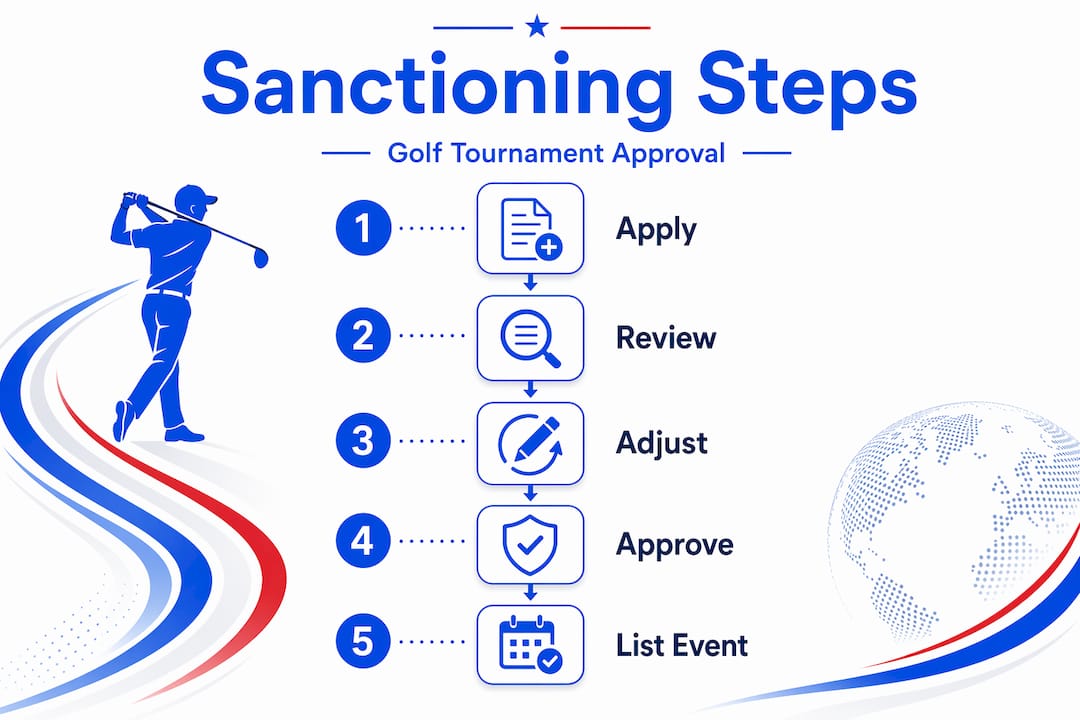
The step-by-step sanctioning process
The golf tournament approval process follows a structured sequence. Skipping steps or misunderstanding requirements is the most common reason organizers face delays or outright rejection.
- Identify the correct sanctioning body. Your event type, player level, and geographic location determine who you apply to. A WAGR-eligible amateur event goes through a different channel than a PGA Tour co-sponsored event.
- Submit a formal application. Most bodies require detailed documentation including proposed dates, venue information, expected field size, format details, and organizer credentials.
- Coordinate calendar placement. Sanctioning bodies protect their existing events from scheduling conflicts. Your proposed dates must not overlap with higher-priority events in the same region or at the same player level.
- Get venue approval. The course must meet standards set by the sanctioning body. For major championships, this means championship-caliber design, appropriate yardage, and infrastructure for officials and spectators.
- Confirm the tournament format. Round counts, cut structures, and tiebreaker procedures must align with the body's competition guidelines. The U.S. Open qualifying process illustrates this precisely: 108 local qualifying sites across the U.S., Canada, and Mexico run 18-hole qualifiers, followed by 36-hole final qualifying at designated U.S. and international sites. Every detail is prescribed.
- Coordinate with allied associations. For events like U.S. Open qualifying, the USGA works through regional golf associations who manage local sites. Organizers running those local qualifiers must be recognized by both the USGA and their state or national federation.
- Execute the sanctioning agreement. Once approved, organizers sign a formal agreement outlining their obligations, including rules compliance, reporting, and any financial arrangements.
- Maintain compliance throughout the event. Sanctioning can be revoked if an organizer fails to meet agreed standards during the event itself.
Pro Tip: Start your sanctioning application at least 12 months before your proposed event date. Most bodies have annual calendar review windows, and missing that window means waiting another full year.
Organizers must fit their tournaments into existing operational models including approved site counts, round structures, and coordinated calendar dates. There is no shortcut around this.

Co-sanctioning: what it means and why it matters
Co-sanctioning is one of the most misunderstood concepts in golf tournament regulations. Many people assume it simply means two organizations both endorsed an event. The reality is more precise. Co-sanctioning is a governance agreement that aligns two bodies so the same tournament awards official points and eligibility status on both tours simultaneously.
Here is how single sanctioning and co-sanctioning compare:
| Feature | Single sanctioning | Co-sanctioning |
|---|---|---|
| Points awarded | One tour only | Both tours simultaneously |
| Player eligibility | Governed by one body | Must meet both bodies' criteria |
| Disciplinary rules | One body's authority | Each body governs its own members |
| Scheduling complexity | Lower | Higher, requires dual calendar coordination |
| Prestige and field depth | Limited to one tour's members | Draws from both tours' memberships |
The strategic value is clear. A co-sanctioned event attracts a deeper, more competitive field and elevates the tournament's profile. Golf Saudi's push to expand co-sanctioned events in North America following the Shadow Creek success shows that major stakeholders see co-sanctioning as the future of elite event development.
"Co-sanctioning aligns governing bodies so that the same tournament confers points and eligibility for both tours simultaneously, facilitating dual recognition." — ESPN Golf
The catch is that co-sanctioning does not create universal clearance for all players. Each body retains independent authority over its own members' eligibility and disciplinary status.
Eligibility, discipline, and what sanctioning actually controls
Sanctioning determines official recognition of results. It does not override the membership rules of the bodies involved. This distinction trips up organizers and players alike.
The Jon Rahm situation at the Genesis Scottish Open made this concrete. The Genesis Scottish Open is co-sanctioned by the PGA Tour and DP World Tour. Rahm competed in the event, but his suspension status with the PGA Tour remained fully in effect. Playing in a co-sanctioned event did not restore his membership or clear his disciplinary record. The PGA Tour confirmed his ineligibility status stood regardless of the event's co-sanctioned nature.
This has direct implications for how organizers structure their fields and communicate eligibility requirements:
- Membership status is checked independently. A player may be eligible under one sanctioning body's rules but restricted under another's.
- Disciplinary actions follow the player, not the event. If a player is suspended by one body, that suspension applies even in events co-sanctioned with other organizations.
- Official world ranking points are only awarded if the player meets both bodies' criteria. Competing in a co-sanctioned event does not automatically mean a player earns points on both tours.
- Tournament results may be officially recognized by one body but not another. This affects everything from tour card status to major championship exemptions.
The separate governance of player memberships and disciplinary statuses is a feature of the system, not a flaw. It protects the integrity of each tour's competitive standards while still allowing collaborative events.
Practical advice for tournament organizers
Getting sanctioning right requires preparation, patience, and a clear understanding of what each body actually requires. Here is what separates organizers who get approved from those who stall out:
Start with the right body. Many organizers apply to the most prestigious body they can find, only to discover their event does not meet that body's minimum standards. Research the tier of sanctioning appropriate for your event's field quality, venue, and format before submitting anything.
Build relationships with regional coordinators. Most national bodies work through regional or state-level golf associations for local event oversight. These coordinators know the process inside out and can flag issues before they become formal rejections. Reach out early and treat them as partners.
- Know your format before you apply. Submitting an application with an undefined or non-standard format signals inexperience and creates delays.
- Secure your venue before your application, not after. Conditional applications based on "pending venue confirmation" are rarely prioritized.
- Review the sanctioning body's annual calendar before proposing dates. Conflicts with existing events are the most common reason for scheduling rejections.
- Budget for compliance costs. Sanctioned events often require certified officials, specific scoring systems, and documented rules procedures that add real expense.
Pro Tip: For amateur events targeting WAGR points, work directly with your national golf federation first. They act as the intermediary with the WAGR office and can significantly speed up the certification timeline.
Co-sanctioning is worth pursuing if your event has the field quality and organizational capacity to satisfy two bodies simultaneously. The added complexity is real, but the payoff in field depth, prestige, and player incentives is substantial. Start with single sanctioning, prove your event's quality, and then approach co-sanctioning as a growth step.
My perspective on where sanctioning is headed
I have spent years working alongside tournament organizers and watching how the sanctioning conversation evolves. The most common mistake I see is treating sanctioning as a checkbox. Organizers focus on getting approved and then stop thinking about what the approval actually requires of them throughout the event.
What I have learned is that sanctioning is a living relationship with a governing body. The initial approval is the beginning, not the end. Bodies monitor compliance, review results, and make decisions about future approvals based on how you run the current event. Organizers who treat it as a partnership consistently get better outcomes than those who treat it as a transaction.
The trend toward more co-sanctioning is real, and it will accelerate. Golf Saudi's expansion plans signal that major financial stakeholders see co-sanctioned events as the model for growing the game's global footprint. For amateur golf, the parallel trend is WAGR certification becoming a baseline expectation rather than a premium feature.
My advice: stay close to the official channels, invest in understanding the governance structures, and do not underestimate the value of a well-sanctioned event. Players notice. Sponsors notice. And the governing bodies notice too.
— Gene
Take your amateur game to the next level with Worldamateurgolftour
If you are a serious junior, collegiate, or amateur golfer looking for events that actually count, Worldamateurgolftour is built for you. The tour runs professionally managed, WAGR-certified amateur events on championship-caliber courses, giving you ranking points that matter for college recruiting and professional pathways.
Every event on the Worldamateurgolftour calendar goes through the full sanctioning process so you know your results carry real weight. The tour prioritizes transparency, competitive integrity, and player development at every stage. Whether you are chasing a WAGR ranking, preparing for collegiate golf, or building your competitive resume, this is the community to be part of. Visit Worldamateurgolftour to explore the 2026 schedule and register for upcoming events.
FAQ
What does it mean for a golf tournament to be sanctioned?
A sanctioned golf tournament has received formal approval from a recognized governing body, authorizing it to award official ranking points and confirming it meets that body's competition guidelines. Sanctioning determines player eligibility, official recognition of results, and the rules framework for the event.
Who sanctions golf tournaments at the amateur level?
Amateur golf tournaments are sanctioned by bodies including the USGA, national golf federations, and the World Amateur Golf Ranking organization. Regional golf associations often act as intermediaries, managing local qualifying and compliance on behalf of national bodies.
Can a tournament be sanctioned by more than one body?
Yes. Co-sanctioned events are formally approved by two governing bodies simultaneously, allowing players to earn ranking points on both tours from a single event. The LPGA and Ladies European Tour co-sanctioned an event at Shadow Creek as a recent example.
Does co-sanctioning mean all players can freely compete?
No. Player eligibility and disciplinary rules are governed separately by each body, even in co-sanctioned events. A player suspended by one tour remains ineligible under that tour's rules regardless of the event's co-sanctioned status.
How far in advance should organizers apply for tournament sanctioning?
Most sanctioning bodies review their annual calendars once per year, so organizers should submit applications at least 12 months before the proposed event date. For major championship qualifying events, coordinating with allied golf associations adds additional lead time to the process.