
You spent four years competing at the highest level of collegiate golf, and now the structure that carried you is gone. No team, no coach in your corner every day, no built-in schedule. The decision to transition college golf to amateur circuit play is exciting, but it catches most players off-guard. The amateur circuit operates differently from anything you experienced in college, and without a clear plan, talented players stall out fast. This guide covers exactly what you need to prepare, which tournaments to target, how to adapt your game, and how to measure real progress.
Table of Contents
- Key takeaways
- How to transition college golf to amateur circuit play
- Selecting the right tournaments
- Executing your game on the amateur circuit
- Tracking progress and planning next steps
- My honest take on this transition
- Your next step on the amateur circuit
- FAQ
Key takeaways
| Point | Details |
|---|---|
| Evaluate game readiness first | Close the execution gap between practice and competition before committing to a full amateur schedule. |
| Prioritize WAGR events | Target ranking-eligible tournaments like the 50Flag series to build your World Amateur Golf Ranking early. |
| Build a support system | Replace your college team structure with coaches, mentors, and peer networks to stay competitive. |
| Track milestones intentionally | Monitor ranking progress and tournament results to know when to stay amateur or consider turning pro. |
| Manage the solo transition | Loneliness and self-reliance are real challenges post-college. Plan for them the same way you plan your game. |
How to transition college golf to amateur circuit play
The single biggest mistake college golfers make when entering the amateur circuit is assuming the skills that made them successful in college will transfer automatically. They do not. About 65% of players making the cut in professional majors have collegiate experience, which proves the college pathway works. But the jump from team-based collegiate play to individual amateur competition requires deliberate preparation across four areas: your game, your body and mind, your logistics, and your network.
Evaluating your game honestly
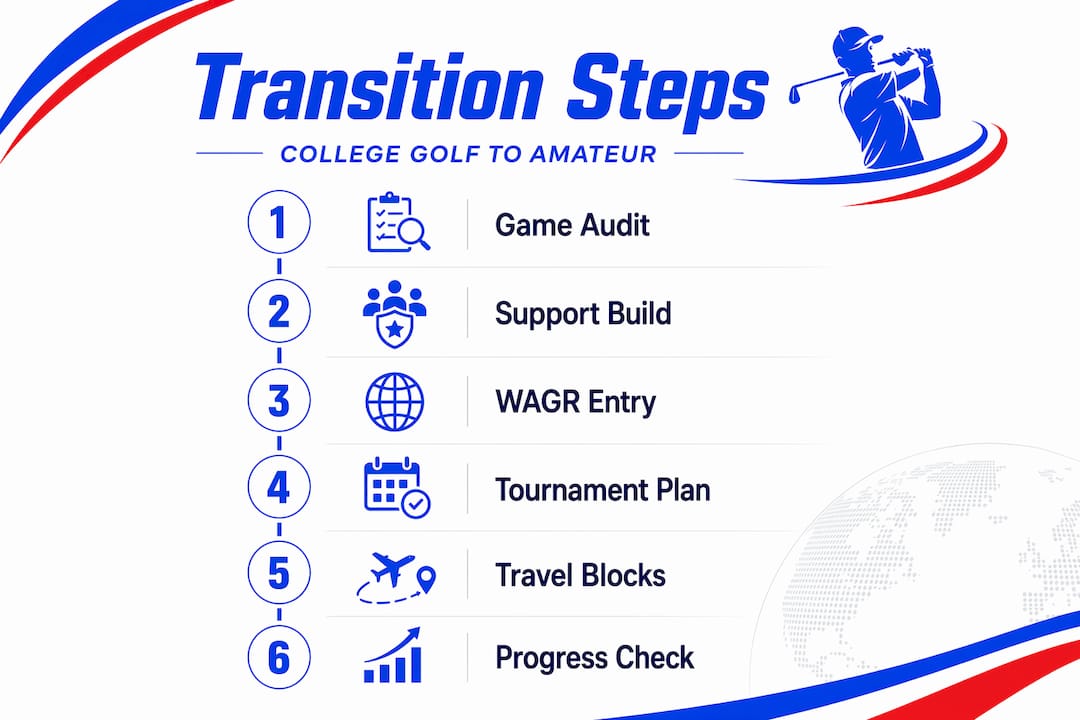
Start with a real audit of your stats. Strokes gained off the tee, approach, around the green, and putting. College golf often rewards players who are strong in one or two areas. The amateur circuit punishes weakness more consistently because the fields are deeper and the courses more varied. Identify where your practice performance exceeds your competitive performance. That gap is your first target.
The execution gap is the discrepancy between your practice swing and your competitive shot. It stems from tension spikes and biomechanical breakdowns under pressure. Closing it is not about hitting more balls. It is about building a pre-shot routine that creates the same psychological state on the first tee of a tournament as it does on the practice range.
Building your support system
Your college coaching staff will not be available daily anymore. You need to replace that structure intentionally. Find a swing coach who works with post-collegiate players, not just juniors. Add a short game specialist if that is your weakness. Consider a sports psychologist, especially if you have struggled with nerves or consistency under pressure.
Discipline over raw talent is what experienced coaches consistently identify as the marker for readiness at the next level. The players who thrive in the amateur circuit are not always the most gifted. They are the most organized and the most consistent.
Legal and financial basics
If you are considering turning professional after your amateur run, start learning the business side now. Many rising pros face long-term issues because they lack legal and financial preparation before signing endorsement deals. Understand what a management contract looks like. Know the difference between an equipment deal and a full sponsorship agreement. You do not need to hire a full team immediately, but you should consult a sports attorney before signing anything.
Pro Tip: Register for WAGR as early as possible. Your ranking starts building from your first eligible event, and early points compound over time as you enter more competitive fields.
Selecting the right tournaments
Understanding the World Amateur Golf Ranking system is non-negotiable for golfing after college at a serious level. WAGR points are the currency of the amateur circuit. They determine which marquee events you qualify for, how visible you are to sponsors and scouts, and whether you can eventually leverage your amateur record into a professional opportunity.
Competitive college golfers should prioritize WAGR events during summer to build ranking and exposure. The 50Flag summer series is a nine-week schedule across multiple states offering flexible tournament access, with every event counting toward WAGR. That kind of structured access is exactly what post-collegiate players need when building a schedule from scratch.
Comparing your tournament options
| Tournament Type | Typical Venue Quality | Entry Requirements | WAGR Points |
|---|---|---|---|
| 50Flag Summer Series | Championship-caliber public and private courses | Open entry with WAGR registration | Yes, all events |
| USGA Amateur events | Top-ranked national venues | Handicap index qualification | Yes, high value |
| State Amateur Championships | Varies by state association | State residency or membership | Yes, moderate value |
| Regional Stroke Play | Mid-tier courses | Local association membership | Yes, lower value |
| Worldamateurgolftour events | Professionally managed venues | Membership registration | Yes, WAGR certified |
The table above shows that not all amateur events are equal in terms of ranking value or competitive depth. Your goal in the first year should be a mix of high-volume WAGR events to build your base ranking and at least two or three marquee events where you test yourself against the best amateur fields available.
Managing travel and fatigue
Adapting to intense travel and diverse courses is one of the most underestimated challenges when moving from college to amateur and professional play. In college, most of your events were regional. On the amateur circuit, you may play in Florida one week and Minnesota the next.

Build your schedule in blocks. Group geographically close events together. Allow at least one full recovery day between travel and a tournament round. Players who ignore fatigue management early in their amateur career often plateau by mid-summer because their body and focus are worn down.
Pro Tip: Use the 50Flag series or similar multi-event formats to maximize WAGR points per travel dollar. Playing five events in a region over two weeks is far more efficient than five separate trips across the country.
Executing your game on the amateur circuit
Adapting your game for the amateur circuit is not just about technique. It is about recalibrating your entire competitive identity. Here is a step-by-step approach to make that shift effectively.
-
Lock in your pre-shot routine. A reliable pre-shot routine creates the psychological loop needed to translate practice swings into consistent tournament shots. Spend the first month of your transition building and testing this routine under simulated pressure before you play in ranked events.
-
Adopt the 70/30 rule. Play 70% of your shots within your reliable range and only attempt aggressive plays when the risk-reward clearly favors it. The amateur circuit rewards consistency far more than highlight shots. Your college team may have needed a birdie on 18 to win a match. In stroke play, a bogey-free round beats a round with three birdies and two doubles.
-
Adjust to solo competition. College golf is a team sport at its core. You had teammates to feed off, coaches to reset your mindset between rounds, and a collective energy that carried you through bad stretches. On the amateur circuit, that is gone. Loneliness and self-reliance become significant challenges post-college. Build rituals that replace the team dynamic: a post-round debrief with your coach, a check-in with a fellow competitor you trust, or a structured journaling practice.
-
Use technology for remote coaching. You will not always have your coach on-site. Record your rounds with a swing camera or use a launch monitor during practice sessions. Share footage with your coach for feedback between events. Apps that track strokes gained data let you and your coach identify patterns across multiple tournaments rather than reacting to single rounds.
-
Manage course conditions actively. Unlike college events where your coach often walks the course with you, amateur circuit play requires you to gather your own intelligence. Walk the course the day before if possible. Note pin positions, wind tendencies, and the firmness of greens. This preparation directly impacts your strategy and your confidence on the first tee.
Pro Tip: Biomechanical precision paired with mental consistency is what elite players use to shrink the execution gap and improve strokes gained metrics. Work with your coach on both dimensions, not just your swing mechanics.
Tracking progress and planning next steps
Your post college golf career needs measurable checkpoints, not just a vague goal of "playing better." Without clear milestones, it is easy to stay in a comfortable middle zone where you are competing but not actually advancing.
Here are the markers that matter most:
- WAGR ranking movement. Track your ranking after every eligible event. A consistent upward trend over six months signals you are on the right path. A flat or declining ranking means your schedule, preparation, or execution needs adjustment.
- Stroke average vs. field. Compare your stroke average not just to par, but to the field average at each event. Finishing in the top 25% of a strong field is more meaningful than shooting a low number in a weak one.
- Top 10 finishes in marquee events. These are the results that get you noticed. Top 10 PGA TOUR University rankings can secure Korn Ferry Tour membership, and the No. 1 spot guarantees full PGA Tour membership. Marquee amateur results are what build the case for that kind of recognition.
- Mental health check-ins. Competitive golf is mentally demanding at every level. Schedule regular check-ins with a sports psychologist or trusted mentor. Motivation dips are normal. Prolonged disengagement is a signal to reassess.
- Turning professional timeline. If your WAGR ranking reaches the top 50 globally and your results in elite amateur events are consistently strong, start having honest conversations with your coach and a sports attorney about the professional pathway. Do not wait for a single breakthrough result to trigger that conversation. Build toward it systematically.
The pathway from college golf to professional ranks is rarely linear and requires discipline beyond skill alone. Incremental progress, measured consistently, is what separates players who make it from those who plateau.
My honest take on this transition
I've watched a lot of talented college golfers step onto the amateur circuit and struggle in ways they never expected. Not because their games weren't good enough. Because they underestimated how much the structure of college golf was doing for them.
In my experience, the players who transition most successfully are the ones who treat the amateur circuit like a business from day one. They build schedules, track data, hire the right support, and plan their finances. They do not just show up and compete.
What I've learned is that the mental side of this transition is harder than the technical side. The isolation that comes after turning pro or entering the amateur circuit as an individual is something most players are completely unprepared for. PGA champion Aaron Rai spoke openly about loneliness after leaving the collegiate environment. That is not weakness. That is reality.
My take: do not try to replace your college team with one coach or one mentor. Build a small community of people who understand your goals. Fellow competitors, a coach, a sports psychologist, a family member who knows the game. That network will carry you through the stretches where your ranking is not moving and your confidence is low.
The transition is not a single moment. It is a process that unfolds over months. Embrace the incremental nature of it. The players who get frustrated by slow progress and start making desperate schedule changes or swing overhauls are the ones who fall back. Stay the course, measure everything, and trust the process.
— Gene
Your next step on the amateur circuit
If you are serious about building your WAGR ranking and competing in professionally run events, Worldamateurgolftour offers exactly the kind of structured, ranking-eligible competition you need to make this transition count.

Worldamateurgolftour runs WAGR-certified events at championship-caliber venues, giving you access to serious competition in a fair and transparent environment. Every event is professionally managed, which means you focus entirely on your game rather than logistics. Whether you are building your ranking from scratch or targeting elite amateur fields, the tour's WAGR amateur tournaments give you the competitive reps and ranking points that move your career forward. Explore the current schedule and take the next step in your post-college golf career.
FAQ
What is the first step to join the amateur golf circuit after college?
Register for WAGR and identify WAGR-certified events in your region. Building your ranking from your first eligible event is the most direct path to accessing stronger fields and higher-value tournaments.
How do WAGR points affect my amateur golf career?
WAGR points determine your global ranking among amateur golfers, which influences which marquee events you qualify for and how visible you are to scouts, sponsors, and professional tour organizations.
How many tournaments should I play in my first amateur season?
Most post-collegiate players benefit from 10 to 15 WAGR-eligible events in their first full amateur season. This volume builds ranking while allowing enough recovery time to maintain consistent performance.
When should a college golfer consider turning professional?
If your WAGR ranking reaches the global top 50 and you are consistently finishing in the top 25% of elite amateur fields, begin conversations with a coach and sports attorney about the professional pathway. The PGA TOUR University ranking system also provides a structured benchmark, with top 10 finishers earning Korn Ferry Tour eligibility.
How do I handle the mental challenges of solo competition after college?
Build a support network intentionally to replace the team dynamic from college. A sports psychologist, trusted coach, and fellow competitors who share your goals will provide the accountability and encouragement that a college team once supplied.