

Most golfers assume "open" means casual, walk-up, anyone-can-show-up play. That's a misconception worth correcting before you miss a real competitive opportunity. Knowing what is an open amateur golf event changes how you approach your development as a player. These events are structured, seriously competitive, and genuinely accessible to eligible amateurs. This guide covers everything: how open events are defined, how they differ from closed competitions, how to enter, and why they matter for your long-term growth in the sport.
Table of Contents
- Key takeaways
- What is an open amateur golf event, defined
- How these events are organized and structured
- Accessibility and benefits for players and families
- Where open events fit in the competitive golf ecosystem
- Practical steps to enter an open amateur event
- My take on open amateur golf events
- Start competing with Worldamateurgolftour
- FAQ
Key takeaways
| Point | Details |
|---|---|
| Open means eligible, not unlimited | Any amateur meeting published criteria, usually handicap, can enter without an invitation. |
| Structure is serious and formal | Expect stroke play, qualifying rounds, rules officials, and formal scoring at most open events. |
| Flighting levels the field | Players are grouped by skill or handicap so competition stays fair and meaningful at every level. |
| WAGR points are on the table | Select open amateur events count toward world amateur rankings, creating pathways to elite competition. |
| Families are welcome participants | Many open events include rules seminars and spectator access, making them great experiences for the whole family. |
What is an open amateur golf event, defined
The term "open amateur golf event" refers to any officially sanctioned competition where eligible amateurs can enter based on publicly stated criteria, most commonly a verified handicap index. No invitation required. No private club affiliation required. If you meet the stated standards, you register and compete.
This is the critical distinction from a closed or invitation-only event. A closed event restricts the field to members of a specific club, association, or region. An invitation-only championship selects competitors by committee. An open event publishes its entry criteria and accepts all who qualify. The field earns its spots rather than receiving them.
Here is what most open amateur events share:
- Published entry criteria: Handicap limits, age brackets, or amateur status requirements are listed publicly before registration opens.
- Stroke play format: Most open events use stroke play, meaning every shot counts across the full round or rounds.
- Qualifying rounds: Larger events use a qualifying stage to narrow the field before the main championship begins.
- Flighting by skill: Players are grouped into flights based on handicap so that a 20-handicap competes against peers, not scratch golfers.
- Formal officiating: Rules officials are present, scorecards are verified, and the competition follows USGA or R&A rules.
The WPGA Open Championship is a strong example. It uses qualifying rounds to set a 54-hole stroke play field and awards WAGR points to top finishers. The Myrtle Beach World Amateur draws 3,000 participants yearly across multiple flights, making it one of the most accessible and well-organized open events in the country.
Pro Tip: Check whether an open event uses a gross or net scoring format. Net scoring adjusts for handicap, which can significantly change your competitive standing and which flight you enter.
How these events are organized and structured
Understanding the structure of an open amateur event removes a lot of the anxiety around entering for the first time. These competitions follow a clear sequence, and knowing it helps you prepare properly.
- Entry period opens. Organizers publish dates, entry fees, handicap requirements, and field size limits. You register online and submit your verified handicap index.
- Qualifying rounds take place. For larger championships, a qualifying round determines who advances to the main event. The 2026 U.S. Amateur Championship at Merion Golf Club and Philadelphia Country Club, scheduled for August 10 through 16, uses a 36-hole stroke play qualifier before match play begins.
- The main competition runs over multiple days. Stroke play events typically span 54 or 72 holes. The Brabazon Trophy, an English Men's Open Amateur Stroke Play Championship, runs 72 holes across four days with a capped field of 144 competitors.
- Flights are assigned. Players are grouped by handicap or skill level before competition begins. This keeps scoring meaningful and competitive within each group.
- Rules officials manage the field. Scorecards are checked, rules disputes are adjudicated on the spot, and results are posted publicly. This is not recreational golf. Every shot is recorded and verified.
- Awards and results are finalized. Winners in each flight receive recognition. At events like the WPGA Open, top finishers also earn WAGR ranking points.
The scoring methods vary slightly by event. Some use gross stroke play for low-handicap flights and net stroke play for higher-handicap flights. Others run a single gross format throughout. Read the event handbook before you register so you know exactly what format applies to your flight.
Pro Tip: Most open events publish a pace-of-play policy. Arriving familiar with it saves you from slow-play warnings that can affect your focus and, in some cases, your score.
Accessibility and benefits for players and families
One of the biggest surprises for first-time participants is how welcoming open amateur events actually are. The word "open" carries that promise, and the best events deliver on it completely.

Amateurs can participate in open events without private club membership. Entry criteria are publicly posted, and handicap verification through an established system like the World Handicap System is typically all you need to confirm eligibility. This makes the format genuinely accessible to players from public courses, college programs, and junior academies alike.
The benefits of participating go well beyond the competitive result:
- Skill acceleration: Playing under formal rules and scoring pressure develops your game faster than casual rounds. You learn to manage nerves, read courses strategically, and make decisions under real competitive conditions.
- Community and connection: Open events bring together players from different backgrounds and regions. The relationships built at a multi-day tournament often last well beyond the event itself.
- Fair competition through flighting: Flighting by skill level means a player with a 15-handicap competes against others in a similar range. You are not fighting for a trophy against scratch players. Your flight is your championship.
- Rules education: Many open events, including the Myrtle Beach World Amateur, offer rules seminars and officiating that help newer competitors understand the game at a deeper level.
- Family involvement: Spectators are welcome at most open events. Families can follow players, watch the competition unfold across multiple courses, and experience tournament golf from the inside.
For junior golfers especially, participating in open events early builds the mental framework for higher-level competition later. You learn how to warm up for a competitive round, how to handle a bad hole without losing the round, and how to carry yourself on a championship-caliber course.
Where open events fit in the competitive golf ecosystem
Open amateur events are not all created equal. They exist across a wide spectrum, from local one-day stroke play competitions to multi-day national championships with world ranking implications. Knowing where a specific event sits in that hierarchy helps you choose the right ones for your goals.
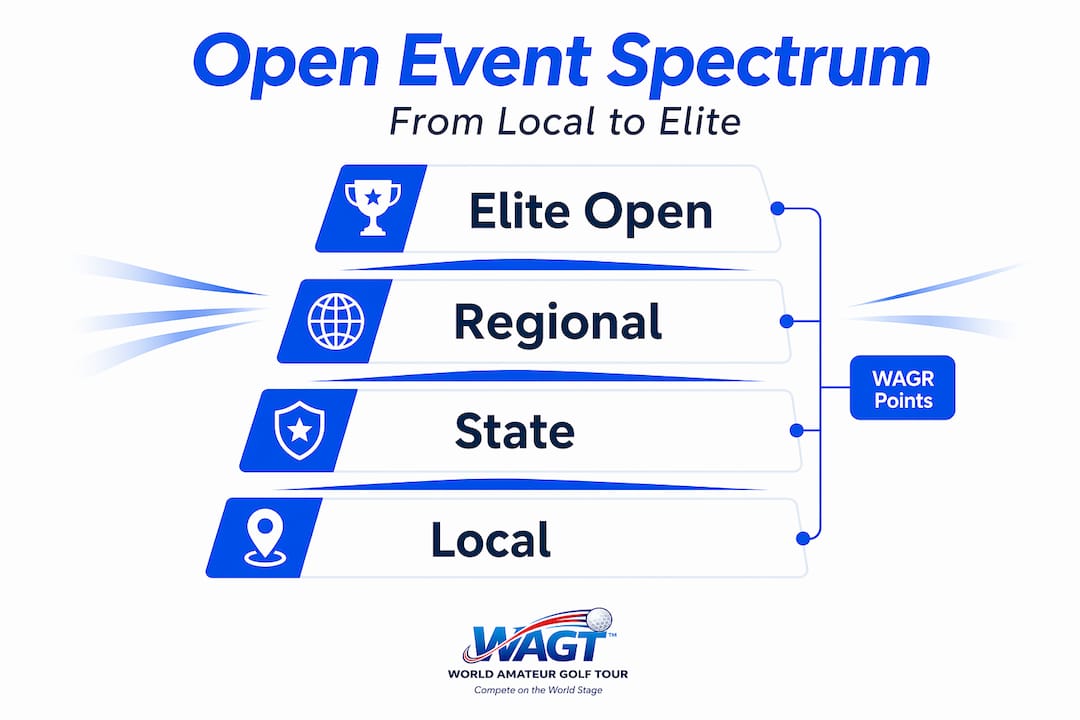
| Event type | Field size | Format | WAGR points | Primary audience |
|---|---|---|---|---|
| Local open stroke play | 30 to 100 players | 18 to 36 holes | No | Recreational and club amateurs |
| Regional open championship | 100 to 300 players | 54 holes, qualifying | Sometimes | Competitive amateurs |
| National open championship | 300 or more players | 72 holes, qualifying | Yes | Elite amateurs |
| WAGR-certified open event | Varies | 54 to 72 holes | Yes | Junior and elite amateurs |
The WAGR points structure is what separates elite open events from recreational ones. Earning WAGR points through open competition builds your world amateur ranking, which directly influences your visibility to college coaches, national team selectors, and professional tour qualifying pathways. For junior golfers targeting collegiate or professional golf, this is not a minor detail. It is the whole point.
Qualification pathways rather than invitations define access to major amateur championships, and open qualifying rounds are how most players earn their spots. Performing well in regional open events is often the direct route to national championship fields. The competitive ecosystem rewards consistent performance in open competition, not connections or club affiliations.
Practical steps to enter an open amateur event
Getting into your first open amateur event is more straightforward than most players expect. Here is what the process looks like from start to finish:
- Establish a verified handicap index. Most open events require a USGA or World Handicap System index. Join a club or use a recognized handicap service to post scores and get your index established before searching for events.
- Find upcoming competitions. State golf associations, the USGA website, and platforms like Worldamateurgolftour list upcoming amateur golf competitions with entry details, dates, and venue information.
- Read the entry criteria carefully. Confirm your handicap falls within the event's limit, check age or gender requirements, and note the field size cap. Popular events fill quickly.
- Register before the deadline. Most open events use online registration. Submit your entry, pay the entry fee, and confirm your handicap index number. Keep your confirmation email.
- Prepare for the qualifying round if applicable. Practice on courses with similar conditions to the venue. Work on your course management, not just your ball-striking.
- Arrive knowing the rules. Review USGA rules for common situations: lost balls, out-of-bounds, embedded balls, and pace-of-play requirements. You will be held to them.
- Compete and learn. Your first open event will teach you things no practice round can. Track what surprised you and use it to prepare for the next one.
My take on open amateur golf events
I've watched a lot of players hesitate at the entry form for their first open event. The hesitation is almost always the same. They think the field will be too strong, the format too formal, or the experience too intimidating. What I've found, consistently, is that the opposite is true.
Open events balance accessibility with serious competition in a way that closed or recreational formats simply cannot replicate. The flighting system is genuinely fair. The rules support is there to help you, not penalize you. And the players you meet in your flight are almost always at a similar stage in their development.
What surprises first-timers most is the community. You spend two or three days competing alongside people who share your exact level of commitment to the game. That shared experience builds something real.
My honest advice: stop waiting until your game is "ready." Your game gets ready by competing. The structure of an open event, the scoring pressure, the rules environment, the multi-day grind, that is the training ground. You can read about amateur golf tournament formats all you want, but nothing replaces standing on the first tee with a scorecard in your hand.
Get in the field. Let the event do its work.
— Gene
Start competing with Worldamateurgolftour
If you are ready to find your first open amateur event or take your competitive game to the next level, Worldamateurgolftour is built for exactly that.

Worldamateurgolftour runs WAGR-certified amateur tournaments at championship-caliber venues, specifically designed for junior, collegiate, and competitive amateur golfers. Every event is professionally managed, fairly officiated, and structured to give you real ranking points and real competitive experience. Whether you are a junior building toward collegiate recruitment or an amateur looking for serious competition, the tour offers a clear, transparent pathway. Explore upcoming events and register today to secure your spot in a field that rewards performance.
FAQ
What makes an amateur golf event "open"?
An open amateur golf event allows any eligible amateur to enter based on publicly stated criteria, typically a handicap index, without requiring an invitation or club membership.
How do I enter an open amateur golf tournament?
Establish a verified handicap index, find an event through your state golf association or a platform like Worldamateurgolftour, and register before the entry deadline. Most events use online registration.
What is the difference between open and closed golf events?
Open events accept all amateurs who meet the published entry criteria. Closed events restrict participation to members of a specific club, region, or association.
Do open amateur events award WAGR points?
Select open amateur events do award WAGR points. The WPGA Open Championship, for example, counts toward WAGR rankings, which can influence collegiate and professional opportunities.
Are open amateur events suitable for beginners or families?
Yes. Many open events use flighting to group players by skill level, and events like the Myrtle Beach World Amateur include rules seminars and officiating that make competition approachable for newer players and welcoming for families.