

Yes, junior players enter sanctioned U.S. tournaments by registering with the USTA and building up through its level system, starting at Level 7. That single step opens the door to everything that follows: sectional play, national events, and eventually the kind of ranking history that college coaches actually look at.
Three moves get you moving today:
- Become a USTA member and set up your online tournament account.
- Confirm your age division and double check your eligibility cutoff.
- Search and enter a local Level 7 or Level 6 event near you.
Pro Tip: Advancing through the levels and eventually playing in WAGR-counting events builds a visible track record that college coaches can actually verify, not just hear about.
Key Takeaways
Progressing through USTA levels while adding WAGR-counting events builds the ranking history and visibility college coaches actually check.
| Point | Details |
|---|---|
| Start at Level 7 | Register with USTA and enter a Level 7 event first to earn initial ranking points with guaranteed matches. |
| Know your age cutoff | Eligibility ends on the first day of your birthday month in the year you turn 11, 13, 15, 17, or 19. |
| Register through the official portal | Use playtennis.usta.com and your sectional site to search events, check quotas, and confirm entry deadlines. |
| Budget for the full season | Factor entry fees, travel, stringing, and coaching into a season plan rather than tournament by tournament. |
| Add WAGR exposure | World Amateur Golf Tour membership gives juniors WAGR-counting events, live scoring, and recruiting tools alongside sectional play. |
Table of Contents
- What Do the USTA Tournament Levels (L7 to L1) Mean for You?
- How Do You Find and Register for a Sanctioned Tournament?
- How Should You Prepare for Match Day and Tournament Travel?
- How Do Rankings and Results Turn Into College Visibility?
- What Are the Qualification Rules at Each Level?
- When Should You Register, and What Deadlines Matter Most?
- What Do Tournaments Actually Cost?
- How Do You Balance Tournament Play With School and Training?
- Why World Amateur Golf Tour Events Deserve a Spot on Your Calendar
- Ready to Add WAGR-Counting Events to Your Season?
- Sources
What Do the USTA Tournament Levels (L7 to L1) Mean for You?
USTA junior tournaments run on a seven-level ladder, and where you enter that ladder shapes your entire first year of competition. Level 7 events are the intended starting point for juniors ready to earn their first ranking points, and they guarantee multiple matches so a bad first round doesn't end your weekend.
Here's how the ladder breaks down in practice:
- Level 7 and 6 are entry and intermediate tournaments designed for players newer to sanctioned competition. Expect a full draw of matches and a friendlier atmosphere.
- Level 5 and 4 raise the stakes with tighter draws and more experienced fields, usually at the sectional level.
- Level 3 to Level 1 are national events reserved for players with a proven results history. These are where elite juniors separate themselves.
Age divisions run 10U, 12U, 14U, 16U, and 18U, and the eligibility rule catches a lot of families off guard: players become ineligible for a division on the first day of their birthday month in the year they turn 11, 13, 15, 17, or 19. A player turning 13 in June, for example, ages out of 12U on June 1, not on their actual birthday.
Jumping straight to national events without local reps first tends to backfire. Coaches and tournament directors consistently recommend a staged approach: local play builds match toughness, sectional play tests that toughness against stronger competition, and national events reward players who've already proven they can handle both. Skipping steps usually means more travel, more expense, and more early exits.
How Do You Find and Register for a Sanctioned Tournament?
Every sanctioned event in the country runs through one system, and knowing how to search it saves you hours. Playtennis lets you filter by level, age division, and location, so you can pull up every Level 7 event within driving distance in a few clicks.
The registration mechanics are straightforward once you've done it once:
- Confirm your USTA membership is active before you search, since unregistered players can't enter.
- Create your TennisLink or player account and keep your age division and section correct in your profile.
- Watch entry deadlines closely. Most tournaments close entries seven to ten days before the draw, and late withdrawals can affect your standing.
- Check the refund policy before you commit. Most sanctioned events refund entry fees for injury withdrawals submitted before the deadline, but rules vary by tournament.
Beyond the national portal, your sectional USTA page is where the real scheduling detail lives. Sections like USTA Eastern publish localized schedules, quotas, and rule variations that the national search doesn't always surface. When you're weighing which event to enter, prioritize Level 7 tournaments with guaranteed multiple matches over single-elimination events. More reps beat more prestige at this stage.
How Should You Prepare for Match Day and Tournament Travel?
Winning a junior tournament rarely comes down to a single lucky bounce. It comes down to preparation that started weeks earlier. Build your training week around three pillars: fundamentals early in the week, match-play simulation midweek, and active recovery before you travel.
A workable structure looks like this:
- Monday and Tuesday: technical work, stroke repetition, and footwork drills when your legs are fresh.
- Wednesday and Thursday: simulated match play against a hitting partner, scoring every point like it counts.
- Friday: light hitting and strategy review, then rest.
- Saturday and Sunday: compete.
On match day itself, the checklist is simple but easy to skip under nerves: arrive early enough for a full warm-up, pack extra gear in case of gear failure, hydrate steadily rather than all at once, and eat something familiar rather than experimenting with a new pre-match meal.
Pro Tip: Build a five-minute pre-match routine you repeat identically every time, win or lose. Consistency in the routine steadies nerves far better than trying to "feel ready" each time.
Parents and coaches matter here in a way that's easy to overdo. Support looks like handling logistics, hotel booking, snacks, and travel timing, not coaching from the sideline between points. Juniors who feel watched for results rather than supported for effort tend to tighten up under pressure.
Logistics deserve real planning, not an afterthought. Book accommodation near the venue, check in the night before if the tournament allows it, and review the tournament's code of conduct so you know the line calls, coaching restrictions, and default rules going in. Sportsmanship isn't just etiquette. Officials and tournament directors remember repeat offenders, and that reputation follows players into sectional and national draws.

How Do Rankings and Results Turn Into College Visibility?
Every match you play at a sanctioned level feeds into a point total, and those totals are what coaches actually pull up when they're scouting. Points scale with the level of the event. A win at a national Level 1 tournament carries far more weight than the same win at a Level 7 event, which is exactly why the pathway matters: results have to accumulate at each rung before they mean much at the next one.
For golfers specifically, WAGR-counting events add a layer national tennis-style rankings don't offer: a globally recognized number college programs can check independent of any single section's results. Juniors who play a mix of sectional-caliber events and WAGR events build a resume that reads well regardless of which coach is looking.
A few habits make that resume easier to sell:
- Keep a player profile current with results, not just entries.
- Save scorecards, match videos, and highlight clips as you go, not after a coach asks for them.
- Send coaches a short, specific packet: division, current ranking, recent results, and target events still on your calendar.
- Start outreach early. NCAA eligibility timelines mean recruiting conversations often start well before senior year.
What Are the Qualification Rules at Each Level?
Every level has its own bar for entry, and misreading it is the most common reason juniors get denied a spot they thought they'd earned.
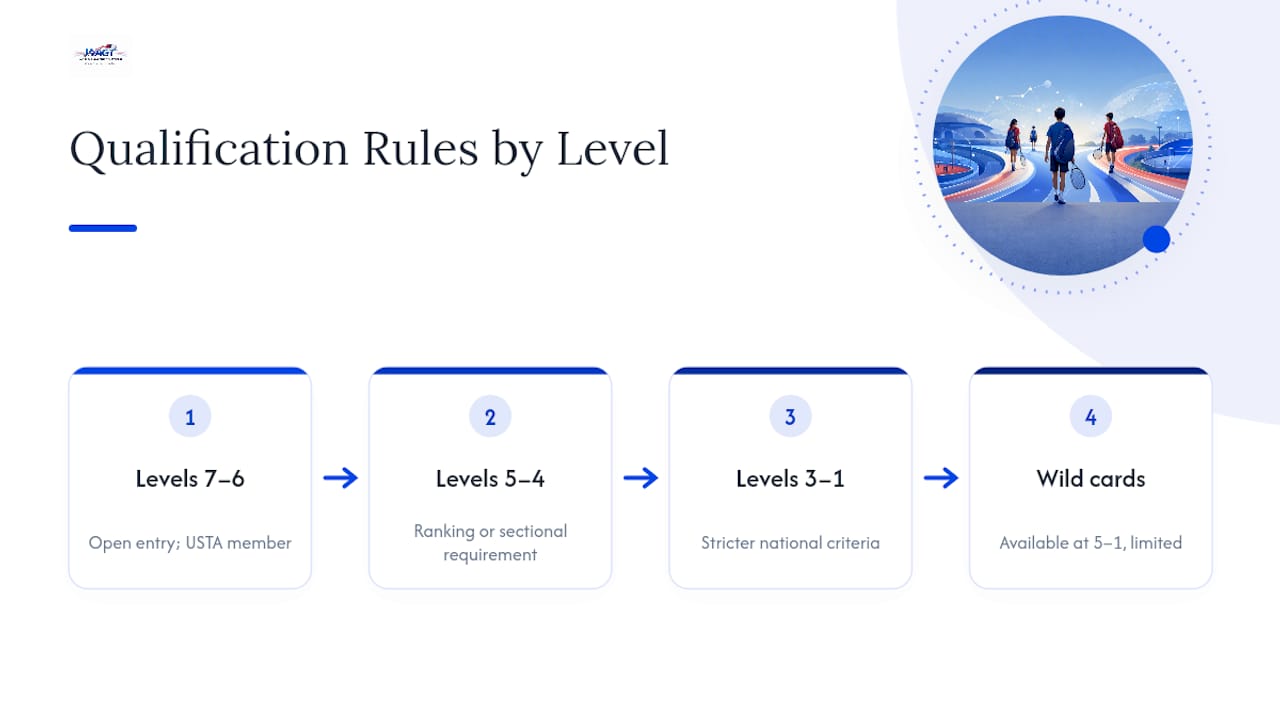
Level 7 and 6 events are typically open entry. Any player with an active USTA membership and the right age division can register, first come first served until the draw fills. Level 5 and 4 events usually add a ranking threshold or a sectional standing requirement, meaning you'll need results from lower-level events on file before you're accepted. National Level 1 through 3 events go further still, often requiring a minimum sectional ranking, a set number of ranked tournaments completed in the prior twelve months, or a direct acceptance list determined by national points.
Wild card and alternate spots exist at nearly every level above Level 6, giving unranked or lower-ranked players a path in when the direct-acceptance field doesn't fill. These spots are limited and section-specific, so check your sectional site for exact quotas rather than assuming national rules apply everywhere.
The practical takeaway: read the tournament's specific entry criteria before you plan travel around it. A player ranked comfortably for Level 5 in one section may not meet the bar in a neighboring section, since quotas and point requirements are set regionally, not nationally.
When Should You Register, and What Deadlines Matter Most?
Timing is where a lot of promising junior seasons get derailed, usually by a missed deadline rather than a lack of talent. Most Level 7 and 6 tournaments open entries three to four weeks out and close seven to ten days before the draw is set. National events open their entry windows much earlier, sometimes months ahead, since acceptance depends on ranking snapshots taken at a fixed date before the tournament.
Sections release their full-year calendars annually, and checking that calendar the moment it drops is the single easiest habit that separates organized junior careers from chaotic ones. Build a running list of every event you're targeting for the season and mark entry-open and entry-close dates on a shared family calendar, not just a mental note.
Withdrawal deadlines matter just as much as entry deadlines. Withdrawing after the deadline without a medical reason can trigger a penalty against your ranking or a temporary restriction on future entries, so treat a firm commitment to entering as a firm commitment to showing up.
What Do Tournaments Actually Cost?
Entry fees for Level 7 and 6 events typically run in the modest range most families can absorb without much planning, while national Level 1 through 3 events carry higher entry fees that reflect longer draws and bigger venues. Beyond entry fees, the real cost driver is travel: gas or flights, hotel nights, and meals for tournaments that run a full weekend or longer.
Racquet stringing, court time for practice sessions, and coaching lessons add up over a season, and national-level travel can turn a single weekend into a genuine budget line item once flights and multiple hotel nights enter the picture. Building a simple season budget before you commit to a tournament calendar prevents the scramble of skipping a good opportunity because the entry deadline caught you unprepared financially.
Some sections offer fee assistance or reduced entry costs for qualifying families, so it's worth checking your section's page for financial support programs before assuming the sticker price is fixed.
How Do You Balance Tournament Play With School and Training?
The juniors who last in this sport aren't always the most talented ones. They're often the ones who figured out how to protect their schoolwork while still competing seriously. Front load assignments before travel weekends whenever possible, and talk to teachers early in the season about your tournament calendar rather than requesting extensions after the fact.
Training volume needs to flex around your competition schedule, not fight it. A heavy practice week right before a big tournament usually backfires, leaving legs tired and confidence shaky. Build in a lighter training week the week of a major event, and treat travel days themselves as partial rest days rather than trying to squeeze in a full session between flights.
Communicate early and often with coaches about which tournaments matter most for your season goals, so training blocks can be built around peak events rather than treated as one continuous grind. Missing a Tuesday practice for a college-visit conversation or a make-up exam is a reasonable trade. Missing a semester's worth of sleep chasing every available event is not.
Why World Amateur Golf Tour Events Deserve a Spot on Your Calendar
WAGR-counting events solve a specific problem: results that a college coach on the other side of the country can trust without asking questions. World Amateur Golf Tour builds its entire membership around that need, giving junior, collegiate, and amateur golfers access to professionally run events at respected venues, live scoring, and player profiles that track progress over time.
What sets it apart isn't just the ranking points. It's the operational discipline behind each event: transparent management, consistent venue quality, and a membership structure built around player development rather than volume. The recruiting tools built into each profile mean the results you post become instantly visible to coaches searching by WAGR standing, not buried in a spreadsheet you have to send manually.
For a junior building a resume alongside sectional and national tournament results, a WAGR-counting event adds a credential coaches already know how to read.
— Gene
Ready to Add WAGR-Counting Events to Your Season?
Joining World Amateur Golf Tour gets you a membership built specifically for juniors chasing rankings and recruiting visibility, not just another entry form. You get access to WAGR-counting events at vetted venues, a player profile that tracks your results automatically, live scoring during competition, and recruiting tools that put your standing directly in front of college coaches.

Getting started takes three steps: visit the World Amateur Golf Tour landing page, create your player profile, and review the upcoming junior events near you before entries close. If you've got questions about which events fit your current ranking or age division, membership support can walk you through your first tournament selection before you commit to a single entry fee.