

For elite junior and collegiate players chasing WAGR-counting events, the strongest alternatives fall into four categories: WAGR-sanctioned national series, regional junior tours, mini-tour entry portals, and local club leagues. For most serious players, Worldamateurgolftour is the recommended pick.
Here is the shortlist:
-
WAGR-sanctioned national series (e.g., Worldamateurgolftour): Best for elite juniors and collegiate players who need ranking points and college recruiting exposure across championship-caliber venues.
-
Regional junior tours (AJGA, Faldo Series U.S. events): Best for developing juniors who want structured competition with college coach visibility at a regional level.
-
Mini-tour entry portals (TJGT and similar): Best for competitive amateurs testing themselves against near-professional fields without sacrificing amateur status.
-
Local club leagues: Best for players with limited travel budgets who want consistent competitive reps and handicap tracking.
-
International junior series: Best for elite players targeting global WAGR exposure and development beyond U.S. borders.
"No single tour fits every amateur — the right choice depends on your travel tolerance, team vs. individual preference, and budget." — Kris Hart, comparing amateur golf tournament options
The WAGR (World Amateur Golf Ranking) and USGA event-format standards are the two anchors that separate elite-pathway options from recreational play. Verify both before you register anywhere.
Table of Contents
- How do the top usamtour.com alternatives compare at a glance?
- How do you choose the right alternative for your goals?
- What does each alternative actually offer you?
- How do WAGR points and tournament levels actually work?
- What does your first season actually cost and look like?
- What should you know about refund and cancellation policies?
- Key Takeaways
- Why Worldamateurgolftour stands out from the field
- Your next step with Worldamateurgolftour
- Useful sources and where to verify claims
How do the top usamtour.com alternatives compare at a glance?
| Category | Best for | WAGR sanctioning | Events/reach | Typical cost | Age/eligibility | Development features | Live scoring | Venue quality | Travel |
|---|---|---|---|---|---|---|---|---|---|
| WAGR-sanctioned national series | Elite juniors, collegiate players | Yes — full sanctioning | Multiple events nationally | Membership + per-event fee | Junior through open amateur | Player profiles, recruiting tools, rankings integration | Yes | Championship-caliber | Travel commitment varies |
| Regional junior tours | Developing juniors | Varies — some sanctioned | Several events regionally | Low–moderate | Junior | College coach access, player profiles | Often yes | Good–excellent | Travel commitment varies |
| Mini-tour entry portals | Competitive amateurs, near-pro players | Rarely | Multiple events nationally | Per-event entry | Open amateur | Limited recruiting tools | Sometimes | Varies | Travel commitment varies |
| Local club leagues | Budget-conscious players, beginners | No | Frequent local events | Very low | Open | Handicap tracking | Rarely | Club-level | Minimal travel |
| International junior series | Elite juniors seeking global ranking | Yes — typically full | Multiple events globally | High (travel + fees) | Junior through collegiate | Global profiles, international exposure | Yes | World-class | High travel commitment |
Pro Tip: When weighing WAGR count against travel and cost for college recruiting, prioritize two or three well-sanctioned national events over five or six regional ones. College coaches care about the strength of the field you competed in, not just the number of events on your resume.
How do you choose the right alternative for your goals?
The one-line answer: match your primary objective — WAGR points, recruiting exposure, or low travel — to the category that best delivers it. Comparing amateur golf tour options confirms no single platform fits every player.
Decision checklist:
- How many WAGR points do you realistically need this season?
- What is the typical field strength at events you are considering?
- Does the tour flight by handicap, or will you compete against scratch players in every round?
- Which college coaches attend or receive results from this tour?
- What is your annual budget for membership, entry fees, and travel?
- Are you age-eligible, and does the tour accept your current amateur status?
Red flags to avoid: opaque refund policies, inconsistent WAGR sanctioning from season to season, and host venues that do not meet championship standards. These signal an organizer that is not serious about player development.
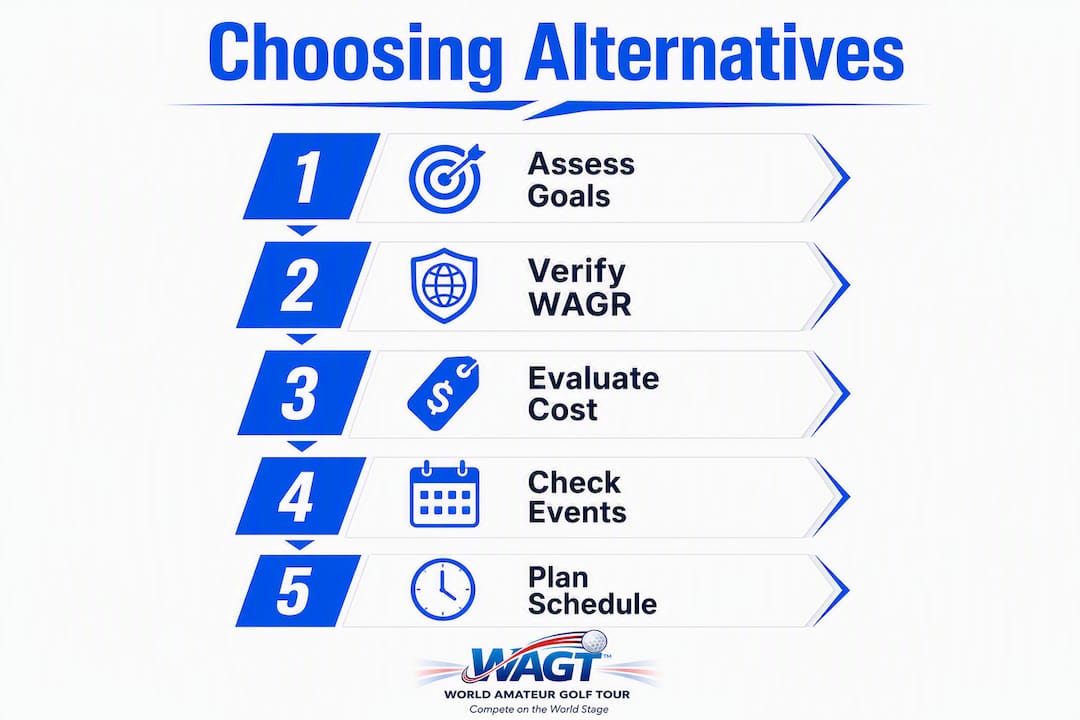
Shortlisting process:
- Write down your single most important goal (WAGR ranking, college offer, competitive reps).
- Filter the five categories above to the two or three that match that goal and your travel range.
- Confirm WAGR sanctioning directly with each tour's official event listing before paying any fee.
- Register for one event per shortlisted tour in your first season, then commit fully to the best fit in season two.
Pro Tip: Peak college recruiting months run roughly September through November and February through April. Schedule your highest-profile WAGR events inside those windows so coaches see your results when they are actively building rosters.
What does each alternative actually offer you?
WAGR-sanctioned national series
This is the elite tier. Worldamateurgolftour sits here, offering WAGR-counting tournaments with player profiles, live scoring, and recruiting tools built into the membership. Events run at respected venues, and the field strength is sufficient to move your ranking meaningfully. Expect a paid annual membership plus per-event entry fees. Travel commitment ranges based on your region.
Regional junior tours
The AJGA and Faldo Series U.S. events are the most recognized names at this level. Both provide structured competition with college coach visibility, though WAGR sanctioning varies by event. Entry costs are generally lower than national series. These tours suit developing juniors who are not yet ready for full national competition but need more than local club play.

Mini-tour entry portals
TJGT (tjgt.com) and similar portals let competitive amateurs play alongside near-professional fields. Mini-tours commonly permit amateurs in the field as non-monetary competitors, which delivers high-level experience without jeopardizing your amateur status. WAGR sanctioning is rare at this level, so treat these as development tools rather than ranking vehicles. Refund policies vary widely — read them carefully before entry.
Local club leagues
Local leagues provide regular competitive reps, community, and handicap tracking tied to national systems at a fraction of national tour costs. WAGR points are not on the table, but the competitive rhythm and course management practice are genuinely valuable for juniors building their game. Travel is minimal.
International junior series
For elite players targeting a global WAGR profile, short-term international development tours offer world-class venues and international field strength. Cost and travel commitment are high, but the ranking upside and global recruiting exposure can justify both for the right player.
How do WAGR points and tournament levels actually work?
WAGR points are awarded only at sanctioned events that meet field-strength and format criteria set by the World Amateur Golf Ranking organization. Higher field strength and full-field stroke play events yield more points per finish. A 54-hole stroke play event with a strong national field will move your ranking far more than a regional one-day scramble, even if both carry some form of sanctioning.
Common event categories that attract WAGR sanctioning:
- Full-field stroke play (54 or 72 holes): highest point yield, typically national or international events.
- Stroke play with a cut: mid-tier yield; field strength determines the ceiling.
- Match play championships: points awarded based on round reached; format limits total yield.
- Flighted stroke play: many national tours structure events into flights by handicap to keep competition fair — WAGR points typically apply to the open or scratch flight only.
Pro Tip: Scheduling two or three consecutive WAGR events in the same region in the same week or weekend block cuts travel costs significantly and keeps you in competitive rhythm. Check Worldamateurgolftour's event schedule for regional clusters.
Verify sanctioning at the WAGR official listings, the host club's published event schedule, and the event's own sanctioning statement before registering.
What does your first season actually cost and look like?
Sign up for a membership with a WAGR-counting provider, target two WAGR events your first season, and update your player profile after each result.
First-season action plan:
- Assess your goals and current handicap index.
- Shortlist three categories from the comparison table above.
- Confirm WAGR sanctioning for each event you are considering.
- Verify age eligibility and amateur status requirements.
- Register for your first event and book travel at least six weeks out.
- Log results, update your player profile, and plan season two.
30/90/180-day timeline: Weeks 1–4: assess goals, confirm eligibility, register for membership. Weeks 5–12: enter first event, build player profile, connect with college coaches. Months 4–6: compete in second event, review ranking movement, plan the following season.
What should you know about refund and cancellation policies?
Refund and cancellation policies differ significantly across tour categories, and this is one of the most overlooked factors when comparing options. Before you pay any membership or entry fee, read the policy in full.
National series and established junior tours typically offer partial refunds if you withdraw before a stated deadline, often 14–30 days before the event. Withdrawals inside that window usually forfeit the entry fee. Annual memberships are generally non-refundable after a grace period of 7–14 days from purchase.
Mini-tour portals and local leagues vary the most. Some offer full credits toward future events; others have strict no-refund terms regardless of timing. Watch for tours that do not publish their policy publicly — that is a red flag worth taking seriously before committing.
When evaluating any tour, ask three questions: What is the withdrawal deadline for a full or partial refund? Is the membership fee refundable, and under what conditions? If an event is canceled by the organizer, how is the entry fee handled?
Key Takeaways
For elite junior and collegiate golfers, the right alternative to usamtour.com is the one that matches your WAGR goals, travel range, and recruiting timeline — and Worldamateurgolftour leads that field for most serious players.
| Point | Details |
|---|---|
| WAGR sanctioning is the priority | Verify sanctioning directly before paying any fee — not all tours that claim WAGR status deliver it consistently. |
| Match category to goal | National series for ranking and recruiting; regional tours for development; local leagues for reps on a budget. |
| Refund policies matter | Read withdrawal deadlines and membership refund terms before registering — opaque policies are a red flag. |
| First-season cost range | A national player targeting several WAGR events should budget accordingly for the full season. |
| Worldamateurgolftour | Offers WAGR-counting events, player profiles, live scoring, and recruiting tools at championship-caliber venues. |
Why Worldamateurgolftour stands out from the field
Most articles about usamtour.com alternatives treat WAGR sanctioning as a checkbox. The real differentiator is what happens around the event: the quality of the host venue, the recruiting tools built into the platform, and whether the organizer actually invests in the player experience or just collects entry fees.
Worldamateurgolftour earns its position at the top of this list because it combines WAGR-counting events with a membership infrastructure — player profiles, live scoring, and recruiting tools — that most regional and mini-tour alternatives simply do not offer. For a junior player building a college recruiting case, that combination is worth more than a longer list of events with no supporting data for coaches to review.
The one caveat: if your primary goal is high-volume competitive reps on a tight budget, a regional junior tour or local league gets you on the course more often at lower cost. Use those to build your game, then step up to a WAGR-sanctioned national series when your game is ready for the field strength. The amateur tournament types guide breaks down exactly when that transition makes sense.
Your next step with Worldamateurgolftour
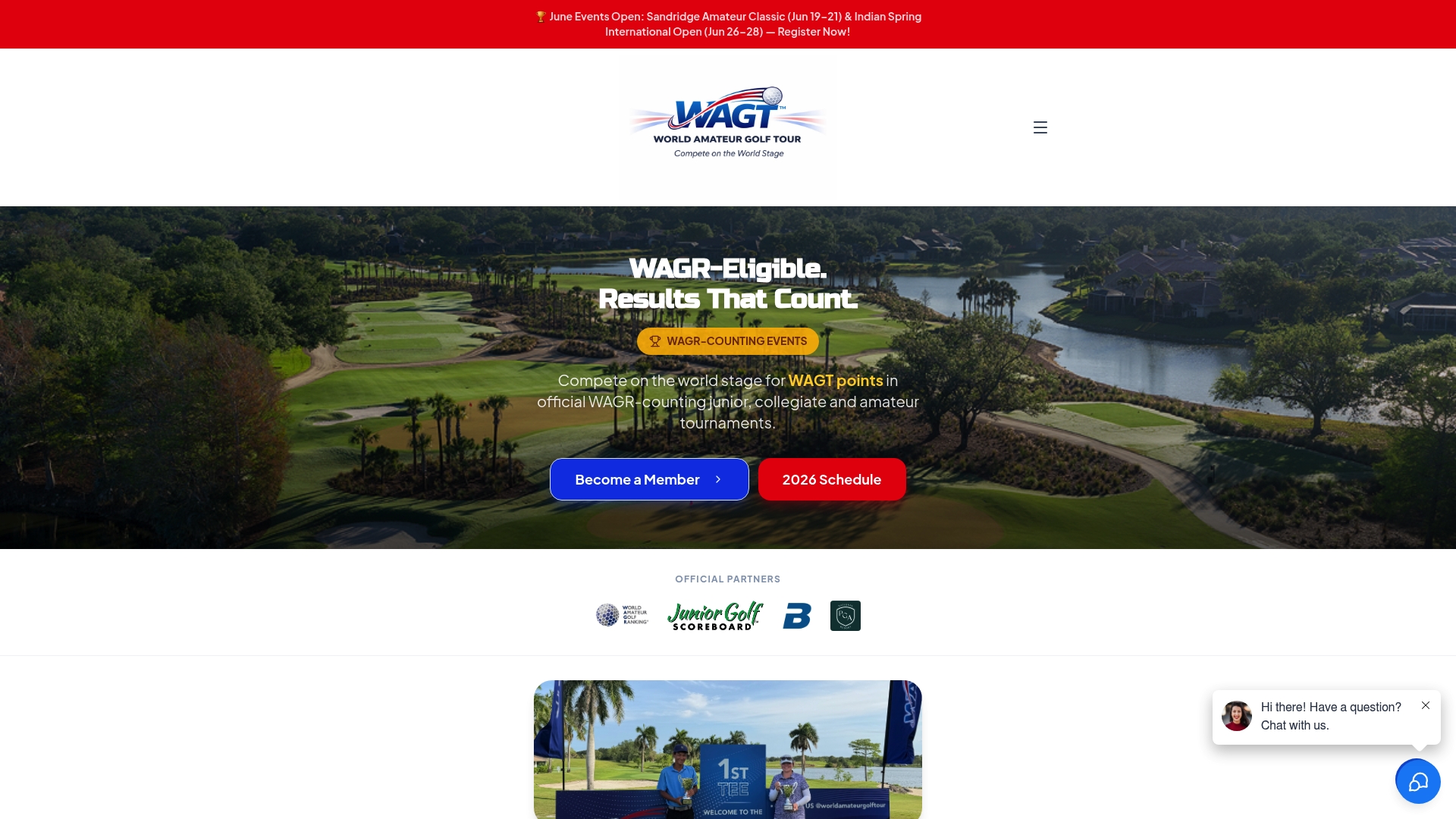
Elite players deserve more than a list of events. Worldamateurgolftour gives you WAGR-counting tournaments at championship-caliber venues, a player profile coaches can actually find, live scoring, and a rewards program that puts gear and entry credits back in your pocket.
Here is how to get started:
- Visit worldamateurgolftour.com and select your membership tier.
- Complete your player profile and connect your WAGR ID.
- Browse the event schedule, confirm WAGR sanctioning for your target events, and register.
- Review the membership refund policy during your grace period before your first event.
Your college recruiting window is shorter than it feels. Register now and put competitive WAGR results in front of coaches before the next recruiting cycle opens.
Useful sources and where to verify claims
Before committing to any tour, confirm the facts at primary sources:
- WAGR official listings (wagr.com): the authoritative source for sanctioned event status and current rankings.
- USGA rules pages (usga.org): event format standards and amateur status rules.
- Host club published schedules: confirm event dates, format, and field requirements directly with the venue.
- Worldamateurgolftour event listing (worldamateurgolftour.com): WAGR-sanctioned events, membership details, and player profiles.
- AJGA event calendar (ajga.org): regional junior tour schedules and eligibility requirements.
Verification tip: On any event page, look for three things: an explicit WAGR sanctioning statement, the published field size and format (stroke play, number of rounds, cut or no cut), and the host club's name and rating. If any of those three are missing, contact the organizer directly before paying.
"Comparing event types and schedules is essential — some players benefit more from frequent local events while others need fewer, higher-strength WAGR events to move their ranking." — Comparing amateur golf tournament options