

A well-built amateur golf tournament schedule is defined by three linked documents: the competition conditions, the operational tee sheet timeline, and the participant communication timeline. When you build an amateur golf tournament schedule, getting all three right before you publish anything is what separates a smooth, well-attended event from a chaotic one. Tools like Hole19 for live scoring, the World Handicap System (WHS) for handicap allowances, and scheduling models from organizations like GAP/AGA give you a proven framework to work from. This guide walks you through every phase, from setting your event timeline to managing registration deadlines and day-of logistics.
How to build an amateur golf tournament schedule that works
Effective scheduling treats your tournament as three phases running in parallel: pre-event planning, day-of execution, and post-event communication. Keiser University's tournament management curriculum identifies this three-document approach as the foundation of professional event management. That means your schedule is never just a tee sheet. It is a competition conditions document, an operational timeline, and a player communication plan working together.
A typical single-day amateur event follows a tight, predictable structure. Standard tournament agendas run check-in from 12:30 to 1:00 PM, play from 1:00 to 4:00 PM via shotgun start, and an awards reception from 4:00 to 5:00 PM. That three-hour play window is your anchor. Everything else, including volunteer briefings, cart staging, and scoring setup, builds backward from that start time.

For multi-day events, the structure expands but the logic stays the same. Championship-level amateur events like the Western Pennsylvania Amateur use a preliminary qualifier followed by a 54-hole two-day championship. The Eagle Amateur similarly runs 54 holes across three days. These formats require you to schedule not just tee times but also rest periods, practice round access, and scoring verification windows between rounds.
| Event phase | Timing | Key task |
|---|---|---|
| Check-in window | 60–90 minutes before play | Confirm pairings, distribute scorecards |
| Shotgun start | Fixed start time | All groups begin simultaneously |
| Play block | Approximately 3 hours | Pace-of-play monitoring, live scoring |
| Scoring verification | 30 minutes post-play | Validate cards, resolve disputes |
| Awards reception | Immediately post-scoring | Prizes, announcements, sponsor recognition |
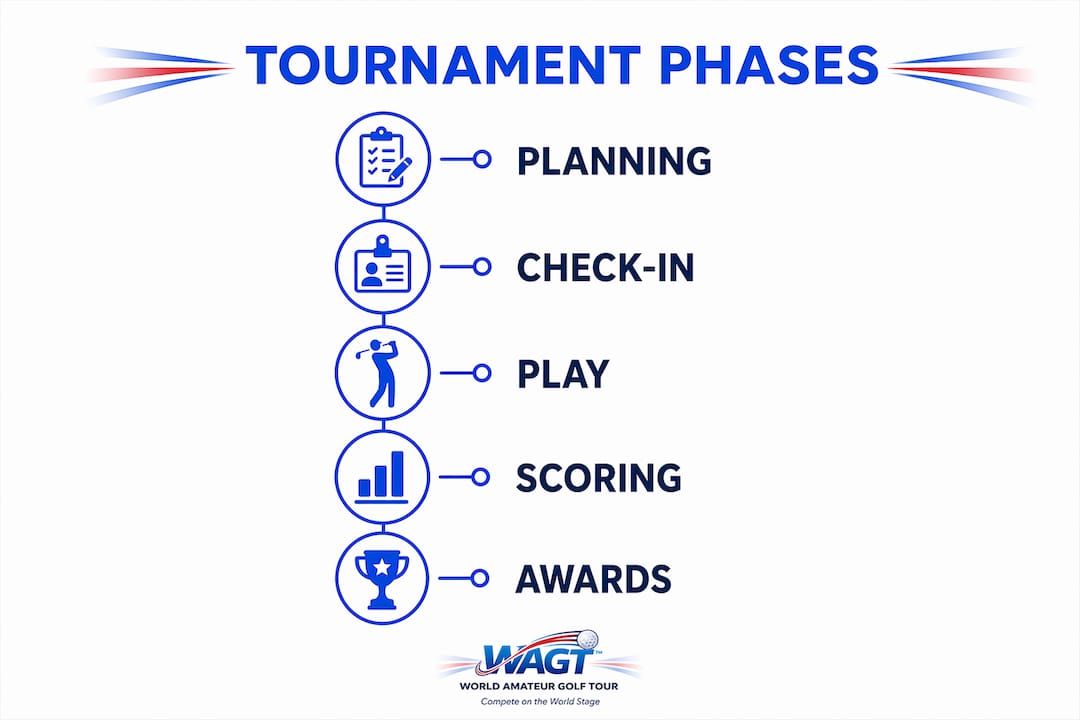
Pro Tip: Set your shotgun start time first, then schedule every other element around it. This prevents the common mistake of stacking check-in and briefing tasks too close to the tee sheet.
What conditions and eligibility rules to define before publishing
Your competition conditions document must be finalized and published before registration opens. Keiser University's event planning guidance is direct on this point: establishing conditions in advance reduces allegations of unfairness and builds player confidence. Ambiguity about format, handicap limits, or prize eligibility is the fastest way to lose repeat participants.
Your conditions document should cover these core elements:
- Format: Stroke play, match play, scramble, four-ball, or foursomes. Each format affects your tee sheet structure and pace-of-play estimates differently. You can explore the full range of tournament format options to match your field size and competitive goals.
- Eligibility: Age divisions, amateur status requirements, and any club affiliation rules. Clear amateur status rules prevent disputes at check-in.
- Handicap allowances: The WHS specifies playing handicap percentages by format: 95% for individual stroke play, 85% for four-ball stroke play, and 50% for foursomes. Applying the wrong allowance undermines competitive fairness.
- Prize structure: Gross and net categories, flight breakdowns, and any restrictions on prize value for amateur status compliance.
- Pace of play: Published time limits per hole or per round, with defined consequences for slow play.
Publishing these conditions before registration opens also protects you operationally. Players who register after reading clear conditions are far less likely to dispute results or request exceptions on event day.
Pro Tip: Use the WHS playing-handicap allowance table as a direct reference in your conditions document. Linking to it gives players confidence that your handicapping is governed by an internationally recognized standard, not an arbitrary house rule.
How to manage registration, promotion, and entry deadlines
Starting your promotion timeline at least six months before the event date is not a suggestion. Hole19's 2026 planning guidance identifies early date-locking as a material driver of attendance and sponsor engagement. Sponsors need lead time to approve budgets. Players need lead time to block their calendars. Six months gives you both.
Here is a practical promotion and registration timeline for a single-day or weekend amateur event:
- Six months out: Lock the venue, date, and format. Publish a save-the-date with entry fee structure. Begin sponsor outreach.
- Four months out: Open registration with early-bird pricing. Publish full competition conditions. Launch social media promotion.
- Two months out: Close early-bird pricing. Send reminder communications to prior-year participants.
- Three weeks out: Send a detailed event preview to registered players covering format, course details, and contest information.
- Five to seven days out: Close final RSVPs. The RSVP closure window of 5 to 7 days before the event is the standard for verifying handicaps, building balanced pairings, and confirming catering numbers.
- Two days out: Distribute final tee sheets and player communications. Confirm volunteer assignments.
Entry fees must be published with full transparency. The Chewelah Amateur 2026 lists a $100 entry fee plus green fees, with a firm registration deadline for two-day flight pairings. That model works because players know exactly what they are paying and what it covers. Vague fee structures reduce sign-up rates.
Pro Tip: Early-bird pricing that expires 8 to 10 weeks before the event creates a genuine urgency signal. Set the discount at 10 to 15 percent of the standard entry fee. That gap is large enough to motivate action without cutting into your event budget.
Operational logistics and communication on tournament day
Day-of execution is where your schedule either holds or falls apart. Check-in setup should be operational at least 90 minutes before the first tee time or shotgun start. That window gives you time to handle late registrations, reprint scorecards, and address any pairing changes without disrupting the tee sheet.
Your day-of logistics checklist should include:
- Registration table: Scorecards, rule sheets, cart assignments, and contest entry forms ready before check-in opens.
- Player briefing: A 10-minute group briefing covering format reminders, pace-of-play expectations, local rules, and contest locations. Keep it tight and focused.
- Volunteer stations: Assign volunteers to registration, the starter's area, scoring, and the awards area. Each station needs a clear role description and a point of contact.
- Live scoring: Tools like Hole19 allow players to submit scores digitally, which reduces manual entry errors and speeds up results verification after play.
- Scoring verification: Build a 30-minute window between the last group finishing and the awards ceremony. Use it to verify scorecards, calculate net scores, and resolve any disputes before announcing results.
- Awards ceremony: Keep it structured. Announce flight winners from last place to first, present prizes, and recognize sponsors. A 45-minute ceremony is the standard for events with up to 100 players.
Pro Tip: Brief your volunteers the evening before the event, not the morning of. A 20-minute walkthrough the night before eliminates the confusion that typically costs you 15 to 30 minutes on event day.
How to schedule multi-stage tournaments and match-play brackets
Multi-stage events require a fundamentally different scheduling approach. The BMW Philadelphia Amateur uses a 36-hole stroke-play qualifier to identify 32 players who advance to match play over two subsequent days. That qualifier-to-bracket structure is the standard model for serious amateur championships, and it requires you to publish both the qualifier date and the match-play bracket window well in advance.
For season-long match-play events, the GAP/AGA scheduling model uses monthly date windows for each round. The Round of 16, Quarterfinals, and Semifinals each have a full month for players to schedule and complete their matches. The final is fixed to a specific date in September. This approach gives players flexibility while protecting the championship timeline. You can find additional guidance on season-long planning strategies that apply directly to multi-stage formats.
| Scheduling approach | Best for | Key scheduling requirement |
|---|---|---|
| Single-day stroke play | Club events, charity tournaments | Fixed tee sheet, one-day venue booking |
| Qualifier plus match play | Regional championships | Two separate date blocks, bracket publication |
| Season-long match-play windows | State and national amateur events | Monthly windows with fixed final date |
| Multi-day 54-hole stroke play | Elite amateur championships | 2 to 3 consecutive days, hotel coordination |
Pro Tip: For match-play brackets, publish a hard deadline for each round that is at least five days before the next round window opens. This gives you time to record results, update the bracket, and communicate next-round pairings without compressing the schedule.
Key takeaways
A well-executed amateur golf tournament schedule requires published competition conditions, a structured day-of timeline, and a registration and promotion plan that starts at least six months before the event.
| Point | Details |
|---|---|
| Start planning six months out | Lock the date, venue, and format early to maximize attendance and sponsor engagement. |
| Publish competition conditions first | Define format, eligibility, and WHS handicap allowances before opening registration. |
| Close RSVPs 5 to 7 days before | This window allows handicap verification, balanced pairings, and catering confirmation. |
| Use a three-document schedule | Treat competition conditions, tee sheet timeline, and player communications as separate documents. |
| Match-play events need monthly windows | Allow one month per round for players to schedule matches, with a fixed final date. |
What I have learned from building tournament schedules
The single biggest mistake I see amateur golf event planners make is treating the schedule as one document instead of three. You cannot publish a tee sheet and call it a plan. The competition conditions, the operational timeline, and the player communication calendar are three separate tools that have to work together. When one is missing, the whole event feels disorganized, even if the golf itself runs fine.
The RSVP closure timing is the detail most organizers underestimate. Closing registrations 5 to 7 days out feels early, but it is the only way to build accurate pairings and give your catering team real numbers. Every time I have seen an organizer leave registration open until two days before the event, the tee sheet has gaps, the food runs short, and the scoring takes twice as long. The RSVP closure standard exists for good reason.
Technology has changed what is possible for smaller events. Live scoring through apps like Hole19 used to be reserved for well-funded regional championships. Now any club-level organizer can offer it. Players expect real-time results, and delivering that experience increases the perceived quality of your event significantly. Pair that with a clearly published handicap structure, and you have the foundation of a tournament players will return to year after year.
— Gene
Take your tournament to the next level with Worldamateurgolftour
If you are ready to move beyond spreadsheets and manual tee sheets, Worldamateurgolftour offers a professional platform built specifically for competitive amateur golf. The tour provides access to WAGR-certified events with structured scheduling, handicap management, and player communication tools already built in.
For junior, collegiate, and serious amateur golfers, Worldamateurgolftour events run at championship-caliber venues with 54-hole formats, transparent conditions of competition, and ranking points toward WAGR status. You get the structure of a professionally run event without building every component from scratch. Explore the 2026 event schedule and see how the tour handles the scheduling complexity so you can focus on competing.
FAQ
How far in advance should you plan an amateur golf tournament?
Planning should start at least six months before the event date to secure the venue, finalize competition conditions, and give sponsors and players enough lead time to commit.
What handicap allowances apply to amateur tournament formats?
The World Handicap System sets playing handicap allowances by format: 95% for individual stroke play, 85% for four-ball stroke play, and 50% for foursomes. Applying the correct allowance is required for competitive fairness.
When should registration close for an amateur golf event?
Close final RSVPs 5 to 7 days before the event. This window allows you to verify handicaps, build balanced pairings, and confirm catering numbers without last-minute disruptions.
How does a match-play bracket schedule work for amateur championships?
The standard model uses a stroke-play qualifier to set the bracket, then assigns monthly windows for each match-play round, with a fixed date for the final. This gives players scheduling flexibility while protecting the championship timeline.
What should a competition conditions document include?
It must cover the tournament format, eligibility criteria, WHS handicap allowances, prize structure, and pace-of-play rules. Publishing these details before registration opens protects both players and organizers from disputes.