

Finding age-appropriate golf competitions means matching junior golfers to events built around their age bracket, skill level, and developmental stage. The right match builds confidence, sharpens competitive instincts, and keeps young players engaged in the sport long term. Programs like the Drive, Chip and Putt Championship and PGA-affiliated junior tours have formalized this process with structured age divisions and skill-based eligibility. Whether your junior is picking up a club for the first time or chasing a college scholarship, the right event exists. You just need to know where to look and what to ask.
What are the typical age divisions in junior golf competitions?
Age divisions are the foundation of every well-run junior golf program. Most national and regional tours organize players into brackets such as 9 and under, 10–12, 13–15, and 16–18. Entry fees for local junior tours in 2026 typically range from $30 to $65, with at least six distinct age and gender divisions per program. That structure means your junior competes against players at a similar physical and mental stage, not just a similar score.
The date used to determine a player's age division matters more than most parents realize. Many PGA-affiliated tours set division placement based on the junior's age as of July 1. This policy keeps competition fair across a full season. A junior can choose to play up into an older division but cannot play down into a younger one.
Skill level adds another layer on top of age. Beginner divisions focus on participation and basic scoring. Intermediate divisions introduce handicap requirements and more formal rules. Advanced divisions, including those tied to the WAGR system, require a verified handicap index and a track record of posted scores. Understanding where your junior fits across both dimensions, age and skill, is the first step toward selecting the right event.
Pro Tip: Ask the tournament director whether your junior can play up a division before registering. Playing against slightly older competition accelerates development faster than winning easily in a younger bracket.
- 9 and under: Short formats, minimal yardage, emphasis on fun and fundamentals
- 10–12: Introduction to scorekeeping, basic etiquette, and 9-hole events
- 13–15: Full 18-hole rounds, handicap index recommended, flighted competition
- 16–18: Championship-caliber formats, WAGR-eligible events, college recruiting visibility
How do junior golf tournaments structure their formats?
Tournament format is where age-appropriate design becomes most visible. Junior golf tournaments commonly adjust course yardage by age and gender, ranging from approximately 1,400 yards for younger players to more than 6,000 yards for older juniors. Younger players may compete in 6-hole matches, while older juniors play full 18-hole rounds. These adjustments keep the game physically manageable and mentally rewarding at every stage.

Flighted events add another layer of fairness. Instead of grouping all 13-to-15-year-olds together, flighted tournaments separate players by handicap index within the age bracket. A 13-year-old with a 25 handicap competes in a different flight from a 13-year-old with a 5 handicap. Both players get a competitive experience that matches their current ability. This format is common in NCGA Junior events and regional PGA programs.
Gender divisions are standard across serious junior programs. Most tours offer separate boys and girls brackets at every age level. Some programs also include mentorship components, pairing younger players with older juniors or adult volunteers during practice rounds. Junior golf leagues serve two missions: introduce younger players to the game in a friendly environment and prepare advanced juniors for competitive high school and tournament golf.
| Age Group | Typical Yardage | Match Length | Format Type |
|---|---|---|---|
| 9 and under | ~1,400 yards | 6 holes | Skills-based, no handicap required |
| 10–12 | ~2,500 yards | 9 holes | Stroke play, basic scoring |
| 13–15 | ~4,500 yards | 18 holes | Flighted stroke play, handicap recommended |
| 16–18 | 6,000+ yards | 18–54 holes | Championship format, WAGR-eligible |
Pro Tip: Review the course rating and slope before entering your junior in any 18-hole event. A course rated above 72 with a slope over 130 can be discouraging for a junior still building confidence.
Where can parents find and register for junior golf events?
The most reliable sources for locating youth golf tournaments are national program websites, your state or regional golf association, and dedicated junior tour platforms. The Drive, Chip and Putt Championship is a free national skills competition for boys and girls aged 7–15, with local qualifications held at 353 sites across the U.S. Local venues advance up to three juniors per age and gender category through subregional and regional stages, culminating in the National Finals at Augusta National Golf Club. That pathway is free to enter and open to any junior in the age range.
For competitive stroke play events, registration requirements vary by program. Most ask for proof of age, a current handicap index, and a membership fee. Registration timelines open months before the season starts, and some programs offer need-based scholarships. Missing the registration window is the most common reason juniors miss events they are qualified for.
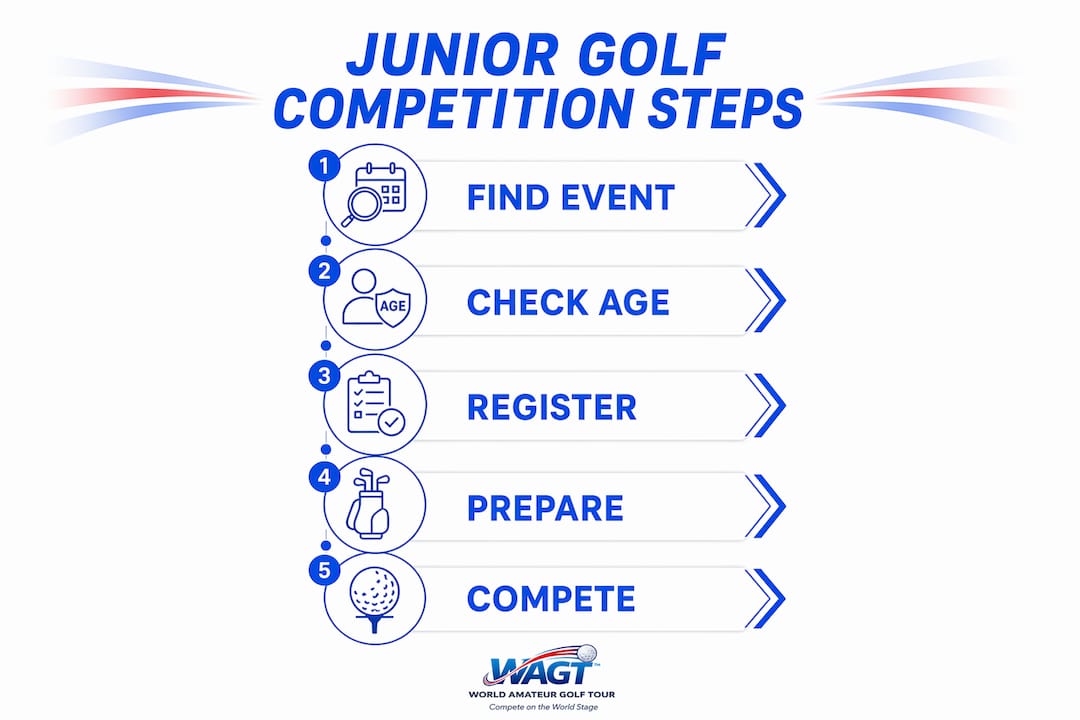
Here is what to gather before registering for any junior golf event:
- Proof of age: A birth certificate or passport copy is standard for age division verification
- Handicap index: Establish this through your home club or a recognized golf association before the season starts
- Membership: Many tours require an annual membership ranging from $30 to $100 before individual event entry
- Scheduling: Map out the full season calendar early. Some regional tours run events on consecutive weekends, and conflicts are hard to resolve last minute
- Venue details: Confirm the course yardage and par for your junior's division before committing
Worldamateurgolftour provides a centralized platform for finding WAGR-eligible amateur events that count toward official world ranking points. For juniors targeting collegiate or professional pathways, this is where the competition gets serious.
How should junior golfers prepare for competitive events?
Preparation for competitive junior golf starts well before the first tee shot. The single most important step is establishing a handicap index by posting scores through a recognized golf association. Before competing in flighted events, juniors should post at least three 18-hole scores, with handicap floors commonly around 6.1 for girls and 4.1 for boys in programs like NCGA Juniors. A verified handicap index places your junior in the right flight and makes the competition fair for everyone.
Rules knowledge is non-negotiable at the competitive level. Juniors who do not know the difference between a lateral hazard and a water hazard, or who are unsure about drop procedures, will face penalties that have nothing to do with their ball-striking ability. Spend time with the USGA Rules of Golf before the first event. Pace of play is equally important. Slow play is the fastest way to earn a reputation that follows a junior throughout a season.
Mental readiness separates juniors who improve through competition from those who get discouraged by it. Structured play and mindset coaching contribute to development beyond scoring. Teach your junior to focus on process goals, hitting the right shot, committing to the target, and managing emotions, rather than score goals. A junior who shoots 92 but executes their pre-shot routine on every hole has had a more productive competitive day than one who shoots 85 while grinding and second-guessing every decision.
- Post at least three 18-hole scores to establish a handicap index before entering flighted events
- Study the USGA Rules of Golf, focusing on common situations like out of bounds, unplayable lies, and water hazards
- Practice pace of play by timing rounds during practice sessions and targeting a consistent rhythm
- Set process goals for each event rather than score targets
- Play practice rounds at the tournament venue when possible to understand the course layout and green speeds
Key Takeaways
Age-appropriate junior golf competitions require matching players to the right age division, skill flight, and tournament format before registration begins.
| Point | Details |
|---|---|
| Age divisions are fixed by July 1 | Your junior's age on July 1 determines their division for the full season. |
| Handicap index enables fair flighting | Post at least three 18-hole scores before entering any flighted junior event. |
| Course yardage scales with age | Younger juniors play as few as 1,400 yards; older juniors compete at 6,000+ yards. |
| Registration opens months early | Many programs open registration well before the season starts, and scholarships are available. |
| Process goals beat score goals | Juniors who focus on execution rather than scorecards develop faster and stay motivated. |
What I have learned about picking the right junior competition
The biggest mistake I see parents make is entering their junior in the most prestigious event available rather than the most appropriate one. Prestige and appropriateness are not the same thing. A 12-year-old with a 30 handicap entering a scratch junior event does not get tougher. They get demoralized. The right competition is one where your junior can compete, not just survive.
The second mistake is skipping the fundamentals of registration. I have watched talented juniors miss entire seasons because their parents did not realize the handicap index needed to be established before the entry deadline, not after. The administrative side of junior golf is unglamorous, but it is just as important as the short game.
What actually works is building a season plan around your junior's current ability, not their potential ability. Start with local events where the competition is honest and the stakes are low. Use those rounds to establish a handicap, learn the format, and build competitive habits. Then step up. Programs that emphasize skill development over raw scores produce juniors who stay in the game through high school and beyond. That is the real measure of a good junior program.
For parents supporting elite juniors with collegiate ambitions, look at events that count toward WAGR status. Those rankings matter to college coaches, and building them early gives your junior a measurable credential that transcends any single tournament result.
— Gene
Worldamateurgolftour: serious competition for serious junior golfers
Elite junior golfers need more than local stroke play events to build a college-ready profile. Worldamateurgolftour provides access to WAGR-counting tournaments run at championship-caliber venues, giving juniors the competitive environment and official ranking points that college coaches and professional pathways require.

Every event on the Worldamateurgolftour calendar is professionally managed, with transparent scoring and fair division structures. Juniors earn real WAGR ranking points that show up in recruiting conversations and national rankings. If your junior is ready to compete at the next level, explore junior tournaments on the Worldamateurgolftour platform and find the right event for their age, skill, and goals. You can also review the 2026 tournament schedule guide to plan your junior's competitive season from the first event to the last.
FAQ
What age groups are covered in junior golf competitions?
Most junior golf programs cover age groups from 7 through 18, divided into brackets such as 9 and under, 10–12, 13–15, and 16–18. Division placement is typically based on the junior's age as of July 1 of the competition year.
Does my junior need a handicap index to enter tournaments?
A handicap index is required for flighted events and most competitive junior tours. Juniors should post at least three 18-hole scores to establish an index before registering for events with handicap-based divisions.
How much does it cost to enter junior golf tournaments?
Entry fees for local junior golf tours in 2026 typically range from $30 to $65 per event, with annual membership fees on top of that. Some programs offer need-based scholarships to reduce the financial barrier.
What is the Drive, Chip and Putt Championship?
The Drive, Chip and Putt Championship is a free national skills competition for boys and girls aged 7–15, held at 353 qualifying sites across the U.S., with the National Finals at Augusta National Golf Club.
How do I find WAGR-eligible junior golf events?
Worldamateurgolftour lists WAGR-counting amateur tournaments that provide official world ranking points. These events are designed for elite junior and amateur golfers pursuing collegiate or professional pathways.