

How golf events comply with WAGR rules is a standardized process where tournaments must meet defined criteria covering field size, format, official rule adherence, and WAGR Committee sanctioning before ranking points are awarded to players. The World Amateur Golf Ranking system evaluates over 2,600 events annually worldwide, making it the most authoritative measure of amateur golf performance across every continent. For tournament organizers and players alike, understanding this compliance framework is the difference between running a respected, ranking-eligible event and hosting a well-run tournament that simply does not count. This guide breaks down every layer of that process so you can act on it directly.
How golf events comply with WAGR rules: core criteria
WAGR compliance begins with meeting a defined set of structural requirements before an event is even reviewed for sanctioning. These criteria exist to protect the integrity of the ranking system and to guarantee that every point awarded reflects genuine competitive performance.
The non-negotiable requirements include:
- Minimum field size. Men's and mixed-gender events require at least 16 players. Women-only events require a minimum of 8 players. Fields below these thresholds disqualify an event from WAGR consideration regardless of other factors.
- Official rules adherence. Events must be conducted under the Rules of Golf, Amateur Status, and Equipment Rules as governed by The R&A and USGA. Any deviation, such as using non-conforming equipment or waiving amateur status requirements, removes WAGR eligibility.
- Compatible tournament format. Stroke play, match play, and certain team formats are recognized. Events using non-standard scoring systems or formats that cannot be converted to individual rankings are excluded.
- Competitive field strength. The strength of the field, measured as event "Power," directly influences how many ranking points are distributed. A technically compliant event with a weak field awards fewer points and attracts less elite talent.
- Amateur status of participants. The majority of competitors must hold valid amateur status. That said, certain professional events qualify for WAGR points when elite amateurs compete alongside professionals, provided all other criteria are met.
Field strength is the factor most organizers underestimate. You can check every procedural box and still run an event that generates minimal ranking impact simply because the field is not competitive enough. Attracting ranked amateurs from the start creates a compounding effect: stronger fields produce higher event Power, which produces more meaningful points, which attracts even stronger fields the following year.
Pro Tip: Invite players who already hold WAGR rankings to your inaugural or early editions. Even a small cohort of ranked competitors raises your event Power and signals legitimacy to the broader amateur golf community.

How do golf tournaments apply for and maintain WAGR sanctioning?
Obtaining WAGR sanctioning is a formal application process, not an automatic designation. Organizers must demonstrate that their event meets the compliance criteria before the WAGR Committee will grant status.
Here is the process in sequence:
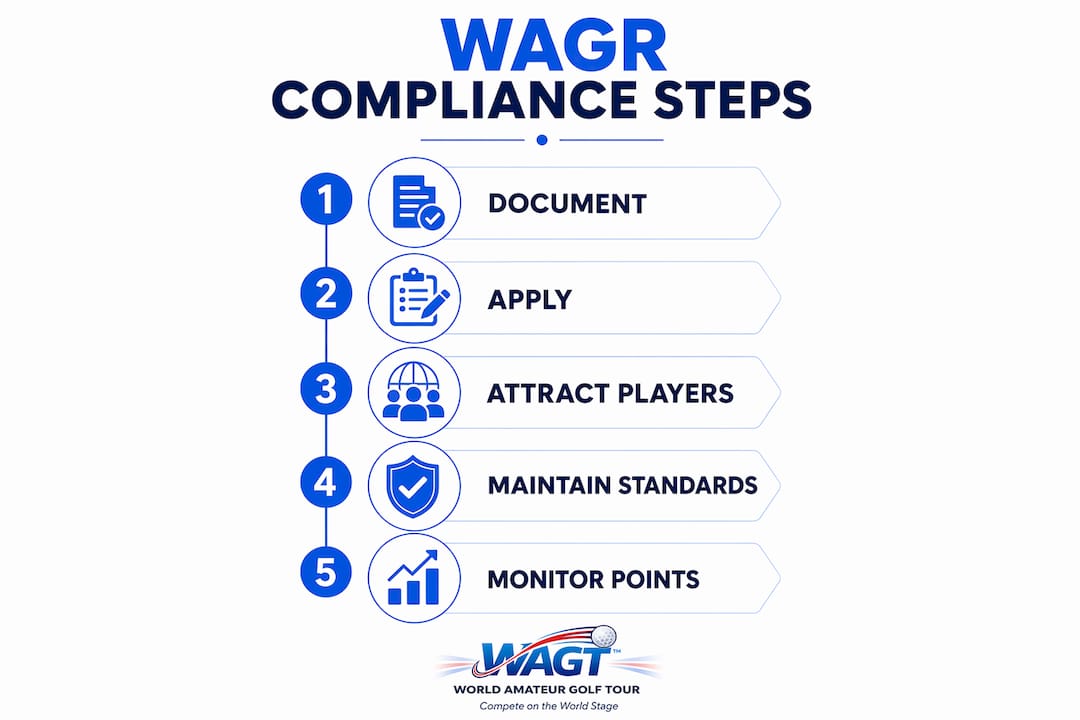
- Prepare your event documentation. Tournament organizers must submit a detailed application covering event history, field strength, format, and competitive prestige. New events without a track record must present a credible plan for field quality and operational standards.
- Submit to the WAGR Committee for review. The committee evaluates the application against current WAGR criteria. History, field strength, and existing prestige are decisive factors in acceptance, often outweighing minor format variations.
- Respond to committee feedback. The committee may request additional information, suggest format adjustments, or flag compliance concerns before granting status. Treat this stage as a collaborative review, not a rejection.
- Receive sanctioning and publish results. Once approved, results from each edition must be submitted accurately and promptly after the event concludes. Delayed or incomplete results can trigger a compliance review.
- Maintain standards annually. WAGR criteria are revised annually to reflect evolving competitive standards. Organizers must stay current with these updates and adapt their event structure accordingly.
- Respond to supervision or warnings. The WAGR Committee regularly reviews sanctioned events and issues written warnings or supervision notices when standards slip. Ignoring these notices puts your event's status at risk.
The sanctioning process for an event like the Inverness Four Day Open illustrates this well. That event achieved WAGR status by demonstrating a credible competitive history and a strong field, not by being the largest or most funded event in its region. Organizers who understand the sanctioning process in detail before applying move through the review stage significantly faster.
Pro Tip: Document your event's competitive history from day one, even before applying for WAGR status. A clear record of past fields, results, and course credentials strengthens your application and reduces back-and-forth with the committee.
How does WAGR ranking point allocation depend on event compliance?
Points are not distributed equally across all WAGR events. The allocation system is built on two variables: the finishing position of each player and the Power of the event itself.
| Factor | How it affects points |
|---|---|
| Event Power | Higher-ranked fields produce greater Power, increasing points at every finishing position |
| Finishing position | Points decrease progressively from first place down through the field |
| Field size | Larger compliant fields generate more total points distributed across positions |
| Player eligibility | Only players meeting the 6.5-point threshold over a rolling two-year period are included in the ranking |
The 6.5-point minimum threshold over two years is a critical detail for players. It means that competing in a single WAGR event and finishing well is not enough to appear in the ranking. Consistent participation across multiple compliant events is required. This structure rewards players who commit to a competitive schedule, not those who cherry-pick one prestigious event per year.
For organizers, the practical implication is direct. An event that consistently attracts ranked players builds its own Power over time, creating a self-reinforcing cycle of stronger fields and higher point values. WAGR also applies a rolling 104-week cycle for counting events, which means recent performance carries more weight than results from three or four years ago. Your event's compliance record in the last two years matters more than its founding history.
The compliance connection here is tight. An event that loses WAGR status mid-season, or that has results disqualified due to rules violations, strips points from players who competed in good faith. That damages your reputation with exactly the elite amateur community you are trying to attract.
Common challenges in maintaining WAGR compliance
Most compliance failures are not dramatic. They are administrative, incremental, and avoidable with the right systems in place.
- Misunderstanding amateur-only requirements. Many organizers assume WAGR events must exclude professionals entirely. This is incorrect. Professional events where elite amateurs compete can qualify, provided all other criteria are met. Misreading this rule leads organizers to either exclude valuable field additions unnecessarily or to invite professionals without understanding the compliance implications.
- Inaccurate or late results submission. WAGR requires precise, timely reporting of all results. Errors in player identification, scoring, or submission timing trigger committee reviews and can result in points being withheld or reversed.
- Failure to enforce amateur status. Organizers are responsible for verifying that competitors hold valid amateur status under USGA and R&A definitions. Understanding amateur golf status rules is not optional. A single ineligible player in the field can create compliance complications for the entire event.
- Inconsistent field quality year over year. An event that qualifies one year with a strong field but drops significantly in competitive standard the next year will face WAGR scrutiny. Consistent field quality is an ongoing obligation, not a one-time achievement.
- Ignoring annual criteria updates. WAGR revises its standards regularly. An event that was fully compliant in 2024 may need format or documentation adjustments to remain compliant in 2026. Organizers who treat sanctioning as a permanent status rather than an ongoing responsibility are the ones who receive unexpected warnings.
The most overlooked challenge is the human element. Enforcing the Rules of Golf consistently across a full field, especially in amateur events where players self-report scores, requires trained officials and clear procedures. Reviewing the essential rules of golf with your officiating team before each event is a practical step that prevents the kind of scoring disputes that create compliance headaches.
Practical benefits of WAGR compliance for events and participants
WAGR status transforms what an event can offer to every stakeholder involved.
For organizers, the most immediate benefit is field quality. Events with WAGR status attract higher-caliber fields, which raises the competitive standard, increases media interest, and builds the event's long-term reputation. This is not a gradual effect. Organizers who achieve WAGR status often report a measurable jump in entry quality within the first one or two editions following sanctioning.
For players, the stakes are even higher. WAGR provides a unified global measure that allows college coaches, national federations, and professional tour exemption committees to compare amateurs who have never competed head-to-head. A strong WAGR ranking opens doors to collegiate scholarships, national team selection, and professional tour exemptions that are simply not available to players without a recognized ranking. For junior golfers in particular, every WAGR point earned at a compliant event is a concrete step toward a collegiate or professional future.
"Achieving WAGR status is not just an administrative milestone. It is a signal to the entire golf community that your event meets the highest standards of competitive integrity and player development."
The prestige effect compounds over time. Events with a consistent WAGR track record become destinations. Players plan their competitive calendars around them. Sponsors recognize the audience quality. Venues prioritize them for scheduling. The long-term growth trajectory of a WAGR-compliant event is fundamentally different from that of an unsanctioned tournament, regardless of how well-run the latter might be.
Key takeaways
WAGR compliance requires meeting defined field size, format, and rules standards, then maintaining those standards through annual committee review and accurate results reporting.
| Point | Details |
|---|---|
| Minimum field size | Men's and mixed events need 16 players; women's events need at least 8 to qualify. |
| Rules adherence | Events must follow Rules of Golf, Amateur Status, and Equipment Rules governed by The R&A and USGA. |
| Application process | Submit event history, field strength, and format documentation to the WAGR Committee for review. |
| Point allocation | Points depend on event Power and finishing position, with a 6.5-point threshold for player ranking eligibility. |
| Ongoing compliance | WAGR criteria update annually, requiring organizers to adapt and respond promptly to committee feedback. |
Why WAGR compliance is worth every bit of the effort
I have watched organizers treat WAGR sanctioning as a checkbox, something to pursue once and then forget. That approach almost always leads to a warning letter within two or three years. The events that sustain WAGR status and grow because of it are the ones where the organizer treats compliance as a living standard, not a certificate on the wall.
The application process itself is genuinely useful. Going through it forces you to document your event's competitive history, evaluate your field quality honestly, and stress-test your rules enforcement procedures. Most organizers come out of that process running a tighter, more credible event regardless of whether they receive sanctioning on the first attempt.
My strongest advice is to engage with the WAGR Committee proactively. If you receive a supervision notice or a request for clarification, respond within days, not weeks. The committee's job is to protect the integrity of the ranking system, and they respond well to organizers who demonstrate the same commitment. I have seen events recover from compliance warnings and go on to become some of the most respected amateur tournaments in their regions, purely because the organizer took the feedback seriously and acted on it fast.
The player development angle matters too. When you run a WAGR-compliant event, you are not just hosting a golf tournament. You are creating a pathway for junior and collegiate players to build the ranking credentials that change their futures. That responsibility is worth taking seriously, and it shows in the quality of every event that earns and keeps its WAGR status.
— Gene
Run your next event with Worldamateurgolftour
If you are ready to host WAGR-compliant tournaments without navigating the compliance process alone, Worldamateurgolftour is built for exactly that.
Worldamateurgolftour specializes in professionally run, WAGR-counting amateur events that give junior, collegiate, and amateur golfers the ranking opportunities they need to advance in the sport. Every event on the tour is managed with full compliance oversight, championship-caliber venues, and a player experience that meets the standards elite competitors expect. Whether you are an organizer looking to partner with a recognized WAGR tournament provider or a player searching for your next ranking event, Worldamateurgolftour gives you the structure, the support, and the competitive field to make every round count.
FAQ
What is the minimum field size for a WAGR-compliant event?
Men's and mixed-gender events require a minimum of 16 players. Women-only events require at least 8 players to qualify for WAGR consideration.
Can professional golfers compete in WAGR-ranked events?
Yes. Certain professional events qualify for WAGR points when elite amateurs compete in the field, provided the event meets all other compliance criteria set by the WAGR Committee.
How many points does a player need to appear in the WAGR ranking?
Players must earn at least 6.5 points over a rolling two-year period to be eligible for inclusion in the World Amateur Golf Ranking.
How often does WAGR review its compliance criteria?
WAGR updates its criteria annually to reflect current competitive standards. Sanctioned events must adapt to these updates to maintain their status and avoid supervision notices.
How long does WAGR count results from past events?
WAGR applies a rolling 104-week cycle, meaning only results from the past two years count toward a player's current ranking. Recent and consistent performance carries the most weight.