

Entering World Amateur Golf Tour events is the most direct path an elite amateur golfer has to earning World Amateur Golf Ranking (WAGR) points and building a competitive profile that colleges, national federations, and professional scouts actually notice. WAGR is administered by The R&A and USGA, assessing thousands of counting competitions annually to rank elite amateurs worldwide. The World Amateur Golf Tour (WAGT), organized through BlueGolf, runs 54-hole championship events specifically designed to feed into that system. If you are a junior, collegiate, or serious amateur golfer planning your 2026 season, this guide gives you the exact steps to find, verify, register for, and perform in WAGR-counting events.
How to enter World Amateur Golf Tour events the right way
Before you register for anything, you need to confirm three things: your eligibility, your profile, and whether the event actually counts toward WAGR. Skipping any one of these steps costs you time, entry fees, and ranking progress.
Eligibility requirements you must meet:
- Amateur status: You must hold a current amateur status recognized by your national golf federation. Playing for prize money in any format voids this status.
- Handicap index: Most WAGT events require a verified USGA Handicap Index posted through an authorized golf club or association. Check each event listing for the specific index limit.
- Age divisions: WAGT events serve junior golfers (typically under 19) and open amateur divisions. Confirm which division applies to you before registering.
- Membership: Worldamateurgolftour requires an active membership to access its events. Review the full membership benefits breakdown to understand what your membership includes.
Building your amateur golf profile checklist:
Your profile is your competitive identity. It should include your current USGA Handicap Index, a complete tournament history, your WAGR number once assigned, and contact information for your home club or association. Platforms like BlueGolf store your registration history and results, so keeping your profile current there is not optional. Think of it as your athletic resume.

Verifying event WAGR eligibility:
Not all WAGT events count toward WAGR points. On BlueGolf event listings, look for the explicit "WAGR" and "JGS" labels next to the event name. If those labels are absent, the event does not contribute to your ranking regardless of the field quality or venue prestige. Many amateurs confuse the WAGT brand with the global WAGR system, and that confusion leads to wasted entry fees.
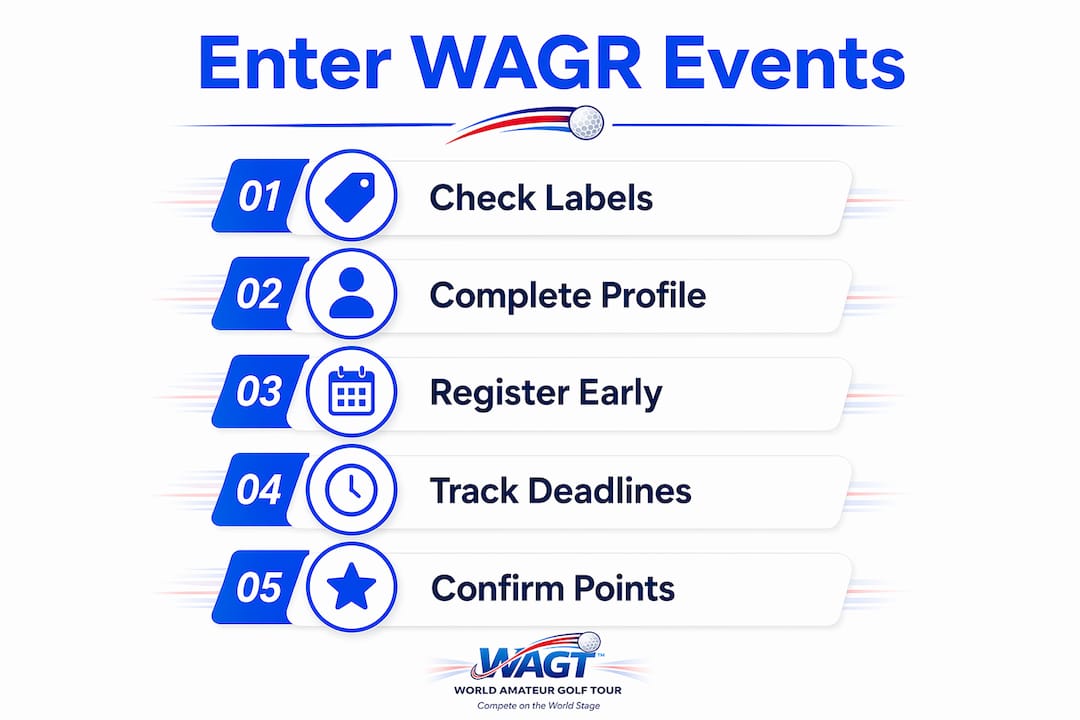
Pro Tip: Screenshot the event listing page showing the "WAGR" label before you register. If a dispute arises about point eligibility, that screenshot is your documentation.
How to find and register for WAGR-counting tournaments
Finding the right events is a process, not a single search. Here is the step-by-step approach that works.
-
Visit the BlueGolf WAGT portal. Go to the WAGT event listings on BlueGolf and filter by date range and division. Every event showing "JGS, WAGR" in the listing is a counting tournament.
-
Cross-reference with the Worldamateurgolftour website. The official WAGT site lists upcoming events with venue details, field sizes, and registration windows. Use both sources together for the most complete picture.
-
Check event format and length. WAGT counting events are 54-hole competitions played over three days. Confirm the format matches your schedule and travel capacity before committing.
-
Review fees and registration requirements. Entry fees vary by event. Most require proof of handicap, active membership, and payment at registration. The 2026 summer series spans Florida, New Jersey, and Alabama, with events like the Tampa Bay Amateur and the Yellowhammer Invitational offering high-quality fields and championship venues.
-
Register early. Applications for 2026 WAGR-counting events opened on a rolling basis starting in early 2026. Competitive events fill quickly. Waiting until two weeks before the event date often means you are on a waitlist.
-
Confirm registration confirmation and event details. After submitting your registration, verify you receive a confirmation email with your tee time assignment, course details, and any pre-event requirements such as practice round bookings.
-
Prepare your equipment and documentation. Bring your handicap verification, WAGT membership card, and any required identification to the event. Some venues require a photo ID at check-in.
Pro Tip: Build a simple spreadsheet tracking each event's application deadline, registration fee, location, and WAGR label status. Amateur golf season planning done this way prevents the most common and costly mistakes. For a deeper framework, see these season planning strategies that experienced tournament players use.
How does amateur golf ranking calculation work for WAGR?
WAGR points are calculated over a rolling two-year period, and a player must accumulate a minimum of 6.5 points during that window to be included in the ranking. This means your performance from 24 months of competition determines your current standing, not just your last event.
Points are awarded based on two variables: field strength and finishing position. A top-10 finish in a weak field earns fewer points than a top-20 finish in a field loaded with ranked players. This design rewards players who seek out competitive events rather than padding their record in low-stakes tournaments.
| Factor | How it affects your WAGR points |
|---|---|
| Field strength | Stronger fields multiply the points available for each finishing position |
| Finishing position | Higher finishes earn exponentially more points than mid-field results |
| Event frequency | More WAGR events entered means more opportunities to accumulate points |
| Rolling two-year window | Old results drop off, requiring consistent participation to maintain ranking |
| Minimum threshold | You need at least 6.5 points to appear in the WAGR at all |
WAGR updates weekly, but ranking improvements accumulate slowly. A single strong finish will not move you dramatically unless your baseline is already established. This is why the system rewards consistent performers over one-event wonders.
"Ranking stabilizes through repeated points from multiple approved tournaments over time. Players should focus on entering multiple WAGR qualifiers and finishing well to accumulate points rather than focusing on a single event." — WAGR Criteria
New players face a specific challenge: the rolling two-year calculation means beginners may require multiple events across two seasons before reaching the 6.5-point inclusion threshold. Starting late in the season delays full ranking inclusion until the next evaluation cycle. The practical implication is clear: begin competing in WAGR events as early in the season as possible.
WAGR also serves a purpose beyond personal ranking. It enables global comparison among amateurs who never compete head-to-head, giving college programs, national federations, and sponsors an objective measure of talent development. A strong WAGR position opens doors that a local tournament record simply cannot.
Strategies to maximize WAGR points from your tournament schedule
Building your ranking is a planning exercise as much as a performance one. The golfers who advance fastest are not always the most talented. They are the most organized.
-
Enter multiple WAGR events per season, not just one or two. The two-year rolling calculation rewards volume. Aim for at least four to six WAGR-counting events per year to build a stable points base.
-
Prioritize events with stronger fields. The Okeeheelee Invitational and similar 54-hole WAGT events attract competitive junior and amateur fields that increase the points value of every finishing position. Seek those out rather than defaulting to the nearest event.
-
Register early for high-demand events. The 2026 summer series events at venues like TPC Tampa Bay fill fast. Early registration also gives you more time to prepare course-specific strategy and arrange travel without last-minute costs.
-
Track your ranking progress actively. Log into the official WAGR platform after each event to confirm your points were recorded correctly. Errors in event reporting do occur, and catching them early matters.
-
Avoid events without verified WAGR labeling. Entering a non-counting event when you thought it counted is one of the most frustrating and avoidable setbacks in amateur golf ranking career planning. Always verify the label before paying the entry fee.
-
Use your results to refine your schedule. After each event, assess where your game cost you strokes and which event formats suit your strengths. A match-play specialist and a stroke-play grinder should not build identical schedules.
Understanding how tournaments get sanctioned also helps you evaluate new events that appear on the calendar mid-season, so you can quickly judge whether they are worth entering.
Key takeaways
Consistent participation in verified WAGR-counting events, combined with strong field selection and early registration, is the most reliable method for building a competitive World Amateur Golf Ranking.
| Point | Details |
|---|---|
| Verify WAGR labeling | Only events marked "WAGR" and "JGS" on BlueGolf listings count toward your ranking. |
| Meet eligibility first | Confirm amateur status, handicap index, and active WAGT membership before registering. |
| Enter multiple events | The rolling two-year window rewards consistent participation across four to six events per season. |
| Prioritize field strength | Stronger fields generate higher points per finishing position, accelerating ranking progress. |
| Start early in the season | Late entry delays ranking inclusion; the 6.5-point threshold requires time to build. |
What I have learned watching serious amateurs navigate this system
I have spent years watching junior and collegiate golfers approach WAGR with the wrong mental model. They treat it like a single-event lottery, pouring everything into one prestigious tournament and then wondering why their ranking barely moved. The system is not built for that. It rewards the player who shows up consistently, competes in verified events, and treats ranking advancement as a multi-season project.
The single most valuable thing I have seen players do is build a simple event calendar in January, identify six to eight WAGR-counting events across the year, and register for all of them before February ends. That discipline alone separates the players who appear in the WAGR from those who are perpetually "almost there."
I have also seen the confusion around event verification cost players real money and real time. Entering a tournament that turns out to be non-counting is demoralizing. The fix is simple: check the BlueGolf listing for the "WAGR" label, every single time, without exception.
The community aspect of WAGT events is underrated. The players you meet at these tournaments become your competitive network. They share event intel, course knowledge, and sometimes travel logistics. That network compounds over a career in ways that a ranking number alone cannot capture.
My honest advice for the 2026 season: commit early, verify everything, and play more events than you think you need to. The ranking will follow.
— Gene
Start competing with Worldamateurgolftour in 2026
Worldamateurgolftour gives you direct access to WAGR-counting 54-hole events at championship-caliber venues across Florida and beyond. The platform handles event discovery, registration, and membership in one place, so you spend your energy on your game instead of administrative logistics.

If you are serious about building your amateur golf ranking this season, the time to act is now. Spots in competitive 2026 events are filling fast, and early registration puts you in the strongest fields available. Visit Worldamateurgolftour to browse the full 2026 event schedule, confirm WAGR eligibility for each tournament, and secure your spot before the waitlists open. Your ranking career starts with the first event you enter.
FAQ
What does it mean to enter World Amateur Golf Tour events?
Entering World Amateur Golf Tour events means registering for WAGT-organized 54-hole tournaments that are verified as WAGR-counting competitions. These events, listed on BlueGolf with "WAGR" and "JGS" labels, allow you to earn points toward your World Amateur Golf Ranking.
How many WAGR points do I need to get a ranking?
You need a minimum of 6.5 points accumulated over a rolling two-year period to appear in the WAGR. Points are awarded based on field strength and finishing position in each approved event.
How do I know if a WAGT event counts toward WAGR?
Check the BlueGolf event listing for the explicit "WAGR" and "JGS" labels next to the event name. If those labels are not present, the event does not count toward your ranking regardless of the organizer's name or venue quality.
Can beginners enter WAGR-counting amateur events?
Yes, but new players should start early in the season. The rolling two-year calculation means it takes multiple events across two seasons to reach the 6.5-point inclusion threshold, so early and consistent entry is the fastest path to ranking inclusion.
Why does WAGR matter for junior and collegiate golfers?
WAGR enables objective global comparison among amateurs who never compete head-to-head, giving college programs and national federations a standardized measure of talent. A strong WAGR position significantly improves your visibility for college recruitment and professional development pathways.