

If you're searching for juniorplayerstour.ca alternatives, the fastest path forward is to pick from one of four proven categories: WAGR-counting event series, national elite circuits, state and regional PGA-affiliated junior tours, or local club-based circuits. Your choice should match your player's current competitive level, college timeline, and how much travel your family can realistically commit to each season.
Here's a quick-reference shortlist to orient you:
- WAGR-counting event series (e.g., Worldamateurgolftour): national reach, elite competition, ranking points that matter to college coaches
- National elite circuits (e.g., AJGA): highly competitive, college-recruiting focus, selective entry
- State/regional PGA-affiliated tours (e.g., SCPGA Junior Tour): structured development, regional scheduling, accessible entry
- California-style regional tours (e.g., CA Junior Golf Tour): strong state-level competition, consistent schedule
- Club-based local circuits (e.g., JC Junior Tour): development-first, low cost, minimal travel
Recommended next step: Create accurate player profiles on tournament management platforms like BlueGolf or GolfGenius right now. Popular junior events reach capacity within minutes of opening registration.
Worldamateurgolftour stands out among these alternatives as a leading WAGR-counting option, offering professionally run events, live scoring, and recruiting tools built specifically for junior and collegiate players.
Table of Contents
- How do these alternative junior tours compare at a glance?
- What should you expect from each alternative tour category?
- How do you pick the right tour for your junior golfer?
- Why do WAGR-counting events matter for junior progression?
- Key Takeaways
- What most parents get wrong about junior tour selection
- Worldamateurgolftour: a WAGR-counting alternative worth your attention
- Official resources and helpful links
How do these alternative junior tours compare at a glance?
| Tour Category | Geographic Coverage | Competitive Level | Age Divisions | WAGR/Points | Membership & Entry Fees | Travel Commitment | College Exposure |
|---|---|---|---|---|---|---|---|
| WAGR-counting event series (Worldamateurgolftour) | National | Elite | Junior, collegiate, amateur | WAGR-counting | Annual membership + per-event fee | Moderate to high | High — recruiting dashboard, player profiles |
| National elite circuits (AJGA) | National | Elite | 12–19 | AJGA points, college-recruiting tools | Annual membership + entry fees | High | Very high |
| State/regional PGA-affiliated tours (SCPGA Jr. Tour) | Regional | Development to competitive | 7–18 | Regional ranking points | Seasonal membership + per-event | Low to moderate | Moderate |
| California-style regional tours (CA Junior Golf) | Regional (CA/Southwest) | Competitive | 7–18 | Regional points | Per-event or seasonal | Low to moderate | Moderate |
| Club-based local circuits (JC Junior Tour) | Local/club level | Development | 7–18 | None | Low per-event | Minimal | Low |
Entry fees at the state and regional level typically run around $300 per event, as seen in events like the Texas Junior Match Play, which limits fields to 120 players and uses stroke-play qualifying followed by match play rounds. Annual costs across a full season, once you add membership, entry fees, and travel, can climb significantly higher than most families anticipate. Popular events at the national level fill within days of opening, so setting up profiles and monitoring registration windows early is not optional.
What should you expect from each alternative tour category?
Worldamateurgolftour (WAGR-counting event series)
- Age range/eligibility: Junior, collegiate, and amateur golfers
- Geographic coverage: National (United States)
- Membership & fees: Annual membership subscription plus per-event entry fees; rewards program redeemable for gear and entry credits
- Best for: Players targeting WAGR ranking points, college recruiting visibility, and elite competition at championship-caliber courses
- How to join: Register at worldamateurgolftour.com, create a player profile, and browse the event schedule for open registration windows
- Parent tip: Use the recruiting dashboard to build your player's profile before the season starts so college coaches can find them during event season
National elite circuits (AJGA)
- Age range/eligibility: Ages 12–19; performance-based entry for most events
- Geographic coverage: National
- Membership & fees: Annual membership required; entry fees vary by event tier; performance criteria may restrict access to top-tier events
- Best for: Players already competing at a high level who want maximum college-coach visibility and national ranking points
- How to join: Register on the AJGA website, complete the membership application, and monitor event openings by performance category
- Parent tip: Understand the performance criteria before paying for membership. Entry to marquee events is not guaranteed.
State/regional PGA-affiliated tours (SCPGA Junior Tour)
The SCPGA Junior Tour is a strong model for what PGA-affiliated regional programs deliver: structured competition across multiple age divisions, consistent scheduling throughout the season, and a clear development pathway. These tours suit players who are building their game and want regular competitive rounds without the travel burden of a national circuit.
- Age range/eligibility: Ages 7–18, divided by age and skill
- Geographic coverage: Regional (state or multi-state)
- Membership & fees: Seasonal membership plus per-event entry; generally more affordable than national circuits
- Best for: Development-stage players who need consistent competitive reps and a path toward higher-level competition
- How to join: Check your state's PGA section website, register for a seasonal membership, and sign up for individual events as they open
- Parent tip: Review the event schedule at the start of the season and block dates early. Regional events fill faster than most parents expect.
California-style regional tours (CA Junior Golf)
CA Junior Golf runs junior tournaments across Southern California with a competitive field that draws serious players from across the region. The tour offers multiple age divisions and a consistent schedule, making it a reliable option for families in the Southwest who want quality competition without cross-country travel.
- Age range/eligibility: Ages 7–18
- Geographic coverage: Southern California and surrounding region
- Membership & fees: Per-event or seasonal registration; fees are publicly listed on the CA Junior Golf website
- Best for: Players in the Southwest seeking competitive regional play and a clear path toward state-level recognition
- How to join: Register directly on the CA Junior Golf website; no complex performance criteria for most age divisions
Club-based local circuits (JC Junior Tour)
The JC Junior Tour is a development-focused circuit built around accessible, low-pressure competition. Events are local, costs are low, and the format prioritizes getting young players onto the course regularly. For a junior golfer who is new to tournament play, this is often the right starting point.
- Age range/eligibility: Ages 7–18, all skill levels
- Geographic coverage: Local/club level
- Membership & fees: Low per-event fees; no complex membership structure
- Best for: Beginners and developing players who need match experience before moving to regional or national circuits
- How to join: Contact the host club or register through the JC Golf website; events are open and accessible
How do you pick the right tour for your junior golfer?
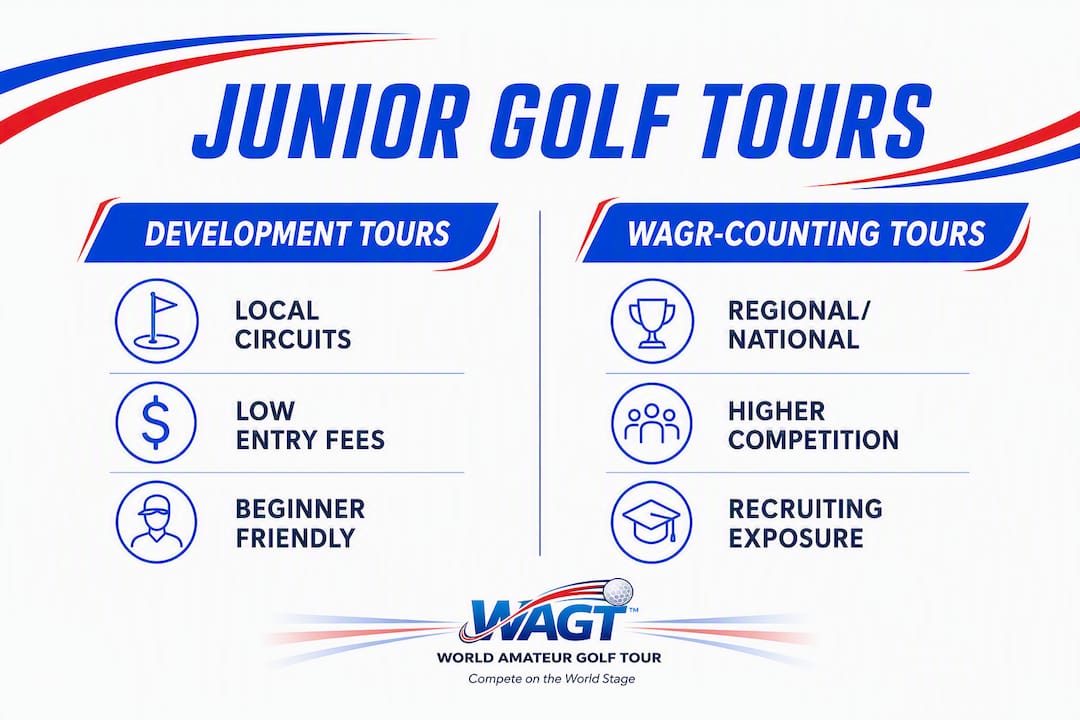
Start with the primary goal. If your player is chasing college exposure and national ranking points, a WAGR-counting series or national elite circuit is the right tier. If they need consistent competitive reps to build their game, a regional PGA-affiliated tour or local circuit fits better. Understanding your player's golf development pathway before comparing individual tours saves time and money.
Decision checklist:
- Assess skill and competitive readiness. Is your player winning locally, or still building fundamentals? Match the tour tier to current performance, not aspirational goals.
- Confirm age divisions. Check that the tour offers a division that fits your player's age and skill level this season, not just in two years.
- Check WAGR or ranking status. If college recruiting is a near-term goal, prioritize tours that generate WAGR points or recognized national ranking data. Review the amateur-to-collegiate transition pathway to understand what coaches actually look at.
- Estimate annual cost realistically. Add membership fees, per-event entry fees, travel, accommodation, and equipment. A single regional event like the Texas Junior Match Play carries a $300 entry fee before any travel costs.
- Review the event schedule and travel requirements. Count the number of events, their locations, and the lead time for registration. A tour with 12 events spread across three states demands a very different commitment than a local circuit with monthly rounds.
Questions to ask tour organizers before you register:
- What is the typical field size, and how competitive is the entry process?
- What is the pace-of-play policy, and how are slow-play violations handled?
- When are tee times and pairings published?
- Is practice-round access included or separately booked?
- What is the refund or withdrawal policy if your player is injured or ill?
- Are coaches and caddies permitted on-course during rounds?
- How are health and safety incidents managed on-site?
- How are WAGR or ranking points calculated and submitted?
Red flags to watch for:
- Membership rules that are vague or change after payment
- Inconsistent scheduling with frequent event cancellations or venue changes
- Poor communication from organizers before and during events
Why do WAGR-counting events matter for junior progression?
WAGR-counting events give your player a measurable, internationally recognized ranking that college coaches can find and verify. The World Amateur Golf Ranking aggregates results from sanctioned events globally, so a strong performance in a WAGR-counting tournament contributes directly to a player's standing. That visibility is something a local club circuit simply cannot replicate.

The 2026 U.S. Junior Amateur Championship, hosted at Saucon Valley C.C. from July 20–25, 2026, illustrates the standard at the top of the junior game: elite host courses, national fields, and results that carry weight in recruiting conversations. Competing in WAGR-counting events at the level below that benchmark is how players build the profile that earns an invitation to events like it.
Worldamateurgolftour runs professionally managed WAGR-counting events with live scoring, player profiles, and a recruiting dashboard that puts your player's results directly in front of college coaches. The sanctioning is clear, the event management is consistent, and the pathway from junior competition to collegiate recruitment is built into the platform.
"Participants can earn ranking points towards WAGR status, enhancing their visibility and opportunities in the sport. This focus on the junior golf community, coupled with consistent high-quality events at respected venues, sets the World Amateur Golf Tour apart as a leader in amateur golf competitions." — Worldamateurgolftour
Pro Tip: Register your player's profile on tournament management platforms like BlueGolf or GolfGenius before the season opens. Top-tier junior events frequently reach capacity within minutes, and an incomplete profile can disqualify an otherwise valid entry.
Key Takeaways
The most effective strategy for replacing juniorplayerstour.ca is to match your player's current competitive level to the right tour tier, prioritize WAGR-counting events if college recruiting is a near-term goal, and register profiles early because competitive junior events fill fast.
| Point | Details |
|---|---|
| Match tier to player level | Choose development circuits for beginners; WAGR-counting or national elite tours for college-bound players. |
| WAGR points drive recruiting | WAGR-counting events give college coaches verifiable, internationally recognized ranking data. |
| Budget realistically | Regional entry fees are $300 per event; annual costs rise significantly when travel is added. |
| Register profiles early | Popular junior events reach capacity within minutes; set up BlueGolf or GolfGenius profiles before the season opens. |
| Worldamateurgolftour for WAGR access | Worldamateurgolftour offers WAGR-counting events, live scoring, and a recruiting dashboard for junior players. |
What most parents get wrong about junior tour selection
The conventional wisdom says to find the most prestigious tour your player qualifies for and enter as many events as possible. That logic works for a narrow slice of juniors who are already elite. For the majority, it produces burnout, inflated costs, and a player competing above their development stage before they have the game to benefit from it.
The more useful frame is this: playing frequency at the right competitive level builds more than playing infrequently at a level that exposes every weakness. A player who competes 15 times in a season at a well-matched regional circuit develops faster than one who plays 6 national events and spends the rest of the year recovering from the gap between their current game and the field quality.
Where WAGR-counting events genuinely change the equation is for players who are already competitive at a regional level and have a realistic college timeline within two to three years. At that point, the ranking visibility is not a luxury. It is the mechanism by which coaches find players they have never seen in person. Tracking event results consistently and communicating development goals with your player's coach every few months is the single habit that separates families who use tours strategically from those who just collect entry fees.
Worldamateurgolftour: a WAGR-counting alternative worth your attention
If your player is ready for elite competition with real recruiting upside, Worldamateurgolftour delivers what most regional alternatives cannot: WAGR-counting events at championship-caliber courses, with the infrastructure to make those results visible to college programs.

Here is what the membership includes:
- WAGR-counting tournaments with professional event management and consistent scheduling
- Live scoring and player profiles accessible to college coaches during and after events
- Recruiting dashboard that puts your player's ranking and results in front of programs actively searching
- Rewards program redeemable for gear and event entry credits
- Practice and tournament tracking tools to monitor development across the season
For families comparing junior golf tour providers and weighing the cost of membership against per-event entry models, Worldamateurgolftour's annual membership structure gives you predictable access to a full season of sanctioned events. The recruiting tools alone justify the membership for any player with a serious college goal. Visit worldamateurgolftour.com to review the current event schedule and start your membership today.
Official resources and helpful links
Use these to check schedules, register, and plan your season:
- World Amateur Golf Tour: WAGR-counting event schedule, membership registration, player profiles, and recruiting tools
- 2026 U.S. Junior Amateur Championship (USGA): national championship schedule, host course details, and entry requirements — the benchmark for elite junior competition
- Texas Junior Match Play (TGA): example of a state-level event with published entry fees ($300), field limits (120 players), format details, and practice-round booking information
- SCPGA Junior Tour: PGA-affiliated regional tour with age divisions, seasonal schedules, and development programming
- CA Junior Golf: Southern California regional tour with event calendar and per-division registration
- JC Junior Tour: local development circuit with open entry and low per-event fees
- Youth Sports Travel: end-to-end travel planning for families attending multiple events, including accommodation and logistics coordination
- Beyond Sports Tours: multi-day competitive travel packages for teams and families seeking international or regional tournament trips
- Junior golf gloves and gear guide: equipment reference for parents budgeting tournament-ready gear for their junior player
Registration tip: Create and maintain accurate player profiles on BlueGolf and GolfGenius before the season opens. These platforms handle registration for many competitive junior events across the United States, and an incomplete or outdated profile is one of the most common reasons families miss entry windows for events they wanted.