

A golf development pathway is a structured, stage-based roadmap that guides a player's technical, physical, mental, and competitive progression from first swings through to long-term participation or elite performance. The industry standard in the United States is the 7-stage American Development Model (ADM), adopted by USA Golf and the USOPC, which organizes development around physical, mental, and emotional maturity rather than strict age cutoffs.
The core elements every pathway includes:
- Staged progression — defined phases from foundational movement through elite competition
- Skill priorities — technique, tactical play, physical conditioning, and mental skills mapped to each stage
- Measurement methods — benchmarks, practice logs, launch monitor data, and ranking systems like the World Amateur Golf Ranking (WAGR)
- Support resources — qualified coaching, strength and conditioning, sports psychology, and appropriate equipment
Table of Contents
- What are the seven stages of a golf development pathway?
- Why does a structured pathway improve long-term outcomes?
- Who should use a golf development pathway?
- How is progress measured, and what timelines and costs should you expect?
- Which U.S. programs map to the ADM stages?
- What common mistakes derail a player's development?
- How do you build a 12-month season plan?
- How Worldamateurgolftour supports your pathway progression
- Key Takeaways
- The long game is the only game worth playing
- Your next step with Worldamateurgolftour
- Further reading and official resources
What are the seven stages of a golf development pathway?
The ADM's seven stages give coaches and parents a shared language for player development. Each stage has a distinct purpose and a set of coaching priorities.
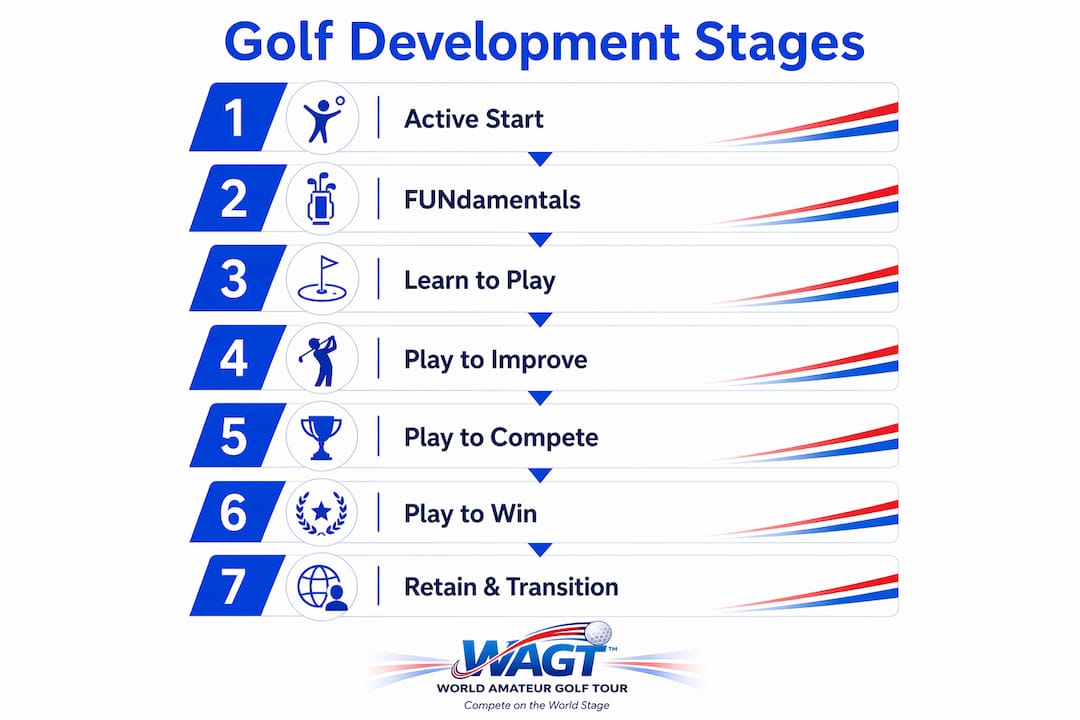
| Stage | Typical Age Range | Core Focus | Readiness Indicators |
|---|---|---|---|
| Active Start | Under 6 | Movement, fun, basic coordination | Enjoys physical activity; follows simple instructions |
| FUNdamentals | 6–8 | Athletic literacy, grip, posture, basic swing | Can replicate simple movement patterns; loves the game |
| Learn to Play | — | Technique, rules, short game, course management basics | Consistent contact; understands scoring |
| Play to Improve | 12–15 | Skill refinement, practice structure, early competition | Tracks stats; competes in local/regional events |
| Play to Compete | 15–17 | Tactical play, physical conditioning, mental skills | Competes at state/national level; builds ranking |
| Play to Win | — | Peak performance, elite competition, professional preparation | Consistent top finishes; WAGR-ranked |
| Play Golf for Life | Any age | Lifelong participation, enjoyment, community | Sustained engagement regardless of competitive level |
A few things worth stressing about this table. First, the age ranges are guides, not gates. A 14-year-old who has not yet consolidated basic technique belongs in Learn to Play priorities, not Play to Compete. Second, the final stage, Play Golf for Life, applies to recreational adults at any point in the journey, not just retired competitors.
Coaching priorities by stage:
- Active Start and FUNdamentals: Motor skill development, multi-sport play, and keeping the experience positive. Technique is introduced gently, never drilled to the point of frustration.
- Learn to Play and Play to Improve: Structured practice sessions, short-game emphasis, introduction to competition formats, and early use of practice logs.
- Play to Compete and Play to Win: Physical conditioning programs, sports psychology integration, statistical analysis, and tournament scheduling aligned with peak performance windows.
Why does a structured pathway improve long-term outcomes?
Ad-hoc training and early specialization produce short-term results at a steep long-term cost. The ADM's five guiding principles — developmentally appropriate activities, quality coaching, long-term focus, multi-sport participation, and athlete wellbeing — exist precisely because programs that ignore them see higher dropout rates, more overuse injuries, and lower peak performance.
The USNDP's THRIVE framework defines pathway success across five dimensions: Training, Health, Relationships, Individual development, and Equipment. That framing matters because it shifts the success metric away from scores and toward holistic athlete wellbeing, which is what sustains a player through a 10-to-15-year development arc.
Why pathways outperform ad-hoc training:
- Reduced burnout through age-appropriate competition loads
- Better retention because players experience success at each stage before advancing
- Improved peak performance timing by building physical and mental foundations before elite competition
- Clearer communication between coaches, parents, and players about what "progress" actually means
Who should use a golf development pathway?
The pathway applies to more people than most families realize. Junior players are the primary focus, but coaches, parents, club academies, and recreational adults all have defined roles.
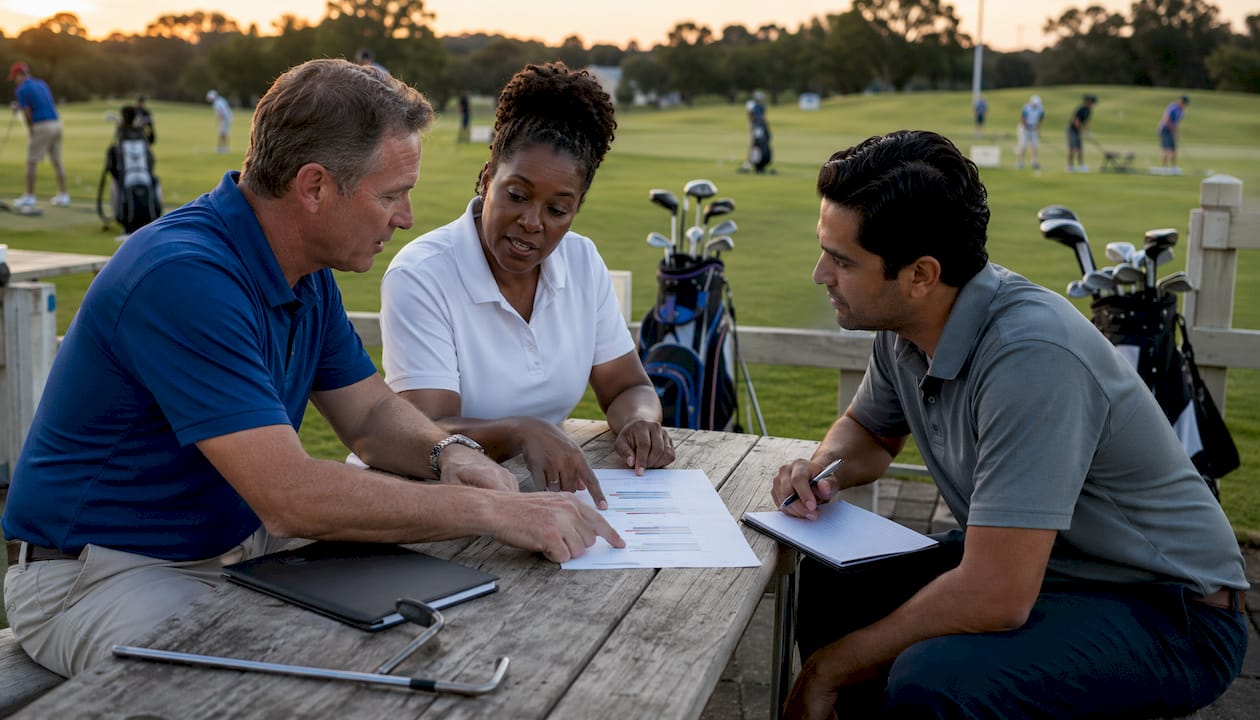
Players: Commit to consistent attendance, maintain a practice log, and communicate honestly with your coach about what feels hard. Your job at the early stages is to build movement competency, not to win tournaments.
Parents: Your role is logistical and emotional support, not technical instruction. Manage the competition schedule to avoid overloading your child, and resist comparing your junior's stage to peers of the same age.
Coaches: Design curriculum around stage-appropriate priorities, conduct regular skill assessments, and use objective data to make promotion decisions. A coach's most important call is recognizing when a player is not yet ready to advance.
Club academies and community programs: Provide access to facilities, group coaching, and entry-level competition. Programs like PGA Junior League and U.S. Kids Golf serve the grassroots end of the pipeline, while USNDP and AJGA events serve the elite end.
Numbered responsibilities for coaches and parents:
- Conduct a baseline skills audit before the season starts
- Set two to three measurable development goals per quarter
- Schedule competition load appropriate to the player's current stage
- Review progress data monthly and adjust priorities
- Integrate cross-training, nutrition basics, and mental skills from Play to Improve onward
How is progress measured, and what timelines and costs should you expect?
Progress in a well-run pathway goes well beyond the scorecard. National programs now use multi-dimensional data — technical metrics, physical testing, and practice-purpose logs — because single-event results are poor predictors of long-term potential.
Measurement tools to use at each stage:
- Skill benchmarks: Greens in regulation %, short-game save %, driving distance dispersion, and putting averages tracked over rolling 20-round samples
- Practice logs: Session frequency, purposeful-practice hours, and drill completion rates
- Launch monitor data: Ball speed, attack angle, and shot dispersion using tools like TrackMan or FlightScope
- Physical assessments: Functional movement screens and strength benchmarks appropriate to the player's age
- Ranking systems: WAGR for elite amateurs, state and regional junior rankings for Play to Compete players
A practical development resume — the kind that gets a player noticed by USNDP talent identification evaluators — includes driving distance dispersion, greens-in-regulation %, short-game save %, fitness test results, and purposeful-practice logs. National selection increasingly weights longitudinal trendlines over single-event wins, so consistent quarterly tracking matters more than one standout performance.
| Development Phase | Typical Timeline | Milestone Checkpoints | Estimated Annual Cost Range |
|---|---|---|---|
| Learn to Play | Ages — | Local club events, junior leagues | Moderate annual investment for lessons, events, and equipment |
| Play to Improve | Ages 12–15 | State junior events, regional rankings | Increasing expenses reflecting more frequent competition and coaching |
| Play to Compete | Ages 15–17 | AJGA events, state teams, WAGR ranking | Significant costs associated with travel, coaching, and tournament play |
| Play to Win | Ages — | USGA championships, national teams, WAGR top rankings | Highest level of financial commitment due to elite competition demands |
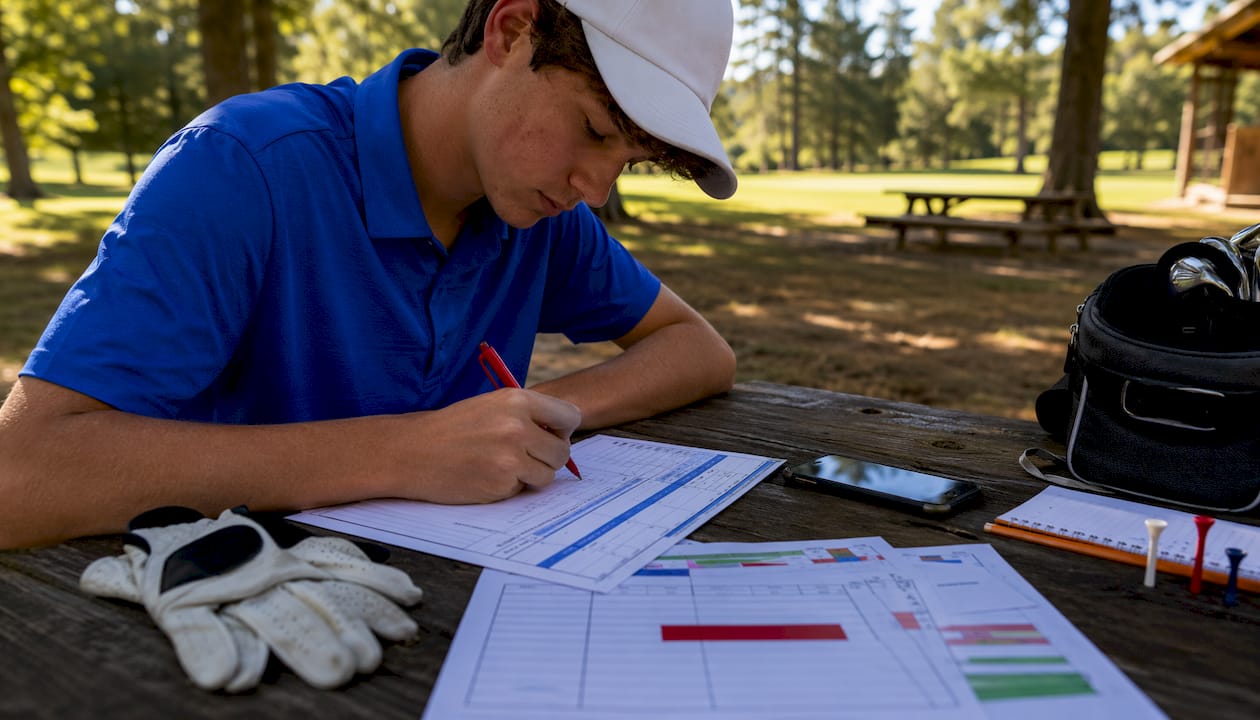
Cost ranges reflect lessons, academy fees, tournament entry, and travel. The USNDP grant program provides financial support for identified talent, covering entry fees, travel, coaching costs, and equipment — a meaningful resource for families navigating the Play to Compete stage. For players exploring the amateur-to-professional transition pathway, costs and timelines shift significantly at the Play to Win stage.
Which U.S. programs map to the ADM stages?
Several established organizations align directly with specific ADM stages, giving coaches and parents clear entry points.
U.S. Kids Golf targets the Active Start through Learn to Play stages. Its World Championship events and local tour structure give young players age-grouped competition in a low-pressure environment. The U.S. Kids Golf Foundation also funds access programs for underserved communities.
USGA / U.S. National Development Program (USNDP) serves the Play to Compete and Play to Win stages. Launched to create the country's first unified, data-driven elite pipeline, the USNDP identifies top juniors through in-person evaluations, partners with Allied Golf Associations and PGA of America sections, and funds national teams with world-class coaching, sports psychology, and nutritional guidance. USGA CEO Mike Whan stated at launch: "Golf is the only major sport in the U.S. without a national development program. Today, that ends."
PGA Junior League bridges the FUNdamentals and Learn to Play stages with a team-format, recreational competition model. Its emphasis on fun and inclusion makes it an ideal first competitive experience before players move into individual stroke-play events.
Club academies and regional junior tours fill the Play to Improve gap, providing structured coaching curricula, local stroke-play events, and early statistical tracking. Many academies now use launch monitor data and video analysis as standard tools at this stage.
For players ready to build a WAGR ranking and gain college-recruiting visibility, Worldamateurgolftour runs WAGR-sanctioned events that connect directly to the Play to Compete and Play to Win stages.
What common mistakes derail a player's development?
The most damaging mistakes are predictable, and most are avoidable with a clear framework.
- Premature specialization: Pushing a child into year-round golf before consolidating multi-sport movement competency raises injury risk and reduces long-term elite potential. The ADM recommends multi-sport participation through at least age 12.
- Over-competition: Too many tournaments at the Play to Improve stage crowds out the deliberate practice time that actually builds skill. A useful rule: practice hours should significantly outpace competitive rounds at every stage below Play to Compete.
- Inappropriate equipment: Adult-length clubs on a junior player distort swing mechanics from the start. Fit equipment to the player's current size and strength, not their aspirational game.
- Neglected physical conditioning: Strength and mobility work is not optional at Play to Compete and beyond. Skipping it increases injury risk and caps distance potential.
- Ignoring mental skills: Sports psychology is not a crisis tool. Introduce goal setting, pre-shot routines, and focus strategies at Play to Improve so they are habits by Play to Compete.
Pro Tip: Watch for these early burnout signals: a player who stops talking about golf between sessions, who avoids practice but still wants to compete, or who shows anxiety rather than excitement before events. When you see two or more of these, reduce competition load immediately and return to skill-building activities the player finds genuinely enjoyable.
Red flags that a program is misaligned with ADM principles: coaches who measure success only by tournament scores at the Learn to Play stage, programs that schedule more than one event per week for players under 14, and academies that discourage multi-sport participation.
How do you build a 12-month season plan?
Converting pathway theory into a working calendar takes about an hour of planning at the start of each season. Here is a practical checklist and a sample annual structure.
Coach and parent checklist:
- Conduct a baseline skills audit in October or November (short game, ball striking, physical screen)
- Set two to three measurable goals for the coming season based on audit results
- Block the competitive calendar first, then build practice structure around it
- Schedule cross-training (strength, mobility, cardio) two to three times per week from January onward
- Integrate nutrition basics: hydration protocols, pre-round fueling, and recovery nutrition
- Plan monthly coach check-ins and quarterly skill audits to review trendlines
- Identify one mental skills focus per quarter (e.g., pre-shot routine in Q1, course management in Q2)
Sample 12-month season plan (Play to Improve / Play to Compete):
- October–December (Off-season): Baseline audit, technique overhaul, physical conditioning foundation, no competitive events
- January–February (Pre-season): Skill-building practice, simulated rounds, physical conditioning ramp-up, equipment fitting check
- March–April (Early competitive season): Two to three local/regional events, practice-to-competition ratio stays at roughly 3:1
- May–July (Peak competitive season): State and regional events, WAGR-eligible tournaments, weekly statistical review, mental skills active
- August–September (Late season and recovery): Selective high-priority events, physical recovery, season debrief, next-year planning begins
For players at the FUNdamentals stage, the entire "competitive season" block is replaced with group clinics, fun formats, and family play. The structure scales up as the player advances. For scheduling guidance around peak performance windows, the competitive peak scheduling guide offers practical frameworks coaches can adapt directly.
Adaptation notes: At FUNdamentals, sessions run 30–45 minutes with games and challenges. At Play to Compete, sessions extend to 2–3 hours with deliberate practice blocks, video review, and physical training integrated into the same day.
How Worldamateurgolftour supports your pathway progression
For junior and collegiate players in the Play to Compete and Play to Win stages, measurable ranking progress is what opens doors to college recruiting and national program consideration. Worldamateurgolftour is built specifically around that need.
Core services that map directly to pathway milestones:
- WAGR-counting events: Every Worldamateurgolftour event is sanctioned to count toward the World Amateur Golf Ranking, giving players the official ranking points that college coaches and national programs track
- Player profiles and recruiting tools: Your profile on the platform functions as a living development resume, visible to college coaches actively searching for talent
- Live scoring and performance tracking: Real-time data from events feeds into your profile, building the longitudinal trendline that national selection processes increasingly prioritize
- Rewards program: Points redeemable for gear and event credits reduce the financial load at the Play to Compete stage
- Membership benefits: A single annual membership provides access to the full event calendar, practice and tournament tracking features, and the platform's recruiting network
For players exploring the benefits of amateur tournament play as part of their development plan, Worldamateurgolftour's event calendar provides a structured, professionally managed environment at championship-caliber courses. The next step is straightforward: join as a member, select events that fit your competitive season, and start building a ranking that speaks for itself.
Key Takeaways
A golf development pathway works when it matches training intensity and competition load to a player's actual developmental stage, not their age or ambition.
| Point | Details |
|---|---|
| ADM is the U.S. standard | The 7-stage American Development Model guides progression by maturity, not strictly age. |
| Measure beyond scores | Build a development resume with driving dispersion, short-game save %, fitness data, and practice logs. |
| Match load to stage | Practice hours should significantly outpace competitive rounds at every stage below Play to Compete. |
| Start with a skills audit | Conduct a baseline assessment each October before setting season goals and scheduling events. |
| Worldamateurgolftour builds your ranking | WAGR-sanctioned events, player profiles, and recruiting tools directly support Play to Compete and Play to Win progression. |
The long game is the only game worth playing
Most families I see get the fundamentals right but stumble on patience. They understand the stages intellectually, then quietly accelerate the timeline when their junior starts winning local events. That is exactly when the ADM framework earns its keep. A player who dominates at the Learn to Play stage has not proven readiness for Play to Compete intensity. They have proven they need harder competition and more deliberate practice, which are different things.
The data-driven approach the USNDP and THRIVE framework advocate is not bureaucratic overhead. It is the difference between a player who peaks at 16 and one who is still improving at 22. Track the trendlines, not the trophies. Review quarterly. Adjust the plan when the data says to, not when the ego says to. The pathway is a multi-year process, and the coaches and parents who treat it that way produce the players who actually reach their potential.
Your next step with Worldamateurgolftour
Elite junior development requires more than a training plan. It requires competitive proof. Worldamateurgolftour gives Play to Compete and Play to Win players access to professionally run, WAGR-sanctioned events at respected venues across the United States, with full transparency in ranking and event management.
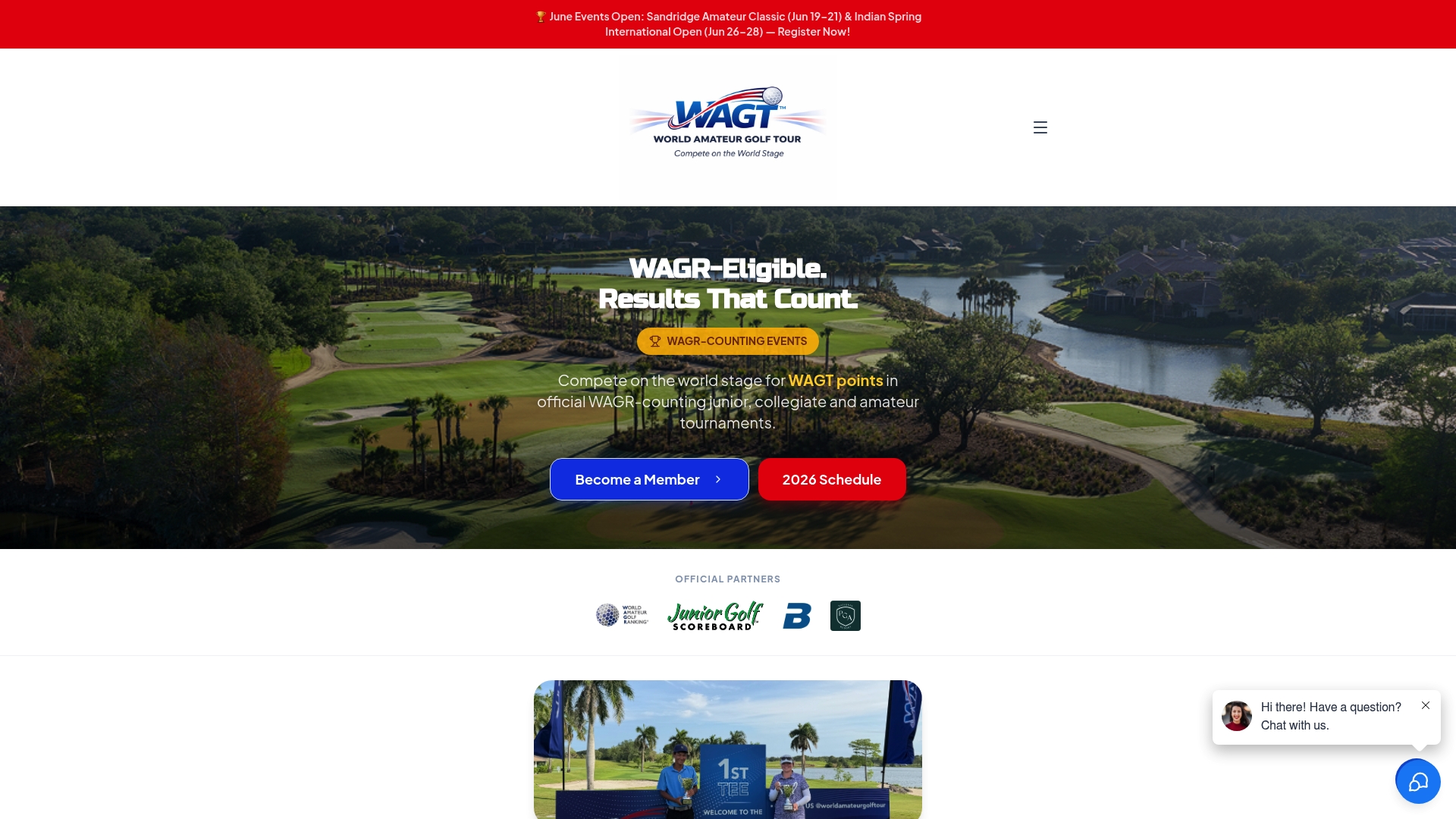
Here is how to get started in three steps: join as a member at worldamateurgolftour.com, select events from the calendar that align with your competitive season, and activate your player profile so college coaches and national program scouts can find you. Membership includes live scoring, performance tracking, a rewards program, and recruiting tools built for serious junior and collegiate competitors. Membership and event-entry details, including current fees, are listed directly on the platform. Your ranking starts building from your first event.
Further reading and official resources
These sources are worth bookmarking whether you are a coach building a curriculum, a parent navigating the pathway, or a junior player aiming for a national program.
- ADM Overview | USA Golf: The primary U.S. reference for the 7-stage model. Coaches should read this before designing any junior curriculum; parents will find the stage descriptions useful for calibrating expectations.
- USGA U.S. National Development Program: The official USNDP page covering talent identification, national teams, grant programs, and the state junior team structure. Relevant for any Play to Compete player or coach working with elite juniors.
- THRIVE Framework | USNDP: The USNDP's holistic development model covering Training, Health, Relationships, Individual development, and Equipment. Useful for coaches integrating sports psychology and physical conditioning into their programs.
- USNDP Program Resources: Practical tools including statistical platforms and guidance on building a non-score development resume. Directly useful for Play to Compete players building a talent ID profile.
- Golf's ADM PDF | PGA Coach: The full ADM document with coaching principles, stage descriptions, and implementation guidance. The most detailed single resource for coaches designing stage-appropriate curricula.
- Golf Canada LTPD: Canada's comparable Long-Term Player Development framework. Coaches will find its implementation tools and stage-by-stage resources a useful complement to the ADM, particularly for program design and parent education.
- Worldamateurgolftour Blog: Practical guides on the amateur-to-professional transition, college recruiting, and amateur status rules for players navigating the upper stages of the pathway.