

The amateur golfer professional transition pathway is the structured series of steps, programs, and eligibility requirements that move top amateur golfers from competitive amateur play into professional tours. Programs like the Global Amateur Pathway, PGA TOUR University, and the LPGA Elite Amateur Pathway each define specific entry points, ranking thresholds, and advancement rules. Understanding which route fits your current ranking, age, and competitive history is the first decision every serious amateur must make.
What eligibility criteria define the amateur to pro pathway?
Your starting point depends on three factors: age, handicap, and ranking. Most major programs set a minimum age of 18 or 20 years old. PGA TOUR Americas, for example, requires players to be 18+ with a handicap index of 2.0 or lower. The Global Amateur Pathway targets non-collegiate amateurs who are 20 or older and ranked in the WAGR top 200. These thresholds exist because programs need players who are already competing at an elite level, not just showing potential.

Here is a breakdown of the major 2026 programs and their core requirements:
| Program | Eligibility | Reward |
|---|---|---|
| Global Amateur Pathway (GAP) | Age 20+, WAGR top 200 | DP World Tour membership for following season |
| PGA TOUR University Accelerated | Top collegiate ranking | Korn Ferry Tour status with deferral option |
| LPGA Elite Amateur Pathway (LEAP) | 20-point system across rankings, wins, awards | LPGA Tour membership |
| LPGA Collegiate Advancement Pathway (LCAP) | Top 10 collegiate players at season end | Epson Tour membership |
| PGA TOUR Americas | Age 18+, handicap index 2.0 or lower | Pathway to Korn Ferry Tour |
The GAP registration for 2026 opens with a June 30 deadline, and the ranking period closes october 11. The top eligible player in the top 20 of the GAP ranking earns 2027 DP World Tour membership. That timeline matters because you need to plan your competitive schedule months in advance to accumulate enough ranking points before the window closes.
Women's pathways follow a parallel structure. The LPGA's LEAP program uses a 20-point system that rewards performance across multiple categories including rankings, wins, awards, and team play. The LCAP grants Epson Tour membership to the top 10 collegiate players at season end. Both programs reward consistent performance across a full season, not a single strong result.
Pro Tip: If you are a collegiate player, check your eligibility for both PGA TOUR University and your conference's LPGA pathway simultaneously. Many players qualify for more than one program and can choose the best fit after seeing their final rankings.
What are the step-by-step routes from amateur to professional tours?
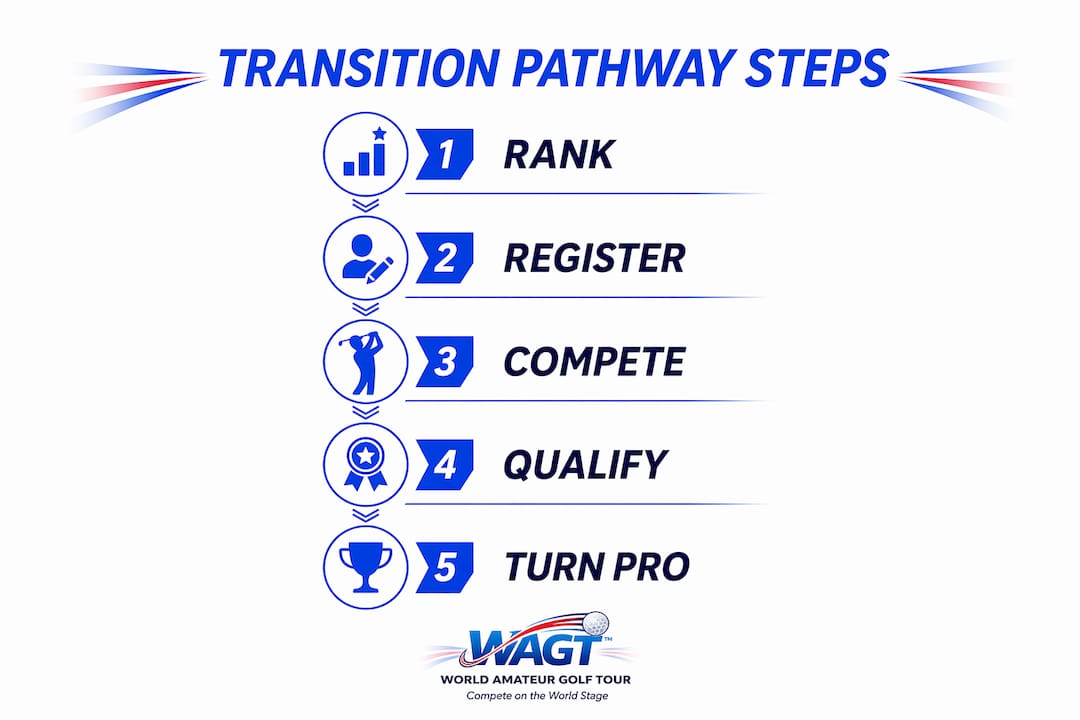
The progression from amateur competition to a professional tour card follows a clear sequence, though the exact path varies by program.
-
Build your WAGR ranking through elite amateur events. WAGR points come from sanctioned tournaments, and your ranking determines which programs you can enter. Competing in WAGR-certified events consistently throughout the year is the foundation of every transition route.
-
Enter a structured pathway program. Once you meet eligibility, register for GAP, PGA TOUR University, or the LPGA pathways. Each program tracks your performance across its designated ranking period and assigns status based on where you finish.
-
Qualify for a developmental tour. PGA TOUR Americas feeds directly into the Korn Ferry Tour. Three wins on PGA TOUR Americas earn you immediate Korn Ferry membership, bypassing the end-of-season points list entirely. That rule rewards players who peak mid-season rather than grinding through a full year.
-
Use Q-School as a backup route. Qualifying School remains a valid entry point for the Korn Ferry Tour and some international tours. It is not the most direct path, but it gives players who miss pathway cutoffs a second chance each season.
-
Turn professional and pay tour fees. Officially declaring professional status is a formal step that affects your amateur eligibility permanently. Some programs, like PGA TOUR University Accelerated, allow you to defer earned membership for multiple seasons. That flexibility lets you complete remaining amateur goals, such as a major amateur title, before committing fully.
-
Advance to top-tier tours. From the Korn Ferry Tour, the top finishers each season earn PGA Tour cards. From the Epson Tour, top performers move to the LPGA Tour. Multiple parallel routes exist to reach a PGA Tour card, including Korn Ferry points, Q-School, international exemptions, and sponsor invites.
Pro Tip: Map your competitive calendar backward from the ranking deadline of your target program. If GAP closes its ranking period in october, you need your strongest events scheduled between april and september, not bunched at year-end.
How to prepare practically for the professional transition
Preparation for the pro level covers four areas: technical skill, physical conditioning, mental readiness, and financial planning. Most players focus almost entirely on the first two and underestimate the last two.
On the technical and physical side, your game needs to hold up under 54-hole events on championship-caliber courses with no off weeks. Work with a qualified coach to identify the specific parts of your game that break down under pressure. Physical conditioning should match the demands of weekly travel and back-to-back competitive rounds.
Mental preparation is where many top amateurs struggle most. Top amateurs face new pressures at their first professional events that require real psychological adaptation. You will not win every week. Accepting that reality before you turn pro, rather than after a string of missed cuts, is the difference between a short career and a long one. Work with a sports psychologist if you have access to one.
Financial planning deserves the same attention as swing mechanics. Major costs include travel, coaching, caddie fees, and conditioning, all on top of tournament entry fees. PGA TOUR Americas offers a Player Achievement Grant of $15,000, but that amount covers only a portion of a full season's expenses. Build a 12-month budget before you turn pro and identify your funding sources clearly.
- Seek mentorship from players who have recently made the transition, not just coaches
- Use the college-to-amateur circuit transition period to test your game against elite competition before committing to pro status
- Track your performance data across events to identify patterns in your scoring and course management
What are the common challenges in the golf career transition?
The biggest challenge most players do not anticipate is the loss of structure. Collegiate support systems disappear the moment you turn pro. No team, no training table, no built-in travel logistics. You manage everything yourself or pay someone to manage it for you.
"There is no guaranteed contract in professional golf. Success depends on surviving a competitive, layered system at every level from junior to developmental tours." — golfhubz.com
Financial stress compounds quickly when results are inconsistent. The players who survive the transition longest are those who planned for a two-year runway without assuming prize money would cover costs. Grants and sponsorships exist but are limited and competitive.
Common pitfalls to watch for:
- Expecting immediate results. Even top-ranked amateurs typically need one to two full seasons on a developmental tour before contending regularly.
- Ignoring conditional status options. Deferred membership programs give you time to finish amateur goals without losing your earned status. Use them.
- Skipping the amateur status rules. Accepting certain payments or endorsements before you officially turn pro can cost you amateur eligibility prematurely.
- Overloading your schedule. Playing every available event to maximize earnings often leads to burnout and declining performance. Quality events beat volume.
The players who navigate this transition well share one trait: they treat the developmental tour as a learning environment, not just a proving ground. Every round teaches you something about managing a professional schedule that no amateur event can replicate.
Key Takeaways
The most effective amateur golfer professional transition pathway combines early WAGR ranking accumulation, strategic program selection, and financial preparation before the first professional event.
| Point | Details |
|---|---|
| Meet eligibility early | Target WAGR top 200 and age requirements well before program registration deadlines. |
| Choose the right program | GAP, PGA TOUR University, and LPGA pathways each suit different player profiles and timelines. |
| Use deferral options | Deferred membership lets you complete amateur goals without losing earned professional status. |
| Plan finances before turning pro | Budget for travel, coaching, and caddie fees beyond entry costs for at least 12 months. |
| Build mental resilience | Accept that inconsistent results are normal in the first professional seasons and prepare accordingly. |
What I have learned watching amateurs make this leap
The players who struggle most in the transition are not the ones with the weakest games. They are the ones who treated turning pro as the finish line instead of the starting gun. I have watched genuinely talented golfers flame out on developmental tours within 18 months because they had no financial runway, no support system, and no realistic expectations about how long the process takes.
The programs available in 2026 are genuinely good. GAP, PGA TOUR University, and the LPGA pathways give elite amateurs a real, structured route to professional status that did not exist a decade ago. But a program can only open a door. You still have to walk through it prepared.
My honest recommendation: do not rush the turn. If you have earned deferred membership through PGA TOUR University Accelerated, use that flexibility. Win the amateur titles you want to win. Build your WAGR ranking to a level that gives you options. The multiple pathways to a PGA Tour card mean you are rarely locked out permanently. What you cannot recover easily is the financial and psychological cost of turning pro six months too early.
The best transitions I have seen share a common thread: the player knew exactly which program they were targeting, had their finances sorted for at least a year, and had already competed against professionals in pro-am or open events before committing. That preparation is not glamorous, but it is what separates a career from a brief experiment.
— Gene
How Worldamateurgolftour and GoD1Golf can accelerate your path
Building the WAGR ranking that opens doors to GAP, PGA TOUR University, and LPGA pathways starts with competing in the right events. Worldamateurgolftour runs WAGR-certified tournaments at championship-caliber venues, giving junior, collegiate, and elite amateur golfers the competitive environment and ranking points they need to meet program eligibility requirements.
For players focused on performance development and D1 recruiting alongside their ranking goals, GoD1Golf.com offers all-in-one training programs built specifically for junior golfers with professional ambitions. Pair competitive WAGR events through Worldamateurgolftour with structured performance training to build the credentials and skills your transition requires. The path to pro starts with the right competitive foundation.
FAQ
What is the minimum age to enter professional golf pathways?
PGA TOUR Americas requires players to be at least 18 years old. The Global Amateur Pathway targets non-collegiate amateurs who are 20 or older and ranked in the WAGR top 200.
Can I defer my professional status after earning it through a pathway program?
Yes. Programs like PGA TOUR University Accelerated allow players to defer earned membership for multiple seasons, giving you time to complete remaining amateur goals before fully committing to professional status.
How many WAGR points do I need to qualify for the Global Amateur Pathway?
The GAP requires you to be ranked in the WAGR top 200 at the time of registration. The ranking period for 2026 closes october 11, so your competitive schedule must be planned to peak before that date.
What is the fastest route from amateur to Korn Ferry Tour?
Three wins on PGA TOUR Americas earn immediate Korn Ferry Tour membership, bypassing the end-of-season points list. PGA TOUR University Accelerated status also grants direct Korn Ferry access for top collegiate players.
How much does it cost to compete on a developmental tour?
Travel, coaching, caddie fees, and conditioning costs go well beyond tournament entry fees. PGA TOUR Americas offers a Player Achievement Grant of $15,000, but most players need a full-season budget of significantly more to compete without financial pressure.