

Amateur golf tours are best evaluated by examining how their tournaments impact player rankings, competitive advancement opportunities, and the quality of player experience. The right tour for a serious competitor is not simply the one with the most events or the lowest entry fee. It is the one that moves your ranking, challenges your game, and runs events with the professionalism you deserve. Understanding the core amateur golf tour comparison factors before you commit to a membership or a season schedule can save you time, money, and competitive momentum.
1. Why WAGR eligibility is the first comparison factor
The World Amateur Golf Ranking, known as WAGR, is the definitive global standard for ranking amateur players. Launched by The R&A in 2007 and produced in partnership with the USGA, WAGR uses thousands of counting events worldwide to rank players on a standardized scale. That standardization means a player competing in Florida can be directly compared to one competing in Scotland, without ever meeting on the same course.
For competitive amateurs, WAGR eligibility is not a bonus feature. It is the baseline. Tours that do not offer WAGR-recognized counting events cannot move your ranking, which means they cannot help you earn college scholarship consideration, NIL opportunities, or exemptions into major amateur championships. A tour may run well-organized events at beautiful courses, but if those events do not count toward WAGR, they deliver no measurable ranking progress.
"WAGR's design allows meaningful player comparisons without head-to-head matches, making event inclusion the true yardstick of competitive value."
When you compare tours, ask one question first: does this tour offer WAGR-counting events? If the answer is no, every other factor becomes secondary for ranking-driven players.
2. Competitive structure and qualifying difficulty
Not all competitive formats are created equal. Stroke play, match play, and multi-stage qualifiers each test different skills and create different advancement dynamics. The format a tour uses directly affects whether you experience authentic meritocracy or a softer competitive environment.

The 2026 U.S. Amateur at Merion illustrates how demanding elite qualifying can be. Local qualifying advancement rates sit between 8% and 12%, while final qualifying narrows further to roughly 2.5% to 5%. Field sizes at local sites run 80 to 130 players, with final sites hosting 78 to 84 competitors. That pipeline architecture means the odds are genuinely stacked against you, which is exactly what makes advancement meaningful.
PGA TOUR CEO Brian Rolapp has publicly emphasized merit-based competition with consistent fields and clear movement between competitive tracks. The same principle applies at the amateur level. Tours with meaningful cut policies and merit-based advancement produce stronger competitive fields and more motivated players.
Pro Tip: When evaluating a tour's qualifying difficulty, look at field size, number of available spots, and cut policies together. A large field with generous cuts is not the same competitive test as a tight field with strict advancement rules.
Here is how key structural elements compare across tour types:
| Factor | Elite national tours | Regional amateur tours | Social/casual tours |
|---|---|---|---|
| WAGR counting events | Yes | Rarely | No |
| Qualifying difficulty | High (2–12% advancement) | Moderate | Open entry |
| Cut policies | Strict | Variable | None |
| Field depth | Deep, competitive | Mixed | Recreational |
3. How player experience quality separates tours
Competitive structure matters, but well-run amateur tournaments go further by delivering a player experience that mirrors major championship quality. The Golf PA identifies structured tee times, professional scoring, social events, and memorable venues as the operational details that elevate an event from a weekend competition to something players plan their season around.
Venue selection carries significant weight. Championship-caliber courses with documented history add prestige that players feel from the first tee. Hospitality elements like welcome receptions, closing ceremonies, and organized social gatherings build community and give players a reason to return year after year. Multi-day formats, typically 54-hole events, also allow scores to stabilize and reward consistent ball-striking rather than one hot round.
"Tournament organizers' operational focus on consistent player experience drives player loyalty and perceived event prestige."
Professional scoring technology, real-time leaderboards, and clear communication from organizers reduce result randomness and signal that the tour takes its players seriously. These details matter to junior golfers and their families who are investing significant time and travel costs into a competitive season.
4. A side-by-side look at leading amateur tours
Comparing tours directly requires looking at the same criteria across each option. The table below summarizes how several tour types stack up on the factors that matter most to competitive amateurs.
| Tour type | WAGR eligible | Format | Qualifying difficulty | Event amenities | Geographic reach |
|---|---|---|---|---|---|
| Worldamateurgolftour | Yes | Stroke play, 54-hole | Competitive, merit-based | Professional scoring, quality venues | National, Florida-based |
| U.S. Amateur Tour | Limited | Stroke play | Moderate | Variable | Regional/national |
| NextGenGolf City Tour | No | Casual stroke play | Open entry | Social focus | Urban markets |
| State golf associations | Varies | Stroke and match play | High for championships | Moderate | State-level |
Worldamateurgolftour stands out specifically because it targets junior, collegiate, and competitive amateurs who need WAGR-counting events to build ranking status. The membership benefits include access to professionally run events at respected venues, with transparent event management and a clear focus on player development.
Pro Tip: Do not compare tours solely on price per event. Calculate the cost per WAGR-counting round instead. A more expensive tour that offers WAGR points delivers measurably more value than a cheaper tour that does not.
5. Site selection and qualifying strategy
Site selection is one of the most underappreciated strategic decisions in amateur golf. Qualifying venues differ dramatically in scoring range, field strength, and number of available spots. Two sites for the same qualifying event can produce advancement rates that differ by several percentage points, simply because of course setup and the caliber of players who choose each location.
This principle extends to tour selection itself. Choosing a tour with events at courses that suit your game, in regions where travel is manageable, directly affects how often you compete and how well you perform. A player who travels 12 hours for a single event faces fatigue and preparation challenges that a local competitor does not.
Tactical preparation for 18-hole qualifying formats also demands a specific mindset. Avoiding doubles and bogeys outweighs chasing extra birdies in single-round formats. Tours that use multi-round stroke play reduce the impact of one bad hole, which creates a more accurate reflection of a player's true ability. This is a meaningful golf tour evaluation criterion that many players overlook when comparing options.
6. Situational recommendations based on your goals
The best tour for you depends on what you are trying to accomplish this season. Here is a direct breakdown by player priority:
- Ranking progression: Choose a tour that offers WAGR-counting events at every stop. Worldamateurgolftour is built specifically for this purpose, giving junior and collegiate players the WAGR points pathway they need to build visibility with college coaches and selectors.
- Competitive rigor: Look for tours with strict cut policies, merit-based advancement, and deep fields. Single-stage open-entry events do not replicate the pressure of real qualifying competition.
- Player experience and travel: If you value championship venues, organized hospitality, and a strong competitive community, prioritize tours that invest in event operations. The Golf PA's research confirms that these details drive player loyalty and perceived prestige.
- Budget and local access: Regional state association events and local amateur leagues offer competitive golf at lower cost. They rarely offer WAGR eligibility, but they provide match-ready competition for players building their game before targeting national tours.
- Season planning: Use a structured approach to plan your competitive season around peak WAGR events, then fill remaining weeks with local competition to stay sharp.
No single tour serves every goal equally well. The most effective approach is to anchor your season around WAGR-counting events and supplement with local competition for volume and variety.
Key takeaways
The single most important factor when comparing amateur golf tours is WAGR eligibility, because ranking points from recognized events directly determine your competitive visibility and advancement opportunities.
| Point | Details |
|---|---|
| WAGR eligibility is non-negotiable | Only tours with counting events can move your ranking and open doors to scholarships and exemptions. |
| Qualifying difficulty signals competitive value | Low advancement rates and strict cut policies produce more authentic and motivating competition. |
| Player experience drives loyalty | Professional scoring, quality venues, and organized hospitality separate elite tours from average ones. |
| Site selection affects your odds | Course setup, field strength, and spot availability vary significantly across qualifying sites. |
| Match the tour to your goals | Ranking-driven players need WAGR events; budget players can use regional leagues to stay competitive. |
What I've learned from years inside competitive amateur golf
The conversation around comparing amateur golf leagues almost always starts with price or convenience. That is the wrong starting point. I have watched talented junior golfers spend full seasons on tours that offered no WAGR eligibility, then wonder why college coaches were not calling. The ranking system is not a formality. It is the infrastructure that makes your results visible to the people who matter.
The second thing most players underestimate is how much tournament operations affect performance. When a tour runs professional scoring, communicates clearly, and places you on a course with real history, you show up differently. You prepare harder. You compete with more focus. That is not a soft observation. It is something I have seen repeatedly across different competitive environments.
My honest recommendation: treat WAGR eligibility as a hard filter, not a preference. Then evaluate everything else, format, venue quality, field depth, and travel logistics, as secondary criteria that refine your choice. If a tour cannot clear the first filter, move on. Your ranking window as a junior or collegiate player is short. Every season spent on non-counting events is a season that does not build your profile.
The round preparation habits you build in practice only pay off when you compete in events that count. Make sure the tour you choose gives those habits somewhere meaningful to land.
— Gene
Compete where it counts with Worldamateurgolftour
If you are a junior, collegiate, or competitive amateur golfer who needs WAGR-recognized events to build your ranking and your future in the sport, Worldamateurgolftour is built for exactly that purpose.
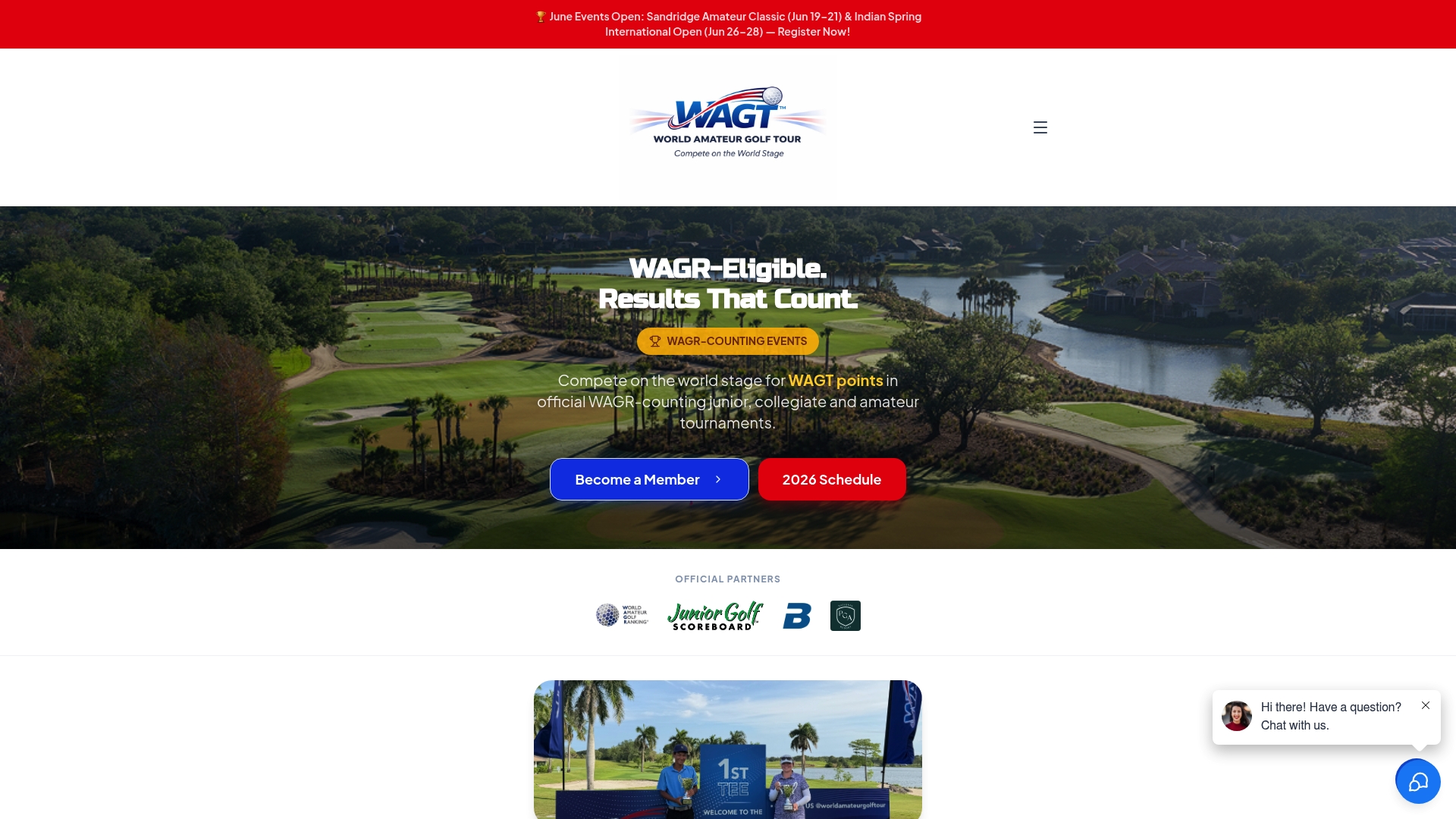
Every event on the Worldamateurgolftour schedule is professionally run, held at championship-caliber venues, and designed to deliver the kind of competitive experience that prepares you for the next level. You earn real WAGR ranking points, compete in structured stroke play formats, and join a community of serious players who share your goals. Explore the full schedule, review membership options, and register for your next event at worldamateurgolftour.com. Your ranking starts with the events you choose.
FAQ
What is the most important factor when comparing amateur golf tours?
WAGR eligibility is the primary factor. Only tours that offer recognized counting events can contribute ranking points, which directly affect college recruitment, tournament exemptions, and competitive visibility.
How difficult is it to qualify for elite amateur championships?
U.S. Amateur qualifying is highly competitive, with local qualifying advancement rates between 8% and 12% and final qualifying rates as low as 2.5%. Field sizes of 78 to 130 players per site make site selection a critical strategic decision.
Do all amateur golf tours offer WAGR ranking points?
No. Most casual, social, and regional tours do not offer WAGR-counting events. Only tours that meet The R&A and USGA standards for recognized events can contribute points to a player's global amateur ranking.
What makes a well-run amateur golf tournament?
Professional scoring, structured tee times, championship venues, and organized social events are the hallmarks of quality amateur events. These operational details reduce result randomness and create a major-like experience that motivates serious competitors.
How do I choose between a national tour and a regional amateur league?
Choose a national WAGR-counting tour if ranking progression and college recruitment are your priorities. Use regional leagues to build competitive volume and stay match-ready between major events.