

Amateur golfer competitive peak scheduling is the practice of structuring your training, tournament selection, and recovery periods to align with your strongest performance windows and highest-priority events. Most amateur golfers train inconsistently and enter too many events, which spreads their energy thin and produces mediocre results across the board. The players who improve fastest do the opposite. They build a deliberate calendar around the North American peak season, use periodization principles borrowed from elite sport, and protect their mental freshness as carefully as their swing mechanics. This guide gives you the exact framework to do the same.
How to design an effective amateur golfer training schedule
The single most effective training structure for competitive amateurs is 3–4 focused sessions per week, each lasting 30–60 minutes. Practice quality drops sharply after 45 minutes because attention limits kick in. That means three sharp, focused sessions beat one three-hour grind every time.
Session content matters as much as frequency. Research shows that allocating 50% of practice time to short game produces faster scoring improvement than full-swing focus. This makes sense when you consider that 60% of golf shots happen within 100 yards. Most amateurs do the opposite, spending the majority of their range time hitting drivers.
A proven practice split looks like this:
- Short game (50%): Chipping, pitching, bunker play, and putting from inside 100 yards
- Irons (30%): Mid-iron consistency, trajectory control, and approach shot shaping
- Woods and driver (20%): Tee shot accuracy and distance management
Each session needs a measurable success criterion. "Hit 20 chip shots and get 15 within three feet" is a goal. "Work on chipping" is not. Measurable session objectives drive faster skill retention than open-ended hitting, because your brain stays engaged when it tracks progress against a specific target.
Pro Tip: Set one concrete goal before every session. Write it on your phone or a scorecard. If you hit the target, the session is a success. If you miss it, you know exactly what to address next time.
Three focused sessions per week with this structure produces measurable handicap improvement within 8–12 weeks. That timeline matters for scheduling, because you want your sharpest form to arrive at your key summer events, not in april when the season has barely started.

When is the peak competitive season for amateur golfers?
The North American peak competitive season runs from early june to mid-august, anchored by major events like the U.S. Amateur Championship and a full calendar of World Amateur Golf Ranking (WAGR) sanctioned tournaments. This window is when the best amateur fields assemble, the courses are at their most demanding, and WAGR points carry the most weight for collegiate and professional pathways.
The critical mistake most competitive amateurs make is treating the entire summer as open season for entering events. Elite amateurs limit their tournament volume to 3–5 top WAGR or state-level events per summer. That focus preserves energy and keeps competitive sharpness high for the events that matter most.
Here is a practical approach to building your peak season tournament calendar:
- Identify your two anchor events. These are your highest-priority tournaments. Everything else in your schedule supports preparation for these two.
- Add two to three secondary events. These serve as tune-ups and confidence builders in the four to six weeks before your anchor events.
- Schedule off-weeks deliberately. Plan at least one full week with zero competition between major events. Mental recovery during off-weeks makes the next performance block sharper.
- Cut anything that does not serve your anchor events. If a tournament falls too close to a key event or requires travel that disrupts your routine, skip it.
- Lock the calendar in may. Committing to your schedule before the season starts removes the temptation to add events impulsively when you are playing well.
"The goal is not to play your best golf every week. The goal is to play your best golf at the right week."
Scheduling your summer amateur events around this framework gives you a clear competitive structure rather than a reactive one.
What are the qualification requirements for major amateur tournaments?
Most major regional amateur events require a handicap of 5.0 or better for entry. That threshold exists because these events use 36-hole stroke play qualifying rounds to determine who advances into match-play brackets, which are typically limited to 32 competitors. Consistent stroke play under pressure is the entry ticket.
Understanding the format shapes how you prepare. Stroke play qualifying rewards ball striking, course management, and avoiding big numbers. Match play rewards aggression, momentum management, and the ability to reset after a bad hole. Your practice and mental preparation need to address both.
The mental side of qualifying is where most amateurs lose ground they should not lose. Common psychological pitfalls include:
- Swing tinkering during competition. Trying to fix mechanics mid-round destroys trust and consistency. Peak competitive phases demand that you play the swing you have, not the swing you want.
- Scoreboard watching. Tracking where you stand relative to the cut line pulls focus away from the shot in front of you.
- Over-analyzing course conditions. Amateurs who obsess over wind, pin positions, and yardages often freeze over the ball. Pick a target, commit, and swing.
Pro Tip: Build a pre-shot routine that takes the same amount of time on every shot, regardless of pressure. Routine creates rhythm, and rhythm creates trust. Practice the routine as deliberately as you practice your swing.
Reviewing the entry requirements and handicap criteria for your target events well before the season starts gives you a clear performance benchmark to train toward.
How to balance practice, competition, and recovery for peak performance
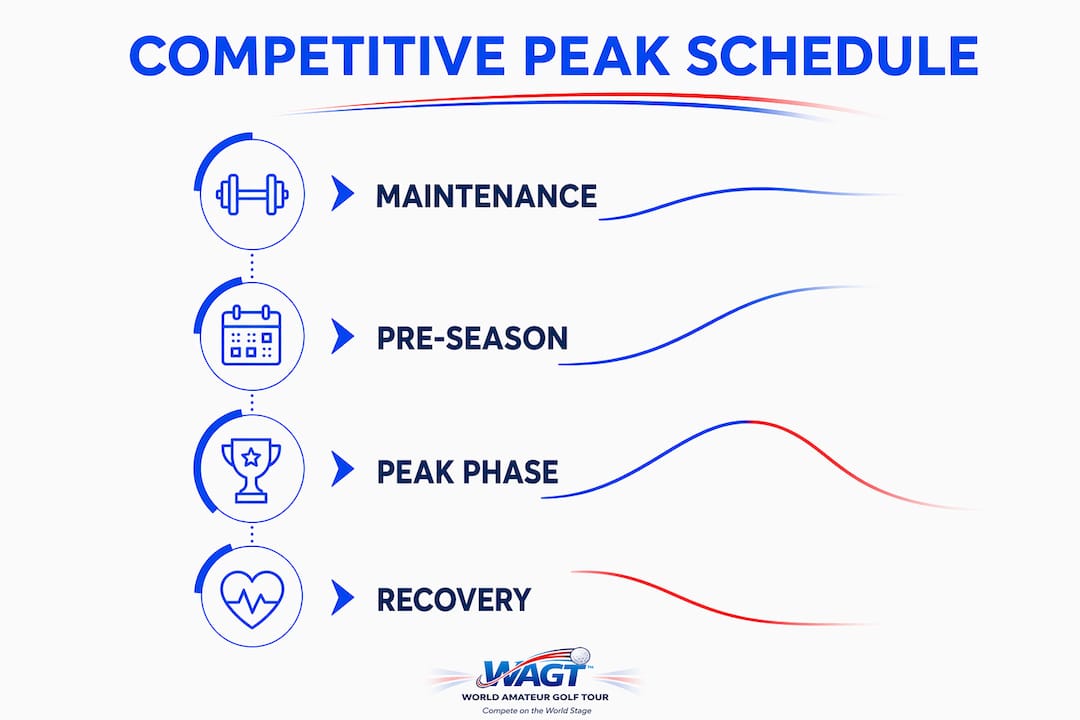
Periodization is the industry term for dividing your training year into distinct phases, each with a different objective. Professional athletes in every sport use it. The concept applies directly to competitive golf for amateurs.
Your annual schedule breaks into two primary phases:
Maintenance phase (september through may): This is when you build and refine skills. Session volume is higher, swing changes are acceptable, and you can experiment with technique. Practice sessions run 45–60 minutes. Tournament play is light, focused on staying sharp rather than peaking.
Peak competitive phase (june through august): This is when you trust what you have built. Swing changes during peak phases consistently produce worse results for amateurs. Session volume drops to two or three 30-minute sessions per week. The focus shifts to course strategy, mental rehearsal, and shot execution.
The table below shows how each phase differs in practice structure:
| Phase | Sessions per week | Session length | Primary focus |
|---|---|---|---|
| Maintenance | 3–4 | 45–60 minutes | Skill building, technique refinement |
| Peak competitive | 2–3 | 30 minutes | Course strategy, mental rehearsal, short game |
| Off-week (recovery) | 0–1 | 20 minutes max | Light putting or chipping only |
Recovery weeks are not optional. Cutting tournament volume and building in off-weeks preserves competitive sharpness for high-stakes events. Schedules of 15–20 events per year consistently outperform high-volume plans of 35–40 events. That is a significant difference, and it runs counter to the instinct most competitive amateurs have.
Mental rehearsal belongs in your peak phase practice. Before each key event, spend 10 minutes visualizing specific shots on the course you will play. Picture the tee shot on the hardest hole. See the ball flight. Feel the swing. This is not mysticism. It is preparation. You can also review your golf event schedule to map out the exact holes and formats you will face.
Physical recovery during the peak season means prioritizing sleep, managing travel fatigue, and incorporating rest and recovery practices that keep your body ready to perform across multiple rounds. A tired body produces a tense swing, and a tense swing produces high scores.
Key Takeaways
Successful amateur peak scheduling requires fewer tournaments, shorter practice sessions, and deliberate recovery periods timed around your highest-priority summer events.
| Point | Details |
|---|---|
| Practice frequency and length | Schedule 3–4 sessions weekly at 30–60 minutes each; quality drops after 45 minutes. |
| Short game priority | Allocate 50% of practice time to shots inside 100 yards for the fastest scoring gains. |
| Peak season timing | The North American competitive window runs from early june to mid-august; target 3–5 key events. |
| Tournament volume | Schedules of 15–20 events outperform 35–40 event plans; fewer events preserve sharpness. |
| Peak phase mindset | Stop making swing changes during competition; trust your skills and focus on course strategy. |
What I have learned about peak scheduling that most guides miss
I have watched a lot of competitive amateurs make the same mistake year after year. They play well in a local event in may, feel momentum building, and immediately add three more tournaments to their summer calendar. By the time their anchor event arrives in july, they are mentally flat and physically worn down. They wonder why their game fell apart. The schedule did it.
The counterintuitive truth is that playing less during the peak season makes you better. Two or three focused 30-minute sessions per week, combined with deliberate off-weeks, keeps your mind sharp and your swing repeatable. The periodization approach that elite athletes use in track, swimming, and tennis applies directly to golf. You build in the off-season. You trust in the peak season.
The other thing most guides miss is the difference between a measurable practice goal and a vague intention. Amateurs who write down one specific target before every session improve faster than those who just "put in the time." The brain needs a target to stay engaged. Without one, you are just hitting balls.
My strongest advice is this: commit to your anchor events before the season starts, protect your off-weeks like they are tee times you cannot cancel, and resist the urge to tinker with your swing when you are in the middle of a competitive stretch. The players who peak at the right moment are almost always the ones who planned for it.
— Gene
Worldamateurgolftour and your competitive calendar
Putting a peak scheduling plan into action requires access to the right events at the right times.

Worldamateurgolftour provides WAGR-sanctioned tournaments across Florida and beyond, giving junior, collegiate, and amateur golfers access to professionally run events that count toward World Amateur Golf Ranking status. The tour's structured event calendar makes it straightforward to identify which tournaments fit your peak season window and which serve as tune-up events. You can register for WAGR events and build your competitive calendar around championship-caliber courses that test every part of your game. If you are serious about peaking at the right moment, starting with the right events is the first real step.
FAQ
How many practice sessions per week should an amateur golfer do?
Three to four focused sessions per week, each lasting 30–60 minutes, produces the best results. Practice quality declines after 45 minutes, so shorter and more frequent sessions outperform long, unfocused ones.
When is the best time for amateur golfers to compete?
The North American peak competitive season runs from early june to mid-august. This window aligns with major WAGR-sanctioned events and the strongest amateur fields.
How many tournaments should an amateur golfer enter per summer?
Elite amateurs target 3–5 high-level events per summer. Schedules of 15–20 events per year consistently outperform high-volume plans, because fewer events preserve mental sharpness and physical energy for the tournaments that matter most.
What handicap do you need for major amateur tournaments?
Most major regional amateur events require a handicap of 5.0 or better. Qualification typically involves 36-hole stroke play rounds that determine who advances into a match-play bracket of 32 competitors.
Should you change your swing during a peak competitive phase?
No. Attempting swing changes during peak competitive phases consistently produces worse results. The peak phase is for trusting your existing skills, focusing on course strategy, and executing the shots you have already rehearsed.