

A golf event schedule is the official week-at-a-glance plan that maps every activity during a tournament, from early practice rounds through the final competition day, including tee times, pro-am events, and gate opening windows. Understanding this framework is what separates a prepared participant or spectator from someone who misses the marquee groups entirely. The PGA Tour's Players Championship and the Memorial Tournament both demonstrate how a golf event schedule explained in full reveals far more structure than a simple start time. For junior and amateur golfers working toward WAGR status, reading these schedules accurately is a competitive skill in itself.
What is a golf event schedule explained day by day?
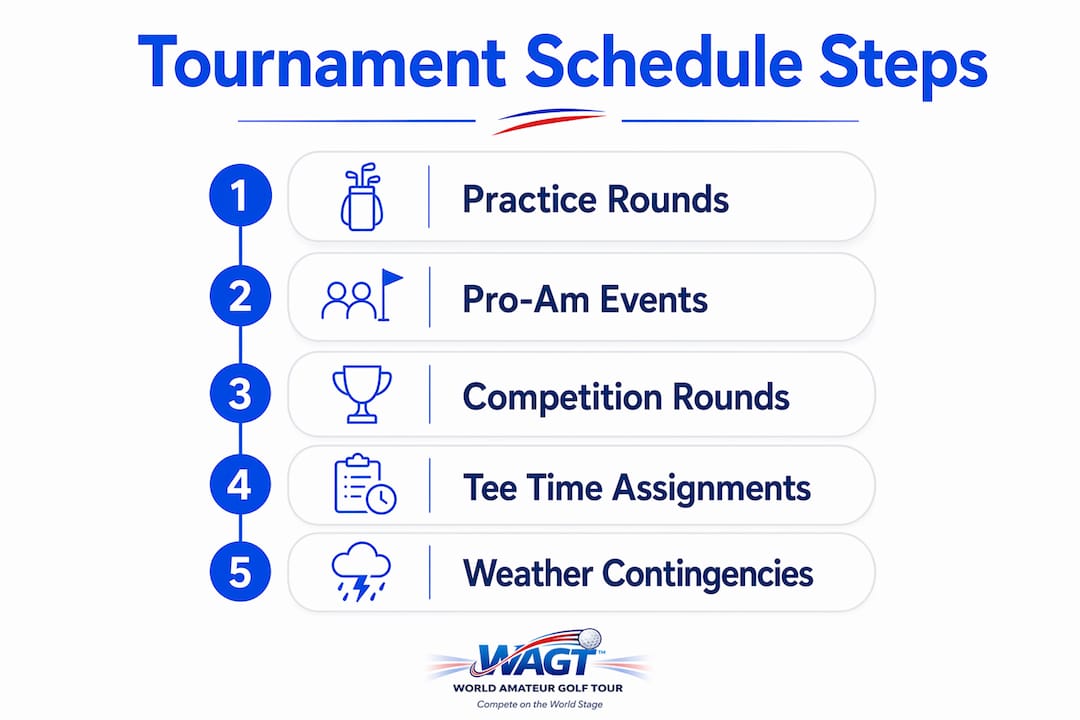
A golf event schedule is built around five distinct activity types: practice rounds, pro-am and honoree events, competition rounds, non-competition programming, and contingency windows. Each type occupies a specific slot in the tournament week and carries different access rules for fans and participants.
Practice rounds typically run Monday through Wednesday before the competitive rounds begin Thursday. These sessions are lower-stakes but strategically important. Players use them to map the course, test pin positions, and calibrate distances. Gate opening times for practice days are often later than tournament days. The 2026 Memorial Tournament, for example, opened gates at 8 a.m. for early practice rounds compared to 7 a.m. or earlier on competition days.

Pro-am and honoree events typically land midweek, often Wednesday. These events pair professionals with amateur partners or corporate sponsors and serve a dual purpose: fundraising and entertainment. They are scheduled events in their own right, not informal warmups, and they appear explicitly on the official tournament calendar.
Competition rounds run Thursday through Sunday in standard stroke-play events. The schedule also includes non-competition programming that enriches the week. The 2026 Memorial Tournament featured a Family Night and Tournament Tailgate on specific days, giving fans reasons to attend beyond watching competitive golf.
Here is a typical tournament week breakdown:
- Monday/Tuesday: Course setup, player arrivals, early practice rounds
- Wednesday: Pro-am or honoree event, final practice rounds
- Thursday/Friday: Rounds 1 and 2, the 36-hole cut window
- Saturday: Round 3, post-cut field only
- Sunday: Final round, trophy presentation
Pro Tip: Check the official tournament site each morning rather than relying on the published week-at-a-glance. Exact tee times and groupings are confirmed daily, not locked in at the start of the week.
How are tee times and groupings determined in golf tournaments?
Tee time assignment follows a structured logic that most fans never see. For the first two rounds, the PGA Tour places players into performance-based buckets. These buckets reflect status categories including recent major winners, career money leaders, and FedEx Cup ranking. Players in the top bucket receive preferred tee times, often in the afternoon wave when course conditions are most visible to broadcast audiences.
The mechanics of a two-tee start are worth understanding in detail. Rather than sending all groups off hole 1 in sequence, organizers split the field between holes 1 and 10 simultaneously. This cuts the time needed to complete a full round nearly in half. Groups receive either a morning or afternoon tee time, and they alternate starting holes. A group that starts on hole 1 in round one may start on hole 10 in round two.
Here is how early-round and weekend-round scheduling differ:
| Factor | Rounds 1 and 2 | Rounds 3 and 4 |
|---|---|---|
| Grouping basis | Status buckets and prior performance | Cumulative score after the cut |
| Starting holes | Two-tee start, holes 1 and 10 | Single tee or two-tee depending on field size |
| Pairing logic | Mixed status groups for broadcast appeal | Score-based, leaders tee off last |
| Tee time flexibility | Set before the week begins | Recalculated after round 2 scores finalize |
After the 36-hole cut on Friday, the entire schedule resets. Players who make the cut are re-paired by score, with the leaders assigned the latest tee times on Saturday and Sunday. This is why weekend golf feels different to watch. The best players tee off last, building tension as the leaderboard fills in from early finishers.
- Identify the player's status bucket before the tournament starts
- Note whether the event uses a two-tee start or single-tee format
- Track the cut line Thursday evening to anticipate Saturday pairings
- Check the updated tee sheet Friday night for weekend groupings
- Confirm starting holes for your target groups before arriving Saturday
Pro Tip: If you want to watch the leaders on the weekend, plan to arrive at least 90 minutes before the final group's tee time. The course fills quickly once the leaderboard tightens.
What contingency factors affect a golf event schedule?
Weather is the single biggest disruptor of any tournament schedule. A 1 hour 40 minute delay occurred during the third round of the 2026 Memorial Tournament, pushing tee times back and compressing the broadcast window. That kind of delay cascades through the entire day's schedule, affecting not just players but also parking operations, concession staffing, and television coverage.
Tournament organizers build contingency timing into every schedule. This means buffer windows between rounds, flexible gate opening procedures, and pre-approved protocols for suspending and resuming play. The goal is to complete each round within the same calendar day whenever possible, since carrying rounds over to the next morning disrupts the entire week's structure.
Several factors beyond weather can shift a schedule:
- Lightning protocols: Play suspends immediately when lightning is detected within a defined radius, often 6 miles
- Tee availability: Course maintenance or damage can restrict which holes are playable at any given time
- Broadcast commitments: Network windows are contractual, so organizers try to align final groups with prime viewing hours
- Player medical situations: Withdrawals and injuries can alter groupings and tee time sequences mid-round
The two-tee start format exists partly as a contingency tool. By splitting the field across holes 1 and 10, organizers create a faster round completion window, which gives them more recovery time if a delay occurs earlier in the day. For fans and participants, the practical takeaway is to treat the published schedule as a starting point and check for updates throughout the day.
How to read a golf event schedule as a spectator or participant
Reading a tournament schedule accurately requires understanding what each entry actually means for your day. The schedule is not just a list of times. It is a map of access, movement, and opportunity.
Start with the ticket type. Practice round tickets are separate from weekly patron passes, and each grants access to different days and activities. At the 2026 Memorial Tournament, single-day practice tickets cost $20 while weekly passes ran $336. Knowing which days your ticket covers determines which schedule entries are relevant to you.
Next, identify the tee time windows for the groups you want to follow. The daily tee-time release from the tournament's official source is the most accurate document available. Published schedules show approximate windows, but the morning release confirms exact times and pairings. Build your day around that document, not the week-at-a-glance.
Here is a practical approach to planning your tournament day:
- Download or bookmark the official tournament app or website
- Check the morning tee-time release before leaving for the course
- Identify whether your target groups start on hole 1 or hole 10
- Map a walking route that intercepts those groups at high-visibility holes
- Build in 20 minutes of buffer for parking, bag check, and gate entry
- Revisit the leaderboard at the turn to adjust your afternoon route
For participants in amateur events, the same logic applies. Knowing your tee time, starting hole, and grouping in advance lets you warm up properly and arrive at the correct location without stress. Reviewing tournament formats before your event also clarifies how the schedule structure connects to scoring and round progression.
Pro Tip: In a two-tee start event, groups finishing on hole 9 and hole 18 converge near the clubhouse at similar times. Position yourself near the 18th green in the final hour to catch multiple groups completing their rounds.
Key takeaways
A golf event schedule is a dynamic, score-driven document that reshapes itself after every round, not a fixed timetable set at the start of the week.
| Point | Details |
|---|---|
| Schedule structure | Tournament weeks include practice rounds, pro-am events, competition rounds, and contingency windows. |
| Tee time logic | Early rounds use status buckets; weekend rounds reassign tee times by cumulative score after the cut. |
| Two-tee starts | Groups alternate between holes 1 and 10, so always confirm your target group's starting hole. |
| Weather contingency | Delays like the 2026 Memorial's 100-minute stoppage can shift the entire day's schedule. |
| Daily updates | Exact tee times are confirmed each morning. Check official sources, not the week-at-a-glance. |
Why schedules reward the golfer who pays attention
I have watched a lot of golfers, both amateurs and serious juniors, arrive at tournaments with a vague sense of when things start and leave frustrated because they missed the groups they came to see. The schedule was always there. They just did not read it closely enough.
The most underrated skill in tournament attendance is understanding the cut. Once you know that weekend pairings are built entirely around Friday's scoring position, you stop treating Saturday as a continuation of Thursday. It is a different event with a different cast. The leaders you want to follow are now grouped together and teeing off last. Plan for that, and your Saturday experience improves dramatically.
For junior and amateur players, I think schedule literacy is even more important. Knowing your tee time, your starting hole, and how your grouping was determined gives you a mental edge before you hit a single shot. It also tells you something about where you stand in the field, since status-based groupings reflect performance history. That context matters when you are trying to build toward WAGR points and collegiate visibility.
Weather flexibility is the other piece most people underestimate. Treat the schedule as a framework, not a contract. Build your day with a 90-minute buffer and you will almost never be caught off guard. The golfers and fans who get frustrated at delays are the ones who planned too tightly.
— Gene
Compete on a schedule built for serious amateurs
If you are ready to move beyond watching and start competing on a structured, professionally managed schedule, Worldamateurgolftour offers exactly that.

Worldamateurgolftour runs WAGR-certified amateur events with clear schedules, fair groupings, and championship-caliber venues. Every event is organized with the same attention to tee times, round structure, and player experience that you would expect from a top-tier tour. You can review upcoming amateur events and plan your competitive season around a calendar built for junior, collegiate, and elite amateur golfers. For players building toward collegiate or professional opportunities, competing on a well-structured tour is not optional. It is the pathway. Check the schedule, register early, and put your game on the line where it counts.
FAQ
What does a golf event schedule include?
A golf event schedule covers practice rounds, pro-am events, competition rounds, gate opening times, and contingency windows. Exact tee times and groupings are confirmed daily rather than fixed from the start of the week.
How are tee times assigned in professional golf tournaments?
For the first two rounds, tee times are assigned based on PGA Tour status buckets that reflect recent performance and career earnings. After the 36-hole cut, tee times for the weekend are recalculated by cumulative score, with leaders teeing off last.
What is a two-tee start in golf?
A two-tee start sends groups off both hole 1 and hole 10 simultaneously to complete the round faster. Spectators should confirm which starting hole their target group uses before planning their viewing route.
How do weather delays affect a golf tournament schedule?
Weather delays push tee times back and can compress or extend the broadcast window. The 2026 Memorial Tournament experienced a delay of 1 hour and 40 minutes during round three, illustrating why organizers build contingency timing into every schedule.
What is the difference between a practice round ticket and a tournament ticket?
Practice round tickets grant access only on designated early-week days, while weekly patron passes cover all competition rounds. At the 2026 Memorial Tournament, single-day practice tickets cost $20 compared to $336 for a full weekly pass.