

You get a call, an email, or a formal letter. You've been invited to play. That's the moment a golf invitational event becomes something different from any other tournament you've entered. Unlike open competitions where qualifying scores or entry fees get you in the door, understanding what is a golf invitational event means recognizing that access is earned through reputation, rankings, or a selector's deliberate choice. This guide breaks down exactly how these events work, what they look like at the junior and amateur level, how they compare to open formats, and what you need to do to put yourself in position for one.
Table of Contents
- Key takeaways
- What is a golf invitational event, exactly
- Notable invitationals and what makes them special
- Open events vs. invitationals and other tournament types
- How to participate in or host a golf invitational
- My perspective on what makes invitationals genuinely different
- Find your path to competitive golf
- FAQ
Key takeaways
| Point | Details |
|---|---|
| Invitation only access | Entry depends on rankings, past performance, or a selection committee, not a qualifying score or open registration. |
| Smaller, elite fields | Invitational events deliberately limit field size to maintain high competition quality and focused play environments. |
| Real development opportunities | Junior invitationals like Sage Valley have produced professional stars, making them genuine career milestones. |
| Restricted spectator access | Many top invitationals limit on-site attendance to players and immediate family, creating a focused atmosphere. |
| Pathways exist for amateurs | Building your ranking and competitive record through tours like Worldamateurgolftour is one of the clearest routes to earning invitations. |
What is a golf invitational event, exactly
At its core, an invitational is a competition where only invited competitors may participate. That single distinction separates every invitational from every open event. You cannot simply register. Someone with authority over the field, whether that's a tournament director, a selection committee, or an automated ranking system, chooses who competes.
The invite-only format shapes everything else about these events. Field sizes stay small and deliberate. The competitive level stays high because every player in the field earned their spot. The atmosphere shifts from a crowded qualifying circus to something more focused and purposeful.
Here's what specifically sets invitationals apart from other golf tournament types:
- Invitation-only entry: No open registration. Players receive a formal invitation based on criteria the tournament sets in advance.
- Selection criteria: Most invitationals use world rankings, national amateur standings, past tournament results, or direct selection by a committee. Some combine several of these methods.
- Limited field size: Fields are deliberately kept small. This is not a logistical accident. It's a feature that protects the quality and exclusivity of the event.
- Controlled access: On-site attendance at junior invitationals is often restricted to players and immediate family only, keeping the environment focused on competition rather than spectacle.
- Tournament duration: Most invitationals run 54 to 72 holes over multiple days, giving the format enough depth to separate the best players.
Pro Tip: If you are a parent, plan early for travel and lodging once your junior receives an invitation. Access restrictions at top events mean your role on-site may be limited, so understanding the specific event's guest policy before you arrive prevents frustration.
Notable invitationals and what makes them special
The Junior Invitational at Sage Valley is the clearest example of what a top-tier junior invitational looks like in practice. It's a 72-hole stroke play event for players aged 18 and under, with a field of 36 boys and 24 girls. Every player in that field earned their invitation based on world junior rankings and outstanding competitive records.
What makes Sage Valley stand out beyond the format is what it has produced. Many alumni of the event have gone on to professional success, including Scottie Scheffler and Joaquín Niemann. For a junior golfer, standing in that field means standing alongside the next generation of professionals.
| Event | Format | Field | Invite Basis |
|---|---|---|---|
| Junior Invitational at Sage Valley | 72-hole stroke play | 36 boys, 24 girls (U18) | World junior rankings and selectors |
| PGA Tour Signature Events | 72-hole stroke play | Limited field | FedExCup standings and past winners |
| USGA Amateur Invitational | Stroke or match play | Selected | Handicap index and competitive record |
| Club-level invitationals | 18 or 36 holes | 40 to 100 players | Club membership and direct invitation |
At the professional level, the PGA Tour's Signature Events operate with eligibility rules based on FedExCup standings and tournament wins. They function exactly like invitationals. Limited fields, curated eligibility, higher prize funds. The Tour designed them specifically to gather the best players at the same events, raising the competitive standard and the television appeal simultaneously.
"The value of an invitational is not just who wins. It's who shows up. When every player in the field belongs there, competition sharpens every single round."
That dynamic benefits junior golfers enormously. When you compete against players who are all serious contenders, you get a clearer picture of where you actually stand and what you need to improve.
Open events vs. invitationals and other tournament types
Most golfers start their competitive lives in open events, and that's the right path. Open amateur events allow any qualifying player to register and compete. They're accessible by design, and they serve a critical role in player development and competitive exposure. But they're a fundamentally different experience from invitationals.

The clearest explanation of how invitationals differ from open events comes down to entry method and field openness. Opens cast a wide net. Invitationals draw a short list.
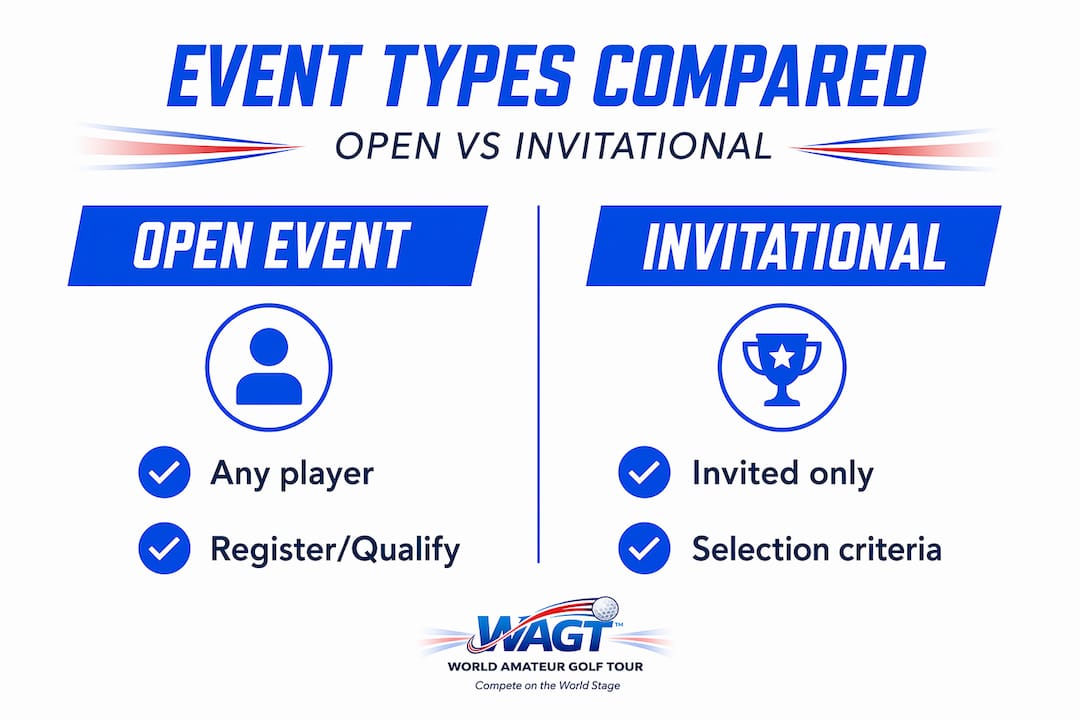
| Feature | Open Event | Invitational Event |
|---|---|---|
| Entry method | Qualify or register | Receive a formal invitation |
| Field size | Large, sometimes hundreds | Small and deliberately limited |
| Prestige | Variable | Generally high |
| Accessibility | Open to all eligible players | Restricted to invited players |
| Development focus | Broad exposure | Elite competitive sharpening |
Beyond open events and invitationals, golf tournament types span a range of competitive formats: stroke play, match play, scramble, Stableford, and team events. Invitationals most commonly use stroke play because it rewards consistency over an entire field, which is exactly the point of gathering elite competitors.
For junior players and amateurs aiming higher, this distinction matters practically. Open events build your competitive record. That record is what earns you an invitation. The two formats are not rivals. They are sequential steps on the same development path.
How to participate in or host a golf invitational
Getting yourself invited
Your ranking is your application. Invitationals use eligibility criteria like world rankings, past tournament success, or selection committees to build their fields. There is no shortcut past consistent performance, but there are clear actions you can take:
- Compete in WAGR-counting events. World Amateur Golf Ranking points are a direct currency for invitational eligibility. Every event where you can earn WAGR points is an opportunity to move up the ranking that selectors are watching.
- Build a consistent competitive record. A single strong finish rarely triggers an invitation. Selectors look for players who perform well repeatedly, across different courses and conditions.
- Register with recognized amateur tours. Being part of an organized tour keeps you on the radar of tournament directors and selectors who staff the invitation lists.
- Target age-appropriate events. Junior invitationals have specific age cutoffs, so planning your competitive calendar around the right windows matters.
- Ask your coach or academy director. Some invitationals accept nominations or recommendations from coaches and junior golf organizations, which is a legitimate pathway not every player knows about.
Pro Tip: Parents, track your junior's results in a simple spreadsheet by date, event, course, and score. When an invitation inquiry arrives, you want a clear record of their competitive history ready to share.
Hosting your own invitational
Hosting a golf invitational requires a clear invitation process and a managed field to preserve competition quality. The event's credibility rests entirely on who gets invited and why. Here are the steps that define a well-run invitational:
First, set your selection criteria before you send a single invitation. Rankings, handicap index, past performance, or committee selection all work. What matters is consistency and transparency. Second, lock in your venue early. Invitationals carry a prestige expectation, so course preparation should match the quality of the field you're assembling. Third, communicate access policies clearly, especially if you're limiting spectators. Parents attending junior invitationals need to know what to expect well in advance.
My perspective on what makes invitationals genuinely different
I've watched a lot of junior golf, and I'll tell you what I've learned: the format of an event matters less than the environment it creates. What I find genuinely impressive about a well-run invitational is the silence, and I mean that literally. When you remove the casual spectators, the crowded leaderboards, and the open-field noise, something shifts in the way players carry themselves on the course.
In my experience, juniors who compete in their first invitational often describe the atmosphere as more serious without being more tense. That's a precise distinction worth paying attention to. Invitation-only formats tend to produce more focused competition and measurably better development than open events of the same distance. I think the reason is simple: every player in the field knows every other player belongs there. That mutual respect raises the standard.
The misconception I hear most from parents is that invitationals are just a status symbol, a trophy for the invitation itself. That's wrong. The best ones are developmental tools. They put your junior in a setting where the competition exposes weaknesses that a larger, more varied open field simply cannot. You learn more about your game in 72 holes against 59 elite peers than you do in 36 holes against 200 players of mixed ability.
What truly differentiates a top-tier invitational beyond the entry method is the intentionality behind every decision: who's in the field, where it's played, and how access is managed. Those decisions signal how seriously the organizers take the players they've invited.
— Gene
Find your path to competitive golf
If you're a junior player or an amateur golfer serious about earning invitations to elite events, your ranking and competitive record are the foundation. Worldamateurgolftour runs WAGR-certified tournaments that directly build the rankings selectors use when they assemble invitational fields. Every event on the tour is professionally managed at championship-caliber courses, and every result counts toward your global standing.

Start building the record that gets you invited. Browse the current tournament schedule and register at Worldamateurgolftour to find WAGR-counting events near you. For junior golfers focused on college recruitment alongside competitive development, GoD1Golf offers performance and recruiting support that works alongside your tournament schedule. Pair elite event experience with smart event planning tools and you're building something real, not just playing weekend golf.
FAQ
What is a golf invitational event in simple terms?
A golf invitational event is a competition where only players who receive a formal invitation may participate, based on rankings, past results, or selection by a committee. Entry is not open to the general public or any qualifying player.
How do players get invited to a golf invitational?
Most golf invitationals use world rankings, past tournament performance, or a selection committee to determine who receives an invitation. Building a strong competitive record in WAGR-counting events is one of the most direct routes to earning one.
What is the difference between an invitational and an open golf event?
The key difference is entry method. Open events allow any eligible player to register or qualify, while invitationals select their fields from a specific list of invited competitors, keeping the field smaller and the competition level higher.
Can junior golfers compete in invitational events?
Yes. Events like the Junior Invitational at Sage Valley are specifically designed for players aged 18 and under, with separate boys' and girls' fields. Junior invitationals are among the most prestigious and developmental events in the sport.
How do I host a golf invitational event?
Start by defining your selection criteria, locking in a quality venue, and setting a limited field size. A clear invitation process and transparent eligibility standards are what separate a credible invitational from a regular tournament with a different name.