

Amateur golf tournaments are structured competitive events open to non-professional players of all skill levels, and they deliver measurable benefits in health, community, and personal growth that casual rounds simply cannot replicate. The reasons to play amateur golf tournaments go far beyond chasing a trophy. From the World Am's 72-hole championship format to USGA-sanctioned events and emerging platforms like the Grass League, organized competition gives you a framework that sharpens your game, connects you with serious players, and keeps you coming back to the course with purpose.
Why play amateur golf tournaments: the core case
The most compelling argument for tournament play is that it changes how you show up. Casual rounds invite distraction. Tournament rounds demand focus, course management, and emotional control under real pressure. That shift in mindset produces growth that no amount of range time can replicate.
Amateur golf tournaments are defined by their use of the World Handicap System, structured formats, and official scoring. They are not reserved for scratch players. Events like the World Am use handicap-based flighting to group competitors by ability, age, and gender, so a 15-handicapper competes against other 15-handicappers, not against a field of near-professionals. That structure is what makes tournament golf accessible and genuinely competitive at every level.
The amateur golf competition advantages are concrete. You post official scores, stabilize your handicap, and build a competitive record. For junior golfers pursuing collegiate or professional pathways, that record matters enormously. For recreational players, it provides a benchmark and a reason to prepare.
What health benefits come from playing tournament golf?
Golf is one of the few sports where the physical and mental health benefits are well-documented across age groups. Golfers live approximately five years longer than non-golfers on average and can burn up to 2,000 calories in a single 18-hole round. That statistic reflects the reality of walking 4 to 5 miles per round while carrying a bag and managing the mental load of competitive play.

Tournaments amplify these benefits because they create structure. You play more rounds, more consistently, when you have events on the calendar. Regular play means regular physical activity, which directly supports cardiovascular health, balance, and muscular endurance. The R&A's Golf and Health reporting identifies chronic disease prevention as one of golf's most significant public health contributions.
The mental health dimension is equally strong. Social interaction during golf is a documented protective factor against depression and cognitive decline. Tournaments concentrate that social benefit. You spend four to five hours per round with playing partners, share meals at the 19th hole, and build relationships that extend well beyond the course.
"Golf clubs that frame membership as an investment in health and wellbeing, not just playing conditions, see stronger retention and broader community engagement." — The R&A / GCMA
Pro Tip: Track your steps and calories during tournament rounds using a GPS watch like Garmin or Apple Watch. Seeing the physical output reinforces the health value and motivates consistent play.
How do tournaments create fair competition for all skill levels?
The World Handicap System calculates your Handicap Index using the best 8 of your last 20 score differentials, with a minimum of three posted rounds required to establish an index. This method produces a reliable, portable measure of your ability that follows you into any sanctioned event worldwide. The more rounds you post, the more stable and accurate your index becomes.
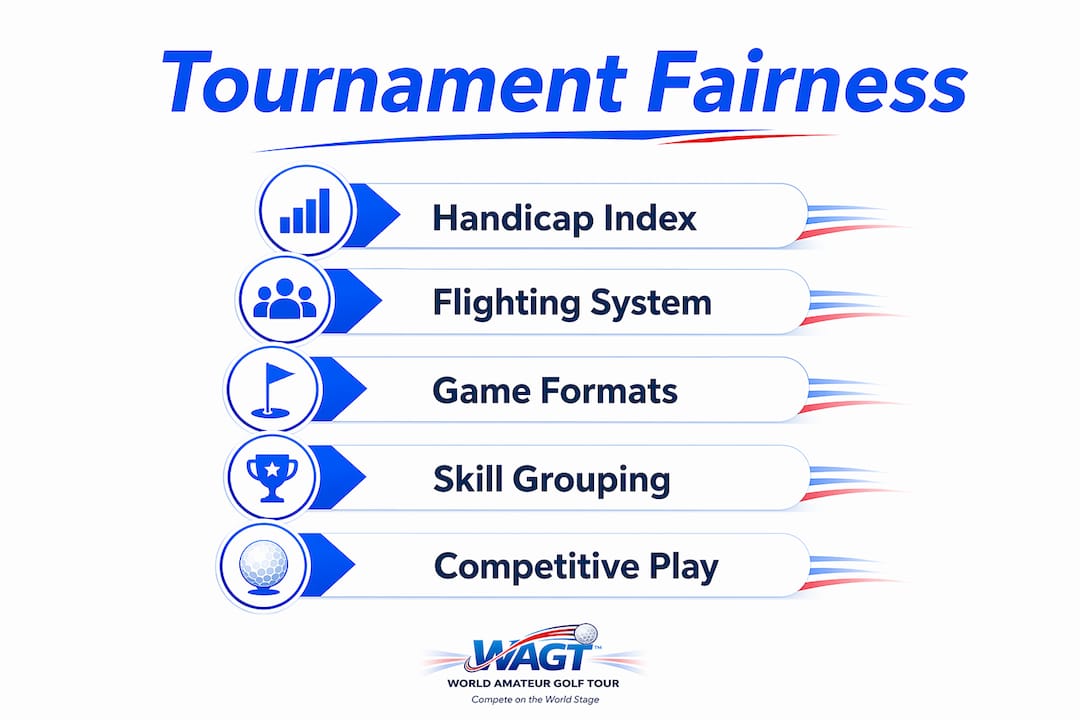
Flighting systems build on that foundation. The World Am, for example, organizes its field into flights by handicap range, age bracket, and gender. A player in the 10 to 14 handicap flight competes only against players in that same range across the same courses. This is not just a courtesy to higher-handicap players. It is a deliberate design that makes the competition genuinely meaningful for every participant.
| Format | Structure | Best for |
|---|---|---|
| Stroke play | Total strokes over 18 or 54 holes | Competitive players building a scoring record |
| Better ball | Best score of two partners per hole | Pairs who want shared pressure and team strategy |
| Scramble | Both players hit, best shot selected | Social events and players new to tournament formats |
| Two-player scramble | Grass League style, drafted teams | Players seeking team dynamics with competitive stakes |
The USGA's U.S. Amateur Championship sits at the elite end of the spectrum, requiring a Handicap Index not exceeding 2.4 and drawing a record 8,253 entries in 2023. That event is not where most amateur golfers start. But it illustrates the range available. From local club events to multi-day national championships, there is a tournament calibrated to your current level.
Pro Tip: Before registering for any event, post at least five to seven recent rounds to stabilize your Handicap Index. A volatile index can place you in the wrong flight, which hurts both your experience and your competitive standing.
What social and community opportunities do tournaments offer?
The amateur golf tournament experience is as much about who you meet as what you shoot. Multi-day events like the World Am are built around community. The 19th Hole gatherings after each round are not optional extras. They are core to the event's identity, giving players a shared space to debrief, celebrate, and connect across flights and backgrounds.
This social architecture matters for retention in the sport. Players who feel connected to a community play more often, invest more in their game, and introduce others to the sport. Tournaments create those connections faster than years of casual weekend rounds.
The Grass League takes the social model further. Its snake-style draft format populates franchise rosters with players who may never have met, then sends them into season-long competition as teammates. The two-player scramble format reduces individual shot pressure while amplifying team strategy and communication. Players report that the franchise model creates a sense of belonging that traditional stroke-play events rarely match.
Here is what community-focused tournament play delivers beyond the scorecard:
- Relationships with players at your skill level who share your competitive appetite
- Exposure to different courses, formats, and competitive cultures
- A network of playing partners for future rounds, travel, and events
- A sense of occasion and tradition that elevates golf from hobby to lifestyle
"The best amateur tournaments I have attended feel like reunions. The competition is real, but the connections are what bring people back year after year." — The Golf PA
How to choose, register for, and prepare for your first tournament
Finding the right event starts with knowing where to look. Local club tournaments, USGA qualifying events, the World Am, the Grass League, and platforms like Worldamateurgolftour all list events with clear eligibility requirements and registration deadlines. Most events publish their flight and format details well in advance, so you can match the event to your current game.
Follow this sequence to prepare effectively:
- Establish your Handicap Index. Post a minimum of three rounds through your home club or an authorized platform. Aim for five to seven rounds before your first event to stabilize your index and land in the correct flight.
- Choose a format that fits your experience. Scramble and better ball formats reduce individual pressure and are ideal for first-time tournament players. Stroke play events demand full accountability for every shot.
- Register early. Popular events like the World Am fill flights quickly. Early registration also gives you more time to prepare mentally and physically for the specific course and format.
- Treat registration as part of training. Posting scores consistently before the event sharpens your handicap accuracy and signals to yourself that competition is the goal, not just participation.
- Plan your multi-day routine. For 54-hole or 72-hole events, recovery between rounds is as important as preparation before them. Prioritize sleep, nutrition, and a brief post-round review of your course management decisions.
Professionally run events, like those described by Amateur Golf Events, feature scheduled tee times, prompt results posting, and organized operations that mirror the professional experience. That structure is part of the value. It teaches you to perform on a schedule, not just when conditions feel right.
Key takeaways
Amateur golf tournaments deliver health, competitive, and social benefits that structured handicap systems and multi-day formats make accessible to players at every skill level.
| Point | Details |
|---|---|
| Health gains are real | Golfers live approximately five years longer than non-golfers and burn up to 2,000 calories per round. |
| Handicap systems create fair play | The World Handicap System uses the best 8 of 20 differentials to place you in the right competitive flight. |
| Social connection drives retention | Events like the World Am and Grass League build community through shared formats and post-round gatherings. |
| Preparation determines experience | Posting five to seven rounds before an event stabilizes your index and improves flight accuracy. |
| Formats suit every skill level | Scramble, better ball, and stroke play options mean there is a tournament structure for every competitive appetite. |
Why tournaments changed how I think about the game
I spent years treating golf as a solo pursuit. Range sessions, casual rounds, the occasional friendly bet. It felt productive, but looking back, it was comfortable in a way that limited real growth.
The first time I entered a properly structured amateur event, with official tee times, a leaderboard, and players who had prepared specifically for that week, everything shifted. The pressure of a real scorecard does something to your decision-making that practice rounds never replicate. You stop gambling on low-percentage shots. You start thinking two shots ahead. You learn, fast, what your game actually looks like under scrutiny.
What surprised me more was the community. I expected competition. I did not expect to finish the week with a group of players I genuinely wanted to see again. That social dimension is what keeps serious amateurs coming back to events year after year, not just the pursuit of a low round.
My honest advice: do not wait until your game feels "ready." It never will. Choose an event with a format that suits your current ability, post your scores, and show up. The tournament atmosphere does the rest. For junior players especially, the competitive record you build through events like those on the Worldamateurgolftour circuit is not just motivating. It is a credential that opens doors to collegiate and professional pathways that casual play simply cannot provide.
— Gene
Start competing with Worldamateurgolftour
If you are ready to move from casual rounds to real competition, Worldamateurgolftour is the platform built for serious amateur golfers. The tour runs WAGR-counting events at championship-caliber venues across Florida, giving junior, collegiate, and amateur players access to professionally managed tournaments that build their competitive record and global ranking.

Whether you are a junior player working toward a collegiate pathway or an experienced amateur looking for structured, fair competition, Worldamateurgolftour offers the events, the community, and the ranking infrastructure to take your game to the next level. Explore current tournament listings, membership options, and registration details at worldamateurgolftour.com and put your first event on the calendar today.
FAQ
What is an amateur golf tournament?
An amateur golf tournament is a sanctioned competitive event for non-professional golfers, governed by rules from bodies like the USGA or R&A, using the World Handicap System to ensure fair competition across skill levels.
Do you need a low handicap to enter amateur tournaments?
No. Most amateur tournaments use handicap-based flighting to group players by ability, so a 20-handicapper competes against similar players, not scratch golfers. Only elite events like the U.S. Amateur require a Handicap Index of 2.4 or below.
How many rounds do you need to get a Handicap Index?
A minimum of three posted rounds is required to establish a Handicap Index, but posting more scores stabilizes the index and improves flight placement accuracy in tournament settings.
What are the best amateur golf tournaments for beginners?
Scramble and better ball formats are the most accessible for first-time tournament players. Local club events, regional amateur opens, and platforms like Worldamateurgolftour offer structured entry points with clear eligibility and format guidance.
How do amateur golf tournaments benefit junior golfers specifically?
Junior golfers who compete in WAGR-counting events build a global ranking that directly supports collegiate recruitment and professional development pathways, providing a competitive credential that casual rounds cannot generate.