
Most golfers assume pro-am events are glorified charity scrambles where amateurs just tag along while pros do the real work. That assumption is wrong. A pro-am golf event is a structured, competitive tournament format where professional golfers and amateurs compete together on the same team, yet also against each other in separate contests running simultaneously. Understanding what a pro-am golf event actually involves, from scoring mechanics to handicap systems to the social dynamics on course, changes how you approach participating in one and what you get out of it.
Table of Contents
- Key takeaways
- What is a pro-am golf event and how does it work
- How pro-am formats vary across major events
- The social and networking side of pro-am golf
- How to participate in a pro-am event
- Pro-am vs. other golf tournament formats
- My honest take on what makes pro-ams worth your time
- Ready to compete in your next amateur event
- FAQ
Key takeaways
| Point | Details |
|---|---|
| Dual competition structure | Pros compete individually while amateurs compete as a handicapped team, creating two contests at once. |
| Handicaps level the field | Amateurs receive GHIN-based handicap strokes so every player contributes meaningfully to the team score. |
| Format varies by event | Best-ball, Double Dip, and flighted stroke play are just a few formats you may encounter. |
| Social value is real | Pro-ams blend competitive golf with networking, hospitality, and relationship-building in ways standard tournaments do not. |
| Amateurs may play fewer rounds | In major events like Pebble Beach, amateurs compete for only part of the tournament before pros continue solo. |
What is a pro-am golf event and how does it work
The term "pro-am" is short for professional-amateur, and it describes a tournament format where one professional golfer is paired with a team of amateurs, typically three or four players. The industry uses "pro-am" as the recognized standard term across tour events, club competitions, and charity fundraisers alike.
What makes the format genuinely interesting is the dual competition structure. The professional is competing for an individual title or prize against other pros in the field. At the same time, the pro and their amateur partners are competing as a team against other pro-am groups. Two contests run on the same course, during the same round, with the same shots.
Scoring most commonly uses a best-ball format. Each player hits their own ball throughout the round, and the team records the lowest score on each hole. Amateurs receive handicap strokes based on their GHIN index, which allows a 20-handicapper to contribute on holes where their stroke allocation gives them an extra shot. Without that system, a scratch pro and a high-handicap amateur would have no meaningful team dynamic.
Here is a quick breakdown of how the team structure typically operates:
- Team composition: One professional paired with three or four amateur golfers
- Amateur scoring contribution: Handicap strokes applied per hole based on GHIN index
- Team scoring format: Best-ball, where the lowest net score on each hole counts for the team
- Pro scoring format: Gross stroke play, competing individually against the full professional field
- Competition phases: Team competition runs concurrently with the individual pro competition
One detail that catches many first-timers off guard: best-ball formats can differ significantly from event to event. Some events use one-of-four best ball, meaning only the single lowest score on each hole counts. Others use two-of-four, where the two best scores are combined. That distinction changes your strategy and your stress level on any given hole.
Pro Tip: Before you register for a pro-am, confirm the exact best-ball variant being used. Knowing whether one or two of your team's scores count on each hole changes how aggressively you should play from the start.
How pro-am formats vary across major events
Not all pro-am tournaments operate the same way. The format can shift significantly depending on the size of the event, the level of professional competition involved, and the goals of the organizers.
The AT&T Pebble Beach Pro-Am is one of the most recognizable examples on the PGA TOUR calendar. The pro-am phase runs 36 holes with 80 pros and 80 celebrity amateurs competing together. After two rounds, the amateurs finish their competition. The professionals then continue into the final rounds competing individually for the tournament title. This phased structure is common in large-scale televised events where logistics and field size require separating the team and individual portions.
At the other end of the spectrum, regional and club-level events experiment with creative formats. The 2026 Double Dip Pro-Am at Oneida Golf & Country Club used a two-of-four best ball alongside a simultaneous one-of-two best ball contest, creating multiple scoring streams in a single round. Every shot stayed meaningful because players were contributing to two separate competitions at once. That kind of format keeps energy high from the first tee to the 18th green.
Community events like the Tupper Lake Open Pro-Am take a different approach by using GHIN-based flighted handicapping to group amateurs by skill level. Flights allow a 5-handicapper and a 22-handicapper to compete in categories where they face comparable competition rather than being measured against the same standard.
| Event type | Format | Amateur rounds | Handicap system |
|---|---|---|---|
| PGA TOUR pro-am (e.g., Pebble Beach) | Best-ball team + individual pro | 2 rounds, then pros continue alone | Celebrity/invited amateurs, no GHIN required |
| Regional PGA pro-am (e.g., Double Dip) | Multi-stream best ball | Full event | GHIN-based, full handicap applied |
| Community pro-am (e.g., Tupper Lake) | Flighted stroke play | Full event | GHIN flights by skill bracket |
| Corporate/charity pro-am | Scramble or best-ball | Full event | Often modified or no handicap |
Understanding these differences matters before you commit to an event. A charity scramble branded as a "pro-am" plays nothing like a Wisconsin PGA pro-am with competitive flighting and real prize money on the line.
The social and networking side of pro-am golf
Here is something the format guides rarely tell you: the social experience at a pro-am is a designed element, not an accident. These events are built to blend competitive golf with relationship-building, and the best ones do both without sacrificing either.
Events like the Vonu Pro-Am in Fiji show how far that concept can extend. The competition combines golf with social atmosphere for business leaders and invited guests, creating an environment where the round itself is only part of the value. You are spending four to five hours walking the course with a professional golfer, which is an experience most amateurs never get outside of a pro-am context.
A few things that define the social experience at pro-ams:
- Branded player packs with premium merchandise, often including apparel, gear, and event memorabilia
- Pre-round and post-round hospitality including meals, clinics, and award ceremonies
- Access to professional golfers in a relaxed, conversational setting during the round
- Networking with other amateurs who are often business professionals, community leaders, or serious competitors
Pace of play at pro-ams is also worth noting. Rounds tend to run longer than a standard competitive round because the format involves more players per group and more interaction. You need to balance pace and social interaction without letting either suffer. The pro on your team will generally set the tone, and following their lead keeps the group moving while still enjoying the experience.
Pro Tip: Introduce yourself to your pro partner on the first tee and ask one question about their game or career. It opens the conversation naturally and makes the round more engaging for everyone in the group.
How to participate in a pro-am event
If you are an amateur golfer interested in competing in a pro-am, the process is more accessible than most people expect. Here is what the typical path looks like:
- Establish a verified handicap. Most pro-ams require a current GHIN index or equivalent. Without a verified handicap, you cannot receive the stroke allocation that makes the format work competitively.
- Find the right event level. Club-level and regional pro-ams are the most accessible entry points. Look for events run by your state or regional PGA section, which often host multiple pro-am events throughout the season.
- Register early. Pro-am spots, especially amateur spots paired with higher-profile professionals, fill quickly. Many events open registration months in advance.
- Understand the format before you arrive. Read the event's scoring rules carefully. Know whether you are playing best-ball, stroke play, or a hybrid format, and understand how your handicap strokes will be applied.
- Prepare for a different pace. Pro-am rounds are social and structured differently from your regular Saturday game. Expect a longer round, more group interaction, and a more formal pre-round process including tee time assignments and player introductions.
For aspiring competitive amateurs, pro-ams also serve as a gateway to understanding how golf tournaments get sanctioned and what separates a well-run event from a poorly organized one. Playing in a professionally managed pro-am gives you a reference point for what competitive golf should feel like.
Pro-am vs. other golf tournament formats
Comparing a pro-am to other common tournament formats clarifies what makes it genuinely distinct. The table below breaks down the key differences.
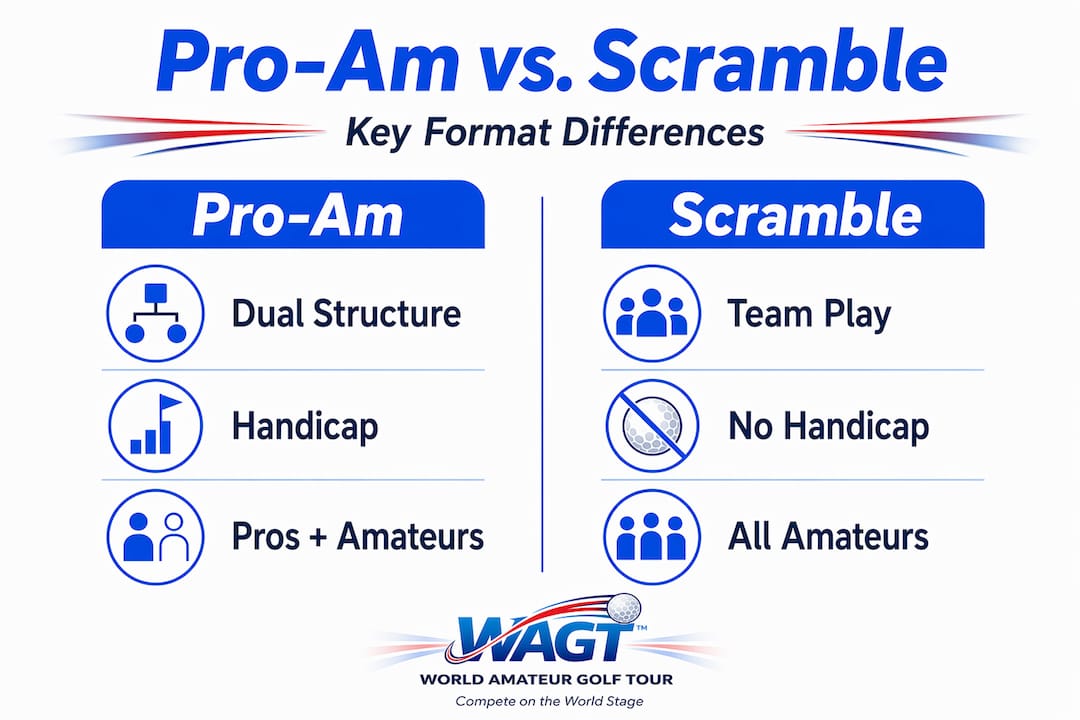
| Format | Team structure | Amateur role | Handicap used | Pro involvement |
|---|---|---|---|---|
| Pro-am | 1 pro + 3-4 amateurs | Active team contributor | Yes, full GHIN | Competes individually and with team |
| Open amateur | Individual or pairs | Sole competitor | Yes | None |
| Professional stroke play | Individual | None | No | Full field of pros only |
| Corporate scramble | Mixed teams | Active, all shots count | Sometimes modified | Optional, often absent |
The pro-am sits in a unique position. It is more competitive than a corporate scramble, more accessible than a straight professional event, and more socially dynamic than a standard open amateur golf event. For many amateurs, it is the closest they will ever get to experiencing professional tournament conditions while still having a real competitive role in the outcome.
That combination of access and competition is exactly why pro-ams continue to grow across every level of the game.
My honest take on what makes pro-ams worth your time
I have seen a lot of amateur golfers approach pro-ams with the wrong mindset. They either treat it like a casual round and leave performance on the table, or they get so locked into their own score that they miss the entire relational dimension of the format.
What I have learned is that the dual competition structure is the real gift here. You are not just playing golf. You are playing golf with a professional, competing against other teams, and building relationships with people who take the game seriously. That combination does not exist in any other format.
The biggest mistake I see is amateurs who do not research the scoring format before they show up. Knowing whether your score counts on every hole or only on certain holes changes how you approach risk on par fives and long par threes. One bad hole in a one-of-four best ball format is forgettable. In a two-of-four format, it could cost your team real ground.
My advice: treat the pro-am as a competitive event first and a social event second. Show up prepared, know your handicap strokes by hole, and play with intent. The social rewards come naturally when you are engaged and performing. The amateurs who get the most out of these events are the ones who respect the competitive structure while staying genuinely present with their group.
The personal growth available in a well-run pro-am is real. You will learn how a professional manages their game under pressure, how they communicate with partners, and how they stay composed. That is worth more than any scorecard.
— Gene
Ready to compete in your next amateur event
If the pro-am format has you fired up about competing at a higher level, the Worldamateurgolftour is where serious amateur golfers take their game next. The tour runs professionally managed events at championship-caliber courses, with WAGR-counting tournaments designed specifically for junior, collegiate, and competitive amateur golfers who want real ranking points and real competition.

Whether you are a junior golfer building your pathway to collegiate golf or an experienced amateur looking for elite-level events, Worldamateurgolftour delivers the structure, fairness, and competitive environment that mirrors what you experience in a top-tier pro-am. Explore upcoming WAGR amateur tournaments and find your next event. Spots fill fast, and the field is always competitive.
FAQ
What does pro-am mean in golf?
Pro-am stands for professional-amateur. It refers to a tournament format where one professional golfer is paired with a team of amateur golfers, with both a team competition and an individual professional competition running simultaneously.
How does scoring work in a pro-am golf event?
Most pro-ams use a best-ball format where the lowest score on each hole counts for the team. Amateurs receive handicap strokes based on their GHIN index to level the competition, while the professional competes at scratch in the individual contest.
Can any amateur play in a pro-am tournament?
Most pro-ams require a verified handicap index, typically through GHIN. Entry is often open to amateurs who register through the host club or PGA section, though major televised events like Pebble Beach use invitation-only celebrity amateurs.
How many rounds do amateurs play in a pro-am?
It depends on the event. In major pro-ams like Pebble Beach, amateurs compete for two rounds before the professionals continue alone. Regional and club-level pro-ams typically have amateurs compete for the full event.
What should I expect at my first pro-am?
Expect a longer round than usual, a more structured pre-round process, and a mix of competitive and social elements throughout the day. Know your format and handicap strokes in advance, and be ready to engage with your professional partner from the first tee.