
Division I coaches can start contacting you directly after your sophomore year of high school, beginning on a date set by NCAA rules. Division II coaches have more flexibility and can reach out earlier, while Division III programs aren't bound by a recruiting calendar at all and can talk to you anytime. Whatever division you're chasing, the move right now is the same: build your player profile, put together a recruiting video, and get into WAGR-counting events so coaches already know your name before that phone call is even legal.
TL;DR:
- Building a recruiting profile, video, and competing in WAGR events early can give you a significant edge before NCAA contact windows open.
- Coaches can only contact recruits during designated periods, with D1 and D2 following strict schedules and D3 coaches able to engage year-round.
- Entering WAGR-counting tournaments before contact periods provides measurable proof of your skills, increasing visibility and recruitment chances.
- Scheduling your best tournaments during evaluation or contact windows makes it more likely that coaches will see and evaluate your performance directly.
- Starting early and maintaining consistent activity before formal contact opens helps prevent missing out on opportunities that fill quickly once the recruiting season begins.
Table of Contents
- When Can Coaches Contact You? The NCAA Golf Recruiting Calendar at a Glance
- What Do Contact, Quiet, Dead, and Evaluation Periods Actually Mean?
- How Do D1, D2, and D3 Recruiting Rules Actually Differ?
- Your Year-by-Year College Golf Recruiting Timeline
- How Do Coaches Actually Evaluate You Before They Can Call?
- Why WAGR-Counting Events Matter for Your Recruiting Visibility
- What Waiting Too Long Actually Costs You
- Get WAGR Visibility Before Contact Windows Open
- Where to Verify These Dates Yourself
- Sources
When Can Coaches Contact You? The NCAA Golf Recruiting Calendar at a Glance
The NCAA breaks its recruiting calendar into contact, quiet, dead, and evaluation periods, and every college golf recruiting timeline runs through them. For Division I, the 2025–26 calendar includes a contact window from August 1 through November 26, a quiet period from December 1 through 22, and another contact window running January 2 through July 31. Dead periods carve out short blackout windows around national conventions and holiday stretches, including exceptions tied to late November and the turn of the calendar year.
| Division | Earliest coach contact | Notable 2025–26 windows | Scholarship structure |
|---|---|---|---|
| D1 | June 15 after sophomore year | Contact: Aug 1–Nov 26, Jan 2–Jul 31; Quiet: Dec 1–22 | Head count and equivalency, varies by program |
| D2 | More flexible, often earlier than D1 | Similar contact/quiet framework, fewer dead-period restrictions | Equivalency scholarships, often partial |
| D3 | No restricted calendar, contact allowed year-round | Not bound by NCAA recruiting periods | No athletic scholarships, need-based aid only |
A few things to keep in mind as you plan around these windows:
- Official and unofficial campus visits commonly open on August 1 before your junior year.
- D1 dead periods often fall around national coaching conventions, so don't expect a callback during those stretches even if you emailed during an open window.
- NAIA and NJCAA programs run their own recruiting rules outside the NCAA structure entirely, which matters if you're keeping multiple pathways open.
- D3 coaches can text, call, or watch you play at any point in high school, so many junior golfers get real interest from D3 programs well before D1 rules even allow contact.
What Do Contact, Quiet, Dead, and Evaluation Periods Actually Mean?
Contact periods are the only windows where a coach can call you, text you, email you, or talk with you and your family off campus. Everything else on the calendar exists to protect you from year-round recruiting pressure, which is exactly how the NCAA frames the purpose of these periods.
During a quiet period, coaches can still evaluate you and may talk with you if you're on their campus, but they can't watch you compete off campus or make calls. A dead period shuts almost everything down: no in-person contact, no evaluations, though phone calls and digital communication are typically still allowed. An evaluation period lets coaches watch you play and review film, but they can't have direct conversations with you yet.
Here's where families get tripped up. National conventions and certain showcase weeks create built in exceptions, meaning a coach might be barred from calling you but still standing behind the ropes watching your group finish on 18. That's not a loophole. It's the calendar working as designed, and it's why showing up to play matters just as much as answering your phone.
- Contact period: calls, texts, emails, in-person conversations, home visits.
- Quiet period: off-campus evaluation and off-campus contact both prohibited; campus visits still allowed.
- Dead period: no in-person contact or evaluation at all, on or off campus.
- Evaluation period: coaches can watch and assess, but can't speak with you directly.
Pro Tip: Schedule your biggest events for known evaluation and contact windows, and use quiet or dead stretches to update your recruiting video and rebuild your swing, not to wait around for an email that legally can't come yet.
Good scheduling looks like this: play your strongest WAGR-counting tournaments in the weeks leading into a contact window, then follow up with a personalized email the moment that window opens. Coaches remember who reached out first.
How Do D1, D2, and D3 Recruiting Rules Actually Differ?
The calendar looks similar across divisions on paper, but the practical experience of being recruited by each one is different enough that your strategy needs to shift depending on your target.
- Division I locks contact until June 15 after sophomore year. Scholarships split between head count and equivalency sports, and golf falls into the equivalency category, so aid packages often get divided across a roster rather than handed out as full rides. Official and unofficial visits open August 1 before junior year, giving you a full academic year of visit windows before signing.
- Division II follows a similar contact/quiet/dead framework but with more flexibility in timing, and coaches there often build relationships earlier than their D1 counterparts because the rules give them more room to do it. Aid is also equivalency based and frequently partial, which makes total cost of attendance a bigger conversation than it is at some D1 programs.
- Division III has no restricted recruiting calendar. Coaches can talk to you as a freshman if they want to. There are no athletic scholarships, but need-based financial aid and academic merit money can add up to a package that rivals a partial athletic scholarship elsewhere, and roster spots often come with real playing time sooner.
- NAIA and NJCAA programs sit outside NCAA jurisdiction entirely, with their own recruiting rules and often earlier, more direct communication with recruits.
Knowing which division actually fits your game changes how urgently you need to move on outreach.
Your Year-by-Year College Golf Recruiting Timeline
- Freshman year: Focus on grades first. Play local and regional junior tournaments, learn how scoring and handicaps translate to rankings, and start a simple recruiting profile with your basic stats and schedule.
- Sophomore year: Start entering WAGR-counting events to build a real competitive record. Film a short recruiting video, and begin researching programs that fit your academics and game before outreach rules even apply to you.
- Summer after sophomore year into junior year: This is when the calendar turns in your favor. D1 contact opens June 15, so have your profile, video, and tournament schedule ready to send the moment coaches can respond. Use the August 1 visit window to schedule campus trips.
- Senior year: Official visits, verbal offers, and paperwork all collide here. Verify your amateurism status with the NCAA Eligibility Center, watch the April 1 and October 1 certification dates if they apply to your situation, and understand that a verbal offer isn't official until you sign a financial aid agreement during the signing period.
Pro Tip: Treat the June 15 contact date after sophomore year like a deadline, not a starting gun. Coaches are already building shortlists in the months before, based on tournament results and video they found on their own.
How Do Coaches Actually Evaluate You Before They Can Call?
Coaches build their shortlists off tournament results, World Amateur Golf Ranking movement, video, and word of mouth from other coaches, long before June 15 ever arrives. Waiting until junior year to start putting yourself in front of them is one of the most common mistakes families make, and it's one that costs golfers real opportunities that got locked up earlier by golfers who started sooner.
Here's what actually moves the needle before formal contact opens:
- A clean, short recruiting video that shows your full swing and a few shots under pressure.
- A concise online profile with scores, tournament history, and academic information a coach can scan in under a minute.
- Consistent entries in WAGR-counting events, since ranking points give coaches a standardized way to compare you against recruits from other states.
- Timed outreach: an email that lands the week a contact window opens gets read faster than one buried in a coach's inbox mid quiet period.
Understanding coach communication patterns, including how programs prioritize which recruits get personal replies versus form responses, helps you set realistic expectations for how fast this process actually moves. And remember: a verbal offer is a conversation, not a commitment. Nothing is official until the financial aid agreement gets signed.
Why WAGR-Counting Events Matter for Your Recruiting Visibility
Ranking points from sanctioned amateur events give coaches something concrete to compare across recruits nationwide, rather than guessing from local scores alone. Scheduling those events ahead of a target program's contact window gives you measurable proof points to put in front of a coach the moment outreach opens.
A few ways to line this up with the calendar:
- Enter WAGR-counting tournaments in the months before your division's contact window opens.
- Keep your player profile and video updated so a coach who searches your name mid-tournament finds something worth clicking.
- Time your biggest events to overlap with evaluation periods, when coaches are actively watching but can't yet call.
What Waiting Too Long Actually Costs You
I've watched more than one talented junior golfer's parent assume recruiting could wait until junior year, only to find their target programs had already filled out their class. The single habit that changes everything is starting the profile and video early, then feeding it with WAGR results as they come in, so there's already a track record by the time contact opens. Get that foundation built now, and the calendar starts working for you instead of against you.
— Gene
Get WAGR Visibility Before Contact Windows Open
The platform gives junior and amateur golfers a way to build the tournament record coaches look for, without waiting on a local circuit to fill a schedule. Membership includes entry into WAGR-counting events, a player profile coaches can review at a glance, and live scoring history.
That combination matters most in the months before your division's contact window opens, when your job is to have proof ready, not promises. Instead of piecing together which local events actually count toward ranking points, you get a calendar of tournaments at well-regarded courses, each one adding to a record a coach can verify. If you're a junior or sophomore mapping out the next twelve months against the NCAA golf recruiting calendar, check World Amateur Golf Tour's event schedule and membership details and get your name into ranking contention before June 15 arrives.
Where to Verify These Dates Yourself
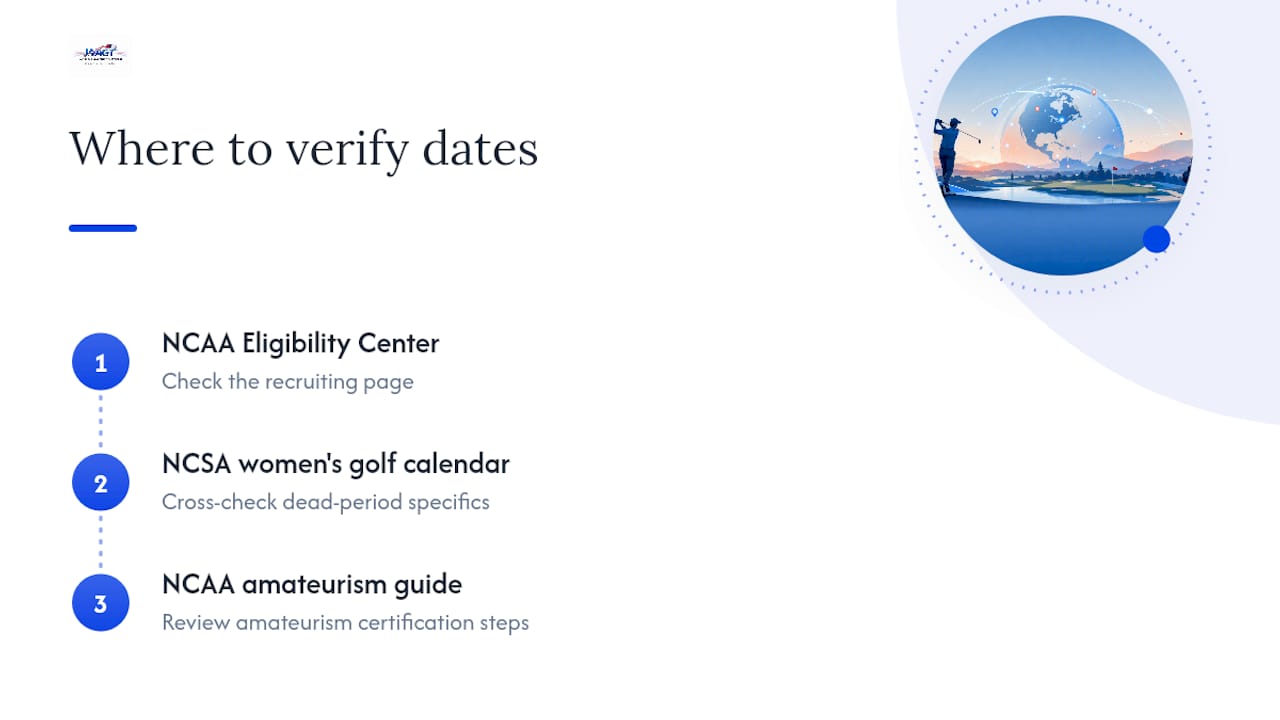
Confirm every date before you build your schedule around it. Start with the NCAA Eligibility Center's recruiting page, cross check the NCSA women's golf calendar for dead-period specifics, and review amateurism certification steps in the NCAA amateurism certification guide.
Sources
- NCAA recruiting — Eligibility Center
- 2025-26 NCAA Men’s Golf Recruiting Rules and Calendar — NCSA Sports