

Start your player development plan this week: join a WAGR-counting membership, identify two upcoming WAGR-sanctioned events within 90 days, and set your first three college coach contact targets. That sequence, repeated with discipline over 12–36 months, is what separates golfers who attract recruiting attention from those who wait for it.
Your first-week checklist:
- Register for a WAGR-counting membership (such as Worldamateurgolftour) and confirm your player profile is complete and searchable.
- Identify two near-term WAGR-counting events that meet the 2025 updated field-size minimums appropriate for the event categories.
- List five college programs that match your academic and athletic profile, and set a calendar reminder to send your first coach email within 30 days.
Within 30 days, you should have a membership active, at least one event registered, and a recruiting contact list ready to work.
Key Takeaways
A focused player development plan built around WAGR-counting events, consistent performance in strong fields, and timely recruiting outreach is the most direct path from junior competition to college or professional opportunity.
| Point | Details |
|---|---|
| Start with membership | Join a WAGR-counting tour like Worldamateurgolftour and complete your player profile before entering events. |
| Prioritize event grade | Target Grade 1–3 events with strong fields; low-grade events carry reduced points under 2025 WAGR criteria. |
| Begin coach outreach early | Start contacting college coaches in sophomore year with WAGR rank, scoring average, and a highlight video. |
| Track metrics monthly | Monitor scoring average, WAGR rank, GIR, and top-finish percentage to document progress for recruiting. |
| Use Worldamateurgolftour | The platform bundles WAGR-counting events, live scoring, player profiles, and recruiting tools in one place. |
Table of Contents
- What does a player development plan mean in this guide?
- Why WAGR and formal pathways matter for your future
- Core components of a strong development plan
- How to choose WAGR-counting events and build your season
- Sample 12-month and 3-year plan templates
- Recruiting visibility: when and how to reach college coaches
- Costs, timeline, and realistic expectations
- How to track progress and document your results
- Common mistakes and eligibility risks to avoid
- What we've seen running WAGR-counting events
- Worldamateurgolftour: your ready path to WAGR visibility
- Sources
What does a player development plan mean in this guide?
This guide defines a player development plan as a structured, tournament-and-ranking-first roadmap. It maps your membership, WAGR-counting event entries, season schedule, recruiting outreach, and performance targets across 12–36 months. Technical coaching curricula, session-level drills, and physical periodization programs are outside this scope. Those matter, but they belong in a separate conversation with your swing coach.
The four entities at the center of this plan are the World Amateur Golf Ranking (WAGR), PGA TOUR University, the LPGA Collegiate Advancement Pathway, and Worldamateurgolftour as the membership and event platform that makes WAGR access practical for junior and amateur golfers.
Why WAGR and formal pathways matter for your future
WAGR was launched by The R&A in 2007 and has been produced in partnership with the USGA since 2009. It ranks amateur players globally across men's, women's, and disability categories, and it processes thousands of counting events every year.
College coaches use WAGR as a filter. A clean, well-documented WAGR profile can generate inbound interest from programs before you send a single cold email. The top-ranked men's amateur earns the Mark H. McCormack Medal. That kind of recognition signals to coaches, sponsors, and tour exemption committees that a player belongs in elite fields.
Core components of a strong development plan
A complete plan has five pillars. Audit yours against each one.
1. Membership and registration
Your membership determines which WAGR-counting events you can enter. Worldamateurgolftour offers a membership built specifically for junior and amateur golfers, with tournament registration, live scoring, player profiles, and recruiting tools bundled together. Confirm your membership includes access to sanctioned events and that your profile is visible to coaches.
2. Event strategy
Targeting higher-grade events and stronger fields consistently produces faster WAGR movement than playing many low-grade local tournaments. Aim for a mix of Grade 4–6 local events to build confidence, Grade 2–3 national events for ranking gains, and at least one Grade 1 or international event per year as you progress. For a full breakdown of WAGR points by event grade, review the junior-specific guide.

3. Performance targets
Track scoring average, top-10 finishes, greens in regulation (GIR), and putting average. Set a WAGR rank goal for each six-month block. Specific numbers matter: "break 75 consistently" is more useful than "play better."
4. Support team
- Swing coach for technical work between events
- Strength and conditioning specialist for physical readiness
- Mental skills coach or sports psychologist for competitive pressure
- Parent or event manager handling logistics, deadlines, and travel
5. Recruiting activities
Build a coach contact list, maintain a recruiting resume with WAGR rank and tournament results, and schedule outreach at the right times in the recruiting calendar (detailed in the recruiting section below).
How to choose WAGR-counting events and build your season
Effective season planning starts with your goal, not the event calendar. Work backward from your recruiting window or professional timeline, then fill in events that serve that goal.
Step-by-step event selection:
- Confirm the event is WAGR-sanctioned and meets the 2025 updated field-size minimums: 16 players for male/mixed events, 8 for women-only events.
- Check the event grade. Grade 1–2 events carry the most points; Grade 5–6 carry the least.
- Evaluate field strength. A Grade 3 event with a strong national field often yields better WAGR movement than a Grade 2 event with a weak one.
- Map travel cost and academic calendar conflicts. Never sacrifice a final exam week for a Grade 5 event.
- Confirm entry deadlines at least six weeks in advance.
Sample 12-month season structure:
| Month | Event Type | Grade | Purpose |
|---|---|---|---|
| January | Local/regional junior | Grade 5–6 | Rust removal, scoring baseline |
| March | State/national junior | Grade 3–4 | First ranking points of the year |
| May | National championship | Grade 2–3 | Peak competition, coach visibility |
| July | International invitational | Grade 1–2 | Maximum WAGR points, elite field |
| September | Regional qualifier | Grade 4–5 | Maintain rank, academic transition |
| November | End-of-year national | Grade 2–3 | Close the season strong |
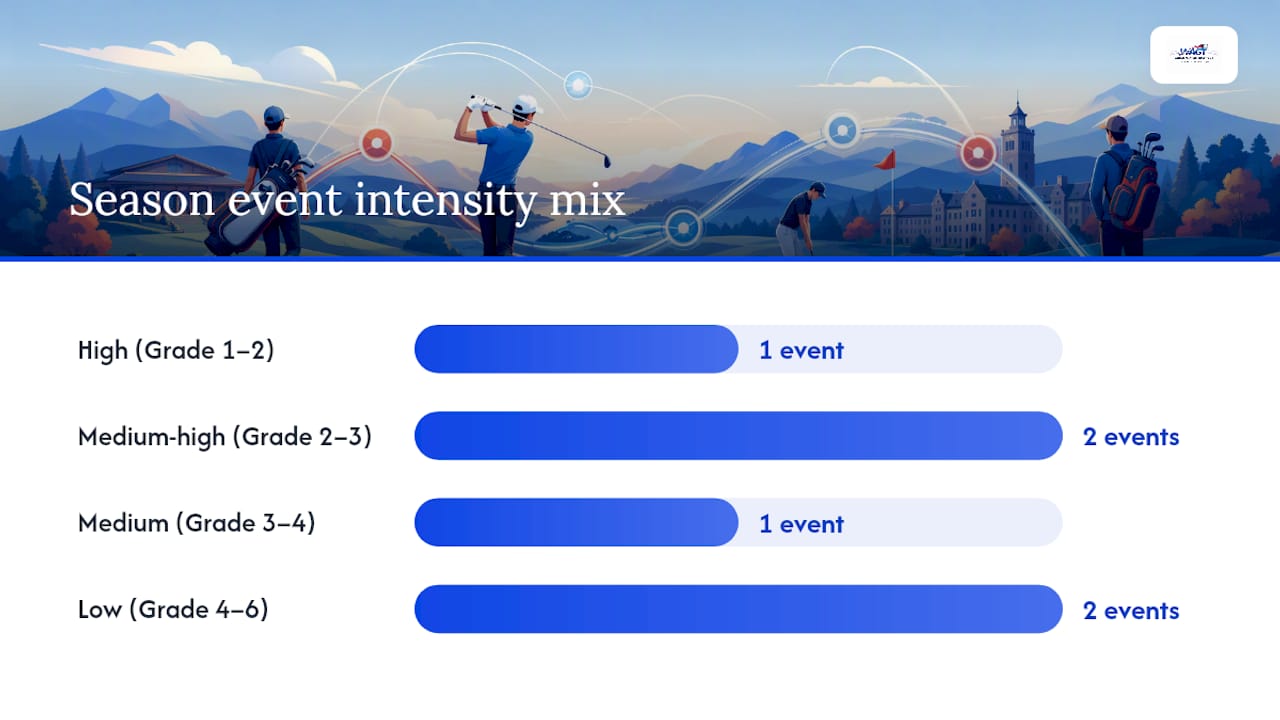
Balance academic obligations by clustering tournament weeks around school breaks and scheduling your hardest academic months as lower-competition training blocks.
Sample 12-month and 3-year plan templates
Use these templates as a starting point, then adapt them with your coach. For deeper context on golf development pathway milestones, the full pathway guide is worth reading alongside this.
12-month milestone template:
- Months 1–2: Activate membership, complete player profile, enter first two WAGR-counting events, establish scoring baseline.
- Months 3–4: Compete in first Grade 3–4 national event, begin coach outreach to five target programs.
- Months 5–6: Mid-year review: compare scoring average and WAGR rank to targets; adjust event schedule if needed.
- Months 7–8: Peak competition block: one Grade 1–2 event, maximum preparation, full recruiting packet ready.
- Months 9–10: Academic focus month; one regional event to maintain rank; update recruiting resume with summer results.
- Months 11–12: Year-end review, set 3-year targets, confirm next year's event calendar.
3-year progression table:
| Year | Event Focus | WAGR Rank Target | Recruiting Milestone |
|---|---|---|---|
| Year 1 | Local/national Grade 3–6 | Establish ranked status | Initial coach contact, profile live |
| Year 2 | National/international Grade 2–4 | Top 500 (men) / Top 300 (women) | Official visits, scholarship conversations |
| Year 3 | International Grade 1–3 | Top 500 (men) / Top 300 (women) | Commitment or PGA TOUR University eligibility |
Recruiting visibility: when and how to reach college coaches
Start coach outreach earlier than you think you need to. For most junior golfers, meaningful contact begins in the sophomore year of high school, with official visits typically in junior year.
Coach outreach checklist:
- Current WAGR rank and recent tournament results (last 6 months)
- Scoring average across all competitive rounds
- Academic GPA and standardized test scores
- Highlight video (3–5 minutes, showing full swing, short game, and course management)
- Recruiting resume with contact information, event schedule, and coach references
Sample initial email (adapt as needed):
Subject: [Your Name] | [Graduation Year] | WAGR #[Rank] | Interested in [Program Name]
"Coach [Last Name], my name is [Name], a [year] from [state] currently ranked [WAGR rank]. I averaged [scoring average] across [X] WAGR-counting events this season and will compete at [upcoming event] in [month]. I'm genuinely interested in [Program] and would welcome a conversation at your convenience. My recruiting profile and highlight video are linked below."
Pro Tip: Keep the first email under 150 words. Coaches read dozens of these weekly. A concise WAGR-backed summary with a direct link to your profile converts far better than a long personal narrative.
Costs, timeline, and realistic expectations
Budget across four main categories:
- Membership: Annual fees for WAGR-counting tour memberships vary; confirm current pricing directly with the tour.
- Entry fees: Grade 1–3 national and international events typically run higher than local events. Budget accordingly per event.
- Travel: Flights, hotels, and meals for 6–10 events per year represent the largest variable cost for most families.
- Coaching and video: Swing coaching, mental skills work, and highlight video production are ongoing costs that peak in pre-season months.
For timeline expectations: most players who commit to a focused, higher-grade event strategy see meaningful WAGR movement within 6–9 months. Coach attention typically follows once a player appears consistently in the top 500 (men) or top 300 (women). Prioritize events that offer the best WAGR return relative to travel cost rather than chasing volume.
How to track progress and document your results
Consistent documentation is what turns good performances into recruiting evidence.
Core metrics to track monthly:
- Scoring average (all competitive rounds, not just best rounds)
- WAGR rank (check after each counting event)
- Top-10 and top-25 finish percentages
- GIR percentage and putts per round
- Event grade performance (are you scoring better in stronger fields over time?)
Documentation tools and tasks:
- Keep a digital scorecard log for every competitive round.
- Update your WAGR profile after each sanctioned event.
- Maintain a one-page recruiting resume updated after every major result.
- Produce or update a highlight video at least once per season.
- Use Worldamateurgolftour's live scoring and player profile features to centralize your competitive record in one place coaches can access.
Pro Tip: Short game practice directly translates to lower scores in competitive rounds. For targeted drills, underrated short game techniques are worth adding to your weekly training block.
Common mistakes and eligibility risks to avoid
Most players derail their plans with the same handful of errors.
- Entering too many low-grade events. Since the 2025 WAGR criteria update, low-power events carry reduced points. Volume without grade quality is wasted travel budget.
- Ignoring field-size rules. Male/mixed events with fewer than 16 players do not count toward WAGR. Verify field size before you register.
- Poor academic timing. Scheduling a Grade 5 event during finals week is a net negative. Protect your GPA; coaches check it.
- Failing to document results. A great finish that never makes it into your recruiting packet might as well not have happened.
- Waiting too long to contact coaches. Programs fill rosters earlier than most families expect.
For eligibility questions, always consult the official WAGR criteria and FAQs directly. Rules change, and relying on secondhand summaries for eligibility decisions is a risk not worth taking. If you need to pivot mid-season because an event falls below field-size thresholds, substitute the nearest higher-grade alternative rather than skipping the competition window entirely.
What we've seen running WAGR-counting events
Running WAGR-counting tournaments for junior and amateur golfers has shown us one pattern repeatedly: the players who progress fastest are not necessarily the most talented at the start. They are the ones with a clear plan, the right events on their calendar, and a recruiting packet ready before coaches ask for it.
Worldamateurgolftour exists because that structure should not be hard to access. Our membership gives you WAGR-counting events at championship-caliber venues, live scoring, player profiles visible to college coaches, and a rewards program that puts gear and entry credits back in your hands. The development focus is not a tagline. It is the reason we build events the way we do: fair fields, transparent results, and a community of serious competitors who push each other to improve.
If you are ready to compete at a level that actually moves your ranking and gets you noticed, the path starts with the right events.
Worldamateurgolftour: your ready path to WAGR visibility
Earning WAGR points and recruiting attention requires more than talent. It requires the right events, the right membership, and a platform that keeps your results organized and visible. Worldamateurgolftour delivers all three.
Membership includes access to WAGR-counting tournaments at respected venues, live scoring, a searchable player profile, recruiting tools built for coach outreach, and a rewards program redeemable for gear and event credits. Every event is professionally run with transparent results. You compete, we handle the infrastructure.
The concrete advantage: instead of piecing together event access, ranking tracking, and recruiting materials across multiple platforms, your entire competitive record lives in one place coaches can find. Register your membership today and check available event dates for the next 90 days.
Sources
The following sources were used throughout this guide and are worth bookmarking for ongoing reference:
- The World Amateur Golf Rankings® (WAGR®) | The Official Men's and Women's Amateur Golf Rankings
- Summary of WAGR® Criteria Updates for 2025 | Junior Golf Hub