

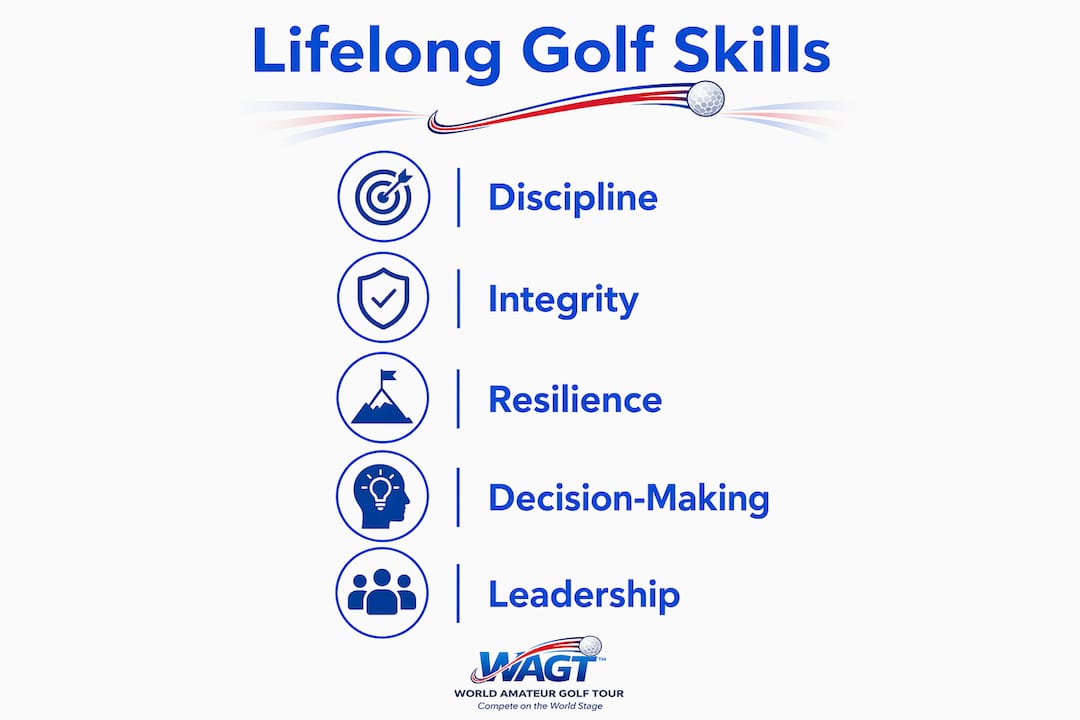
Golf reliably builds transferable lifelong skills — discipline, integrity, resilience, decision-making, leadership, and time management — because the game's rules and practice structure demand them, not suggest them. Every round you play is a self-administered test with no referee, no coach hovering over your shoulder, and no one else to blame for a miscounted stroke. That accountability is the mechanism. For junior, collegiate, and amateur players, these skills compound over seasons into a competitive profile that matters far beyond the course. A scoping review mapping over 300 studies confirmed golf's positive associations with physical health, cardiovascular fitness, and social well-being. Add WAGR-counting events through Worldamateurgolftour, and skill development becomes measurable, visible, and recruiter-ready.
Your single action right now: register for a WAGR-counting event and start a four-week deliberate practice schedule this week.
Table of Contents
- Why golf builds lifelong skills through its own structure
- What each skill looks like on the course and off it
- What academies, research, and programs say about golf's character benefits
- How to build these skills through a practical training and competition plan
- How WAGR events and Worldamateurgolftour membership build college visibility
- Your next 30 days: a focused action checklist
- Key Takeaways
Why golf builds lifelong skills through its own structure
Golf does not teach discipline through a motivational speech. It teaches it by making you show up, track every stroke honestly, and repeat the process across hundreds of rounds before improvement becomes consistent. The structure is the curriculum.
"Golf's rules, etiquette, and self-management are not add-on lessons — they are formative experiences built into every round a junior plays." — Golf Foundation, Skills for Life
Self-policing and scorekeeping are where integrity gets built. There is no referee calling penalties; you call them on yourself. The PGA describes this as developing an "honesty muscle" — repeated self-accountability that generalizes directly to academic and workplace behavior. Miss a penalty call once and you know it. That discomfort is the lesson.
Delayed feedback is golf's other great teacher. You practice a swing change for three weeks before it shows up reliably under pressure. That gap between effort and result trains patience, goal-setting, and the ability to trust a process without instant confirmation. Most sports give you feedback in seconds. Golf makes you wait, and that waiting builds something most athletes never develop: tolerance for uncertainty.

Etiquette and pace-of-play add a third layer. Repairing divots, raking bunkers, and keeping your group moving on schedule are not optional courtesies. They are responsibilities to every other player on the course. Walking the course amplifies this further, adding cardiovascular benefit and time in a shared environment that strengthens both physical conditioning and social awareness.
What each skill looks like on the course and off it
The transfer from course to classroom or boardroom is direct once you know where to look.
- Discipline: Committing to a practice schedule — short game on Monday, full swing on Wednesday, mental rehearsal on Friday — mirrors the study habits that produce consistent academic performance. The Sergio Garcia Golf Academy puts it plainly: the work and responsibility in golf cannot be shortcut. That lesson applies to every long-term goal you will ever pursue.
- Honesty and integrity: Calling a penalty on yourself when no one saw it, then signing a scorecard you stand behind, builds accountability that transfers directly to professional life. Junior programs consistently identify this as golf's most distinctive character contribution.
- Resilience: Bouncing back after a double bogey requires a mental reset routine — take a breath, commit to the next shot, release the last one. That same routine works after a failed exam, a tough interview, or a bad quarter at work.
- Decision-making: Every club selection is a risk-reward calculation under time pressure. Lay up or go for the green? That analytical habit, practiced hundreds of times per season, sharpens the judgment you bring to study decisions and career choices.
- Etiquette and leadership: Caring for shared spaces and leading by example in team events shows others what standards look like. Junior programs at First Tee build on this explicitly, pairing technical lessons with community-building activities.
- Time management and focus: Pace-of-play is a real responsibility. Balancing a tournament schedule with academics requires the same prioritization skills you will use managing competing deadlines for the rest of your life.
Pro Tip: After every bad hole, use a three-breath reset before you pull your next club. Name what went wrong in one word, exhale it, and commit fully to the next shot. This routine transfers directly to any high-pressure situation off the course.
What academies, research, and programs say about golf's character benefits
The evidence base here is strong and consistent across independent sources.
The Golf Foundation's Skills for Life program identifies honesty, respect, commitment, communication, and leadership as skills golf develops progressively from a junior's first lesson through competitive play. These are not aspirational labels; they are structured into lesson plans and measured through the Junior Golf Passport at each stage.
"Golf places strong emphasis on good sportsmanship, self-discipline, and behavior — making it an ideal medium through which children and young people can develop honesty, respect, perseverance, and self-motivation that carry through to adulthood." — Golf Foundation
National Geographic's synthesis of health and cognitive research shows golf combines aerobic activity, strength engagement, and sustained decision-making in a way few other sports match. An 18-hole walking round routinely produces over 11,000 steps and is associated with measurable cardiovascular and longevity benefits. The physical and mental demands reinforce each other.
First Tee programs pair golf instruction with a structured life-skills curriculum, explicitly targeting confidence, resilience, and interpersonal skills alongside technical development. GoD1Golf supports the recruiting side, giving players tools to build profiles that NCAA coaches can find and evaluate. Worldamateurgolftour events provide the competitive results that make those profiles credible.
How to build these skills through a practical training and competition plan
Structure your development around four components each week.
- Technical practice (2 sessions): Full swing and iron play at a range, with deliberate focus on one specific change per session.
- Short game (1 session): Chipping, pitching, and putting account for roughly half your strokes. Treat this as non-negotiable.
- Mental game (daily, 10 minutes): Visualization, breathing routines, and journaling one observation from your last round.
- Conditioning and walking rounds (1–2 sessions): Walk at least one full round per week. The PMC scoping review confirms walking maximizes cardiovascular, metabolic, and mood benefits compared to cart play.
- Competition: Enter one event per month minimum, progressing from local junior events to WAGR-counting tournaments as your handicap and readiness develop.
| Development area | Metric to track | Review frequency |
|---|---|---|
| Ball-striking consistency | Fairways and greens in regulation | Weekly |
| Short game | Up-and-down percentage | Weekly |
| Mental resilience | Holes recovered after bogey or worse | Per round |
| Competitive progress | WAGR points accumulated | Monthly |
| Academic balance | GPA and missed practice sessions | Monthly |
For recruiting visibility, your GoD1Golf profile should include current handicap, WAGR points, tournament results, and a video of your swing. NCAA coaches review these profiles actively during recruiting windows, and a documented competitive history through WAGR-counting events carries far more weight than a single strong scorecard.
Pro Tip: Set one measurable goal per month — not "play better," but "reduce three-putts to fewer than two per round." Specific targets create feedback loops that accelerate both skill development and the self-discipline that transfers off the course.
How WAGR events and Worldamateurgolftour membership build college visibility
The World Amateur Golf Ranking measures a player's performance relative to the field strength of each event entered. WAGR-counting tournaments weight results by the quality of competition, so playing in well-organized, sanctioned events consistently builds a ranking that reflects genuine competitive ability. Worldamateurgolftour runs WAGR-certified events at championship-caliber courses, giving junior and collegiate players access to the kind of competitive field that moves rankings.
For NCAA recruiting, the timeline matters. Most Division I programs identify prospects by their sophomore or junior year of high school. That means your WAGR-counting event history needs to start building by age 15–16 at the latest. Worldamateurgolftour membership gives you access to amateur events in college that maintain eligibility while continuing to build your ranking profile.
Balancing academics and tournament travel is a real challenge. A structured seasonal plan — heavy competition in summer, lighter schedule during exam periods, consistent practice year-round — keeps both on track. The student guide on balancing academics and golf provides a practical scheduling framework for exactly this situation.
Your next 30 days: a focused action checklist
Start here, in this order:
- Week 1: Register for your next WAGR-counting event through Worldamateurgolftour. If you are not yet a member, join now at worldamateurgolftour.com.
- Week 1: Update your GoD1Golf and NCAA recruiting profile with current handicap, recent tournament results, and WAGR points.
- Week 2: Launch your four-week deliberate practice schedule using the five-component template above.
- Week 3: Identify one mentor — a coach, a club pro, or a senior competitive player — and schedule a single conversation about your competitive goals.
- Week 4: Review your round journal. Identify the one skill that most limited your performance and build the next month's practice around it.
Pro Tip: Reach out to your club's head pro or a local junior program coordinator this week. Mentorship in golf communities accelerates development faster than solo practice alone, and the relationships you build now often become the network you rely on later.
Key Takeaways
Golf builds lifelong skills because its structure — self-scoring, etiquette, delayed feedback, and competitive pressure — demands discipline, integrity, resilience, and decision-making from every player, every round.
| Point | Details |
|---|---|
| Golf's structure enforces character | Self-policing, scorekeeping, and etiquette build integrity and discipline without external enforcement. |
| Walking rounds multiply benefits | An 18-hole walking round routinely produces over 11,000 steps and is associated with cardiovascular and longevity gains. |
| WAGR events make skills visible | Consistent WAGR-counting tournament results create a competitive record NCAA coaches and recruiters can evaluate. |
| Specific goals accelerate progress | Tracking metrics like up-and-down percentage and WAGR points monthly turns practice into measurable development. |
| Start competing early | Building a WAGR history by age 15–16 aligns with NCAA Division I recruiting timelines. |
What organizers see in players who develop through competitive golf
The juniors who stand out at Worldamateurgolftour events are not always the ones with the lowest scores in round one. They are the ones who call their own penalties, shake hands with genuine respect, and come back stronger after a rough back nine. That pattern of behavior is exactly what college coaches ask about when they call event organizers for a reference. Sportsmanship and competitive integrity are not soft qualities in this context. They are selection criteria.
Worldamateurgolftour events are designed to create the conditions where those qualities get tested and demonstrated. Championship-caliber venues, WAGR-certified scoring, and professionally run formats give every player a fair environment where their results and their character both show up on the record. When a recruiter pulls a player's WAGR history and sees consistent participation in sanctioned events, they see more than a ranking. They see a commitment to serious competition and the discipline to keep showing up.
Authoritative sources and further reading
- PMC Scoping Review: Maps over 300 studies on golf and health; covers cardiovascular, metabolic, and social benefits with specific walking recommendations.
- Golf Foundation — Skills for Life: Defines the life-skills framework integrated into junior golf programs; includes lesson plan structures and the Junior Golf Passport.
- National Geographic — Golf and Brain/Body Health: Synthesizes research on aerobic, cognitive, and longevity benefits of regular golf play.
- Sergio Garcia Golf Academy: Coach-centered perspective on character development through long-term practice commitment.
- First Tee — Golf and Life Skills: Program model combining technical instruction with structured character development for juniors.
- PGA — Golf Teaches Life Skills: Practitioner insights on integrity, emotional management, and resilience in competitive golf.
- Worldamateurgolftour: Membership and event-entry platform for WAGR-counting tournaments; includes player profiles, recruiting tools, and live scoring.