

Here, "ready golf tournaments" means WAGR-counting events for junior, collegiate, and amateur players, the tournaments that generate official ranking points and catch a college coach's eye. The one move that matters most when you're picking events: check the tournament's Power rating and confirm its counting status before you spend a dime on entry or travel.
TL;DR:
- Prioritize WAGR-approved tournaments with high Power ratings that include deep fields of ranked players to maximize ranking points potential.
- Ensure events meet WAGR minimum field size, round count, and format standards before investing time and money to avoid low or invalid points.
- Balance your schedule with a few high-Power, competitive events and several accessible regional tournaments to maintain recent play within the 52-week window.
- Use a membership platform to streamline registration, track results, and access recruiting tools, saving time and reducing paperwork stress.
- Prepare thoroughly for each event with confirmed tee times, proper equipment, and pre-planned pacing to meet strict rules and optimize performance.
Table of Contents
- What Are Ready Golf Tournaments in the WAGR System?
- What Makes an Event Count Toward Your WAGR Ranking?
- How Should You Choose and Schedule Your Events?
- Registering for Events and Getting Recruiting Visibility
- Your Week-Of and Tournament-Day Checklist
- Tournament Formats and Rules You'll Actually Encounter
- Where Ready Golf Tournaments Typically Take Place
- Why Playing WAGR-Counting Events Actually Matters
- Skills and Preparation That Separate Contenders
- Building a Season Calendar Around WAGR Timing
- How Tournament Results Shape More Than Just Points
- The Membership-First Path to Ranking Points
- How a World Amateur Golf Tour Membership Simplifies Your Path
- Where to Verify Event Status and Ranking Rules
- Sources
What Are Ready Golf Tournaments in the WAGR System?
Every WAGR-counting tournament earns a "Power" rating, and that single number decides how many ranking points the field is playing for. Power weighs two things: how many players are in the field and how strong those players already are. A stacked field of ranked competitors produces a high-Power event; a thin local field produces a low one, even if the golf course is championship caliber.
The math translates directly into points. According to WAGR's own FAQ, winners of low-power events typically earn a modest number of points, while champions of the highest-power amateur tournaments can earn significantly more points. Runner-up and lower finishes still earn points, but the drop-off from first place is steep, which is why field strength matters more than field size alone.
Points don't sit on your record forever. WAGR runs on a rolling 104-week cycle, with a 52-week window carrying full weight. Players need at least 4 points earned in that trailing 52 weeks just to stay active in the system, and roughly 6.5 points to become officially ranked.
A quick look at how Power shapes your point ceiling:
- Low-power local events: winner earns roughly 7 to 8 points
- Mid-power regional events: moderate point range, scaled to field strength
- Elite, high-power amateur championships: winner can earn up to 25 points
- Weak or thin fields at any level: sharply reduced points, even for a win
Changes that took effect starting in 2023 also reduced how much professional-event participation contributes to Power, while opening the door to more formats, including qualifying rounds and pod-style match play. For juniors and college-bound amateurs, the practical effect is that domestic amateur events with strong, deep fields now carry more relative weight than they used to. That's good news if your travel budget is built around regional and national junior tournaments rather than pro-am crossovers.
What Makes an Event Count Toward Your WAGR Ranking?
Not every well-run tournament earns counting status. WAGR sets specific criteria, and organizers have to apply for approval before a single shot counts toward the ranking.
- Minimum field size. Counting events need a minimum field size in each division, as determined by WAGR criteria. Thin fields either get rejected or get assigned a very low Power.
- Minimum rounds. Events must meet a required round count, and the WAGR criteria spell out how qualifying rounds can count toward match-play formats without shortchanging the round requirement.
- Approved formats. Stroke play, match play, team match play, and qualifying-round setups are all acceptable, provided the format matches what was submitted for approval.
- Championship course setup. Tees, hole lengths, and course conditions have to reflect a genuine championship test, not a member-day layout.
- Committee approval. Organizers register the event and the WAGR Committee reviews and approves it before results count.
If a tournament's website is vague about field size, doesn't list a rounds format, or can't tell you whether it's WAGR-approved, that's a red flag worth chasing down before you register.
Pro Tip: Email the tournament director and ask directly: "Is this event currently on the WAGR-approved counting list?" A legitimate organizer will answer in one sentence with a link to prove it.
How Should You Choose and Schedule Your Events?
Chasing every high-Power event on the calendar sounds smart until you realize the trade-off: travel costs pile up, and a single missed cut at a marquee event does nothing for your ranking if your last four results are stale.
The smarter play is a mixed calendar. Anchor your schedule with a few high-Power targets where ranked players are entered, then fill the gaps with consistent, accessible events that keep points flowing inside your 52-week window. Because the divisor rewards recent, regular play over one big swing, a player who competes six times a year against solid fields usually outranks one who plays twice a year at marquee events and disappears in between.
- Target events where the field list already includes ranked or previously-ranked players.
- Balance one or two "reach" events against three or four dependable, local-to-regional counting tournaments.
- Weigh travel cost against realistic point upside. A high-Power event four states away isn't worth it if your game isn't peaking that week.
- Ask organizers for the event's prior-year Power rating and final field list before committing.
Pro Tip: Keep a simple spreadsheet of target events with their Power history. A tournament that jumped from low to mid Power last year is often building toward stronger fields, which means better points now, before it gets more competitive.
Registering for Events and Getting Recruiting Visibility
Elite counting events almost always require registration well ahead of the field deadline, along with a WAGR ID, proof of amateur status, and sometimes a qualifying score or index. Miss the deadline and entry may not be accepted, as fields often close at the registration cutoff.
This is where a membership platform simplifies things considerably. Instead of chasing separate registration portals for every tournament, a centralized membership typically handles:
- Streamlined registration across multiple counting events
- Live scoring so results post quickly and accurately
- A player profile that tracks your ranking history and recent form
- Recruiting tools that put your results in front of college coaches
Cost is worth planning for early. An annual membership fee usually runs cheaper over a season than paying separate per-event entry fees at every stop, especially once you factor in the strongest WAGR-counting tournaments you'll want on your calendar. Budget for entry fees, travel, and a buffer for last-minute field changes.
Your Week-Of and Tournament-Day Checklist
The week before a counting event isn't the time to discover you're missing a waiver or that your tee time changed.
- Confirm the basics early. Verify your tee time, entry confirmation, and any required ID or waiver forms at least 48 hours out.
- Check equipment against the rules. Championship tee setups sometimes come with local equipment notices. Confirm your clubs and ball meet the event's stated conditions of competition.
- Build a real warm-up plan. Arrive early enough for a full range session, short-game work, and a few practice putts that match the greens' actual speed.
- Dial in pacing and scoring habits. Know the field size and expected round time so you're not rushing your pre-shot routine on the back nine.
- Protect your amateur status. Decline any prize money or benefit that conflicts with amateur rules, and know the event's policy before you tee off.
Pro Tip: Print your tee time, starting hole, and any local rules sheet the night before. Scrambling for a printout in the parking lot is a self-inflicted bogey before you've hit a shot.
Tournament Formats and Rules You'll Actually Encounter
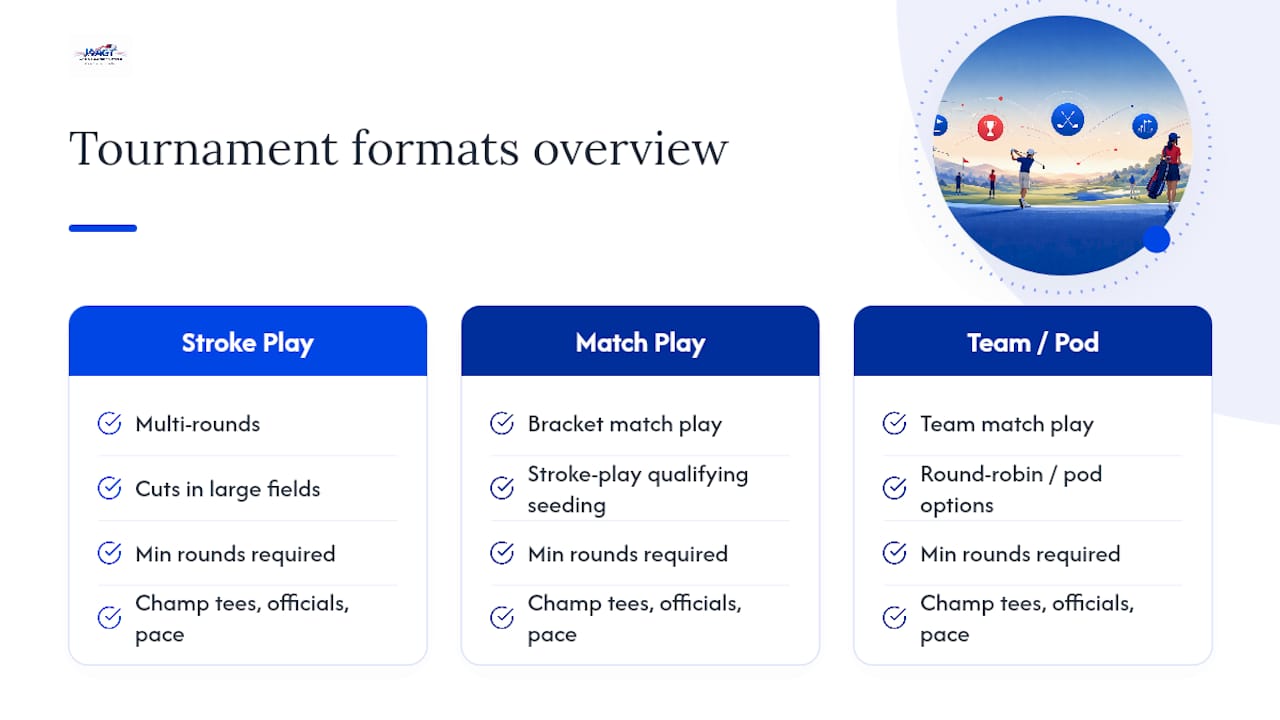
Stroke play is the predominant format for counting events, typically played over multiple rounds and days, with cuts used in larger fields. Match play shows up at select championships, often preceded by stroke-play qualifying rounds that determine seeding for bracket play.
Team match play and pod- or round-robin formats have become more common since the 2023 format expansion, giving organizers flexibility while still meeting minimum rounds requirements. Whatever the format, the conditions of competition mirror professional standards: championship tee markers, strict pace-of-play policies, and rules officials on-site for rulings.
Scoring integrity matters more here than at a casual weekend event. Players are responsible for verifying and signing scorecards, and disputes get resolved on the course, not after the fact. Most counting events also enforce a hard stance on distance-measuring device rules, local drop procedures, and pace-of-play penalties, since a slow round at a nationally ranked event affects every other group behind you. Know the local rules sheet cold before your round, because ignorance of a posted rule rarely gets you relief.
Where Ready Golf Tournaments Typically Take Place
Counting events need a course that can produce a legitimate championship test, which rules out most executive courses and heavily played municipal layouts. You'll typically find these tournaments at private clubs willing to host outside play, resort courses built for tournament traffic, and dedicated championship-caliber public facilities with the length and green complexes to challenge a strong field.
Course setup matters as much as course pedigree. A layout has to offer championship tee positions and enough yardage variety to test every club in the bag, tee to green. That's part of why the same handful of respected venues host multiple counting events across a season: they already have the infrastructure, from scoring stations to gallery ropes, that a WAGR-sanctioned event demands.

Regional venues matter too. Not every counting event happens at a marquee resort. Plenty of strong, mid-Power tournaments run at well-maintained regional clubs that meet field size and course setup standards without the five-star price tag, which is exactly where budget-conscious families should be scouting first.
Why Playing WAGR-Counting Events Actually Matters
Points aside, competing in WAGR-counting tournaments puts you in rooms you can't get into any other way. College coaches watch these fields specifically because the competition level is verified, not just claimed.
A ranking gives a coach a fast, credible way to evaluate you against players from other regions they haven't personally scouted. That single number does work a highlight reel can't. Beyond recruiting, the format itself, deep fields, strict pace-of-play rules, real rules officials, prepares you for the pressure of college golf better than a friendly weekend event ever will.
There's also a community dimension worth naming. You start recognizing the same competitive names event after event, and that repeated exposure to strong players sharpens your game in ways solo practice never will.
Skills and Preparation That Separate Contenders
Ball-striking gets a player into contention, but the players who actually climb the leaderboard usually win with their short game and course management under pressure. Prioritize practice time on shots inside 100 yards, since that's where counting-event scores are made or lost.

Mental preparation deserves equal weight. Deep, strong fields mean bogeys happen to everyone, and how you respond to one over the next three holes often decides your finish more than any single great shot. Build a pre-round routine you can repeat at any venue: same warm-up sequence, same mental checklist, same pace regardless of who you're paired with.
Course management matters more in high-Power fields because the margin for reckless decisions shrinks. A tucked pin that's a reasonable go at a weaker event might be exactly wrong at a stacked-field championship, where a two-shot penalty for a poor decision can cost you the points differential between an unranked finish and a ranked one.
Building a Season Calendar Around WAGR Timing
Counting events cluster heavily around the school calendar. Spring and summer carry the bulk of junior and amateur tournaments, when school is out and course conditions across most regions peak, while fall brings a second, smaller wave tied to college qualifying windows.
That seasonality creates real scheduling tension. The 52-week full-weight window rewards recent play, so a player who only competes in summer risks a stale ranking by the following spring, right when coaches are building their recruiting boards. Spacing entries across at least two seasons, rather than clustering everything into a six-week summer sprint, keeps your point total from going quiet at the exact moment recruiters are looking.
How Tournament Results Shape More Than Just Points
A strong finish does more than add points to your total. It changes the caliber of field you can enter next, since some counting events set entry priority partly by current ranking standing. A good result at a mid-Power event can be the qualifier that gets you into a higher-Power field next season, which then opens the door to bigger point ceilings.
Consistency compounds too. Because the ranking runs on a rolling divisor rather than a career-best snapshot, steady results across several events carry more long-term weight with recruiters than one standout week followed by silence. Coaches building a roster tend to trust a trend line over a single hot round.
The Membership-First Path to Ranking Points
Chasing counting events one registration form at a time is possible, but it's rarely efficient. The players who climb steadily are usually the ones treating this like a season-long plan: enter consistently, protect the 52-week divisor, and target Power intelligently instead of chasing prestige alone.
What gets underrated is how much field composition, not talent alone, determines who gets ranked and who doesn't. A talented junior in a weak regional field can genuinely out-play a rival stuck in a stronger one and still earn fewer points. That's not a flaw to complain about. It's a scheduling problem to solve, and solving it is exactly why organized membership access to vetted, WAGR-counting events matters so much for serious junior and college-bound players.
— Gene
How a World Amateur Golf Tour Membership Simplifies Your Path
A membership platform consolidates registrations, so your energy goes toward preparing for events instead of chasing paperwork.

Membership often provides access to WAGR-counting tournaments, live scoring, player profile tracking, and recruiting tools that help college coaches find your results. Some membership platforms include rewards programs that offer credits toward gear and future entries, potentially offsetting some competitive season costs. Centralized event registration can help families balance travel budgets and busy spring and summer schedules more effectively. If you're ready to stop guessing which events actually count and start building a season plan around real Power ratings, visit Worldamateurgolftour to check membership details and open events near you. For players preparing the mental side of competition, resources like Roberts Neurotraining's golf program pair well with a structured tournament calendar.
Where to Verify Event Status and Ranking Rules
Before you register anywhere, confirm the details directly with the sources that set the rules.
- WAGR's Criteria page for field size, rounds, and approval requirements
- WAGR's official men's events list to check counting status
- USGA's explainer on WAGR for pathway context
- Worldamateurgolftour's WAGR points breakdown for threshold specifics