

WAGR points, the official scoring currency of the World Amateur Golf Ranking system, measure a junior golfer's competitive performance across approved events worldwide. With wagr points junior golfers explained correctly, families stop guessing and start planning. Points are calculated from tournament finishes and field strength, averaged over a rolling two-year window. A minimum of 6.5 points is required to earn an official WAGR ranking. For any junior serious about collegiate golf or a professional pathway, understanding this system is not optional.
How are WAGR points calculated for junior golfers?
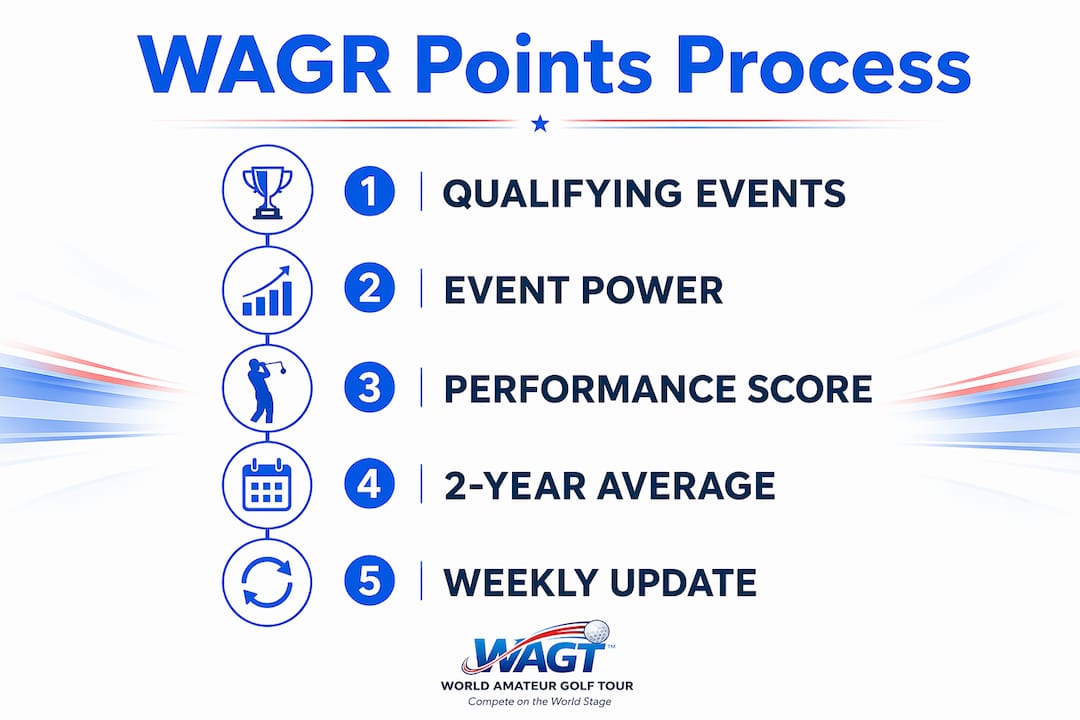
WAGR points are calculated from performance in approved qualifying events, averaged over a rolling two-year period. Results are weighted, meaning recent performances carry more influence than older ones. The system rewards consistency, not just one strong finish at a major junior event.
Every approved event carries a "Power" rating. Power reflects the strength of the field, the prestige of the tournament, and the level of competition. A higher-power event awards more points to top finishers, but the competition is steeper. A lower-power event awards fewer points, but a strong finish is more achievable for developing juniors.

Here is a simplified look at how event power and finishing position interact:
| Event Power Level | Example Tournament Type | Points for 1st Place (Approx.) |
|---|---|---|
| High (Power 7+) | National Junior Championship | 8.0–12.0 |
| Mid (Power 4–6) | Regional Elite Junior Open | 3.0–6.0 |
| Low (Power 1–3) | Local WAGR-Certified Junior Event | 0.5–2.5 |
The table above is illustrative. Actual points vary by specific event certification and field size. Always confirm point values on the official WAGR event page before committing to a tournament schedule.
Rankings update every Wednesday, which means a strong weekend performance can shift a junior's standing within days. That weekly cadence creates real momentum when a junior is on a hot streak. To appear in the official rankings at all, a player must accumulate at least 6.5 points over two years. That threshold is the entry ticket to being visible on the global stage.
Pro Tip: Start the season with at least one confirmed WAGR-counting event early. Juniors who delay their first qualifying event can remain invisible in the rankings for months, even if they are playing well in non-certified tournaments.
Why do WAGR points matter for junior golfers and families?
WAGR points are not just a stat on a leaderboard. They function as pathway currency that directly affects college recruiting attention, tournament invitations, and professional development eligibility. College coaches at Division I programs track WAGR rankings actively. A junior ranked in the top 500 globally gets noticed. A junior with no ranking does not, regardless of local wins.
Here is what strong WAGR points unlock for junior golfers:
- College recruiting visibility. Playing in WAGR-counting events generates points tracked by college programs and national team selectors. Coaches use WAGR rankings as a filter when building scholarship offers.
- Elite tournament invitations. Many high-level junior invitationals and national championships use WAGR rankings to set eligibility thresholds or seedings. Without a ranking, a junior may not qualify at all.
- National team consideration. Golf associations in the United States and internationally use WAGR standings to identify players for junior national teams and international competitions.
- PGA TOUR University Accelerated eligibility. This professional pathway program uses career-best WAGR rankings as one of its core criteria. The higher the ranking, the more pathway points a junior accumulates toward turning professional.
"WAGR points represent more than competitive achievement. They are the measurable benchmark that college programs, national federations, and professional pathway systems use to evaluate junior golfers on a global scale."
The international dimension is worth emphasizing. A junior who only competes locally may dominate their region but remain unknown to programs outside their state. WAGR points create a universal language that translates local performance into global credibility.
What strategies help juniors improve their WAGR rankings?
Strategic event selection is the single biggest factor separating juniors who build strong WAGR rankings from those who stall. Consistent results across multiple qualifying events benefit juniors far more than one peak performance in a single elite tournament. The rolling two-year average rewards players who show up and compete well repeatedly.
Follow these steps to build a smart WAGR tournament schedule:
- Verify WAGR certification first. Before registering for any event, confirm it counts toward WAGR on the official event listing. Many juniors waste an entire season competing in non-certified tournaments and earning zero ranking points.
- Mix event power levels intentionally. Enter a combination of high-power events for exposure and mid-power events where a top-five finish is realistic. Mixing field strength with achievable finishes is the most reliable way to grow a two-year rolling average.
- Plan around Wednesday ranking updates. Finishing a tournament on Sunday or Monday means your new points appear in the rankings by the following Wednesday. Timing events to align with recruiting windows, such as fall college evaluation periods, maximizes visibility.
- Track your two-year window actively. Points from events more than two years old drop off the average. Juniors who played well two years ago need to replace those points with fresh results or their ranking will fall even without playing poorly.
- Use the official WAGR event pages for planning. The WAGR event listings show Power ratings, dates, and certification status. Build your annual schedule around confirmed events, not assumptions.
Pro Tip: Avoid chasing only the biggest, highest-power events if your current game cannot realistically produce a top-third finish. A mid-tier finish in a high-power event earns fewer points than a top-three finish in a mid-power certified event. Play where you can score.
Understanding how golf events comply with WAGR rules also helps families evaluate new tournaments before committing time and travel budgets.
How do WAGR points support collegiate and professional pathways?
The connection between WAGR points and college golf scholarships is direct and documented. PGA TOUR University Accelerated awards pathway points based on a player's career-best WAGR ranking. The program is designed to give elite amateurs a faster route to professional status, and WAGR rank is one of its primary inputs.
Here is how WAGR ranking levels translate into PGA TOUR University Accelerated pathway points:
| Career-Best WAGR Rank | Pathway Points Awarded |
|---|---|
| No. 1 in the world | 5 points |
| No. 2 | 4 points |
| No. 3 | 3 points |
| No. 4 | 2 points |
| No. 5 | 1 point |
Additional points are awarded for each week a player holds the No. 1 ranking. That structure rewards sustained excellence, not just a single peak. For a junior golfer building toward a professional career, reaching and holding a top-five WAGR ranking has measurable, documented value beyond prestige.
On the collegiate side, Division I coaches at programs like Stanford, Oklahoma State, and Vanderbilt use WAGR rankings as a primary recruiting filter. A junior ranked inside the global top 200 is considered a serious Division I prospect. A ranking inside the top 50 puts a junior in conversation for the most competitive programs in the country. WAGR points for juniors, in this context, are a scholarship tool as much as a competitive metric.
For families thinking long-term, the benefits of amateur tour membership extend well beyond individual events. Consistent participation in certified events builds the ranking profile that opens doors at every level of the sport.
Key takeaways
WAGR points are the global standard for measuring junior amateur golf performance, and consistent participation in certified events is the most reliable path to ranking growth.
| Point | Details |
|---|---|
| Minimum threshold matters | Earn at least 6.5 points over two years to appear in official WAGR rankings. |
| Event power drives point value | Higher-power events award more points, but realistic finish potential must guide selection. |
| Rankings update every Wednesday | Time tournament participation to align with recruiting windows for maximum visibility. |
| WAGR points open collegiate doors | College coaches and PGA TOUR University Accelerated both use WAGR rankings as core evaluation criteria. |
| Verify certification before competing | Always confirm WAGR eligibility on official event pages to avoid wasted seasons in non-counting tournaments. |
What i've learned watching juniors chase WAGR rankings
After years of watching junior golfers and their families navigate this system, one pattern stands out clearly. The juniors who build strong WAGR rankings are not always the most talented players in the field. They are the most consistent ones, and the most strategic.
The rolling two-year average is the key insight most families miss early. A junior who plays 12 certified events per year and finishes in the top third consistently will outrank a junior who plays four events and wins two of them. The math rewards volume and reliability. One spectacular finish does not move the needle the way families expect it to.
The second mistake I see repeatedly is failing to verify event certification. A family drives across three states, pays entry fees and hotel costs, and the event does not count toward WAGR at all. That is an avoidable loss. The official WAGR listings exist for exactly this reason. Use them every single time.
The third thing I would tell any junior golfer directly: do not skip the mid-power events because they feel beneath you. Those are the events where you build your average, protect your ranking during tough stretches, and stay visible to recruiters between the big tournaments. The golf world rankings system rewards the player who shows up, not just the one who peaks.
— Gene
Find wagr-certified events through Worldamateurgolftour
If your junior golfer is ready to start earning ranking points in professionally run, WAGR-certified competitions, Worldamateurgolftour is built for exactly that.

Worldamateurgolftour runs WAGR-counting events at championship-caliber courses, giving juniors the competitive environment they need to build real rankings. Every event is professionally managed, fairly run, and designed to support the junior golf community at every level. For families who want to pair tournament play with recruiting support, GoD1Golf.com offers an all-in-one performance and D1 recruiting platform built specifically for junior golfers. Start planning your competitive schedule and register for upcoming WAGR events through Worldamateurgolftour today.
FAQ
What is the minimum score to appear in WAGR?
A junior golfer must earn at least 6.5 points over a rolling two-year period to be included in the official WAGR rankings. Without reaching that threshold, a player does not appear in the global standings regardless of how many events they enter.
How often do WAGR rankings update?
WAGR rankings update every Wednesday, reflecting results from events completed the prior week. This weekly cadence means a strong tournament finish can improve a junior's ranking within days.
Do all junior golf tournaments count toward WAGR?
No. Only events that have received official WAGR certification count toward the ranking. Families should confirm certification on the official WAGR event listings before registering for any tournament.
How do WAGR points help with college recruiting?
College coaches at Division I programs actively track WAGR rankings to identify and evaluate junior recruits. A strong WAGR ranking signals competitive credibility on a global scale, which carries more weight than local or regional results alone.
What age can junior golfers start earning WAGR points?
WAGR eligibility for young players applies as long as the golfer maintains amateur status and competes in certified events. There is no minimum age restriction, though competitive readiness for WAGR-level events is the practical limiting factor for most young juniors.