

The golf world ranking is defined as the Official World Golf Ranking (OWGR), a performance-based system that ranks male professional golfers according to their results in sanctioned tournaments over a rolling 104-week period. Every serious player and dedicated fan needs to understand this system because it controls access to the most prestigious events in the sport. Your position in the OWGR determines whether you tee it up at The Masters, the U.S. Open, or the Olympic Games. This is not a participation metric. It is the primary currency of professional golf.
What is a golf world ranking and how does it work?
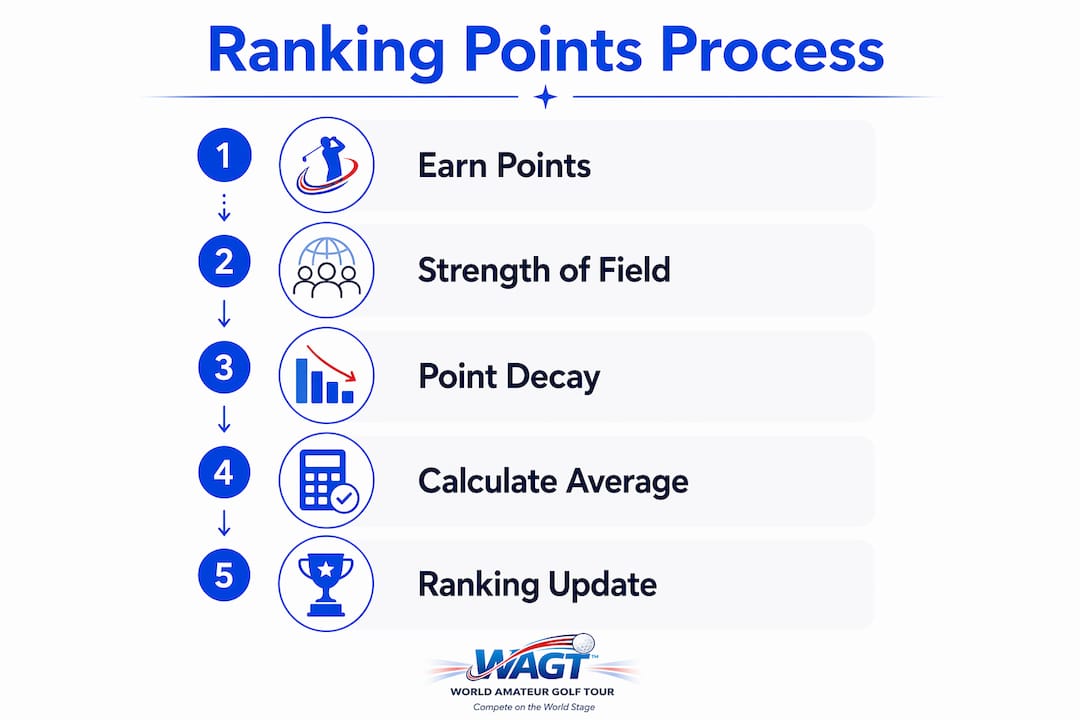
The OWGR ranks players by calculating their average points per tournament, not their total points. This distinction matters more than most players realize. A player who competes in 30 elite events and finishes consistently in the top 20 will outrank a player who plays 60 events and wins two of them at weak-field tournaments.
Points are awarded based on finishing position in each eligible event, but the value of those points depends entirely on the tournament's Strength of Field (SOF). The SOF calculation incorporates the strokes gained ratings of every player in the field, and the presence of top-ranked competitors increases the point pool exponentially. Winning a major championship with 80 of the world's top 100 players in the field earns dramatically more points than winning a developmental tour event with no top-50 players present.

The ranking period in golf spans 104 weeks, which is exactly two years. Points from any event maintain their full value for the first 13 weeks after that result. After week 13, points begin a gradual weekly decay that continues for the remaining 91 weeks of the cycle. This nonlinear decay system rewards current form without completely erasing longer-term performance. A win from 18 months ago still counts, but it counts far less than a win from last month.
To calculate your average, the OWGR divides your total accumulated points by a divisor representing the number of events played. The minimum divisor is 40, and the maximum is 52. If you play fewer than 40 events in the two-year window, your points are still divided by 40, not by your actual event count. This rule penalizes selective scheduling and discourages players from cherry-picking only the highest-value events while avoiding competitive exposure.
Only individual stroke play, match play, and stableford formats qualify for OWGR points. Team events are excluded entirely, meaning the Ryder Cup and Presidents Cup generate zero ranking points regardless of outcome.
Pro Tip: When reviewing a player's ranking trajectory, look at their average points per event rather than their total points. A rising average signals genuine improvement in performance quality, not just increased playing volume.
What factors influence your ranking position and opportunities?
Understanding what moves your ranking up or down requires thinking about three variables at once: performance quality, event selection, and playing frequency. Most amateur observers focus only on wins and losses. Elite players think in terms of ranking points per event.
Here are the key factors that shape your position on the ranking calendar:
-
Consistency over peaks. The OWGR rewards sustained professional excellence across two years, not a single hot stretch. A player who finishes in the top 10 in 15 events over two years will typically outrank a player who wins twice and misses cuts the rest of the season.
-
Strength of field selection. Players who target strong-field events earn more points per event than those who accumulate starts on weaker tours. The PGA Tour, DP World Tour, and LIV Golf events carry different SOF values, and those differences compound over a two-year cycle.
-
The minimum divisor trap. Playing fewer than 40 events in two years means your points get divided by 40 regardless. A player with 35 starts and strong results will see their average suppressed by this rule. Knowing this, most competitive professionals target at least 20 to 22 events per year.
-
The ranking threshold for majors. The top 50 ranking is the most widely recognized benchmark tier in professional golf. Players inside the top 50 receive automatic exemptions into major championships. Falling outside that threshold means relying on alternate entry routes, which are far less reliable.
-
Recent form weighting. Because points decay after 13 weeks, a strong run of form in the three months before a major's entry deadline carries outsized influence on your ranking position. Players time their peak preparation accordingly.
Pro Tip: If you are chasing a top-50 ranking before a major's entry cutoff, focus your schedule on events with the highest SOF values in the 13 weeks before the deadline. Those weeks represent your maximum point-earning window.
How rankings impact tournament eligibility and career visibility
The practical consequences of your OWGR position extend well beyond which events you can enter. Your ranking is the single most visible credential in professional golf, and its effects reach into sponsorship, media coverage, and long-term career trajectory.
Here is where ranking thresholds create real-world outcomes:
-
Major championship entry. The four major championships, including The Masters, U.S. Open, The Open Championship, and the PGA Championship, each use OWGR top-50 status as an automatic entry criterion at specific cutoff dates in the ranking calendar. Missing that threshold by even one position can cost a player a major start.
-
Olympic eligibility. The International Golf Federation uses OWGR to determine Olympic qualification. The top 15 players in the world qualify automatically, with a maximum of two players per country. For players outside the top 15, the next 60 spots are filled based on ranking, again with the two-per-country cap.
-
Ryder Cup and Presidents Cup selection. While captains retain picks, automatic qualifying spots for both team competitions are determined by OWGR and tour-specific points lists. A strong ranking position removes the uncertainty of waiting for a captain's pick.
-
Sponsorship and career visibility. Higher ranking correlates directly with increased sponsorship opportunities and media exposure. Equipment manufacturers, apparel brands, and tournament sponsors all use OWGR position as a benchmark for player value. Breaking into the top 100 often triggers the first serious equipment deals for young professionals.
How does the OWGR compare to other ranking systems?
The OWGR is one of several ranking and performance measurement systems in professional and amateur golf. Each serves a different audience and purpose.
| System | Audience | Purpose | Reset cycle |
|---|---|---|---|
| OWGR | Male professionals | Global performance ranking | Rolling 104 weeks |
| Women's World Golf Rankings | Female professionals | Global performance ranking | Rolling 104 weeks |
| FedExCup | PGA Tour members | Season-long points race | Annual reset |
| Race to Dubai | DP World Tour members | Season-long points race | Annual reset |
| World Amateur Golf Ranking (WAGR) | Amateur golfers | Amateur performance ranking | Rolling 104 weeks |
| Handicap Index | All golfers | Scoring potential and equity | Continuous update |
The most common source of confusion is between the OWGR and the Handicap Index. These are fundamentally different metrics. A Handicap Index measures your scoring potential relative to course difficulty, designed to create fair competition between players of unequal ability. The OWGR measures competitive performance against elite fields in sanctioned events. One is an equity tool for amateurs. The other is a professional performance credential. Mixing them up is like comparing a batting average to a salary ranking.
For junior and collegiate players, the World Amateur Golf Ranking (WAGR) mirrors the OWGR structure but applies to amateur competition. Building a strong WAGR position is the direct pathway to collegiate recruitment and professional tour exemptions. You can learn more about tournament handicap management to understand how these systems interact at the amateur level.
How to follow and interpret golf world rankings effectively
Reading the OWGR correctly takes more than glancing at the number next to a player's name. Here is how to extract real meaning from the data:
-
Find official updates at owgr.com. Rankings update every Monday following the conclusion of worldwide tour events. The site displays total points, average points, and events played for every ranked player.
-
Watch average points, not total points. A player ranked 30th with a high average points score is performing at a genuinely elite level. A player ranked 30th with a low average but high event count is benefiting from volume, not quality.
-
Track the SOF of upcoming events. Before a major's entry cutoff, identify which events on the ranking calendar carry the highest SOF values. Those events represent the best ranking opportunities for players on the bubble.
-
Monitor the top-50 and top-100 thresholds. The top 50 controls major exemptions. The top 100 is the benchmark for PGA Tour card eligibility and serious sponsorship conversations. Watch how players near these lines manage their schedules in the final weeks before key cutoff dates.
-
Understand that ranking credibility comes from the two-year window. A player who jumps from 200th to 40th in six months has had a remarkable run, but their position is fragile. A player who has held the top 30 for 18 months has demonstrated the sustained excellence the system is designed to reward.
Key takeaways
The OWGR measures sustained competitive excellence over two years, and your average points per event determines your position far more than your total wins or starts.
| Point | Details |
|---|---|
| Rolling 104-week period | Rankings use a two-year window with full points for the first 13 weeks, then gradual decay. |
| Average points determine rank | Total points divided by a divisor of 40 to 52 events sets your actual ranking position. |
| Strength of field drives value | Competing in events with top-ranked fields earns exponentially more points per finish. |
| Top-50 is the key threshold | Players ranked inside the top 50 receive automatic major championship exemptions. |
| OWGR differs from Handicap Index | The OWGR ranks professional performance; a Handicap Index measures amateur scoring potential. |
Why the ranking system rewards the right things
I have spent years watching players misread the OWGR and pay for it with missed major starts and stalled careers. The most common mistake is treating the ranking as a scoreboard to chase rather than a reflection of genuine competitive quality. Players who obsess over their number tend to make poor scheduling decisions, chasing weak-field events for easy points instead of testing themselves against the best fields available.
The system is designed well. The minimum divisor rule, the SOF weighting, and the two-year decay curve all push players toward the same behavior: compete consistently, compete against strong fields, and perform when it matters. That is exactly what the sport should reward.
What I find underappreciated is how the ranking shapes the amateur-to-professional transition. Junior players who build strong WAGR positions through events like those run by Worldamateurgolftour are not just earning points. They are developing the competitive habits that the OWGR will later reward. Consistent performance in well-run, competitive amateur events is the best preparation for the professional ranking grind.
The one area where I think the system could improve is transparency around SOF calculations. Most fans and even many players cannot easily verify how a tournament's SOF was determined. Greater public visibility into that calculation would strengthen trust in the ranking's credibility and help players make smarter scheduling decisions.
— Gene
Start earning ranking points with Worldamateurgolftour
If you are a junior, collegiate, or competitive amateur golfer serious about your ranking trajectory, the path forward starts with competing in the right events. Worldamateurgolftour provides WAGR-counting tournaments at championship-caliber courses in Florida, giving you direct access to ranking points that matter for collegiate recruitment and professional pathways.

Every event is professionally run, fairly managed, and designed to give serious players the competitive environment they need to grow. Whether you are chasing a WAGR benchmark or building the consistency the OWGR will one day reward, WAGR amateur tournaments are where that work begins. Explore membership options and upcoming events at Worldamateurgolftour and take the next step in your competitive golf career.
FAQ
What is the OWGR ranking period in golf?
The ranking period in golf spans 104 weeks, or two full years. Points from each event hold full value for the first 13 weeks, then decay gradually over the remaining 91 weeks of the cycle.
What ranking threshold qualifies a player for major championships?
The top 50 in the OWGR is the primary ranking threshold for automatic major championship exemptions. Players inside the top 50 at the relevant entry cutoff date receive automatic invitations to all four major championships.
How is the golf world ranking different from a Handicap Index?
The OWGR ranks professional golfers based on competitive performance in sanctioned events. A Handicap Index measures a golfer's scoring potential relative to course difficulty and is designed for amateur equity, not professional performance comparison.
How do players earn more ranking points per event?
Players maximize ranking points by competing in events with the highest Strength of Field values. Tournaments where many top-ranked players compete award more points for every finishing position, making field quality more important than event quantity.
Does the WAGR use the same system as the OWGR?
Yes. The World Amateur Golf Ranking mirrors the OWGR structure, using a rolling 104-week period and SOF-weighted points. Junior and collegiate players use WAGR to build visibility for collegiate recruitment and professional tour exemptions.