

Amateur golfer tournament handicap management is the process of converting your Handicap Index into a playing handicap tailored for each specific event, ensuring fair competition across different courses and formats. The World Handicap System (WHS), administered by the USGA and managed through platforms like GHIN, governs this conversion for every sanctioned amateur event. Understanding how this system works gives you a real competitive edge. You stop guessing at your strokes received and start making deliberate decisions about tee selection, format strategy, and score posting that directly affect your results.
How to calculate your playing handicap for tournament formats
The Course Handicap formula is the foundation of every tournament calculation: Course Handicap = Handicap Index × (Slope Rating ÷ 113) + (Course Rating − Par). That number reflects the strokes you need to play to par on a specific course from a specific set of tees. It is not your playing handicap yet. One more step applies.
Once you have your Course Handicap, the tournament committee applies a format-specific allowance to produce your Playing Handicap. Here is how the most common formats break down:
- Stroke play: 95% of Course Handicap. The reduction accounts for the competitive nature of individual medal play.
- Match play: 100% of Course Handicap. Full strokes are applied because you are competing hole by hole against one opponent.
- Four-ball (best ball): Approximately 85% of Course Handicap per player. The format advantage of two players sharing the best score justifies the reduction.
- Alternate shot (foursomes): Typically 50% of the combined team handicap. Shared shot-making responsibility lowers the strokes needed.
To make this concrete: a player with a Handicap Index of 14.2 playing a course with a Slope Rating of 128 and a Course Rating of 72.1 on a par-72 layout calculates a Course Handicap of 17. In a stroke play event at 95%, that player receives 16 strokes. In match play, they receive the full 17.
Format-specific allowances change the strokes given or received and directly affect your shot-planning strategy. A player who knows they receive one fewer stroke in stroke play will approach risk differently than in match play.
Pro Tip: Always confirm which tee set the tournament uses before the event. Tee selection changes your Slope Rating and Course Rating inputs, which shifts your Course Handicap by one or two strokes in either direction. That difference matters in close competition.
Tee selection is not just a comfort choice. Strategic tee and format selection is a recognized part of handicap optimization. A longer tee set with a higher Slope Rating will increase your Course Handicap, potentially giving you more strokes in formats that use the full allowance.
How does score posting work under the World Handicap System?
Posting scores promptly is not optional under WHS rules. Your Handicap Index updates daily at midnight, incorporating any rounds posted that day along with Playing Conditions Calculation (PCC) adjustments. If you play on Saturday and wait until Monday to post, you may compete Sunday with an outdated index.
Here are the core score posting rules every tournament competitor needs to know:
- Post every acceptable round. An acceptable round is any 18-hole or 9-hole round played on a rated course under normal playing conditions. This includes casual rounds, not just tournament play.
- Apply net double bogey as your maximum per hole. Net double bogey equals par + 2 + any handicap strokes you receive on that hole. If you make a 9 on a par-4 where you receive one stroke, your posting score for that hole is 7, not 9.
- Understand PCC adjustments. The Playing Conditions Calculation automatically adjusts score differentials between −1.0 and +3.0 when conditions are significantly harder or easier than the course rating suggests. This runs nightly when enough qualifying scores are submitted from the same course and date.
- Post 9-hole scores separately. Under WHS, you post 9-hole scores individually. They combine automatically when two 9-hole scores from the same day are available, but you do not need to wait.
Pro Tip: After a tournament round, post your score before you leave the facility. Most tournament committees post scores on behalf of players in official events, but confirm this with your committee. Relying on them without checking is a common source of posting errors.
The net double bogey rule is one of the most misunderstood elements of the system. Capping extreme hole scores prevents one disastrous hole from inflating your differential and artificially raising your index. It protects the integrity of your handicap over time.
How do different tournament formats affect handicap strategy?
Different tournament formats apply different handicap allowances, and understanding those differences changes how you approach each event. The table below summarizes the most common formats and their standard allowances.

| Format | Handicap allowance | Strategic implication |
|---|---|---|
| Stroke play (individual) | 95% | Fewer strokes received; consistency rewarded |
| Match play (individual) | 100% | Full strokes; hole-by-hole strategy matters |
| Four-ball (best ball) | 85% per player | Team format advantage reduces individual strokes |
| Alternate shot (foursomes) | 50% of combined | Shared responsibility; partner selection is critical |
| Scramble | Varies (typically 20–35%) | Low allowance reflects team format advantage |
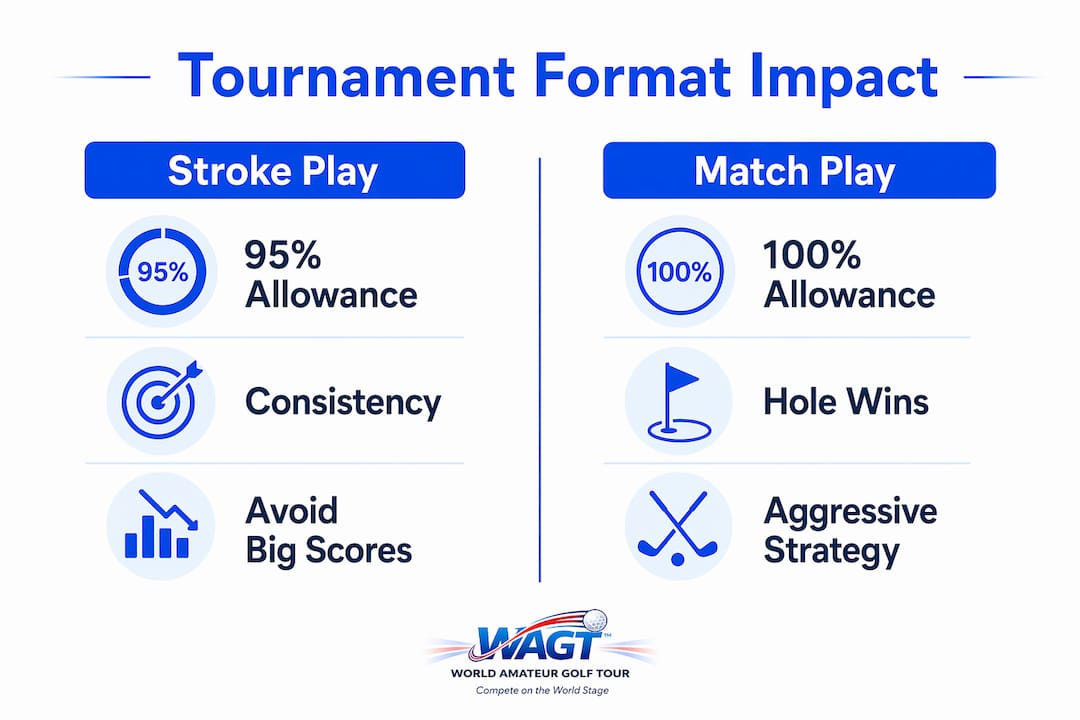
Stroke play rewards consistency above all else. With a 95% allowance, your net score depends on avoiding big numbers across all 18 holes. One triple bogey on a hole where you receive no stroke can cost you the event. This is why understanding your handicap strokes by hole allocation matters. You receive strokes on the hardest-rated holes first, so knowing which holes those are helps you manage risk.
Match play at 100% allowance shifts the strategy entirely. You are not protecting a cumulative score. You are winning individual holes. A player who receives a stroke on a difficult par-4 can afford to play more aggressively because the stroke provides a safety net. Losing a hole by one net stroke costs the same as losing it by five.
Team formats like four-ball require you to understand how golf tournament formats interact with handicap allowances at the team level. In four-ball, the higher-handicap player often receives more strokes on the hardest holes, which creates specific opportunities. That player should take calculated risks on those holes because their partner can cover a bad score.
Common mistakes in managing tournament handicaps
Most handicap problems in amateur tournaments come down to a short list of repeatable errors. Recognizing them before they affect your index is the fastest way to protect your competitive standing.
- Delaying score posting. Incorrect or delayed posting misrepresents your current ability and creates an inaccurate index. Post every round the same day you play it.
- Confusing net double bogey with actual play rules. The cap applies only to handicap posting, not to your score during the round. In tournament play, you must count every stroke. Picking up because you have "reached your max" is a rules violation.
- Ignoring PCC adjustments. Players often assume their posted score differential is final. PCC can shift it by up to 3.0 strokes. Check your GHIN record after posting to confirm the adjusted differential.
- Overlooking format allowances. Showing up to a four-ball event expecting your full Course Handicap and receiving 85% instead is a surprise that affects your game plan. Confirm the allowance with the committee during registration.
- Neglecting index maturity. Your index matures after 20 rounds, using the best 8 of your 20 most recent differentials. Early in your posting history, fewer scores are averaged with a sliding scale. Players new to competitive golf often have indexes that do not yet reflect their true ability.
"The handicap system only works when every player treats it as a responsibility, not a formality. Post every round, apply every rule, and let the math do its job."
What are the best strategies to improve your handicap for tournaments?
Golf handicap improvement for tournament play is not about gaming the system. It is about giving the system accurate data to work with, then improving the scores you feed into it.
- Post all rounds without exception. Good rounds lower your index. Bad rounds are capped by net double bogey and have limited upward impact. Selective posting, where players skip bad rounds, is a violation of WHS rules and distorts your index.
- Practice scoring consistency, not just ball-striking. Your index uses your best 8 differentials from your last 20 rounds. A player who shoots 78, 79, 80, 78 consistently will have a lower index than one who alternates 74 and 88. Reducing your worst rounds matters as much as improving your best.
- Use course and format knowledge strategically. Before a tournament, review the hole handicap allocation on the scorecard. Identify which holes you receive strokes on and build your game plan around those holes. Aggressive play on stroke holes, conservative play on others, is a proven approach.
- Track your differentials over time. GHIN and similar platforms display your score differentials in order. Reviewing them tells you whether your index is trending down, which is the goal, or whether specific course conditions are inflating your scores.
- Engage with open amateur events regularly. Competitive rounds under tournament conditions produce more accurate differentials than casual rounds. The pressure of competition changes how you score, and your index should reflect that reality.
Pro Tip: If your index feels higher than your actual ability, audit your last 20 differentials in GHIN. Look for rounds posted from unusually difficult conditions that received large PCC adjustments. Those rounds may be pulling your index up. Understanding why your index sits where it does is the first step to moving it.
Key takeaways
Effective amateur golfer tournament handicap management requires accurate score posting, format-specific allowance knowledge, and a clear understanding of the Course Handicap formula under the World Handicap System.
| Point | Details |
|---|---|
| Course Handicap formula | Multiply Handicap Index by Slope Rating divided by 113, then add Course Rating minus Par. |
| Format allowances vary | Stroke play uses 95%, match play 100%, and four-ball approximately 85% of Course Handicap. |
| Post scores same day | Daily midnight index updates mean delayed posting creates an inaccurate Handicap Index for your next event. |
| Net double bogey caps posting | The cap equals par + 2 + handicap strokes received; it applies to posting only, not actual tournament play. |
| Index matures at 20 rounds | The best 8 of your last 20 differentials determine your index; consistent posting accelerates accuracy. |
What I've learned watching amateurs mismanage their handicaps
I have spent years watching competitive amateurs walk into tournaments with a solid game and a handicap that does not represent them. The most common pattern is not cheating. It is neglect. Players post inconsistently, skip rounds they are embarrassed by, and then wonder why their index feels off when they compete.
The second pattern is misunderstanding the net double bogey rule. I have seen players pick up mid-hole during a tournament round because they believed they had reached their "handicap maximum." That is a rules violation. The cap exists only for what you record on your scorecard after the round for posting purposes. During play, every stroke counts.
The third thing I would tell any serious amateur is to talk to your tournament committee before the event, not during it. Ask about the format allowance, confirm how scores will be posted, and clarify whether the event uses WHS or a local system. Committees appreciate the question, and you avoid surprises on the first tee.
Understanding the mechanics of your handicap is not a bureaucratic exercise. It is competitive preparation. The players who manage their handicaps well are the ones who show up knowing exactly how many strokes they receive, on which holes, and why. That knowledge changes how you play every single hole.
— Gene
Compete where your handicap is managed with precision

Worldamateurgolftour organizes WAGR-counting amateur events where WHS handicap rules are applied correctly and consistently across every round. If you are serious about competing in fair, professionally run tournaments that count toward your WAGR amateur ranking, this is where you belong. Every event uses certified courses, proper handicap allowances by format, and transparent scoring that gives every player a genuine shot at competing. Whether you are a junior building your ranking or a collegiate player transitioning to the amateur circuit, Worldamateurgolftour provides the competitive environment your game deserves. Visit worldamateurgolftour.com to explore upcoming events and register today.
FAQ
What is a playing handicap in tournament golf?
A playing handicap is your Course Handicap adjusted by a format-specific allowance, such as 95% for stroke play or 100% for match play. It determines the exact number of strokes you receive during a tournament round.
How do I calculate my Course Handicap?
Your Course Handicap equals your Handicap Index multiplied by the Slope Rating divided by 113, plus the Course Rating minus Par. The result is rounded to the nearest whole number.
What is net double bogey and when does it apply?
Net double bogey is par + 2 + any handicap strokes you receive on a hole, and it serves as the maximum score for posting. It applies only when recording your score for handicap purposes, not during actual tournament play.
How does the Playing Conditions Calculation affect my handicap?
The PCC adjusts differentials between −1.0 and +3.0 when course conditions are significantly harder or easier than the rating suggests. It runs automatically each night when enough qualifying scores are submitted from the same course and date.
How many rounds does it take for a Handicap Index to become accurate?
Your index reaches full maturity after 20 posted rounds, at which point it uses the best 8 differentials from your most recent 20 scores. Early in your posting history, fewer scores are averaged using a sliding scale weighting system.