

The Women's World Amateur Golf Ranking (WWAGR) ranks female amateur golfers by averaging points earned in designated Counting Events over a rolling 104-week window, with rankings updated every Wednesday. Five things drive the number next to your name: which events count, how strong those fields are, how many points you bank, how your point average is divided, and how recent that performance was. Miss any one of those, and your ranking either stalls or slides even if your golf is trending in the right direction.
Here's what actually moves the needle:
- Play events that count. Not every tournament feeds your WWAGR; verify status before you enter.
- Check your profile weekly. Your divisor and points average live on your player page and update every Wednesday.
- Stack strong fields, consistently. One great week won't outrun six months of skipped opportunities.
Key Takeaways
Women's WAGR ranks amateur golfers by averaging points from Counting Events over a rolling 104-week period, with weekly Wednesday updates that reward consistent, high-field competition over occasional big weeks.
| Point | Details |
|---|---|
| WWAGR is governed jointly | The R&A and USGA administer the system, ensuring geography-blind, objective comparisons. |
| Points age over 104 weeks | Full value for 52 weeks, then roughly 2% weekly reduction until points drop off. |
| Rankings update weekly | Every Wednesday at noon (GMT/BST), reflecting events concluded by the prior Sunday. |
| Ranked Player status has thresholds | Requires 36 holes and 6.5 minimum points; DQs and withdrawals score zero. |
| World Amateur Golf Tour offers a direct pathway | Its 54-hole, WAGR-compliant events give players a reliable route to earn ranking points. |
Table of Contents
- What Is Women's WAGR and Who Runs It?
- How Women's WAGR Rankings Are Calculated
- Which Tournaments Count Toward Your Women's WAGR?
- Why a Strong Women's WAGR Actually Matters
- How to Check and Correct Your Women's WAGR
- How to Improve Your Women's WAGR
- How WAGR-Counting Events Work in Practice
- Why Understanding Women's WAGR Changes How You Compete
- Play WAGR-Counting Events With World Amateur Golf Tour
- Sources
- FAQ
What Is Women's WAGR and Who Runs It?
Women's WAGR is the global ranking system that measures elite amateur performance and gives every serious female golfer, from a high school standout to a college All-American, an objective number that coaches, committees, and championship organizers actually trust. It launched as a companion to the men's list and now stands as its own governed, independently calculated system.
The ranking is administered by The R&A in partnership with the USGA, the two organizations most amateur golfers already recognize from major championships and rules governance. That joint stewardship matters because it removes the guesswork. There's no regional bias baked into the math, no home-country advantage, just points earned against verified competition.
The purpose behind WWAGR runs deeper than a leaderboard. The R&A frames it as both a scouting tool for talent identification and a way to push national federations to build stronger development pipelines, since a country's average WWAGR standing becomes a visible scoreboard of its own. For an individual player, that translates into something simpler: a transparent, geography-blind way to prove you belong in the conversation.
A few starting points worth bookmarking:
- The official WAGR site hosts the full methodology, FAQs, and current criteria.
- The R&A's WAGR overview explains governance and the system's broader mission.
- The women's rankings date back to February 2011, and names like Lydia Ko and Rose Zhang have already written themselves into the ranking's early history.
How Women's WAGR Rankings Are Calculated
Every women's WAGR number comes down to one formula repeated across thousands of results: points earned, divided by events counted, averaged over time. Here's how each piece works.
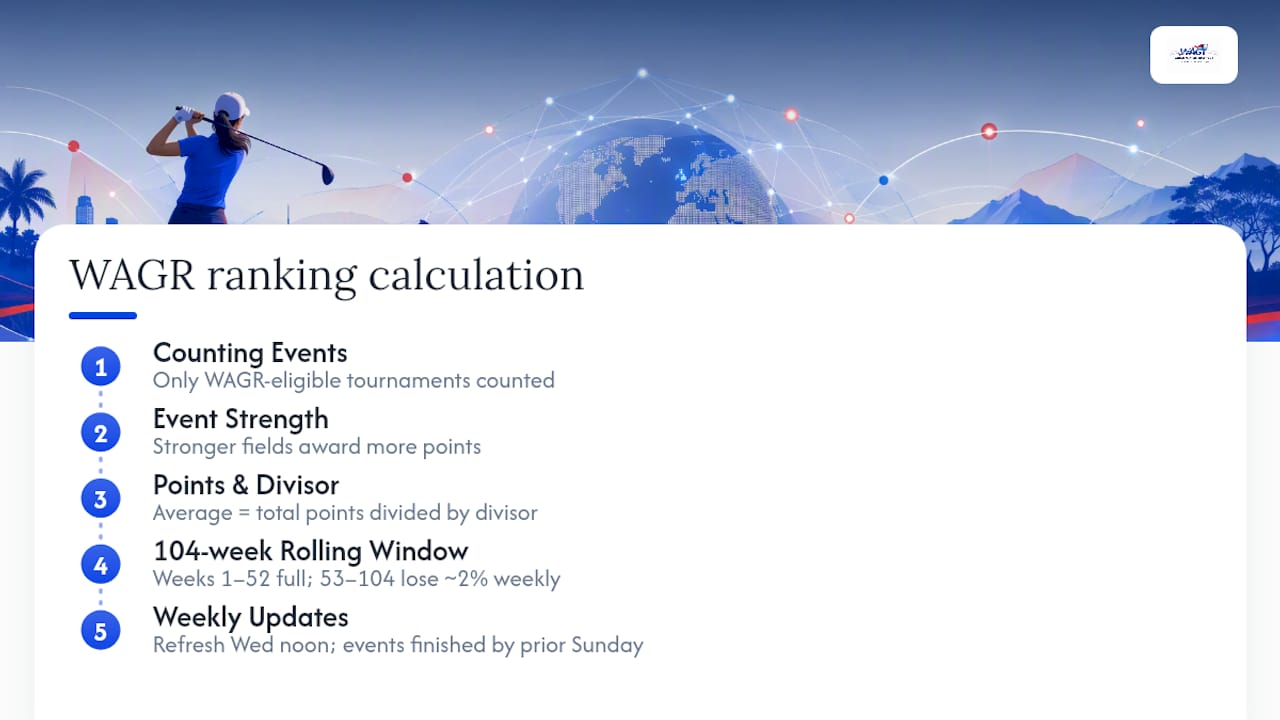
1. Counting Events. A Counting Event is any tournament that meets WAGR's format and field criteria, including recognized amateur championships and select professional events where amateurs are in the field. Casual club events, informal matches, and non-sanctioned scrambles never enter the math.
2. Event strength. Not all fields are equal, and WWAGR doesn't pretend otherwise. A national amateur championship stacked with top-100 players awards more points to its winner than a regional qualifier with a thin field. The strength rating is baked into how many points each finishing position is worth.

3. Points and the divisor. Each Counting Event you complete adds points to your total, but your ranking isn't your point total; it's your average. WAGR divides your cumulative points by a divisor, which reflects the number of events counted (with rules on minimum and maximum events considered). A stronger divisor built on consistent play across many strong fields produces a more stable, defensible average than one built on a single hot week.
4. The 104-week rolling window. This is the part most players misunderstand. Results from your most recent 52 weeks count at full value. Weeks 53 through 104 don't vanish instantly, they decay gradually, losing roughly 2% of their value each week until they drop out of the calculation entirely. That means a great fall from two years ago is still influencing your number today, just quietly less so every week that passes.
5. Weekly updates. WAGR rankings refresh every Wednesday at noon (GMT/BST), incorporating any Counting Event that concluded by the previous Sunday. If an organizer submits results late, your points simply wait for the next Wednesday cycle. That lag catches a lot of players off guard right before a deadline.
Quick math, made real: Say you've played eight Counting Events over two years and earned a combined 120 ranking points across those rounds, with your divisor set at 10 (accounting for a mix of counted and partially-weighted events). Your points average lands at 12.0. Add one strong finish at a highly-rated championship worth 15 points, and depending on how that event enters your divisor, your average can climb noticeably in a single Wednesday update, or barely move if your divisor is already large. Volume and quality both matter, but they pull in different directions on the math.
Which Tournaments Count Toward Your Women's WAGR?
Before you build a season around chasing points, confirm the events you're targeting actually count. Most players assume anything with "championship" in the name qualifies. It doesn't always.
Eligible events typically include:
- National and state amateur championships run by recognized golf federations.
- International amateur championships with verified fields and formats.
- Select professional events that permit amateur entrants, such as certain LPGA or developmental tour stops with open qualifying.
- Multi-round tour events, like those run by World Amateur Golf Tour, that meet WAGR's minimum format and reporting requirements.
Exceptions trip up plenty of good players. Single-day scrambles, invitational pro-ams without a verified amateur field, and shortened events that don't meet minimum hole requirements typically won't count, no matter how competitive the field looks on paper.
Event category and field strength together decide how many points are actually available. A 54-hole national championship with a deep field of ranked competitors offers a bigger points pool than a 36-hole regional event, even if both technically qualify. Before entering, check the WAGR event list or ask the event organizer directly whether results will be submitted for ranking credit. That two-minute email can save you from wasting an entry fee on a week that does nothing for your number.
Why a Strong Women's WAGR Actually Matters
A high WWAGR isn't a vanity metric. It's a door opener, and the doors are specific.
The most visible reward is the Mark H. McCormack Medal, awarded to the leading female amateur at the close of the calendar year. That recognition typically comes with real exemptions into marquee events, giving the top-ranked amateur a shot at competing alongside professionals on golf's biggest stages.
A high ranking is not just recognition. It functions as an active pathway, converting amateur performance into college recruiting leverage, scholarship offers, Name, Image, and Likeness opportunities, and even exemptions into major championships like the US Women's Open and the AIG Women's Open.
Beyond the medal, WWAGR feeds directly into structured pathways. Programs like PGA TOUR University and the LPGA Collegiate Advancement Pathway use ranking data to identify and fast-track talent. College coaches lean on it constantly, since a verified WWAGR number is a faster, more objective signal than a highlight reel or a single tournament result.
- McCormack Medal winners have historically earned starts in major women's championships.
- College programs use WWAGR standing as a primary recruiting filter, especially for international prospects.
- Consistent top-200 rankings tend to open doors to NIL conversations that raw talent alone doesn't guarantee.
How to Check and Correct Your Women's WAGR
Finding your number takes about thirty seconds once you know where to look.
- Go to the women's ranking page on WAGR.com and search your name or browse the current leaderboard.
- Open your player profile to see your Divisor and Pts Avg fields, the two numbers that actually determine your rank.
- Cross-check recent results against your event history to confirm everything you played has posted.
You don't officially become a Ranked Player just by teeing it up. WAGR requires completing at least 36 holes in a Counting Event and earning a minimum of 6.5 ranking points before you're assigned a number. A disqualification or a withdrawal scores zero for that event, which can drag your average down if it happens during a stretch where you're still building your divisor.
Pro Tip: If a tournament you just finished isn't showing up in Wednesday's update, don't assume it's an error on your end. Results only post once the organizer submits them, so a quick email to the tournament director asking about submission timing usually solves it faster than waiting another week.
How to Improve Your Women's WAGR
Improving your number is less about one big week and more about how you build your schedule over the full 104-week window.
- Prioritize Counting Events with deeper, stronger fields over easier events with thinner competition.
- Protect your finishing position; a mid-pack finish at a strong event often beats a win at a weak one.
- Avoid unnecessary withdrawals or disqualifications, since both score zero and can quietly erode your average.
- Spread strong results across the rolling window instead of front-loading one hot season and going quiet.
- Check which tournaments actually count before building your calendar around them.
Coaches planning junior or college schedules should weigh entry chances against event strength realistically. A player who consistently finishes top-20 at well-rated events builds a more durable average than one chasing a handful of marquee fields she's unlikely to crack. Since your divisor rewards steady participation, a season with six solid results usually outperforms a season with two great ones and four skipped months.
Pro Tip: Treat your WWAGR schedule like a portfolio, not a lottery ticket. Balance one or two aspirational, high-strength events with several realistic, winnable Counting Events to keep your average climbing instead of stalling between big swings.
How WAGR-Counting Events Work in Practice
Getting a tournament certified as a Counting Event isn't automatic. Organizers have to meet specific criteria before a single point can be awarded.
That checklist generally includes minimum format requirements (typically 54 holes of stroke play), verified field strength, and, critically, prompt result submission after the final round. Miss that submission window, and player points simply wait for the next Wednesday cycle, which can be the difference between meeting a deadline and missing one.
World Amateur Golf Tour builds its events around exactly that checklist: multi-round formats, verified fields, and disciplined result reporting that keeps the pathway from entry to points clean and fast. A player registers for an event, competes across the full format, and once results are submitted, her performance flows directly into her WAGR profile without extra paperwork on her end. That's the whole point of choosing events that report correctly: the ranking work happens in the background while you focus on your golf.
Why Understanding Women's WAGR Changes How You Compete
Most players treat their WAGR number as something that happens to them. It shouldn't work that way. Once you understand that points age, fields carry different weight, and your divisor rewards consistency over streaks, scheduling stops being guesswork and starts being strategy.
Coaches who track this data gain a real recruiting and performance-planning edge, spotting which players are trending up before a single highlight goes viral. Transparency in the system is the whole advantage: everyone is working from the same rulebook, so the players who understand it best simply plan better.
Play WAGR-Counting Events With World Amateur Golf Tour
If you've made it this far, you already know the fastest way to move your WWAGR number is to play in verified Counting Events with strong fields and clean result reporting. That's exactly what World Amateur Golf Tour is built around: championship-caliber courses, professionally run 54-hole events, and a membership that gets your results submitted correctly the first time, without you having to chase an organizer for confirmation.

Beyond the events themselves, membership gives you a rewards program redeemable for gear and entry credits, live scoring, and player profiles that college coaches can actually find and evaluate. If you're planning your next season and want events that count from day one, check the current tournament schedule and register for an upcoming stop near you.
Sources
- The World Amateur Golf Rankings® (WAGR®) | The Official Men's and Women's Amateur Golf Rankings
- World Amateur Golf Ranking
- What is WAGR?
- World Amateur Golf Ranking - Wikipedia
FAQ
What does WWAGR stand for? It stands for the Women's World Amateur Golf Ranking, the global ranking system for elite female amateur golfers administered by The R&A and the USGA.
How often does the women's WAGR update? Rankings update every Wednesday at noon (GMT/BST), incorporating results from Counting Events completed by the previous Sunday.
How many events do I need to play to get ranked? You need to complete at least 36 holes in a Counting Event and earn a minimum of 6.5 ranking points before you're assigned an official ranking.
Do old results ever fall off my WAGR? Yes. Results from your most recent 52 weeks count fully, then gradually lose value over weeks 53 through 104 until they drop out of your average entirely.
Does World Amateur Golf Tour count toward WAGR? Yes, World Amateur Golf Tour runs multi-round events built to meet WAGR's format and reporting requirements, giving players a direct route to earn ranking points.