

Junior golf age divisions typically group players in two-year bands (9u, 11u, 13u, and so on) with 9-hole formats for younger juniors and 18-hole formats once players hit their early teens. Every event publishes an "age as of" cutoff date and a yardage grid tied to that bracket, so the fastest path to the right division is checking the specific tournament's eligibility page before you assume anything about age or distance.
TL;DR:
- Confirm the age-as-of cutoff date and verify yardage ranges for the specific tournament before registering a player to ensure proper division placement.
- Recognize that players generally move from 9-hole to 18-hole formats when their consistent scoring indicates readiness and physical endurance.
- Understand that championship and elite divisions require pre-approval based on scoring history or rankings, and WAGR-counting events carry important recruiting significance.
- Avoid playing a player up a division solely for ego; instead, assess maturity, scoring stability, and fatigue to ensure safe, developmentally appropriate competition.
- Use the eligibility page as a rulebook, check yardage grids carefully, and ask direct questions to match expectations with actual tournament standards.
Table of Contents
- What Are the Standard Junior Golf Age Divisions?
- How Do Tournaments Determine Age Eligibility?
- 9-Hole vs. 18-Hole Divisions: What's the Yardage Difference?
- What Are the Elite and Championship Junior Divisions?
- How Do You Choose the Right Division for Your Player?
- Junior Golf Yardage Chart by Age Division
- Why WAGR-Counting Events Matter for Serious Juniors
- What This Means for the Family Sitting on the Fence About Divisions
- Sources
What Are the Standard Junior Golf Age Divisions?
Most junior golf age groups fall into recognizable bands: 8-under, 9-10, 11-12, 13-14, and 15-18, though the exact labels shift depending on who's running the event. PGA Jr. League keeps things simple with three tiers: 9u, 13u, and 17u, using league-age rules tied to a specific cutoff date rather than a player's actual birthday on tournament day. Regional bodies like JGAA structure divisions as 8-10, 11-12, 13-14, and 15-18, a pattern that shows up across dozens of state and regional junior golf organizations.
Organizers do not split brackets randomly. They're balancing course logistics against player development, and the format often changes with age:
- U.S. Kids Golf runs age-specific 9-hole and 18-hole events, scaling yardage by year rather than by wide bracket.
- Gateway PGA Junior Tour separates its junior golf categories by both age and playing ability, using stroke-average thresholds to decide who plays 9 holes versus 18.
- Hurricane Junior Golf Tour (HJGT) leans toward 18-hole competitive divisions once players reach the 12-13 range, reflecting its focus on tournament-ready juniors.
- PGA Jr. League builds its 9u, 13u, and 17u tiers around team scramble formats rather than traditional stroke play.
Boys' and girls' brackets frequently diverge past age 12, mostly because yardage needs and participation numbers start to separate as players mature physically. A 13-year-old boy and a 13-year-old girl might tee it up on the same course during the same week, but from different markers entirely.
The action item here is simple: don't assume your player's division from age alone. Pull up the specific event's division names, confirm the birthdate cutoff, and register accordingly.
How Do Tournaments Determine Age Eligibility?
"Age as of" is the rule that decides everything. It means your player's division is locked to their age on a fixed calendar date, not their age on the day they tee off. PGA Jr. League ties All-Star eligibility to league age as of July 31, 2026, so a player who turns 13 in August still competes at their pre-cutoff age for All-Star selection that season.
Eligibility often goes beyond birthdate. Here's how it typically works:
- Age cutoff placement. The tournament sets a reference date; your player's age on that date determines the division.
- Performance thresholds. Gateway PGA Junior Tour uses stroke-average benchmarks, sometimes requiring averages below 65 for certain 9-hole eligibility tiers, to keep divisions competitively even.
- Pre-approval for championship divisions. Some events request scoring history or ranking evidence before granting entry to a higher bracket.
Pro Tip: If your player's birthday falls within a few weeks of a tournament's cutoff date, call the event director directly. Cutoff interpretations vary enough between tours that a five-minute conversation can save a wasted entry fee.
9-Hole vs. 18-Hole Divisions: What's the Yardage Difference?
Younger divisions play 9 holes because stamina, attention span, and swing development haven't caught up to a full competitive round yet. Once players show consistent scoring and the physical endurance to finish 18 holes without their swing falling apart on the back nine, tours move them into the longer format.
Yardage scales right along with that shift. Typical 9-hole junior divisions run approximate yardages in the lower thousands, while 18-hole brackets range roughly from mid to upper thousands of yards for girls and boys, depending on age. U.S. Kids Golf builds these numbers using the Longleaf Tee System, a scaled approach that sets yardages by age rather than forcing every junior onto one fixed set of markers.
Signs your player is ready to step up to 18 holes:
- Scoring stays consistent across the back nine, not just the front.
- Practice rounds of 18 holes don't produce a visible drop in swing quality by hole 14 or 15.
- Your coach has flagged readiness based on strength and shot-shaping consistency, not just age.
What Are the Elite and Championship Junior Divisions?
Championship divisions carry tighter age windows, higher yardages, and often a pre-approval step tied to scoring history or ranking position. JGAA notes that its championship divisions require approval rather than open entry, a pattern that repeats across most regional and national tours.
PGA Jr. League's All-Star format sits inside this category too. Selection for the 9u, 13u, and 17u All-Star teams runs on league-age rules that differ from regular-season registration, which trips up families who assume the two use the same cutoff.
At the top end, invitationals raise the bar further:
The Dye Junior Invitational runs as a 54-hole event with a capped field, and entries are ranked using AJGA, WAGR, and other national lists rather than accepted on a first-come basis.
That's the pattern to watch for as your player moves up: WAGR-counting events attach real ranking weight to results, which matters directly for college recruiting visibility. Before applying anywhere at this level, confirm the ranking cutoff, the application window, and whether the event actually counts toward WAGR.
How Do You Choose the Right Division for Your Player?
Getting the division right protects both development and safety, and it starts with a short checklist before you hit submit on any entry form:
- Confirm the tournament's age-as-of cutoff date against your player's birthdate.
- Check the published yardage grid for that bracket, not a generic estimate.
- Verify whether the event runs 9 or 18 holes at that age level.
- Read the eligibility page for scoring thresholds or pre-approval requirements.
- Review caddie and parent-on-course rules, since these vary widely by tour.
Playing up a division makes sense when scores are consistently low for the current bracket, a coach recommends it, and the player shows the maturity to handle longer yardage and slower pacing. It's a mistake when it's driven by ego rather than readiness. Watch for fatigue late in the round, wide gaps between good and bad holes, or a player who can't recover mentally from a rough start. Those are signs the jump happened too soon.
Pro Tip: Ask the event director two direct questions before committing: what's the exact age-as-of date, and does the yardage grid match what your player has practiced on? Mismatched expectations here cause more mid-round meltdowns than actual skill gaps.
Equipment matters here too. A player moved up to longer yardages needs clubs and tee selection that match the new distances. Forcing a swing to reach markers it isn't ready for is a fast way to build bad compensation habits, if not an actual injury risk.
Junior Golf Yardage Chart by Age Division
Yardages below reflect typical ranges published by major junior tours. Confirm exact numbers on the specific event's page, since course setup and tee placement shift year to year.
These ranges draw on the Longleaf Tee System used by U.S. Kids Golf and division setups published by Gateway PGA Junior Tour. Individual courses adjust based on par configuration and hazard placement, so treat these as planning ranges, not fixed numbers.
Why WAGR-Counting Events Matter for Serious Juniors
Ranking points earned through WAGR-counting events give a junior's results real weight outside the local scoreboard. Because organizers hold every player in an event to the same yardage and eligibility standards, the resulting scores become comparable and trustworthy data for college coaches evaluating talent. That consistency is exactly what separates a scouting-worthy result from a number nobody outside the club recognizes. Families building toward recruiting exposure should look at professionally run tournament options that maintain consistent standards from one event to the next.
What This Means for the Family Sitting on the Fence About Divisions
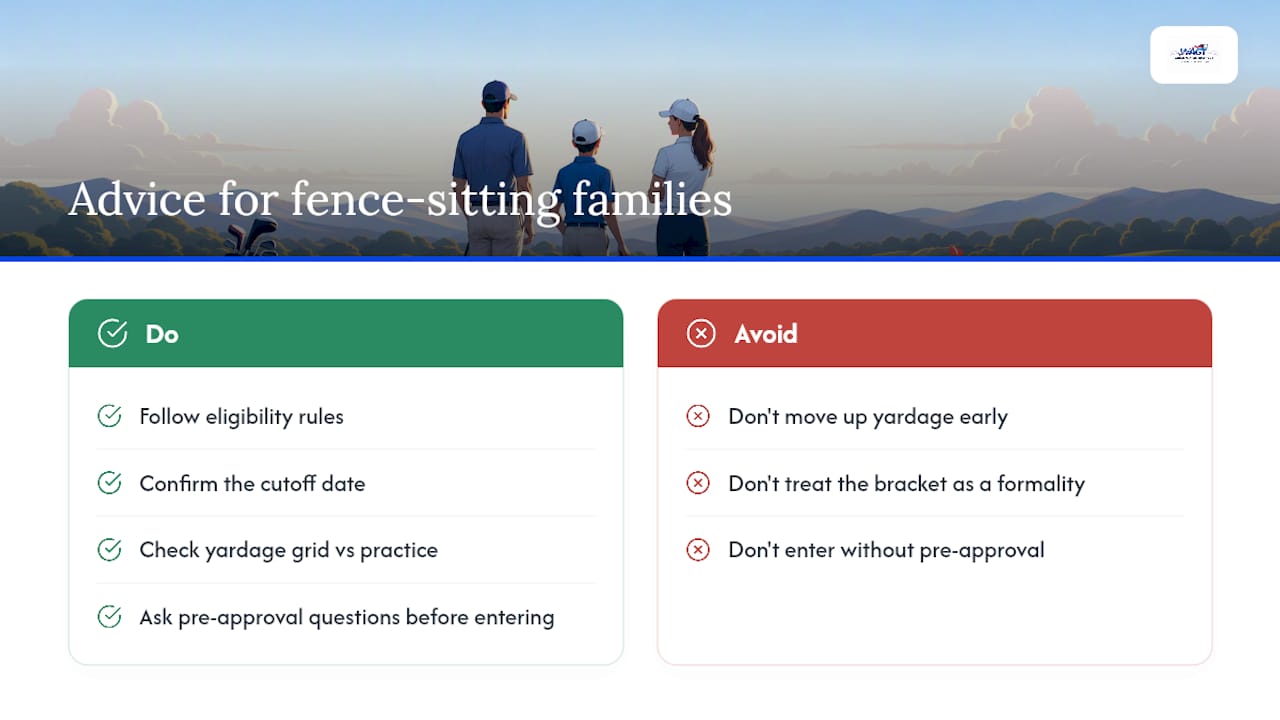
The biggest mistake I see in how families approach age divisions isn't picking the wrong bracket. It's treating the bracket as a formality instead of a competitive strategy. A player capable of a 78 average in their current division but forced into 6,400 yards a year early because of ego or impatience usually posts worse numbers and loses confidence, not gains it. The yardage grids and cutoff dates exist because someone tested what distance and hole count actually produce fair, developmentally sound competition. Ignoring that structure doesn't make a player better faster. It just makes the data on them harder to trust.
The families who get real value out of junior golf age divisions treat the eligibility page like a rulebook, not a suggestion. They confirm the cutoff date, they check the yardage grid against their player's practice rounds, and they ask direct questions before entering anything with a pre-approval requirement. That discipline is what turns a season of tournaments into a résumé college coaches can actually evaluate, rather than a stack of scores from mismatched competition.
— Gene
Sources
- Age Groups and Yardages | U.S. Kids Golf
- Learn | How Does PGA Jr. League Work? — PGA Jr. League
- Gateway PGA Junior Tour – Gateway PGA Section
- Age Divisions — JGAA