

Yes, you can transfer colleges and play golf immediately, but only if you meet two conditions the NCAA put in place starting in 2024: you enter the transfer portal during golf's designated window, and you stay academically eligible at your new school. Miss either one, and you're looking at a delayed start or a full year on the sideline. Before you touch the portal, talk to your compliance office and academic advisor. They'll tell you exactly where you stand.
TL;DR:
- Meeting transfer window dates and maintaining academic eligibility are the only conditions for immediate college golf transfer and play rights starting in 2024.
- Confirming your academic credits and scholarship status before entering the portal is crucial to avoid unnecessary sitting out or losing financial aid.
- The NCAA transfer portal functions as a recruitment notice, triggering instant contact from coaches once your name is posted, so timing your exit with your current coach is vital.
- Shorter, specific transfer windows for fall and spring in 2026 demand precise planning; missing these can delay your transfer by several months.
- If your transfer doesn't result in a new spot, your scholarship might still be active, and junior college offers an alternative path to compete and transfer later.
Table of Contents
- Quick Transfer Checklist for Golf Student-Athletes
- How the Transfer Portal Actually Works
- Transfer Windows and Dates for College Golf in 2026
- What Determines Immediate Eligibility After a Golf Transfer
- How a Portal Entry Affects Your Scholarship and Roster Spot
- Your Step-by-Step Timeline From Decision to New Team
- If You Enter the Portal and Nothing Happens
- Where to Confirm Your Exact Situation
- Why Academics, Not Athletics, Decide Your Transfer Now
- Sources
- FAQ
Quick Transfer Checklist for Golf Student-Athletes
Before you enter your name anywhere, run through this list. Skipping a step here is how good players end up sitting out a season they didn't need to lose.
- Confirm your academic standing and which earned credits will actually transfer toward a degree at your target school.
- Check the exact opening and closing dates of your sport-specific window (fall and post-championship spring).
- Meet with your compliance office and academic advisor, and request your unofficial transcript now, not later.
- Get clear on what happens to your scholarship the moment you enter, and document any current offer in writing.
- Build a simple recruiting profile with your contact information, stats, and academic record ready to send.
Pro Tip: Request your unofficial transcript before you tell anyone you're considering a transfer. Coaches at other programs will ask for it within days of seeing your name in the portal, and scrambling to get it from your registrar's office costs you time you don't have during a 15-day window.
How the Transfer Portal Actually Works
The transfer portal is a centralized NCAA database that does one job: it tells every other program in the country that you're available to be recruited. It is not a job board, and it is not optional paperwork you can quietly withdraw. Here's the sequence:
- You notify your current school of your intent to transfer, and the compliance staff enters your name into the portal.
- Your entry becomes visible to coaches and authorized staff at other institutions, who can now legally contact you.
- Recruiting rules still apply. Tampering rules bar coaches from contacting you before you're officially in the portal, and violations carry real consequences for programs.
- Withdrawal is possible but not simple. You can pull your name back out, but that requires specific steps with your school, not just a change of heart.
The NCAA is direct about this mechanism: entering the portal is a notification, and the practical fallout, phone calls, official visits, and offers, starts almost immediately once your name posts. Plan your conversations with your current coach and teammates before you enter, not after. Once you're in, the news travels fast, and you want to control that story rather than have it control you.
Transfer Windows and Dates for College Golf in 2026
College golf runs on two windows, and missing either one pushes your transfer timeline back months. For Division I, the fall window traditionally opens December 1 and runs 15 days, and the second window opens the day after your sport's Division I championship concludes and runs for a short period.
Golf's spring window matters more than most sports' equivalent. Because it lands right after the national championship, coaches and rosters are already in flux, making it the period when the most meaningful movement happens.
For 2026, the NCAA narrowed and re-dated the spring windows specifically for golf. Men's and women's golf now open their spring windows on different days, a deliberate change to keep roster movement from colliding with championship week itself.
- Fall window: opens December 1, runs 15 days.
- Spring window: opens the day after your division's championship, runs 15 days, with separate start dates for men's and women's golf under the 2026 update.
- Miss both, and you generally wait until the next window opens, which can mean sitting out a semester of eligibility to transfer at all.
Shorter windows exist partly because most transfers resolve quickly once they start, and partly to protect the integrity of championship week from being overshadowed by portal chaos. Confirm your exact dates every year using the official DI windows document. Dates shift, and your compliance office has the current schedule.
What Determines Immediate Eligibility After a Golf Transfer
Immediate eligibility no longer hinges on how many times you've transferred or whether a coach signs off. Since 2024, the NCAA eliminated the old year-in-residence requirement for undergraduates who meet academic standards, replacing an athletic penalty with an academic gate.
What actually gets checked:
- Whether you've passed the minimum required credits for your term and maintained cumulative progress toward a degree.
- Whether those credits transfer as core credits at your new school, not just as elective filler. Credits that look transferable on paper often don't count toward your major requirements at the receiving institution, which is why a transcript audit needs to happen before you commit, not after.
- Your standing with the NCAA Eligibility Center, which reviews academic progress alongside your new school's compliance office.
Division differences matter more than most golfers realize. Division I and Division II both use the transfer portal and windows described above, with DII generally following similar academic benchmarks but its own specific credit thresholds. Division III operates entirely differently: there's no portal, no windows, and no athletic scholarships to negotiate. DIII transfers run through a permission-to-contact or self-release process, which makes the move closer to a standard admissions decision than an athletic one.
Two alternate paths deserve a mention. Graduate transfers, players who've finished their undergraduate degree, follow a separate eligibility track and can often move with fewer restrictions since academic progress at the new school looks different for a grad program. The junior college route offers another route entirely: JUCO golf lets you keep competing and developing while you work through credits, then transfer into a four-year program once your academic and playing record supports it.
How a Portal Entry Affects Your Scholarship and Roster Spot
Entering the portal is not a reversible thought experiment. It's a signal to your current school that you may be leaving, and that signal has consequences.
- Your current program may decline to renew your scholarship or reassign that money to another player once you've entered.
- Division I roster limits introduced in recent years have pushed more players, especially those lower on the depth chart, toward the portal simply because there are fewer spots to go around.
- Get every scholarship offer from a new school in writing before you verbally commit to anything.
- Walk-ons and partial-scholarship players face the highest stakes here: you have less financial cushion if a transfer stalls, so confirm funding at both ends before you notify anyone.
Pro Tip: Ask your current coach directly, in writing if possible, whether your scholarship is safe if you decide not to transfer after entering the portal. Some programs treat a portal entry as a farewell; others don't. Knowing which kind of program you're on changes your entire calculus.
Your Step-by-Step Timeline From Decision to New Team
Getting through a golf transfer cleanly comes down to sequencing. Do these out of order and you risk losing eligibility time you can't get back.
- Before you decide: Run a full academic audit with your advisor, request your unofficial transcript, and have an honest conversation with your current coach.
- Entering the portal: Notify your school's compliance office, who enters your name officially. From here, coaches and staff at other programs can legally reach out, and you manage outreach, calls, and official visits.
- When offers arrive: Get scholarship terms confirmed in writing from any program you're seriously considering, then start the admissions and eligibility clearance process with that school's compliance office.
- Final enrollment: Submit final transcripts to your new school and confirm your NCAA and institutional eligibility clearance before you're allowed to compete, not just enroll.
Build extra time into every step. A strong recruiting profile ready to send the moment your name posts saves you days you'd otherwise spend building one from scratch while coaches are already calling.
If You Enter the Portal and Nothing Happens
Not every portal entry ends in a new roster spot, and that outcome is more common than most players expect. First, check whether your scholarship at your current school is actually gone or still intact. In many cases, you can simply stay and try again during the next window if the fit wasn't right anywhere else.
- JUCO is a legitimate reset, not a step-down: it preserves playing time and gives you a second shot at a four-year transfer later.
- Keep every email and text about offers and scholarship terms. Misunderstandings about verbal promises cause more problems than the transfer itself.
- Sit down with your academic advisor regardless of outcome. Confirm your credits and degree progress weren't affected by the process.
Where to Confirm Your Exact Situation
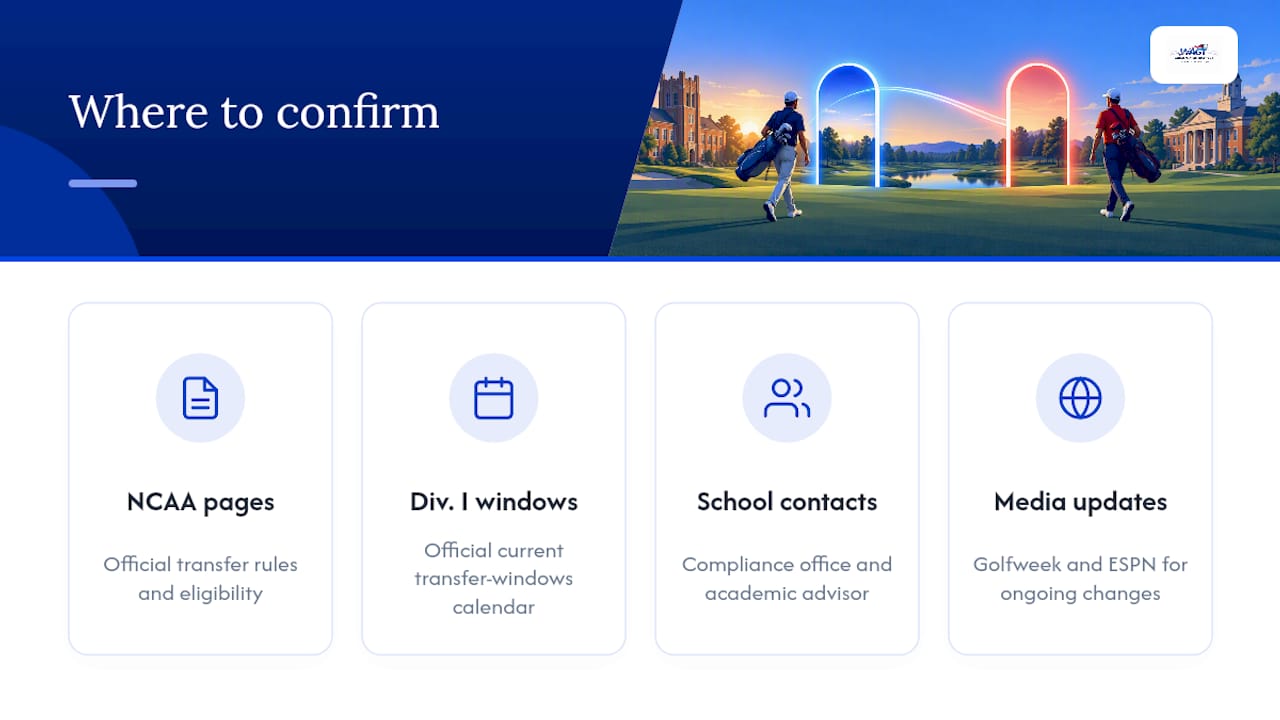
Rules shift year to year, so verify specifics rather than relying on last season's dates. Start with the NCAA's own transfer rules and eligibility pages and the official Division I undergraduate transfer windows document for the current calendar. Your school's athletics compliance office and academic advisor remain your best source for anything specific to your credits, scholarship, or division. For ongoing rule changes, outlets like Golfweek and ESPN cover updates as they happen. A broader look at how NCAA eligibility rules intersect with amateur circuits can also help you see the bigger picture.
Why Academics, Not Athletics, Decide Your Transfer Now
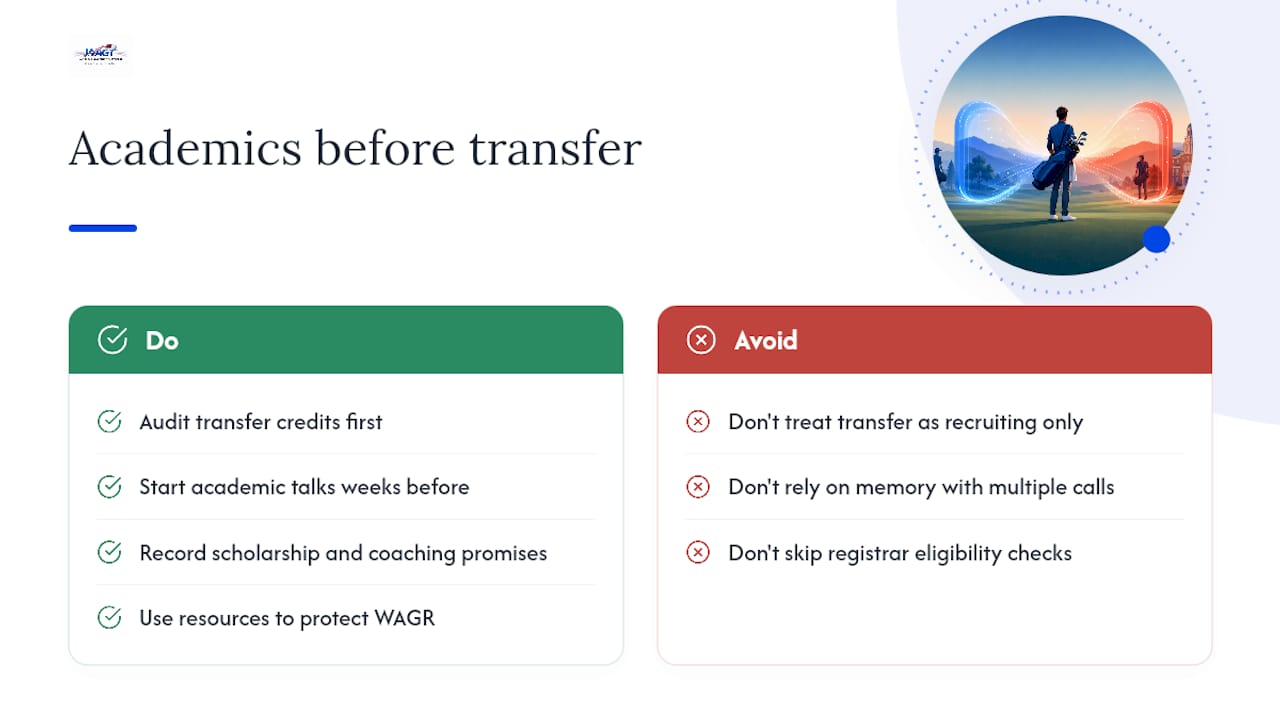
The biggest shift in this rule set isn't the portal itself. It's that eligibility now runs through the registrar's office as much as the athletics department. Players who treat the transfer process as a recruiting exercise, and forget to audit their credits first, are the ones who end up losing a semester they didn't have to lose.
Start the academic conversation weeks before you even think about entering the portal. Keep a written record of every scholarship conversation and coaching promise; memory is unreliable once three schools are calling you in the same week. If you're weighing a transfer as part of a longer plan around amateur status or WAGR-counting competition, resources built for junior and collegiate golfers can help you keep your competitive résumé strong no matter which campus you're on next fall.
— Gene
Sources
- Ncaa
- Fs
- NCAA approves changes to college golf transfer portal dates - Golfweek
- NCAA approves new transfer rule allowing immediate eligibility - ESPN
FAQ
What are the new NCAA transfer rules for golf?
Since 2024, academically eligible undergraduates can transfer and play immediately as long as they enter during golf's designated transfer window. The old year-in-residence penalty for multi-time transfers no longer applies to athletes who meet academic standards.
What is the 4-2-4 transfer rule?
This term doesn't correspond to an official NCAA golf transfer rule; definitions floating around for it vary and aren't consistent with published NCAA guidance. If you've heard this phrase applied to your situation, verify it directly with your compliance office rather than treating it as an established standard.
Do transfer portal players have to sit out a year?
Not anymore, as long as you meet academic eligibility requirements and enter during your sport's transfer window. The sit-out year was tied to athletic transfer penalties that the NCAA removed for undergraduates starting in 2024.
What happens if you enter the transfer portal and don't get picked up?
You can typically stay at your current school if your scholarship remains intact, though you should confirm that status with your coach directly. Some players use junior college as a reset path to keep competing and try the portal again during a later window.