

To land a college golf scholarship, you need three things locked in: NCAA Eligibility Center registration with qualifying core courses and GPA, tournament scores that match your target division's benchmark, and a coach-ready profile documenting both. Start with the Eligibility Center account today, then build your tournament calendar around it.
TL;DR:
- Most golf recruits should aim for tournament scores in the 70s on ranked events, as this consistent performance attracts Division I coaches' attention.
- NCAA Division I programs offer up to 9.0 scholarship equivalencies per team, which are usually split among multiple players rather than full rides.
- Academic certification through the NCAA Eligibility Center, including core courses and GPA thresholds, must be completed early to qualify for athletic aid.
- Coaches can only contact recruits legally from junior year onward, making early tournament scheduling and WAGR results crucial for visibility.
- Combining athletic aid with academic scholarships is essential, as golf scholarships rarely cover full tuition costs alone.
Table of Contents
- What Are the Golf Scholarship Requirements by Division?
- Academic Eligibility and the NCAA Eligibility Center
- What Golf Score Do You Need for a Scholarship?
- When Can College Coaches Contact Golf Recruits?
- How Do Golf Scholarship Offers and Signings Work?
- Can You Combine Multiple Types of Golf Aid?
- Your Golf Recruiting Action Checklist
- Why WAGR-Counting Events Matter for Recruiting Visibility
- What Physical and Skill Assessments Do Golf Coaches Value?
- What Character and Leadership Qualities Do Coaches Look For?
- How Important Are Letters of Recommendation for Golf Recruiting?
- What Happens During an NCAA or NAIA Eligibility Investigation?
- How Do You Keep a Golf Scholarship Once You Have It?
- What Recruiting Data Misses
- Get Your Results in Front of College Coaches
- Sources
- FAQ
What Are the Golf Scholarship Requirements by Division?
Golf scholarships come in two forms, and knowing which one your target school offers changes everything about how you plan your recruiting. Equivalency scholarships let coaches split a fixed pool of scholarship money across as many players as they want, meaning most golfers receive partial aid rather than a full ride. Headcount scholarships, by contrast, guarantee a full scholarship per athlete, but golf almost never uses this model at any level.
Per-team scholarship limits vary sharply by division and set the ceiling on what a coach can offer:
- NCAA Division I: up to 9.0 scholarship equivalencies per team
- NCAA Division II (men): up to 3.6 equivalencies
- NCAA Division II (women): up to 5.4 equivalencies
- NAIA: generally 5.0 equivalencies
- NJCAA Division I: up to 8.0 equivalencies
These numbers come from NCSA's golf scholarship breakdown, and they explain why so few golfers get a "full ride." A DI program with nine equivalencies might spread that money across 10 to 12 roster spots, since equivalency-based awards are routinely split across many players rather than concentrated on one or two athletes. Practically, this means most recruits should plan to stack athletic aid with academic scholarships, need-based financial aid, or outside awards rather than expecting golf alone to cover tuition.
Academic Eligibility and the NCAA Eligibility Center
Coaches cannot offer you money if you are not academically certified, and certification starts months, sometimes years, before signing day. Here is the sequence that matters:
- Register with the NCAA Eligibility Center and choose the Division I/II track if you plan to compete at either level. This account tracks your coursework, test scores where applicable, and amateurism status.
- Complete 16 NCAA-approved core courses across English, math, science, and social studies. Ten of those 16 credits must be finished before the start of your seventh semester of high school, a rule known as the 10/7 timing requirement.
- Hit the minimum core-course GPA. Division I requires a 2.3 GPA across those core courses; Division II requires 2.2. Both figures come straight from the NCAA Eligibility Center's own academic standards fact sheet.
- Upload transcripts through your high school counselor or directly via the Eligibility Center portal once official grades post. This has to happen before you sign any athletics aid agreement.
Once your file is complete, the Eligibility Center issues one of three certification outcomes. A qualifier can practice, compete, and receive athletic aid immediately as a freshman. An academic redshirt can receive aid and practice but cannot compete in year one. A nonqualifier cannot practice, compete, or receive athletic scholarship money during that first year. Each outcome directly shapes whether the scholarship offer on the table actually pays out on schedule. The NCAA amateurism certification process runs alongside this academic review, so plan to handle both simultaneously rather than treating them as separate errands.
What Golf Score Do You Need for a Scholarship?
Handicap index looks impressive on paper, but it is not what coaches actually read. They read your tournament scoring average, the number you post against real fields under tournament pressure, because that figure predicts college performance far better than a casual handicap ever could.
Statistic to know: insiders inside the recruiting process point to consistently shooting in the 70s across competitive rounds as the benchmark that gets a Division I coach's attention, according to NCAA Eligibility Center resources for high schools. Below that, most DI programs won't extend an offer regardless of how strong your short game looks on video.
Event quality matters as much as the number itself. A 74 average at an AJGA, USGA, or WAGR-counting event carries far more weight than the same average at an unranked local tournament, because coaches know the field strength behind the score. When you present your results to a coach, include:
- Your scoring average across your last 10 to 15 competitive rounds
- Best finishes at ranked events, named specifically (AJGA, USGA, state opens, WAGR events)
- Your current WAGR position or points total, if you have one
- Links to official leaderboards or scorecards, not screenshots or self-reported numbers
Recruits who present it that way get read; recruits who list a handicap and hope get skipped.
When Can College Coaches Contact Golf Recruits?
NCAA contact rules restrict exactly when a DI or DII coach can reach out directly, and missing that timeline costs you visibility during the window that matters most. Coaches face restrictions on off-campus, direct contact with a recruit until specific dates tied to the end of a student's junior year, which is why the groundwork has to happen well before contact legally opens.
- Freshman and sophomore year: register with the Eligibility Center, start building a tournament schedule, and get onto WAGR-counting events early so your name has history behind it.
- Junior year: this is your evidence-gathering year. Coaches can watch you compete at unofficial events and tournaments, even before direct contact opens, so your scoring average and event selection need to peak here.
- Summer after junior year into senior year: restricted contact opens according to the NCAA recruiting calendar, and coaches who have already seen your results start reaching out directly.
- Senior year: official visits, offers, and signing typically happen in this window, assuming your academic certification is on track.
Pro Tip: Build your tournament calendar around events coaches actually attend or scout remotely through official leaderboards. A packed schedule of low-visibility events does less for you than three well-chosen tournaments with WAGR points attached.
How Do Golf Scholarship Offers and Signings Work?
An offer becomes real the moment you sign an athletics aid agreement, and that document commits both sides to specific terms. It is not a verbal promise. It is a binding statement of the scholarship amount, the duration, and the conditions attached to it.
- Signing locks in your award, but it also triggers communication restrictions that stop other coaches from contacting you.
- Before you sign anything, confirm your academic certification is finalized. A qualifier status needs to be settled, not pending.
- Most Division I and II awards renew annually rather than covering all four years automatically, so read the renewal language before you sign.
- If a school reduces or cancels your aid, NCAA rules require written notice, and you generally have the right to appeal that decision through the athletics department.
- NAIA programs handle renewal and notification slightly differently, since NAIA eligibility and scholarship processes run separately from NCAA rules.
Read every renewal clause before signing. A scholarship that looks generous in year one can shrink in year two if your performance or academic standing slips.
Can You Combine Multiple Types of Golf Aid?
Yes, and for most golfers outside of a small number of fully funded DI programs, stacking aid is the realistic path to affording college. Stacking works best at the Division II, NAIA, and NJCAA levels, where combining athletic equivalency money with institutional academic merit scholarships often produces a stronger total package than athletic aid could deliver alone.
- Apply for institutional merit scholarships separately, through the school's general financial aid office, alongside your athletic recruiting conversations.
- Ask your target coach directly whether athletic and academic aid can combine at that specific school, since policies vary by institution.
- Search outside scholarship sources tied to golf associations, local clubs, or general academic merit, and apply for several rather than betting on one.
- Track every award's renewal terms separately so nothing lapses quietly in year two.
Your Golf Recruiting Action Checklist
- Register with the NCAA Eligibility Center now and upload transcripts as soon as grades post.
- Build a coach-ready profile listing your scoring average, WAGR position, and best finishes, following the format outlined in this guide to player profile pages.
- Schedule your tournament calendar around WAGR-counting, AJGA, and USGA or state-level events, tracking every result with a link to the official leaderboard.
- Produce a short highlight video, ideally following the format in this 90-minute recruiting video guide, and attach it to your outreach emails.
Pro Tip: Coaches often decide whether to keep reading within seconds. A cluttered profile with no clear stats line gets skipped even if the golfer behind it is talented.
Why WAGR-Counting Events Matter for Recruiting Visibility
WAGR status measures how your results stack up against a global amateur field, and it gives coaches an instantly recognizable reference point instead of an unfamiliar local scoring average. Events with standardized scoring and official leaderboards let coaches verify your performance remotely, which speeds up recruiting decisions considerably compared to word-of-mouth results.
- Choose WAGR-counting events over unranked local tournaments whenever your schedule allows it.
- Document every result with the event link, your finish, and any WAGR points earned.
- Add that data directly to your player profile so coaches see it without asking.
Some golf event organizers run WAGR-counting junior and amateur events built around this need, providing live scoring and standardized results coaches can check in seconds.
What Physical and Skill Assessments Do Golf Coaches Value?
Coaches increasingly look past the scorecard to how a recruit's body and swing hold up over four competitive rounds, not just one good day. Many college programs now run informal fitness screens during camps or official visits, checking rotational strength, core stability, and swing speed consistency across repeated swings rather than a single demonstration shot.

Skill-specific assessments tend to focus on the areas that separate good high school players from college-ready ones: short game precision inside 100 yards, bunker recovery consistency, and putting under pressure in a mock-tournament format. Some coaches will ask a recruit to play a practice round with current team members, which tells them more about course management and shot selection than any single swing evaluation could.
Physical conditioning matters more than most junior golfers assume. A recruit who can maintain swing mechanics and decision-making quality through 36 holes in one day, common in college tournament formats, stands out immediately against a recruit who fades mentally or physically after round one. Strength and conditioning programs built around rotational power and endurance, not bulk, tend to translate best into golf-specific performance.
If a coach requests a video beyond your highlight reel, expect it to include full-swing footage from multiple angles, a short-game sequence, and ideally unedited footage from an actual tournament round rather than a range session. Unedited tournament footage tells a coach more about composure and shot-making under real conditions than a polished highlight package ever will.
What Character and Leadership Qualities Do Coaches Look For?
Coaches manage small rosters, often eight to twelve players, and one difficult personality can disrupt an entire season. That is why character evaluation runs alongside every scoring average and GPA check during recruiting conversations.
Reliability tops the list. Coaches ask around, contact your high school coach, junior tour officials, and even fellow competitors, to learn whether you show up on time, handle a bad round without a scene, and follow through on commitments. A junior golfer who throws a club or argues a ruling at a tournament will have that story follow them into recruiting conversations whether they realize it or not.
Leadership shows up in smaller ways than a title. Coaches notice whether you help a struggling teammate, mentor a younger player at a club event, or take initiative organizing practice rounds. These behaviors get mentioned in recommendation letters and informal conversations between coaches, and they often tip a close decision between two similarly skilled recruits.
Coachability matters just as much as raw talent. A recruit who accepts swing or strategy feedback without defensiveness signals to a coach that four years of development will go smoothly. Many coaches will deliberately offer minor, low-stakes feedback during a recruiting visit specifically to watch how a prospect reacts.
Travel readiness rounds out the character checklist. College golf means weekly travel, missed classes, and long bus or flight schedules. Coaches want evidence, through junior tournament travel history, that a recruit can handle that disruption without their grades or attitude slipping.
How Important Are Letters of Recommendation for Golf Recruiting?
A strong letter of recommendation does something your stats line cannot: it tells a coach how you behave when no one is grading your swing. Coaches read these letters looking for specific evidence of character and coachability, not generic praise.
The strongest letters come from people who watched you compete or practice repeatedly over time, your high school coach, a junior tour director, a swing instructor, or an academic teacher who can speak to your work ethic in the classroom. A one-time observer writing a generic letter carries far less weight than someone who can describe a specific moment, how you responded to a bad round, how you handled a rules dispute, or how you mentored a younger player.
To get an effective letter, ask early, ideally months before you need it, and give the person writing it something concrete to reference. Share your tournament results, your academic record, and two or three specific moments you would want mentioned. A coach or instructor writing from memory alone often defaults to vague language that does not move the needle.
Ask for letters from people across different contexts, one from a golf background and one from an academic or community setting, so the coach receiving them sees a fuller picture. A letter that only confirms what the scorecard already shows adds little; a letter that reveals something the stats cannot is the one coaches remember.
What Happens During an NCAA or NAIA Eligibility Investigation?
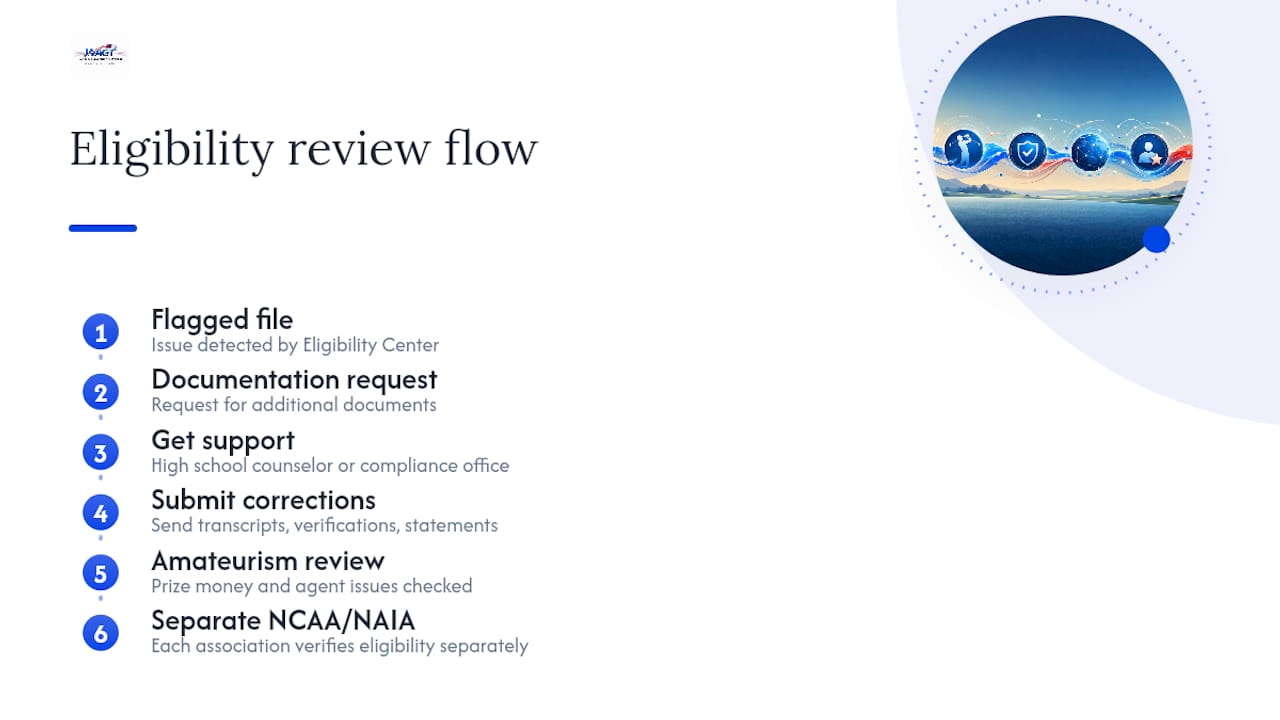
Compliance issues sound alarming, but most cases involve paperwork gaps rather than intentional violations, things like a missed core-course submission, an amateurism status question, or a delayed transcript. Understanding the process removes most of the panic.
If the NCAA Eligibility Center flags an issue, you will typically receive a request for additional documentation before any final ruling. Respond quickly and completely. Most flagged files resolve once the missing paperwork, an amateurism statement, a corrected transcript, a missing core-course verification, gets submitted. Your high school counselor and the college's compliance office are your best resources here; both deal with these requests routinely and can walk you through exactly what is missing.
Amateurism status causes more confusion than any other compliance category. Accepting prize money, signing with an agent, or competing in certain professional-adjacent events can jeopardize your certification, so check the NCAA amateurism certification requirements before accepting any payment or endorsement tied to golf, even something that seems minor.
NAIA compliance runs through a separate process from NCAA's, with its own eligibility verification standards, so a question resolved under NCAA rules does not automatically clear you for an NAIA program or vice versa. If you are recruited by schools across both associations, confirm your status separately with each governing body rather than assuming one clearance covers the other.
How Do You Keep a Golf Scholarship Once You Have It?
Winning the scholarship is the first test. Keeping it requires meeting ongoing academic and athletic standards that schools monitor every term, not just at signing.
Academically, NCAA and NAIA schools require continued progress toward a degree, generally measured in credit hours completed and a minimum GPA that rises slightly each year. Falling below your school's minimum GPA can trigger probation, a reduced practice schedule, or in serious cases, loss of aid eligibility for a semester. Most athletic departments run academic check-ins multiple times per term specifically to catch problems early, before they become renewal issues.
Athletically, coaches evaluate whether your on-course performance and practice commitment match what they expected when they offered the scholarship. Most Division I and II awards renew annually rather than guaranteeing four years automatically, meaning a poor season can affect next year's award amount even without any rule violation.
Behavior matters for renewal too. Violating team rules, missing mandatory study hall, or academic misconduct can all factor into a reduction decision. If a school does reduce or cancel aid, NCAA rules require written notice explaining the reason, and athletes generally have the right to appeal that decision through the athletics department before it becomes final.
What Recruiting Data Misses
Coaches remember the recruit who showed up early, helped rake a bunker without being asked, and handled a rules dispute calmly. That intangible reliability often decides a close call between two similarly skilled players more than either one's scoring average does. A balanced academic-athletic profile, solid GPA paired with a consistent tournament record, tends to beat a spikier one because it signals fewer surprises over four years.
— Gene
Get Your Results in Front of College Coaches
World Amateur Golf Tour is built for exactly the gap this article just walked through: coaches need verifiable, WAGR-counting results, and most junior golfers struggle to get consistent access to events that provide them.
Membership gets you into professionally run tournaments where every round counts toward your WAGR profile, with live scoring that lets a coach check your performance the same day you post it instead of waiting on a scanned scorecard. Your player profile tracks scoring averages, best finishes, and WAGR points automatically, so the "coach-ready stats line" this article recommends builds itself as you compete. Signing up gets you on the calendar for upcoming WAGR-counting events at respected courses, with entries and rankings tracked in one place instead of scattered across unrelated tournament sites. If you are serious about getting recruited this season, check current event listings and membership options and get your name into the rankings coaches actually check.
Sources
- Golf Scholarships: Everything You Need to Know
- Division I academic standards (NCAA Eligibility Center fact sheet)
- Pga
FAQ
How Hard Is It to Get a Golf Scholarship?
It is competitive but achievable for golfers who combine a qualifying core-course GPA with a tournament scoring average in the 70s, since most awards are partial equivalency scholarships split across a roster rather than full rides.
Is Golf One of the Hardest Sports to Get a D1 Scholarship In?
Golf ranks among the tougher sports for full funding because Division I programs get only 9.0 scholarship equivalencies to split across an entire roster, forcing most offers into partial awards rather than complete coverage.
What Golf Score Do You Need for a Scholarship?
Coaches generally look for a tournament scoring average consistently in the 70s at ranked events like AJGA, USGA, or WAGR-counting tournaments, since that benchmark predicts college-level performance better than handicap index does.
How Many Division I Scholarships Does Golf Get Per Team?
NCAA Division I golf programs can award up to 9.0 scholarship equivalencies per team, which coaches typically distribute across multiple players rather than concentrating on one or two full rides.
Do WAGR-Counting Events Actually Help With Recruiting?
Yes. Events with standardized scoring and official leaderboards, like those run through World Amateur Golf Tour, let coaches verify your results remotely and quickly, which speeds up how fast they can act on your recruiting profile.