

A recruiting-focused player profile page is a digital CV that puts your video, measurable stats, and verified results where coaches can find them fast. It works best during recruiting season, right after a tournament, or whenever you're reaching out to college programs directly. The format matters less than the substance: coaches want proof, not promises.
TL;DR:
- Only include verified, high-quality tournament results with links to official leaderboards, emphasizing recent top finishes over numerous unsubstantiated claims.
- Use a streaming video host and keep clips short, well-labeled, and focused solely on your skills to maximize coach engagement.
- Ensure your profile layout is clean, structured, and highlights your most recent top achievement first, with consistency across all sections.
- Link social media accounts that reflect your tournament activity and verify results through external sports networks to strengthen credibility.
- Regularly update your profile with new results and targeted outreach to coaches, avoiding outdated information and broad, undirected messaging.
Table of Contents
- Core Elements Every Player Profile Page Needs
- How Should You Present Recruiting Videos and Highlight Reels?
- What Stats and Achievements Actually Convince a Coach?
- Should You Use a Hosted Platform or Build Your Own Page?
- What Coaches and Recruiters Actually Look For
- How Do Social Media and External Sports Networks Fit In?
- How Can You Improve Your Profile's Visibility to Recruiters?
- Author Perspective: Profile Priorities for Junior and Collegiate Golfers
- Sources
Core Elements Every Player Profile Page Needs
A profile page earns a coach's attention in the first ten seconds or loses it. That means every element on the page has to justify its placement. Skip the filler and build around what a recruiter actually needs to make a quick judgment call.
Here's what belongs on a recruiting-ready profile:
- Headshot, short bio, position, and grad year. A clear photo and a two-sentence bio tell a coach who you are before they read a single stat.
- Direct contact information. Email and phone number, listed plainly, not buried behind a "contact me" button that adds friction.
- Measurable sport-specific stats and academic info. Height, weight, swing speed, or scoring average, paired with GPA and test scores if you're targeting college programs.
- Competition history with links to verified results. Tournament names, dates, finishes, and a link back to the official leaderboard or ranking body.
- A video section with a recruiting reel and labeled individual clips. One polished highlight video up top, supporting clips below.
- A call to action, plus testimonials or references if you have them. A coach's or instructor's endorsement adds a second voice vouching for your game.
Structured layout matters here more than people assume. Professional sports profiles, like Nba, organize information into distinct sections: profile, stats, bio, videos, recent games, and awards. That predictability isn't accidental. Recruiters skim, and a page that forces them to hunt for information gets closed faster than one that doesn't. According to guidance on building athlete profile pages for recruitment, the baseline expectation from coaches is a headshot, bio, physical stats, and verified competitive records, all visible without scrolling through unrelated content first.
How Should You Present Recruiting Videos and Highlight Reels?
Video is where most player profile pages fall apart. Too long, too cluttered, or too focused on the wrong things, and a coach clicks away before your best shot ever plays.
Follow this order when building your video section:
- Lead with a 60 to 90-second recruiting video. Open with your strongest play, not your warm-up swing.
- Follow with skill-specific clips. Short segments showing a single shot type, swing, or drill, each under 30 seconds.
- Include full competition footage only as a supplement. Link to it separately rather than forcing coaches to sit through an entire round.
- Label every clip with the date and event. "Junior Am Semifinal, March 2026" tells a coach more than an untitled file ever will.
- Add a one-line caption for context. Note the hole, the shot, or the pressure situation if it's relevant.
Keep the camera on you. Recruiting-focused profiles perform best when video content is clean and ad-free with a single-athlete focus, because coaches are evaluating your mechanics, not your teammates' banter or a sponsor's logo. If other athletes appear in the footage, especially minors, get consent before posting and crop or blur where you can.
Pro Tip: Host your recruiting video as a streaming link (YouTube, Vimeo, or Hudl) rather than a downloadable file. Coaches on tight schedules almost never download and open an unfamiliar file, but they'll click a link in ten seconds.
What Stats and Achievements Actually Convince a Coach?
Numbers without context are noise. A "top 10 finish" means something different at a 30-player local event than at a 150-player national qualifier, and coaches know the difference immediately.
Include the stats that matter for your sport and position, then back them up:
- Sport-specific performance numbers. Scoring average, driving distance, greens in regulation, or whatever metric your sport uses to separate good players from great ones.
- Verified results with a paper trail. Link directly to the official tournament page, a results PDF, or the ranking body's event listing.
- Contextual details for every number you cite. Field size, course rating, or par, so a single score isn't misread.
- Academic and eligibility information. GPA, class rank, and NCAA eligibility status, presented in one clean block.
- Event identifiers for ranking-linked results. Exact finishing position and event ID let a coach verify ranking points directly rather than taking your word for it.
Verification checklist: attach or link the official leaderboard, note the field size and course rating next to any score, and list the exact tournament date and division.
Recruiter-facing resources consistently flag context as the missing piece most athletes skip. GCSAA's guidance on presenting results recommends attaching course rating and field strength to any statistic, because a coach evaluating dozens of profiles a week has no patience for numbers they can't immediately place.
Should You Use a Hosted Platform or Build Your Own Page?
Platform-hosted profile pages come with built-in structure, verified stat integration, and a link you can send in one click. DIY pages give you full design control but put the verification and hosting burden entirely on you.
Weigh it this way:
- Hosted platforms handle updates, mobile formatting, and often connect directly to tournament results, saving you the manual work of re-verifying every score.
- DIY pages work if you're comfortable managing your own hosting, SEO, and mobile testing, but they demand ongoing maintenance most players underestimate.
- Sharing formats matter as much as hosting. A short public link works for open outreach; a PDF one-sheet works for email attachments; a private, expiring link works when you're targeting a specific coach and don't want the page indexed publicly.
- Mobile optimization isn't optional. Most coaches review profiles on a phone between recruiting events, so a page that doesn't load cleanly on mobile gets skipped.
- Match your choice to your recruiting stage. A freshman still building a résumé can start simple; a junior actively emailing college coaches needs a page built for fast, verified evaluation.
What Coaches and Recruiters Actually Look For
Coaches don't read profiles. They scan them, and they're trained to spot the difference between a claim and a verified achievement in seconds. That distinction drives nearly every decision about what stays on the page and what gets cut.
That principle, drawn from PGA career-services resume guidance, applies directly to junior and collegiate golf profiles. A coach judging your page in under a minute is looking for:
- Verified, measurable results, not self-reported claims with no source link.
- Clean, uncluttered layout. PGA's resume formatting guidance notes that whitespace and focused organization signal professionalism, and that translates directly to how a digital profile reads on a screen.
- Your best result first. Lead with your most recent top finish or signature stat, then add a one-line contextual note underneath it.
- Consistency between your video, your stats, and your competition history. Mismatched information is the fastest way to lose credibility.
Presentation isn't decoration here. It's a signal. A profile that looks disciplined tells a coach you'll likely be disciplined on the course, too.
How Do Social Media and External Sports Networks Fit In?
Your profile page shouldn't live in isolation. Coaches increasingly cross-reference a player's social presence against their stated profile, so the two need to tell the same story.
Link your active accounts, primarily Instagram, X, or a golf-specific network profile, directly from your page, but keep the connection purposeful. A coach clicking through to your social feed should find match updates, tournament photos, or swing clips, not unrelated content that dilutes your recruiting narrative.
External sports networks and ranking databases add a second layer of credibility your own page can't provide alone. When your profile links out to a verified results page, a ranking body's event listing, or a recognized golf network, you're letting a third party confirm what you're claiming rather than asking the coach to take it on faith. That's a meaningfully stronger signal than a screenshot or a self-reported number.

Keep your channels updated in parallel with your profile page. A recruiting video posted to your page in March but never shared on social, or a tournament result on Instagram that never made it to your profile, creates gaps a careful coach will notice. Consistency across platforms is part of what makes a profile read as trustworthy rather than curated for effect.
How Can You Improve Your Profile's Visibility to Recruiters?
Visibility comes down to three things: findability, freshness, and targeting. A beautifully built profile that never reaches the right inbox doesn't help your recruiting.
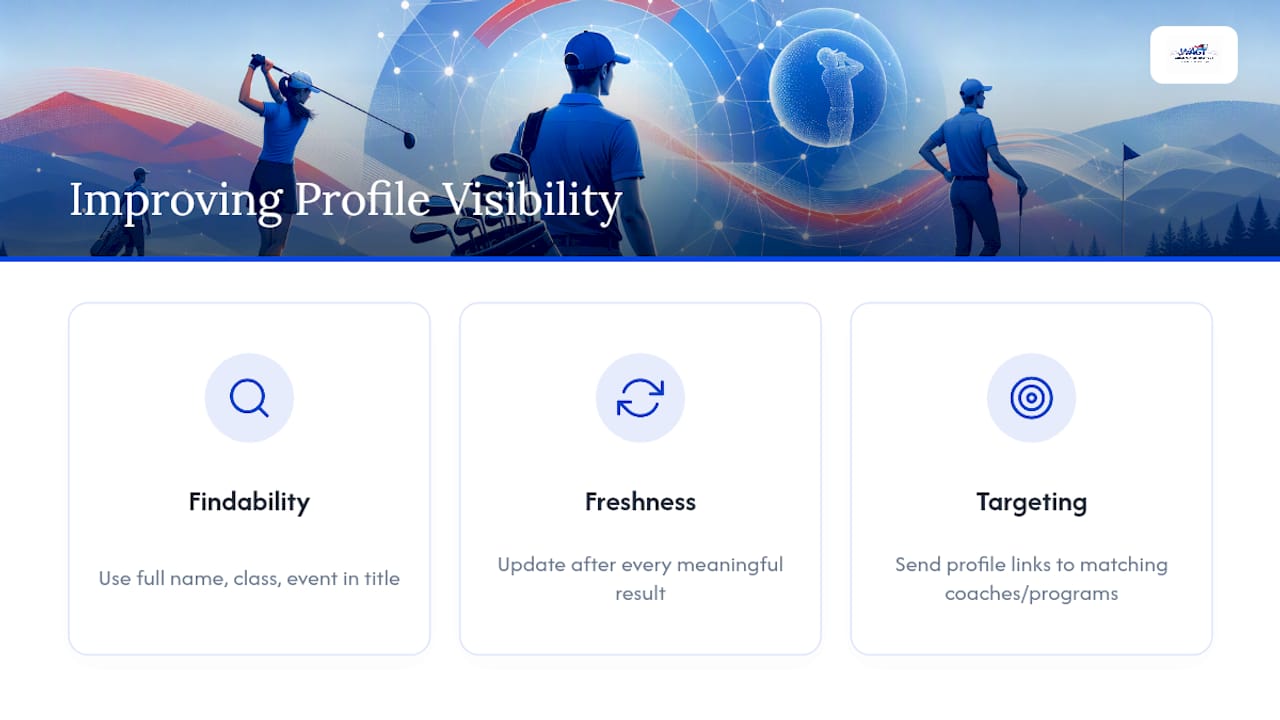
Start with search basics. Use your full name, graduating class, and primary event circuit in your page title and headline, since that's roughly how coaches and recruiting databases search for players. A vague title like "Junior Golfer Profile" gets buried; "Jordan Ellis, Class of 2027, WAGR-Ranked Amateur" gets found.
Update your profile every time you post a meaningful result, not once a season. A profile with a six-month-old top finish as its headline stat reads as inactive, even if you've competed since. Tournament participation tied to ranking points is one of the strongest updates you can make. Understanding how ranking algorithms calculate points helps you know exactly which results are worth highlighting first.
Finally, target your outreach. Send your profile link directly to coaches at programs that match your academic and competitive level, rather than mass emailing every Division I roster. A clear pathway from amateur to professional golf starts with recruiting outreach that's specific, not scattershot, and choosing the right amateur tour or event to feature can sharpen that targeting even further. Player development programs built around structured recruiting outreach, like the frameworks covered in DepthChartIQ's guide to player development and recruiting, reinforce the same point: visibility rewards players who update often and target deliberately.
Author Perspective: Profile Priorities for Junior and Collegiate Golfers
Most junior golfers overload their profile with every stat they've ever posted. That's backwards. I'd rather see three verified, WAGR-linked results than fifteen unverifiable claims. A single top finish at a WAGR-counting event, with the event ID and exact placement attached, tells a coach more than a season's worth of self-reported scores ever will.
Tournament participation is easy to surface if you're competing in the right events. If your profile is thin on verified results, the fastest fix isn't a redesign. It's entering a WAGR-sanctioned tournament this season and updating your page the moment the results post.
— Gene