

A golf ranking algorithm is a rules-based statistical system that converts tournament results into numeric ranking points, then orders players worldwide by their rolling average. Three components drive every system: event strength (the Field Rating), points allocation by finishing position, and decay and averaging across a two-year rolling window. The Official World Golf Ranking (OWGR), the World Amateur Golf Ranking (WAGR), and the newer Strokes Gained (SG) World Rating each apply these principles, though with different scopes and eligibility rules.
The core mechanics break down like this:
- Event strength: Every tournament earns a Field Rating based on the collective performance values of its starters. Higher-rated fields produce more points at the top of the leaderboard.
- Points allocation: Ranking points are distributed across finishing positions using a distribution curve. The winner collects the most; points taper off down the field.
- Decay and averaging: Points hold full value for 13 weeks, then reduce weekly over the remaining 91 weeks of the two-year cycle. A player's ranking is their adjusted points total divided by an event divisor.
Pro Tip: When choosing your schedule, prioritize events with the strongest possible fields. A top-10 finish in a high-rated event can move your ranking more than a win in a weak field.
Key Takeaways
A golf ranking algorithm converts tournament results into a rolling average using three mechanics: Field Rating, points allocation by finishing position, and a two-year decay schedule with a minimum divisor of 40.
| Point | Details |
|---|---|
| Field Rating drives point value | Stronger fields produce higher Field Ratings, which set the winner's point ceiling for that event. |
| Majors award 100 first-place points | THE PLAYERS awards 80; most other events scale below that based on their Field Rating. |
| Full value lasts 13 weeks | After week 13, points decay by 1/92 of their original value each week until they expire at week 104. |
| Minimum divisor is 40 | Even players with fewer than 40 events divide by 40, preventing inflated averages from small sample sizes. |
| SG World Rating includes all starters | Every player's real score data now contributes to the Field Rating, making the system more performance-driven. |
Table of Contents
- What are the major golf ranking systems?
- How does an event's Field Rating get calculated?
- How are ranking points split across finishing positions?
- How do points age, and how is a player's average calculated?
- Which tournaments and players are eligible for ranking points?
- What changed when OWGR moved to a Strokes Gained World Rating?
- A worked example: calculating ranking points from start to finish
- Why rankings matter and how players can use them strategically
- Why a transparent algorithm is good for the sport
- Sources
What are the major golf ranking systems?
Three systems cover the competitive landscape most players and coaches care about.
- OWGR (Official World Golf Ranking): The primary professional system, used globally to determine tournament invitations, seeding, and eligibility for majors and elite events. It covers stroke-play individual events across sanctioned professional tours.
- WAGR (World Amateur Golf Ranking): The amateur equivalent, using similar rolling-window logic but with eligibility rules tailored to amateur stroke-play competitions. WAGR standing directly affects college recruiting visibility and pathways to professional status.
- Rolex Women's World Golf Rankings: Applies the same OWGR methodology to the women's professional game, covering the LPGA Tour and partner tours. The algorithm structure mirrors OWGR, though the specific event list and field compositions differ.
All three systems focus on individual stroke-play results. Team formats, match play, and pairs events are excluded from ranking calculations.
How does an event's Field Rating get calculated?
The Field Rating is the engine of the golf ranking methodology. It determines how many points are available at any given tournament.
Under the current SG World Rating approach, every player who tees up carries a Strokes Gained performance value derived from their historical score data, adjusted for course difficulty across multiple rounds. Those individual values feed into a Performance Curve, which converts each player's SG rating into Performance Points. The Field Rating for an event is the sum of all starters' Performance Points.
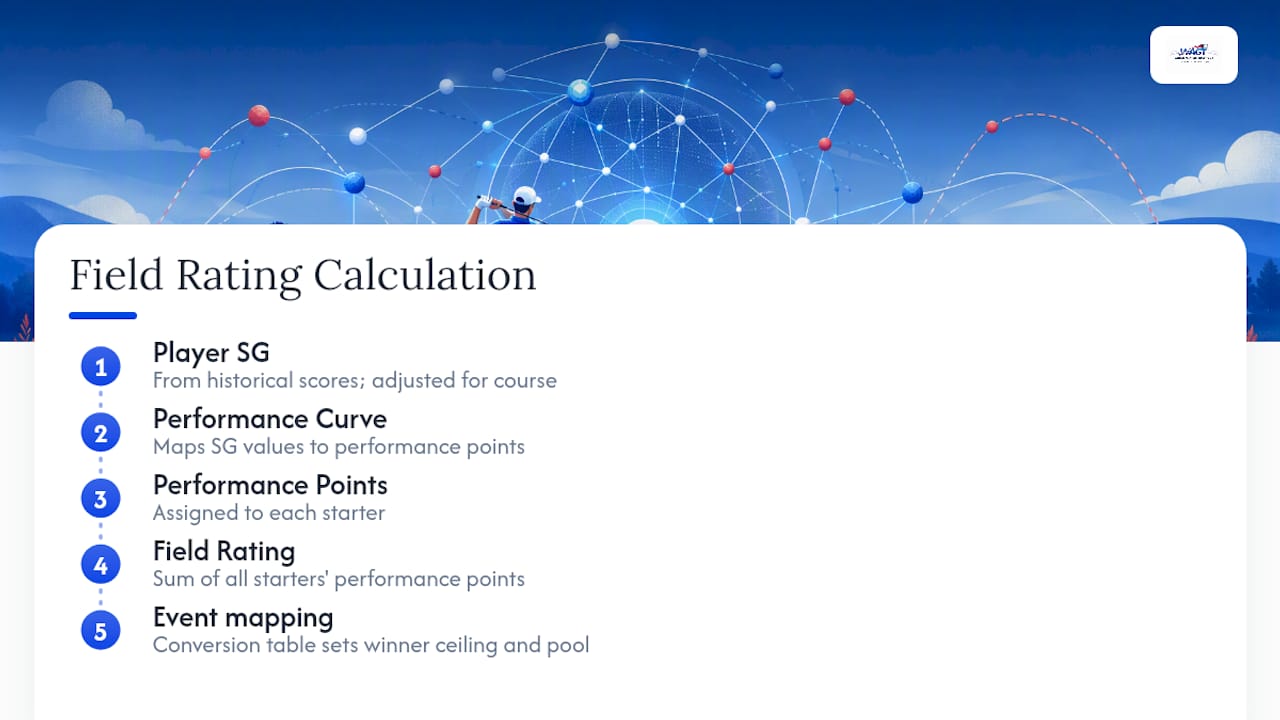
A stronger field, meaning more highly rated players, produces a higher Field Rating. That Field Rating then maps to an event ranking on a conversion table, which sets the winner's point ceiling and the total pool distributed across finishing positions. Golf Monthly explains that this field-based statistical approach replaced the older system, which relied only on fixed integer ratings for the top 200 players in the world.
The practical result: every player in the field now contributes to the event's value, not just the elite names at the top of the draw sheet.
How are ranking points split across finishing positions?
Points flow from the top of the leaderboard downward along a Ranking Points Distribution Curve. The winner collects the maximum points for that event's rating tier. From there, each successive finishing position receives a percentage of the winner's total.
Key rules to know:
- Majors award 100 first-place points; THE PLAYERS Championship awards 80.
- Second place typically receives roughly 60% of the winner's points, with the curve tapering progressively through the field.
- Points are distributed down to deep finishing positions, covering a large portion of the field in most events.
- Ties are averaged: when two or more players finish tied, the points for those positions are added together and divided equally among the tied players.
- Players must complete the event or make the primary cut to receive any ranking points. A withdrawal or missed cut earns zero.
No-cut events follow a modified distribution, since every player who starts completes the tournament. The points pool still derives from the Field Rating, but the allocation extends further down the finishing order.
How do points age, and how is a player's average calculated?
Points don't hold their value forever. The decay schedule is precise: points stay at full value for the initial weeks after they are awarded. Then, starting after that period, they reduce by a fraction of their original value each week over the remainder of the two-year cycle, eventually expiring entirely by the end of that period.
Key rule: A point worth 10.00 at week 1 is worth roughly 5.00 at week 47 and zero after week 104.
A player's ranking average is calculated by summing all adjusted (decayed) points and dividing by an event divisor. The divisor rules prevent inflation from a small number of high finishes:
- Minimum divisor: 40, regardless of how few events a player has entered. A player with only 20 events still divides by 40.
- Maximum counted events: the most recent 52 events within the two-year window.
- Players who have played more than 52 events use 52 as their divisor, capping the denominator and rewarding consistent performance across a full schedule.
The minimum divisor of 40 was introduced to prevent players from earning inflated averages through a handful of exceptional results, keeping the system honest about volume as well as quality.
Which tournaments and players are eligible for ranking points?
Not every golf event feeds into the OWGR or WAGR. Eligibility depends on formal sanctioning and event structure.
- Sanctioned stroke-play events: only individual stroke-play competitions approved by recognized tours and governing bodies count. IGF governance documents define how national bodies and international tours interface with ranking administrators.
- Approved tours: the PGA TOUR, DP World Tour, Asian Tour, Korn Ferry Tour, and other affiliated tours all contribute OWGR events. Each tour's events are reviewed and assigned a baseline eligibility status.
- Cut completion: players must make the primary cut and complete the event to receive points. A player who withdraws after making the cut typically receives no points for that event.
- No-cut events: handled separately, with points distributed to all finishers since there is no cut to make.
- Minimum point thresholds: events must meet a baseline field quality standard to be included. Under the SG-based system, this threshold is now derived statistically from the field itself rather than from a fixed list of top-200 members.
For amateur players, WAGR eligibility follows similar principles but applies to amateur stroke-play events specifically. Understanding which events count toward your WAGR standing is one of the most practical pieces of knowledge a competitive junior can have.
What changed when OWGR moved to a Strokes Gained World Rating?
The shift to a Strokes Gained World Rating, implemented by the PGA TOUR and OWGR in 2022, was the most significant methodological change to the system in decades. The previous approach assigned fixed integer world ranking values only to players inside the top 200. Everyone outside that threshold contributed nothing to a field's rating.
The SG model changed that entirely. Now, every player's real score data, adjusted for course difficulty across rounds, generates a performance rating. Those ratings feed the Performance Curve, so a field of 156 players all contribute to the Field Rating, not just the top-ranked names in the draw.
The practical consequences are real:
- More inclusive: smaller tours and developing-market events can now generate meaningful Field Ratings even without a roster of top-200 players.
- Better differentiation: players with similar rankings but different recent form are now separated more accurately.
- Greater short-term volatility: a strong week in a small-field event can produce a sharper ranking move than it would have under the old system, since the SG-based approach is more sensitive to recent performance data.
Pro Tip: If your recent form is strong, target events with competitive but not elite fields. Your SG value will contribute meaningfully to the Field Rating, and a top finish will carry outsized ranking weight relative to the entry.
A worked example: calculating ranking points from start to finish
Here is a step-by-step calculation showing how the algorithm works in practice.
Starting conditions:
- A regional stroke-play event has 80 starters. Their aggregated Performance Points produce a Field Rating that maps to an event ranking with a winner's allocation of 24 points.
- Player A finishes 2nd, earning approximately 60% of the winner's points: 24 × 0.60 = 14.4 points.
- Player B finishes tied 5th with one other player. The points for 5th and 6th are 9.0 and 8.0 respectively. Combined: 17.0 ÷ 2 = 8.5 points each.
Applying decay:
- Player A earned those 14.4 points 30 weeks ago. The first 13 weeks were full value. Weeks 14–30 = 17 weeks of decay. Each week reduces by 1/92 of the original value: 17 × (14.4 ÷ 92) = 17 × 0.1565 = 2.66 points of reduction. Adjusted value: 14.4 − 2.66 = 11.74 points.
Calculating the ranking average:
- Player A has played 28 events in the two-year window. The minimum divisor is 40, so the divisor is 40 (not 28).
- Total adjusted points across all events: 380 points. Ranking average: 380 ÷ 40 = 9.50.
| Step | Variable | Value |
|---|---|---|
| Event winner's allocation | Points at 1st place | 24 |
| Player A's finish | 2nd place (60%) | 14.4 |
| Weeks since earned | 30 weeks | 17 decay weeks |
| Decay reduction | 17 × (14.4 ÷ 92) | 2.66 |
| Adjusted points (this event) | 14.4 − 2.66 | 11.74 |
| Total adjusted points (all events) | Rolling two-year sum | 380 |
| Divisor applied | Minimum 40 | 40 |
| Ranking average | 380 ÷ 40 | 9.50 |
This is the number that determines where Player A sits in the world rankings. A higher average means a better ranking position.

Why rankings matter and how players can use them strategically
Rankings are gatekeepers. World ranking position directly determines which tournaments you receive invitations to, which exemption categories you qualify for, and how visible you are to sponsors and college coaches. As The Fried Egg notes, ranking systems encode the priorities of their designers, and methodological choices directly shape career incentives.
For players, the strategic implications are clear:
- Event selection matters as much as performance. A win in a weak field earns fewer points than a top-5 in a strong one. Understand the Field Rating of every event on your schedule before you commit.
- Frequency and quality must be balanced. Playing too few events keeps your divisor at 40 with a thin points base. Playing too many dilutes your average if results are inconsistent.
- Time your peaks. Points earned in the last 13 weeks carry full value. A strong stretch of form heading into a major qualifying window is worth more than the same results six months earlier.
- For organizers: inviting higher-rated players raises your Field Rating, which increases the points available to every finisher. Co-sanctioning with a recognized tour is the fastest way to elevate an event's ranking value.
For junior and amateur players, WAGR standing opens doors to college recruiting visibility and elite amateur invitations. The same strategic logic applies: choose WAGR-counting events with competitive fields, and play consistently within your two-year window.
Why a transparent algorithm is good for the sport
The move to a data-driven, statistically grounded ranking system is one of the best things to happen to competitive golf in the past decade. Here is why that matters, especially for junior and amateur players working toward collegiate or professional careers.
A transparent algorithm removes subjectivity. When the ranking methodology is published, auditable, and based on real score data, players can make informed decisions about their schedules. Coaches can advise with confidence. Parents can understand why a result moved their child's ranking. That clarity builds trust in the system.
The shift to SG-based ratings also levels the playing field for players outside the traditional elite circuits. Under the old system, a talented junior competing on a regional amateur tour contributed almost nothing to a field's rating unless they cracked the top 200. Now, their actual performance data counts. That is a meaningful change for the development pathway.
At Worldamateurgolftour, we see this directly. Our WAGR-counting events give junior and collegiate players access to competitive fields at championship-caliber venues, where every round of real golf feeds into a ranking system that college coaches and professional scouts actually use. The algorithm rewards performance. Our events give you the stage to perform.

Sources
These are the primary sources for verifying the rules and mechanics covered in this article:
- Official World Golf Ranking - Ranking Explained
- Changes to the Official World Golf Ranking System now in effect - PGA TOUR
- How the OWGR System Works and Affects Rankings - Golf Today
- How Does The Official World Golf Ranking Work? | Golf Monthly