
How international golf events drive college recruiting
International golf events are the single most direct path for junior and collegiate players to earn visibility with U.S. college coaches. Rankings like the World Amateur Golf Ranking (WAGR) and the Junior Golf Scoreboard (JGS) give coaches a standardized way to compare talent across continents, and the events that feed those rankings are where recruiting decisions begin. About 25% of NCAA Division I men's and women's golfers are international players as of 2026, reflecting how global competition has reshaped U.S. college golf programs.
For you as a junior player, a coach, or a parent navigating this process, understanding which events matter and why is the first step toward a real college opportunity. Here is what the role of international events in college golf actually looks like in practice:
- Global exposure: International tournaments put your game in front of coaches who would otherwise never see you play.
- Ranking currency: WAGR and JGS points earned at sanctioned events are the primary metrics coaches use to evaluate international prospects.
- Scouting hubs: Events like the Junior World Golf Championships consolidate talent from dozens of countries in one location, making them efficient recruiting grounds.
- Team competition experience: Events like the Arnold Palmer Cup demonstrate that a player can perform under pressure in a team format, which college coaches value highly.
- Relationship building: International tournaments connect players with national and academy coaches who serve as gatekeepers to U.S. recruiting networks.
Key international tournaments that influence U.S. college recruiting
Several events stand out as genuine recruiting catalysts, each offering a different format and competitive environment.
| Event | Format | Location | Recruiting Impact |
|---|---|---|---|
| Junior World Golf Championships | Stroke play, age divisions | San Diego, CA (annual) | Over 1,100 players from 55 countries |
| Arnold Palmer Cup | Match play, Ryder Cup style | Alternates U.S./Europe | Top collegiate players; direct pro pathway points |
| FISU World University Championship | Stroke play, team and individual | Varies (biennial) | Showcases enrolled university golfers globally |
| WAGR-sanctioned amateur events | Stroke play, multi-day | Worldwide | Direct ranking points; primary coach evaluation tool |
What makes these events different from a typical domestic junior tournament is the quality of the competitive field and the course difficulty. The Junior World Golf Championships bring more than 1,100 players from 55 countries and 40 U.S. states to San Diego each year, with play spread across courses including Torrey Pines. Oregon coach Casey Martin, a former Stanford standout and PGA Tour player, has attended Junior World almost every year across more than two decades of coaching. He finished second there as a junior himself, and the result changed his own recruitment.
Key features that make these events valuable for scouting:
- Multi-day stroke play formats that reveal consistency, not just peak rounds
- Championship-caliber courses that expose weaknesses in a player's game
- Large, internationally diverse fields that give coaches calibration points across different talent pools
- On-site access to national and academy coaches who travel with international players
- Direct WAGR or JGS ranking implications that follow the player into the recruiting process
The FISU World University Championship adds a collegiate dimension, bringing together enrolled university golfers from around the world in a format that mirrors the team dynamics of college programs. For players already in college programs outside the U.S., it is one of the few events that can attract attention from coaches looking to transfer-recruit international talent.
How international players are changing U.S. college golf programs
The presence of international players in NCAA Division I golf has grown steadily and is now a defining feature of elite programs. International players account for about 25% of current NCAA Division I men's and women's golfers. That share reflects a deliberate shift in how coaches recruit, not just an organic trend.
Arizona State head coach Matt Thurmond runs one of the most internationally diverse rosters in college golf. A significant portion of players on his 2026 roster are international students.
"They know that there's a lot of great places in the world. They know that there's a lot of great people in the world, and they learn a lot about each other. They travel to each other's homes, their roommates get to know each other's families, cultures, religions, and languages." — Coach Matt Thurmond, Arizona State
Thurmond's point goes beyond team chemistry. Coaches who recruit internationally are building programs that can compete at the highest level because they are drawing from the widest possible talent pool. Recent NCAA roster limits have made this calculus sharper. With fewer roster spots available, coaches prioritize international prospects who arrive with proven competitive experience at WAGR-sanctioned events over players whose records are built entirely on domestic junior circuits.
The physical preparation demands on international recruits are also distinct. Players who have competed across multiple time zones, on unfamiliar courses, and under varying weather conditions tend to adapt faster to the rigors of a college season.

How WAGR and JGS rankings open doors to scholarships and recruitment
WAGR and JGS are not just leaderboards. They are the primary tools coaches use to evaluate international players they have never seen in person. International rankings like WAGR and JGS let coaches compare a junior from Sweden with one from South Korea on equal footing, using a consistent performance metric across sanctioned events worldwide.
College coaches place tournament experience and national rankings above high school achievements when evaluating recruits, specifically because college courses are more demanding and multi-day events reveal a player's true competitive ceiling.
Pro Tip: Target WAGR-certified multi-day events consistently throughout the year, not just the marquee championships. Coaches track ranking trajectories over time, and a steady climb across multiple events signals competitive maturity more convincingly than a single strong result.
Steps international players can take to maximize their ranking-driven recruiting profile:
- Enter WAGR-sanctioned events early and often. Points accumulate over a rolling period, so consistent participation builds a stronger profile than sporadic appearances.
- Prioritize multi-day stroke play formats. These carry more ranking weight and give coaches the performance data they need for full evaluations.
- Build your JGS profile alongside WAGR. JGS aggregates results from junior events and is widely used by U.S. college coaches as a first-pass filter.
- Compete on difficult courses. A strong score at a championship-caliber venue carries more credibility than the same score on a shorter, easier layout.
- Reach out to coaches directly after strong results. Rankings get you noticed; direct contact converts that attention into a conversation.
Worldamateurgolftour runs WAGR-certified amateur events at respected venues, giving junior and collegiate players a direct path to building the ranking profile that U.S. coaches look for. For players who want to understand why amateur events matter during the college years, the case is straightforward: every sanctioned round is a data point in your recruiting file.
How international golf governing bodies set the standard for collegiate events
The credibility of any international event depends on who sanctions it. For college coaches, a tournament's governing body is a signal of whether the results and rankings it produces are trustworthy.
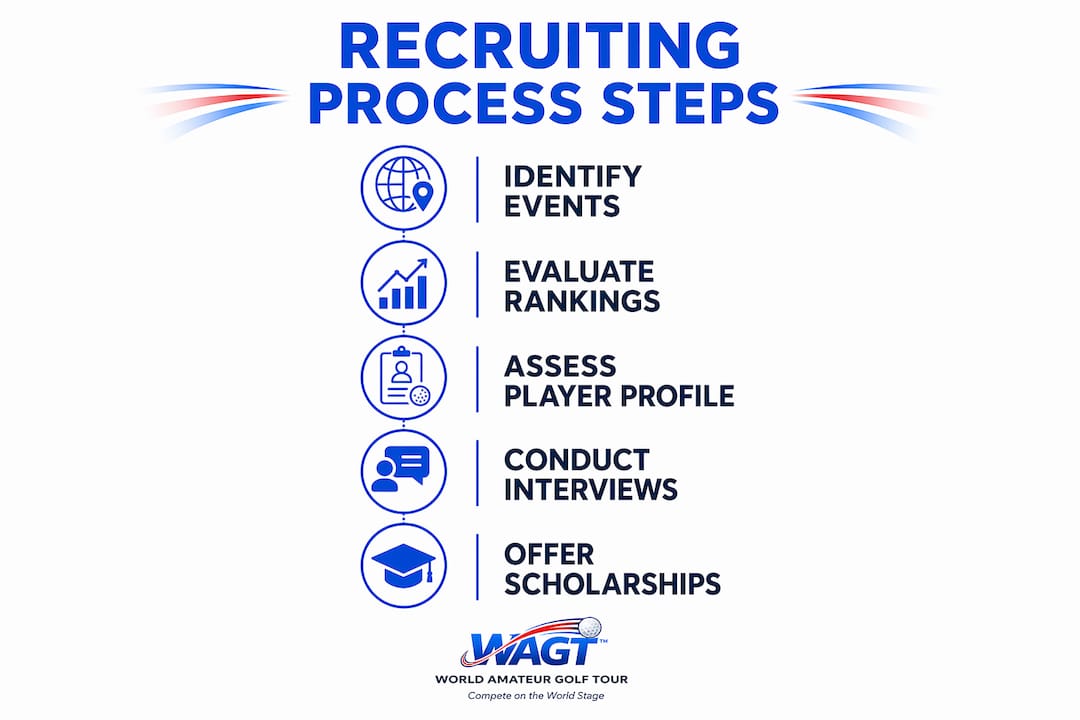
The International Golf Federation (IGF) organizes biennial amateur team championships and promotes sportsmanship and development across global amateur golf. Its events carry the kind of institutional weight that makes results meaningful to coaches evaluating international prospects. The IGF also oversees golf's inclusion in multi-sport events, extending competitive opportunities for collegiate players beyond traditional golf circuits.
Key functions governing bodies perform in international collegiate golf:
- Sanctioning events so that results count toward official rankings like WAGR
- Setting course and format standards that ensure competitive conditions are consistent and evaluable
- Coordinating eligibility rules that determine which players can compete at which level
- Promoting sportsmanship standards that align with the values U.S. college programs expect from recruits
- Facilitating international scheduling so that events do not conflict and players can build full competitive calendars
The Golf Coaches Association of America (GCAA) co-founded the Arnold Palmer Cup with Arnold Palmer in 1997, and its involvement ensures the event meets the standards U.S. college programs recognize. Understanding how governing bodies shape golf events helps players and parents identify which tournaments genuinely move the needle in recruiting versus which ones simply carry an impressive name.
How the influence of international events on college golf recruiting has evolved
The Arnold Palmer Cup launched in 1997 with two eight-man teams, one from the United States and one from Great Britain and Ireland. Arnold Palmer's founding vision was explicit: he wanted international competition to enrich the lives of young players and serve as a springboard for professional success. Among the players in those early years were Charles Howell III, Matt Kuchar, Luke Donald, and Graeme McDowell, names that would go on to define professional golf for the next two decades.
The event expanded over time, first broadening the opposing team to all of Europe, then growing to ten-man squads, and in 2018 adding women's players so that both men's and women's collegiate golfers compete together under one team score. That expansion reflects a broader shift in college golf recruiting: what began as a niche pipeline for elite men's players has become a genuinely global and gender-inclusive system.
The Junior World Golf Championships followed a parallel arc. What started as a regional junior event in San Diego grew into one of the most important annual gatherings in junior golf, now drawing players from 55 countries. College coaches who once relied almost entirely on domestic junior circuits began making annual trips to San Diego as the international field grew, recognizing that the talent they needed was increasingly coming from outside U.S. borders.
NCAA policy has accelerated this evolution. Recent roster limits have pushed coaches to be more selective, and international players with WAGR rankings and multi-day event experience have become the standard benchmark for a scholarship-worthy recruit.
Recruiting trends tied to international event participation in 2026
The clearest trend in college golf recruiting right now is that coaches treat international event participation as a prerequisite, not a bonus. Top programs expect recruits to have competed in WAGR-sanctioned multi-day events before they make contact, because those results give coaches the data they need to make confident offers.
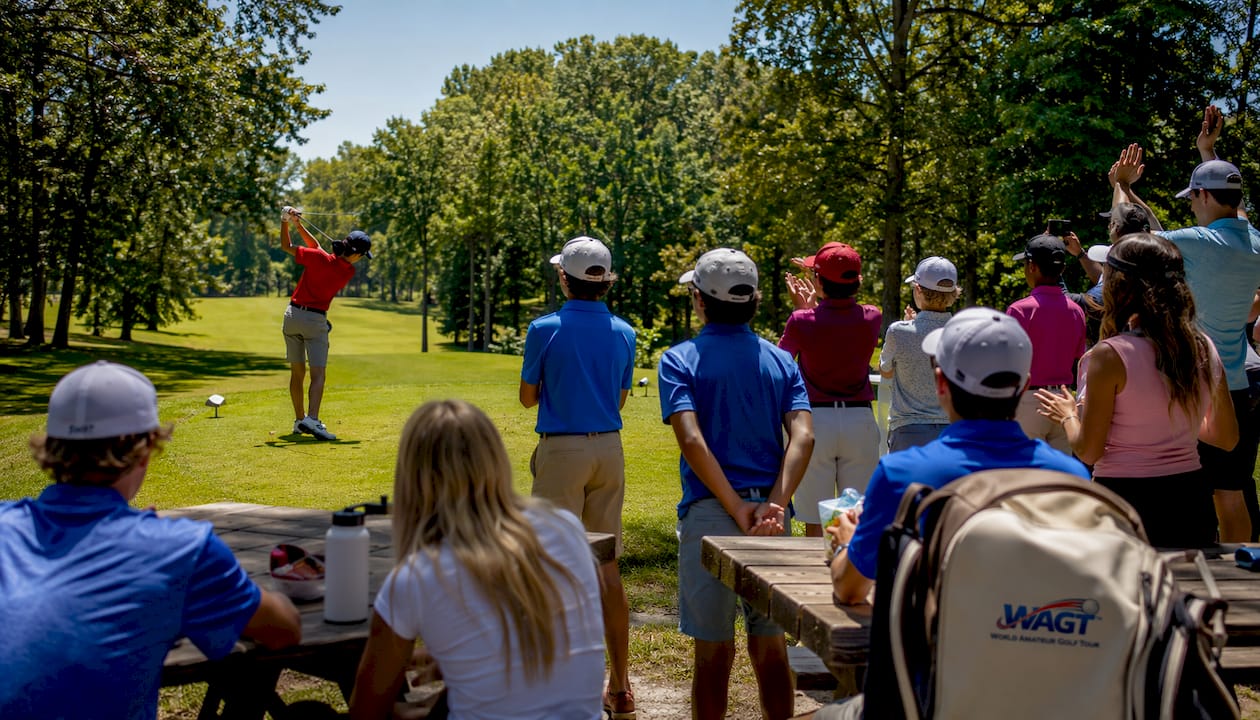
San Diego State coach Ryan Donovan captures the practical reality: at Junior World, coaches see players from Australia, Thailand, Japan, Mexico, Europe, and South America all in one city, on difficult courses, in a single week. Without that event, evaluating those players would require international travel budgets that most programs cannot sustain.
A second trend is the growing role of relationship networks. International players often arrive at events with national or academy coaches who are unfamiliar with U.S. recruiting mechanics. College coaches have learned to build relationships with those gatekeepers, because a trusted intermediary can accelerate a recruit's path to a scholarship offer. Junior World and similar events function as networking hubs where those connections form.
Third, coaches are increasingly using WAGR trajectory, not just current ranking, as a recruiting signal. A player ranked outside the top 500 who has moved up steadily over 18 months of consistent international competition is often a more attractive prospect than a player with a higher current ranking built on a thin event schedule.
Players who built their college careers through international events
Oregon coach Casey Martin's own story is one of the clearest examples of how a single international event can redirect a player's trajectory. As a junior from Oregon, Martin competed at the Junior World Golf Championships at Torrey Pines, finished second, and was subsequently recruited by a large number of schools. His own assessment: without that result at an international event, coaches simply would not have traveled to Oregon to watch him play.
The Arnold Palmer Cup has produced an even longer list of players whose college careers translated directly into professional success. More than 245 alumni have gone on to earn cards on the PGA Tour, DP World Tour, or LPGA Tour, and those alumni have combined for 450 professional victories, including 23 major championships. Russell Henley won the 2025 Arnold Palmer Invitational, and Maja Stark captured the 2025 U.S. Women's Open. Both are Palmer Cup alumni. Forty-six Palmer Cup alumni have represented their countries in the Ryder Cup, Presidents Cup, or Solheim Cup.
The pattern across these cases is consistent. Players who competed in high-profile international events during their junior or collegiate years arrived at college programs with proven competitive experience, adapted faster to the demands of college golf, and moved through the professional pipeline more efficiently than players whose records were built on domestic circuits alone.
How international events shape scholarship opportunities
Scholarships in college golf are competitive. More than 8,300 student-athletes compete for 4,545 scholarships across programs that offer athletic aid, which means the opportunity exists but is far from guaranteed. For international players, the path to a scholarship runs almost entirely through tournament performance and rankings.
Coaches at scholarship-granting programs use WAGR as a primary filter. A player without a WAGR ranking, or with a ranking built on events that coaches do not recognize, starts the recruiting conversation at a disadvantage. International events sanctioned by recognized governing bodies solve that problem directly: they produce rankings that coaches trust and results that translate across borders.
The Arnold Palmer Cup adds another dimension. Participants earn a point toward PGA Tour University Accelerated eligibility, linking collegiate international competition directly to professional career pathways. For a recruit, the message is clear: the events you choose during your junior and collegiate years do not just affect your scholarship chances. They shape your entire career arc.
Parents and players evaluating scholarship opportunities should also consider Division II, NAIA, and junior college programs, which have produced PGA Tour winners including Bubba Watson and Lee Janzen. The scholarship pool across all divisions is broader than most families realize, and international event experience translates across every level.
International events versus domestic events: what coaches actually value
Domestic junior events and international competitions serve different purposes in the recruiting process, and coaches are direct about which carries more weight. A strong result at a domestic junior event on a short, friendly course tells a coach relatively little about how a player will perform on a 7,000-yard college layout against elite competition. A strong result at Torrey Pines, against a field from 55 countries, tells a coach a great deal.
San Diego State's Donovan has watched junior tournaments where short tees and easy pin positions distort the field, forcing coaches to mentally adjust every score they see. At Torrey Pines, no adjustment is needed. The course does the evaluation work on its own.
That said, domestic events are not irrelevant. They build ranking points, establish consistency, and keep players competitive between major international gatherings. The most effective recruiting profiles combine both: a strong domestic record that demonstrates consistent performance, layered with international event results that validate that performance against a global field.
The practical difference comes down to credibility. A coach recruiting an international player who has only competed domestically in their home country is making an educated guess. A coach recruiting a player with WAGR points from multi-day international events is working from verified data. For players serious about a U.S. college scholarship, competing in summer amateur events that carry international ranking weight is the most direct way to build that credibility.
Start building your recruiting profile with Worldamateurgolftour
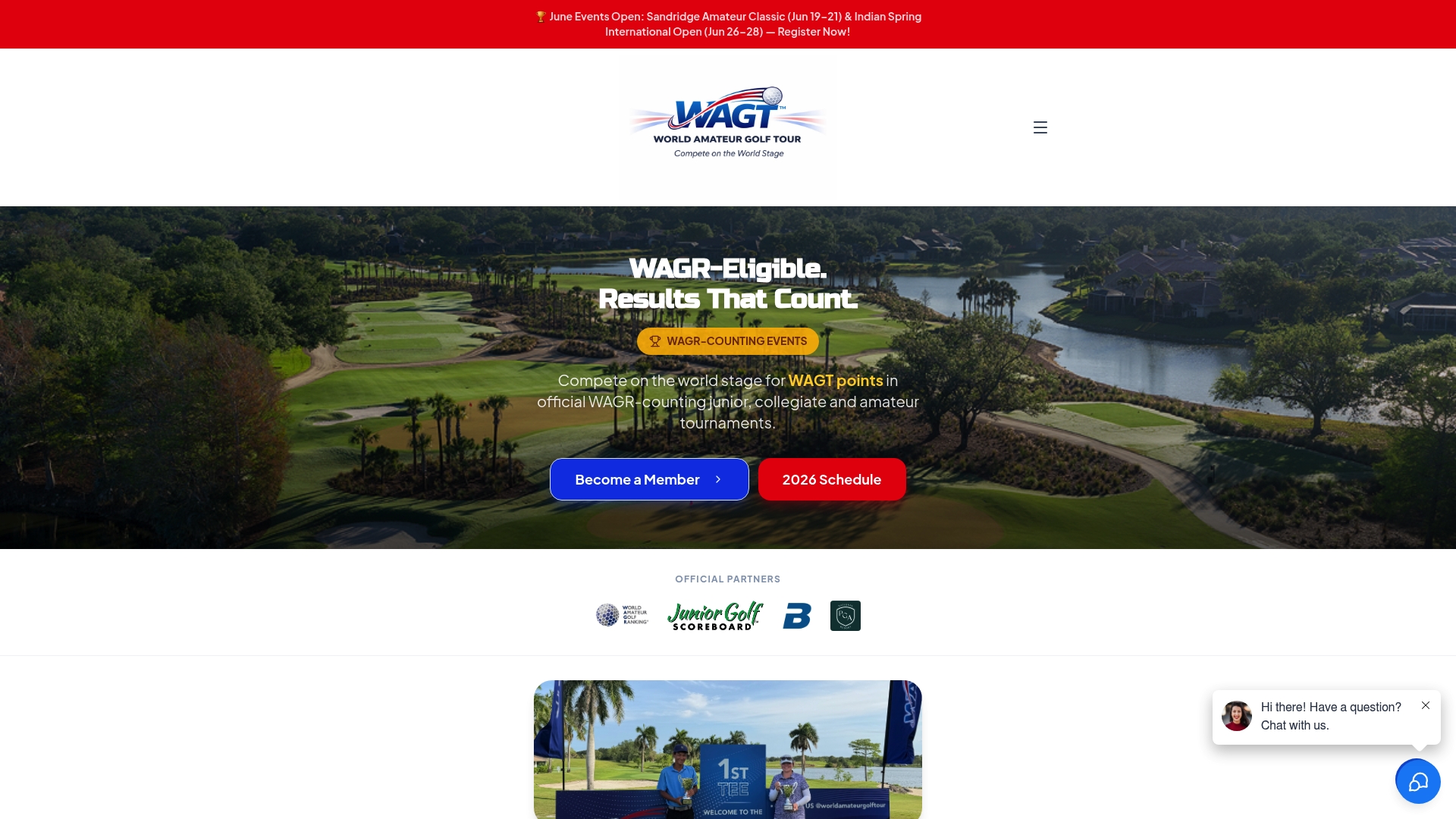
If you are serious about earning a spot in a U.S. college golf program, your WAGR ranking is the foundation everything else is built on. Worldamateurgolftour runs professionally managed, WAGR-certified tournaments at championship-caliber courses, giving junior and collegiate players the ranking points and competitive experience that college coaches look for. Every event is designed to test your full game, from tee to green, in a fair and competitive environment.
Join the Worldamateurgolftour community and compete in events that count. Your college future starts with the right events on your resume.
Key Takeaways
International events are the most direct path for junior and collegiate golfers to build the WAGR and JGS rankings that U.S. college coaches use to evaluate and recruit international talent.
| Point | Details |
|---|---|
| International player share | About 25% of NCAA Division I golfers are international players as of 2026. |
| WAGR and JGS are essential | Coaches use these rankings to compare players across countries on equal footing. |
| Arnold Palmer Cup pipeline | More than 245 alumni have earned cards on the PGA Tour, DP World Tour, or LPGA Tour. |
| Junior World as a scouting hub | Over 1,100 players from 55 countries attend. |
| Course difficulty matters | Championship-caliber venues like Torrey Pines give coaches reliable evaluation data. |