

A golf leaderboard is the live, public ranking of every player in a tournament, ordered by score relative to par. It updates after each hole, giving spectators an immediate picture of who leads, who is climbing, and who is falling behind. Fields in professional and elite amateur events regularly exceed 100 players competing across four 18-hole rounds, making the leaderboard the only practical way to track the full competition. Whether you are watching on broadcast or following along on PGATour.com, the leaderboard is your definitive guide to tournament standings.
What is a golf leaderboard and how does it work?
A golf leaderboard is a real-time public ranking ordered by each player's cumulative score relative to par. It refreshes after every hole, so standings can shift dramatically within minutes. That constant movement is what makes following a tournament genuinely exciting rather than waiting for a final result.
The core logic is simple. Every hole on a standard course carries a par value, and a full 18-hole course typically plays to a par of 72. When a player finishes a hole in fewer strokes than par, their score goes negative. When they take more strokes, their score goes positive. The leaderboard ranks all players from the lowest (best) score to the highest (worst), giving you an instant comparison regardless of how many holes each player has completed.

This relative scoring system is what separates golf from most other sports. Two players can be on completely different holes yet still be compared fairly because both scores are measured against the same par standard. That design makes the leaderboard functional even when 100-plus competitors are spread across the course simultaneously.
How to read a golf leaderboard: columns, scores, and notations
Every leaderboard follows a consistent column structure. Once you know what each column means, reading any tournament board becomes straightforward.
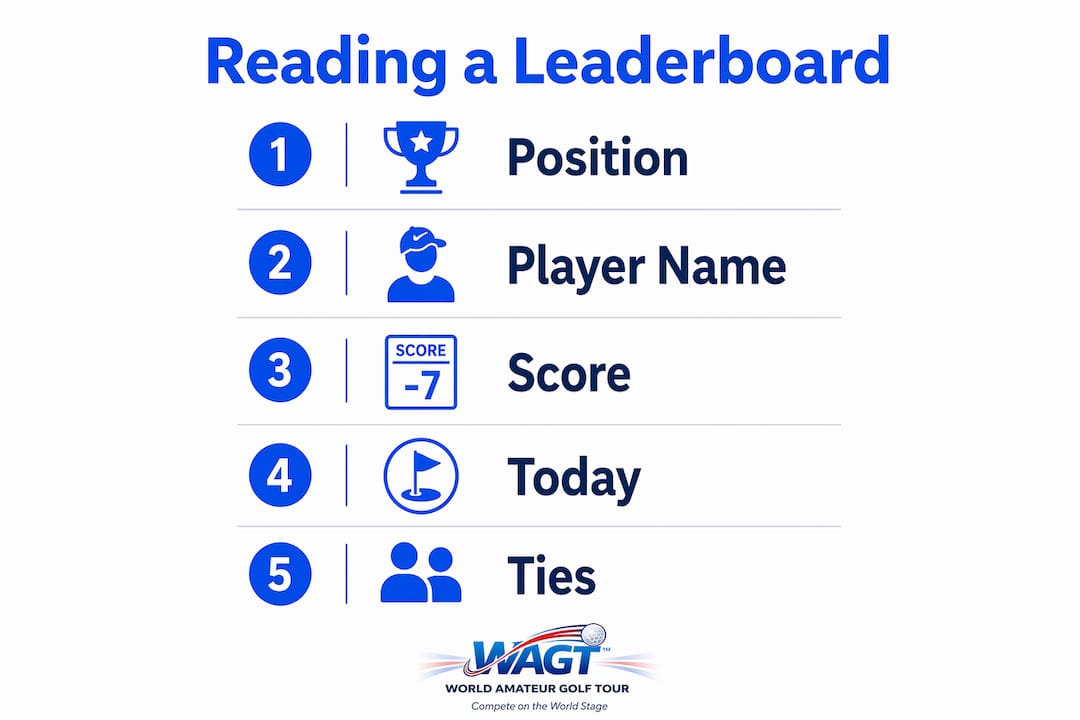
The five standard columns are:
- POS (Position): The player's current rank. A "T" prefix means tied. "T3" means the player shares third place with at least one other competitor.
- Player Name: The competitor's name, sometimes with their country flag in digital formats.
- To Par: The cumulative score relative to par. Negative numbers (like "8") mean strokes under par. Positive numbers (like "+3") mean strokes over par. "E" means even par.
- Thru: The number of holes the player has completed in the current round. "F" means the round is finished.
- Today: The player's score for the current round only, separate from their overall total.
Scores relative to par use negative numbers for under par, positive for over par, and "E" for even, enabling fair comparison even when players are on different holes. That system is the foundation of every leaderboard you will ever read.
The "Today" column deserves special attention. A player might sit at "2" overall but be having a terrible current round at "+4 Today." That tells you their lead is shrinking in real time. Conversely, a player at "+1" overall but "5 Today" is making a serious charge up the standings.
Pro Tip: When two players share a position, the "T" prefix is your signal. T2 with five players means five competitors are tied for second. The next available position after those five would be seventh, not third. Recognizing this prevents misreading the standings entirely.
Tied positions are grouped by shared score, and the gap between position numbers can be large. Knowing this helps you understand why a player listed at T7 might still be very much in contention.
How does a leaderboard differ from a scorecard?
A scorecard and a leaderboard serve completely different purposes, and confusing the two leads to real misunderstandings about how tournaments work.
A scorecard is the official, hole-by-hole record of a player's strokes. Players and their playing partners verify and sign it after each round. It carries legal weight in tournament administration. If a scorecard shows the wrong score and a player signs it, the recorded score stands regardless of what actually happened. That is how official golf rules work under bodies like the USGA and R&A.
A leaderboard, by contrast, is a public live ranking tool that aggregates all players' scores for spectator consumption. It has no legal standing in the tournament. Its job is to display comparative standings clearly and quickly.
The practical differences matter in four specific ways:
- Detail level: Scorecards show every stroke on every hole. Leaderboards show only the cumulative score relative to par.
- Verification: Scorecards require player signatures. Leaderboards are updated by tournament officials and technology systems.
- Timing: Scorecards are finalized after each round. Leaderboards update continuously during play.
- Purpose: Scorecards determine official results and prize allocations. Leaderboards inform fans, media, and betting markets in real time.
Understanding this distinction also matters when watching broadcast coverage. The score you see on screen is the leaderboard figure, not a direct read from the signed scorecard. Discrepancies can occasionally occur mid-round before scores are officially verified. The score verification process is handled by tournament officials who reconcile both systems at the end of each round.
Why does viewing the full leaderboard matter?
TV broadcasts focus on the top 20–30 players or featured groups, and that narrow view can seriously mislead your understanding of a tournament. The full leaderboard tells a very different story.
Consider a player sitting at "2" overall. On broadcast, that looks comfortable. But if the full leaderboard shows 15 players within two shots, that player is under enormous pressure. Partial leaderboard views can mislead about player standing and tournament context. That is not a minor detail. It changes how you interpret every shot you watch.
Viewers who track only the top five players on broadcast miss the real drama unfolding in the middle of the leaderboard. A score of "2" means something completely different when you are in a three-way tie versus when you are four shots clear of the field. Context is everything in reading tournament standings.
The full leaderboard also reveals the cut line, which is the score players must beat to continue into the weekend rounds. Watching a player at "+3" without knowing the cut sits at "+2" means you are missing the entire stakes of their round. That context is only visible when you check the complete standings.
Three habits separate informed spectators from casual viewers:
- Check the full leaderboard on the official tournament app or website at least once per hour during a round.
- Note how many players are within five shots of the leader, not just who leads.
- Track the "Today" column to identify who is moving, not just who is currently ranked highest.
Understanding golf rankings in their full context is what separates a casual viewer from someone who genuinely understands the competitive dynamics of a tournament.
How have digital leaderboards changed the fan experience?
Modern digital leaderboards do far more than display scores. They have become full data platforms that change how fans engage with tournaments.
Modern digital leaderboards integrate interactive statistics, historical data, and betting information, enhancing fan engagement beyond simple scores. That shift means you can now track a player's strokes gained statistics, their driving accuracy for the round, or how their current performance compares to their historical average at the same course. Fans who use these tools analyze momentum and player statistics live, turning passive viewing into active analysis.
The contrast with traditional static boards is significant:
| Feature | Traditional static board | Modern digital leaderboard |
|---|---|---|
| Update frequency | Manual, periodic | Live, after every hole |
| Data available | Score and position only | Stats, history, betting odds |
| Access | Physical course only | Apps, websites, broadcast |
| Interactivity | None | Filters, player tracking, alerts |
Physical leaderboards on course still serve a purpose for spectators walking the fairways. But for depth of analysis, official tournament apps and sites like PGATour.com give you the complete picture that broadcast graphics simply cannot fit on screen.
Pro Tip: Set up player-tracking alerts in the official tournament app for two or three players you want to follow closely. You will get notified of score changes in real time without needing to refresh the leaderboard manually.
The integration of live tournament data with fan platforms has also changed how amateur events are followed. Worldamateurgolftour events, which offer WAGR-counting competition for junior and amateur golfers, benefit from the same digital leaderboard standards that make professional events engaging. When players and families can follow live standings on their phones, the competitive experience becomes richer for everyone involved.
Key Takeaways
A golf leaderboard is the definitive real-time ranking tool in tournament play, and reading it correctly requires understanding scores relative to par, standard column formats, and the difference between broadcast summaries and the full competitive picture.
| Point | Details |
|---|---|
| Core definition | A leaderboard ranks all players by score relative to par, updating after every hole. |
| Reading scores | Negative numbers mean under par, positive means over par, and "E" means even par. |
| Tied positions | A "T" prefix signals a tie; T3 with four players means the next position listed is seventh. |
| Leaderboard vs. scorecard | Scorecards are official legal records; leaderboards are live public ranking displays. |
| Full leaderboard value | Broadcast shows only top players; the full leaderboard reveals cut lines and true competition depth. |
Why I think most fans are watching tournaments wrong
Most golf fans watch tournaments the same way they watch football. They pick a favorite, follow that player, and treat everything else as background noise. That approach works fine for casual entertainment. It fails completely if you want to understand what is actually happening in a competition.
The leaderboard is not a scoreboard for your favorite player. It is a map of an entire competitive ecosystem. When I started checking the full standings every 30 minutes during a round rather than just tracking one or two names, my appreciation for the sport changed completely. Shots that looked routine suddenly carried enormous weight once I understood where the player stood relative to 15 other competitors within striking distance.
The most common mistake I see is treating a player's score in isolation. A score of "5" sounds great. But if the leader is at "10" and the cut is at "1," that player is in a very different position than the number alone suggests. The leaderboard gives you the context to read those numbers correctly.
My honest recommendation: next time you watch a tournament, pull up the full leaderboard on the official app alongside the broadcast. Watch how the standings shift in real time. Pay attention to the "Today" column as much as the overall score. You will find yourself understanding the drama of every hole at a level that broadcast coverage alone simply cannot deliver.
— Gene
Worldamateurgolftour and real-time tournament standings
Competitive golf is most exciting when you can follow every shot in context, and that starts with a live leaderboard.

Worldamateurgolftour runs WAGR-certified events for junior, collegiate, and amateur golfers at championship-caliber venues across Florida. Every tournament features real-time scoring and live standings so players, families, and fans can track the competition as it unfolds. Whether you are a player chasing WAGR ranking points or a fan following the next generation of elite amateurs, you can find the full event schedule and live results at the official Worldamateurgolftour site. Serious competition deserves a leaderboard that matches its intensity.
FAQ
What is a golf leaderboard?
A golf leaderboard is the live, public ranking of all players in a tournament, ordered by their cumulative score relative to par. It updates after each hole throughout every round.
How do you read scores on a golf leaderboard?
Negative numbers (like "8") mean strokes under par, positive numbers (like "+3") mean strokes over par, and "E" means even par. Lower scores rank higher on the leaderboard.
What does "T" mean on a golf leaderboard?
The "T" prefix stands for tied. T4 means the player shares fourth place with at least one other competitor, and the next listed position skips ahead accordingly.
What is the difference between a leaderboard and a scorecard?
A scorecard is the official, player-signed hole-by-hole record used to determine official results. A leaderboard is a live public display that aggregates scores for fan and media consumption.
Where can you find the full golf leaderboard during a tournament?
The full leaderboard is available on official tournament websites and apps, including PGATour.com, the Masters site, ESPN, and CBS Sports, which all provide live rankings beyond what broadcast graphics show.