

The golf elite amateur category is defined as the highest tier of competitive amateur golf, reserved for players who meet strict ranking thresholds, program eligibility criteria, and performance standards recognized by governing bodies like the USGA and R&A. If you are a serious competitive player or junior golfer mapping your path to the next level, understanding what is a golf elite amateur category is not optional. It is the framework that determines which tournaments you can enter, which professional pathways you can access, and how visible you become to coaches, scouts, and sponsors.
What is a golf elite amateur category?
The golf elite amateur category is not a single universal label. It is a collection of classifications applied by governing bodies, tours, and programs to identify the top fraction of amateur players globally. The primary tool for this classification is the World Amateur Golf Ranking, known as WAGR, which is the definitive global ranking system used to categorize elite amateur performance and provide exemptions into professional and championship events.
WAGR supports thousands of counting events annually and issues separate rankings for men, women, and players with disabilities. That breadth makes it the closest thing to a universal standard in amateur golf. When a governing body, tour, or program refers to an "elite amateur," they almost always mean a player with a strong WAGR position, supplemented by specific performance benchmarks.
Programs like the LPGA LEAP pathway and the USGA Elite Amateur Program use WAGR as a foundation but layer on additional criteria. These programs represent the formal infrastructure of elite amateur golf. They are the structures that turn a high ranking into a real career opportunity.
What criteria define an elite amateur golfer?
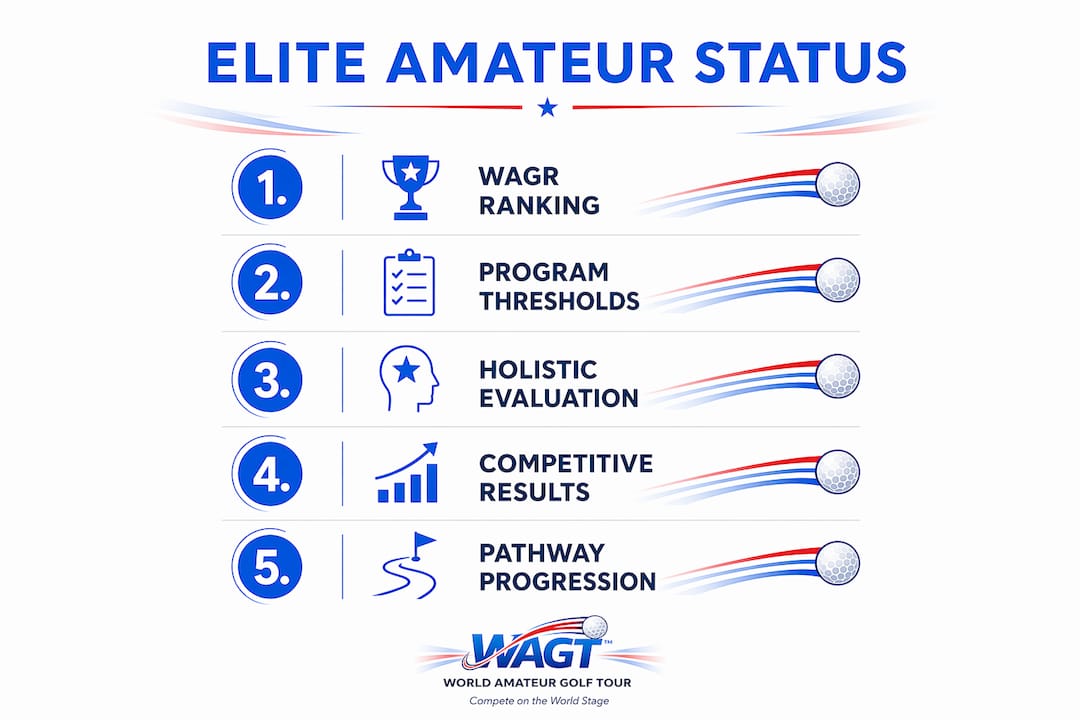
Elite amateur status is earned through a combination of ranking performance, program-specific thresholds, and holistic evaluation. No single metric tells the whole story.

WAGR ranking thresholds
Your WAGR position is the starting point for almost every elite classification. Programs and exemptions typically target players ranked within the top 200 globally, though the exact cutoff varies by program and event. The higher your ranking, the more doors open automatically.
LPGA LEAP points system
The LPGA LEAP program requires a 20-point threshold earned through a structured points system. Points are awarded across five categories: highest WAGR ranking achieved, major LPGA finishes, amateur championship wins, individual awards, and team competition results. Points range from 1 to 4 depending on the achievement, and only the highest point value per finish counts. That structure rewards consistency across multiple performance dimensions, not just one strong result.
Players like Rose Zhang and Leona Maguire are cited examples of amateurs who met LPGA LEAP criteria early in their careers. Elite status represents the top fractional percentage of amateur players performing consistently at championship level. That exclusivity is the point.
Holistic selection criteria
The USGA Elite Amateur Program goes beyond rankings. Selection committees use holistic criteria including nationality, age, academic progress, conduct, and long-term development potential. The 2026 roster included just 10 players, reevaluated annually. A player can have a strong WAGR ranking and still miss selection if their academic trajectory or sportsmanship record does not meet the standard.
- Strong WAGR ranking within the top 200 globally
- Points threshold met through LPGA LEAP or equivalent program criteria
- American nationality and amateur status for USGA program eligibility
- Demonstrated academic progress and conduct record
- Consistent performance across major amateur championships and team events
Pro Tip: Track your WAGR ranking monthly, not just before major events. Ranking movement is cumulative, and a single strong result at a high-field counting event can shift your position significantly.
How do WAGR rankings influence elite amateur classification?
WAGR is the backbone of elite amateur golf rankings, but understanding how it works in practice separates players who rise quickly from those who stall.
How points are allocated
WAGR does not assign points equally across all tournaments. Field strength and tournament designation as a counting event directly determine how many points are available. A win at a weak-field event moves your ranking far less than a top-10 finish at a high-designation championship. Players who understand this schedule their season around events that maximize ranking gains.
| Tournament type | Points impact | Strategic value |
|---|---|---|
| WAGR-designated major amateur championships | High | Maximum ranking movement per event |
| Strong-field counting events | Medium to high | Consistent ranking gains across the season |
| Low-field or non-counting events | Minimal or none | Limited ranking benefit regardless of result |
| Team competitions (Walker Cup, Curtis Cup) | Moderate | Points plus program eligibility credit |
Men's, women's, and disability rankings
WAGR issues three separate rankings: men, women, and players with disabilities. Each operates on the same core methodology but applies to distinct competitive fields. Women competing for LPGA LEAP eligibility build their ranking through women's WAGR events. Men targeting the Global Amateur Pathway focus on the men's ranking. Understanding which ranking applies to your pathway prevents wasted effort on events that do not count toward your specific goal.
Pro Tip: Use the golf world rankings guide to map which specific events in your region carry the highest WAGR point designations before you finalize your tournament calendar.
What elite amateur programs and pathways exist?
Three programs define the formal structure of elite amateur development in 2026. Each targets a different player profile and offers a distinct route toward professional competition.
-
LPGA LEAP Program. LEAP is the LPGA's structured pathway for top women amateurs transitioning to professional status. It requires a 20-point threshold earned across ranking, major finishes, championships, awards, and team play. Points expire at predefined eligibility periods, so timing matters. Players who accumulate points early but delay turning professional can lose eligibility. LEAP rewards players who perform consistently across multiple competitive dimensions over a sustained period.
-
DP World Tour Global Amateur Pathway. This program targets the top 200 ranked male amateurs globally, excluding NCAA Division I players. Top qualifiers earn DP World Tour cards, making it one of the most direct routes from elite amateur status to professional competition. Registration for the 2026 season ran to June 30, with the ranking period ending October 11, 2026. The NCAA exclusion is significant. It means collegiate players must weigh the trade-off between staying in school and pursuing this pathway.
-
USGA Elite Amateur Program. The USGA program supports top American amateurs with coaching resources, international competition experience, and structured development. The 2026 roster included 10 players selected through an annual review process. Selection weighs performance, conduct, academic standing, and long-term potential. This program complements collegiate golf rather than competing with it, making it accessible to players still in school.
These three programs are not mutually exclusive. A top-ranked American woman could simultaneously build LPGA LEAP points, maintain USGA program eligibility, and compete in WAGR-counting events. Strategic planning across all three is how the best players accelerate their development. Learning how to transition from college golf to the amateur circuit is a critical step in this process.
What are the practical benefits of elite amateur status?
Elite amateur classification is not just a label. It produces concrete, measurable advantages for your competitive career.
- Tournament exemptions. Elite-ranked amateurs receive direct exemptions into major championships including the U.S. Amateur, U.S. Open, and The Open Championship. These exemptions bypass qualifying rounds entirely, saving energy and reducing variance.
- International competition access. Programs like the USGA Elite Amateur Program fund international travel and competition, exposing players to fields and conditions they would not encounter domestically.
- Coaching and development resources. USGA program members receive structured coaching support. That access to high-level instruction is not available to the general amateur field.
- Sponsorship and scouting visibility. A strong WAGR ranking makes you searchable and credible to equipment sponsors, apparel brands, and professional tour scouts. Agents and sponsors track WAGR actively. A top-200 ranking puts your name in front of decision-makers who never attend local events.
- Career planning clarity. Elite status gives you a defined timeline. LPGA LEAP eligibility periods and Global Amateur Pathway registration windows create concrete deadlines that force strategic decision-making about when to turn professional.
The amateur tour membership benefits that come with competing in recognized tours compound over time. Each WAGR-counting event you enter is both a ranking opportunity and a credential on your competitive record.
Key takeaways
The golf elite amateur category is determined by WAGR rankings, program-specific point thresholds, and holistic selection criteria that together identify the top fraction of competitive amateur players worldwide.
| Point | Details |
|---|---|
| WAGR is the foundation | Your World Amateur Golf Ranking determines eligibility for exemptions, programs, and professional pathways. |
| Programs have specific thresholds | LPGA LEAP requires 20 points; Global Amateur Pathway targets the top 200 ranked men; USGA selects 10 players annually. |
| Holistic criteria matter | Conduct, academic progress, and long-term potential factor into USGA program selection beyond ranking alone. |
| Tournament selection is strategic | Field strength and counting event designation determine how much each result moves your WAGR position. |
| Elite status creates real advantages | Exemptions, coaching access, sponsorship visibility, and professional pathway eligibility all follow from elite classification. |
Why the elite amateur category matters more than most players realize
I have watched competitive amateur golf evolve significantly over the past decade. The shift toward data-driven ranking systems like WAGR has been the single biggest structural change in how talent gets identified and developed. Before these systems existed, a player from a smaller market could perform brilliantly and still get overlooked because the right people were not watching. Now, a strong WAGR ranking is visible to every program director, tour scout, and sponsor globally.
What surprises me most is how few players actually understand the strategic layer of elite amateur classification. They know WAGR exists. They do not know that a single well-chosen event at a high-designation tournament can move their ranking more than five wins at weaker fields. That gap in knowledge costs players real opportunities.
The programs themselves, LPGA LEAP, the Global Amateur Pathway, and the USGA Elite Amateur Program, represent something genuinely valuable. They codify the path from amateur excellence to professional competition in a way that is merit-based and transparent. That is better for players and better for the sport. My advice for anyone targeting elite status in 2026 and beyond is simple: treat your tournament calendar like a ranking strategy, not just a schedule. Every event is a choice with ranking consequences. Make those choices deliberately.
— Gene
Compete for WAGR points with Worldamateurgolftour
If you are serious about building your WAGR ranking and reaching elite amateur status, the events you enter matter as much as how you play in them. Worldamateurgolftour runs professionally managed, WAGR-counting tournaments specifically designed for junior, collegiate, and competitive amateur golfers. Every event is held at a championship-caliber course and run with the integrity and transparency that serious players deserve.

You can earn real ranking points, compete against strong fields, and build the competitive record that elite programs and professional scouts look for. Whether you are targeting LPGA LEAP eligibility, the Global Amateur Pathway, or simply want to compete in top-tier events, Worldamateurgolftour gives you the platform to do it. Explore the tournament calendar and membership options at worldamateurgolftour.com and start building your ranking today.
FAQ
What is the golf elite amateur category?
The golf elite amateur category is the highest tier of competitive amateur golf, defined by WAGR rankings, program-specific points thresholds, and eligibility criteria set by governing bodies like the USGA, LPGA, and R&A. It determines tournament exemptions, professional pathway access, and development program eligibility.
How does WAGR determine elite amateur status?
WAGR ranks amateur golfers globally based on performance in designated counting events, with field strength affecting point values. A strong WAGR position, typically within the top 200, is the primary qualifier for elite amateur programs and major championship exemptions.
What is the LPGA LEAP program?
LPGA LEAP is a structured professional pathway for top women amateurs requiring a 20-point threshold earned through WAGR ranking, major finishes, championship wins, awards, and team competition results. Points expire at predefined eligibility periods, making timing a critical factor.
Who qualifies for the USGA Elite Amateur Program?
The USGA Elite Amateur Program selects approximately 10 American amateur players annually based on performance, nationality, age, academic progress, conduct, and long-term development potential. Selection is reevaluated each year, and ranking alone does not guarantee inclusion.
What is the Global Amateur Pathway?
The Global Amateur Pathway is a DP World Tour program offering professional tour cards to top qualifiers from the top 200 ranked male amateurs globally, excluding NCAA Division I players. The 2026 ranking period ran through October 11, 2026.