

A golf event official is a designated authority responsible for enforcing the Rules of Golf and ensuring fair competition throughout a tournament. These officials operate under frameworks established by the USGA and the R&A, the two governing bodies that jointly publish and maintain the Rules of Golf worldwide. The four main categories of officials are Rules Officials, Starters, Scorers, and Operations Managers. Each role carries distinct duties, and together they form the backbone of every well-run tournament. Understanding what is a golf event official explained in full requires looking at how these roles interact, not just what each person does in isolation.
What are the primary roles of a Rules Official in golf tournaments?
A Rules Official interprets and applies the Rules of Golf on the course in real time, resolving rulings on equipment, penalties, and player conduct. This is the most visible officiating role in competitive golf, and it demands both deep knowledge of the rulebook and sharp situational judgment. No two rulings are identical, which makes experience as valuable as technical knowledge.
The core duties of a Rules Official include:
- Responding to player calls. When a player encounters an unusual situation, such as a ball embedded in soft ground or an immovable obstruction, they call for an official. The official walks the scene, assesses the facts, and delivers a ruling.
- Adjudicating equipment issues. If a club is damaged during play or a ball becomes unfit, the official determines whether a replacement is permitted under the rules.
- Issuing penalty strokes. Officials apply one-stroke or two-stroke penalties depending on the breach, and they document each ruling for the tournament record.
- Monitoring pace of play. On professional tours, officials time groups and issue warnings or penalties when a group falls behind the set pace.
- Reviewing broadcast footage. Officials use tablets and specialized software to access real-time shot data and video feeds, enabling evidence-based rulings in complex situations.
Tournaments deploy 15–20 officials during final rounds to maintain full course coverage. That staffing level reflects the volume and speed of decisions required when competitive pressure peaks.
Pro Tip: If you are studying to become a Rules Official, practice applying rules to video scenarios before attempting live rulings. The pressure of a real tournament ruling is different from a classroom exercise, and repetition builds the confidence you need.
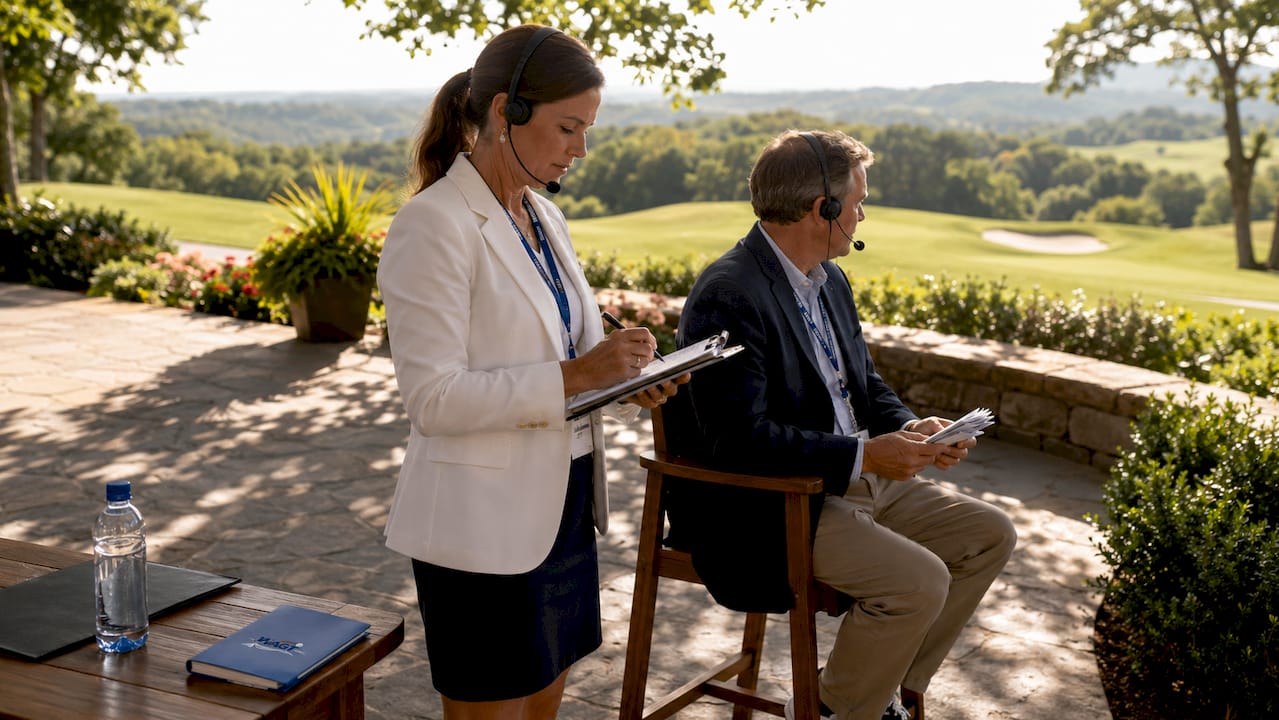
At elite events like The Masters, officials wear blue blazers as a visual signal of their authority. That color coding helps players and spectators identify officials instantly, reducing confusion on a crowded course.
How do Starters and Scorers contribute to golf event officiating?
Starters and Scorers handle the procedural side of tournament management, and their accuracy directly affects competitive integrity. A missed tee time or an incorrectly signed scorecard can change the outcome of an event. These roles are less visible than Rules Officials, but they are equally consequential.
A Starter manages the first tee with precision. Their responsibilities include:
- Confirming group compositions before each tee time
- Announcing players formally as they prepare to hit
- Managing the 30–60 second window between groups to keep the field moving on schedule
- Communicating delays or changes to the tournament operations team
That narrow window at the first tee is more demanding than it appears. A Starter must track multiple groups, communicate with marshals, and handle late arrivals without disrupting the field's rhythm.
Scorers carry a different but equally serious responsibility. They collect signed scorecards from players at the end of each round, verify that scores are correctly recorded, and submit the cards to the tournament committee. When a discrepancy appears, such as a score that does not match a recorded ruling, the Scorer escalates the issue to a Rules Official. That escalation process protects both the player and the integrity of the competition. A player who signs for a score lower than actually taken faces disqualification under the Rules of Golf, making the Scorer's verification step one of the most consequential moments in any round.
The golf event schedule depends on Starters and Scorers working in sync. When either role breaks down, delays and scoring errors ripple through the entire field.
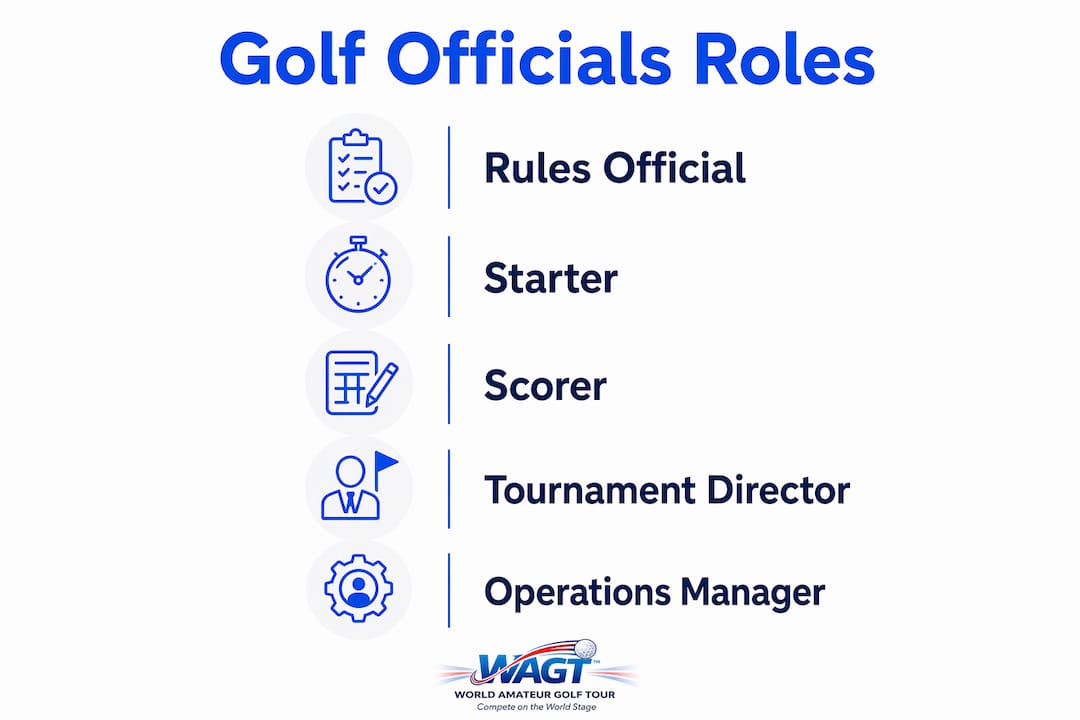
What is the role of the Tournament Director and Operations Manager?
The Tournament Director and Operations Manager handle everything that happens beyond the white stakes. Their work makes the on-course officiating possible by creating a safe, functional, and legally compliant environment.
The Tournament Director's responsibilities follow a clear hierarchy:
- Strategic oversight. The Director manages commercial agreements, sponsor relationships, and regulatory compliance with governing bodies like the USGA and R&A.
- Final authority on rulings. When a disqualification recommendation comes from a Rules Official, the Tournament Director reviews it before it becomes official.
- Weather and safety decisions. The Director calls play suspensions and determines when conditions are safe enough to resume.
- Liaison with governing bodies. The Director communicates with the USGA or R&A when a ruling requires interpretation beyond the standard rulebook.
The Operations Manager works at the execution level. Operations Managers coordinate logistics including ropes, gallery control, safety protocols, and hospitality vendor management. They also oversee course setup, working alongside grounds staff to position markers, ropes, and out-of-bounds stakes correctly before the first group tees off.
Course preparation for major tournaments involves multiple inspections by officials, the Tournament Director, and grounds staff to confirm rules compliance and competitive fairness. That process often spans several months before the event begins.
Pro Tip: Aspiring Operations Managers should shadow a Tournament Director during the setup phase of a regional event. The decisions made in those 48 hours before the first round reveal more about tournament management than any textbook.
Golf tournament success depends on a clear separation between rules enforcement and logistical management. When those lines blur, both competition integrity and spectator experience suffer.
How do golf event officials coordinate to resolve disputes?
Dispute resolution in golf follows a defined chain of command, and every step in that chain exists to protect competitive fairness. A player who disagrees with a ruling does not simply argue with the nearest official. The process is structured and deliberate.
The key steps in resolving a dispute include:
- Provisional ball play. When a player is unsure about a ruling, they may play a provisional ball to protect their position while the official investigates.
- On-site review. The Rules Official examines the situation, consults the rulebook, and may review tablet footage before delivering a decision.
- Senior official escalation. If the player contests the ruling, the matter moves to a senior Rules Official for a second review.
- Tournament Director final decision. Disqualification recommendations require the Tournament Director's approval before they take effect.
"Disqualification recommendations originate from Rules Officials but require senior approval to become official. Premature disqualification decisions are avoided by routing recommendations through senior officials and Tournament Directors for consistency and fairness."
That layered review process reflects a core principle in golf officiating. Rules Officials balance strict rule application with the professional stakes involved, often working collaboratively with players to gather all relevant facts before ruling. The goal is accuracy, not speed. A wrong ruling delivered quickly does more damage to a tournament than a correct ruling that takes five minutes.
Understanding local rules at golf events is equally important for players, because local rules modify standard procedures and officials must apply them consistently across the field.
Key Takeaways
Golf event officiating requires four distinct roles working in coordination, with Rules Officials at the center of on-course competition integrity.
| Point | Details |
|---|---|
| Rules Officials are the core authority | They interpret the Rules of Golf in real time, covering penalties, equipment, and pace of play. |
| Starters control tournament flow | They manage the first tee window and confirm group compositions to keep the field on schedule. |
| Scorers protect scoring integrity | They verify signed scorecards and escalate discrepancies to Rules Officials before submission. |
| Tournament Directors hold final authority | Disqualification decisions and weather calls require Director approval, not just field officials. |
| Role separation drives event quality | Clear boundaries between rules enforcement and operations management prevent breakdowns in both areas. |
Why golf officiating deserves more respect than it gets
The most common misconception about golf officials is that their job is simply to know the rulebook. Every serious official I have spoken with over the years will tell you the same thing: knowing the rules is the minimum requirement, not the skill. The real skill is applying them under pressure, in front of players whose careers may hinge on a single decision, while cameras and spectators watch every move.
What surprises most people is how collaborative the process actually is. Officials do not swoop in with authority and walk away. They gather information, listen to the player, review footage when available, and consult colleagues before ruling. That collaborative approach is not weakness. It is the system working exactly as designed.
The separation between Rules Officials and Operations Managers is also frequently misunderstood. I have seen well-meaning tournament organizers ask their Rules Official to handle rope placement or vendor logistics. That is a mistake. The moment an official is pulled into operational tasks, their attention to on-course rulings suffers. Clear role boundaries are not bureaucracy. They are what makes a tournament run cleanly.
For anyone considering a path into golf officiating, my honest advice is to start at the local level and volunteer at as many events as possible before pursuing formal certification through the USGA or your regional golf association. The classroom knowledge comes quickly. The judgment takes years.
— Gene
Worldamateurgolftour and the standard of professional officiating
Serious competition demands serious officiating. Worldamateurgolftour builds every event around that principle, running WAGR-counting tournaments with trained officials who apply USGA and R&A rules consistently across every round.

For junior, collegiate, and amateur golfers who want to compete in a fair and well-regulated environment, Worldamateurgolftour delivers championship-caliber events at respected venues. Every tournament follows the same standards you have read about here: clear role separation, proper scorecard verification, and rules enforcement that protects every player in the field. If you are ready to compete where the officiating matches the level of play, register for a tournament and experience the difference that professional event management makes.
FAQ
What is a golf event official?
A golf event official is a designated individual responsible for enforcing the Rules of Golf during a tournament. The role includes four main positions: Rules Official, Starter, Scorer, and Operations Manager.
What does a Rules Official do during a tournament?
A Rules Official interprets and applies the Rules of Golf in real time, handling penalty rulings, equipment decisions, and player disputes. Tournaments typically deploy 15–20 officials during final rounds to maintain full course coverage.
How do Scorers and Starters differ in their duties?
Starters manage the first tee and control group timing, while Scorers collect and verify signed scorecards after each round. Both roles directly affect the accuracy and flow of tournament competition.
Who has final authority on disqualification decisions?
The Tournament Director holds final authority on disqualification decisions. Recommendations originate from Rules Officials but must receive senior approval before they become official.
How can you become a golf event official?
Aspiring officials should volunteer at local events and pursue formal certification through the USGA or their regional golf association. Practical experience on the course builds the judgment that rulebook study alone cannot provide.