

A golf event local rule is an additional or modified rule adopted by a competition Committee to adapt the standard Rules of Golf to the specific conditions of a course or tournament. These rules exist alongside the 25 fundamental Rules of Golf, not in place of them. Approximately 90 Model Local Rules are authorized for use as of 2026, covering everything from preferred lies after heavy rain to dropping zones near construction areas. Whether you are a junior competitor chasing WAGR points or an organizer running a club championship, understanding golf tournament local rules is the difference between playing confidently and making costly mistakes.
What is a golf event local rule?
A golf event local rule is a Committee-approved modification that supplements the standard Rules of Golf for a specific competition or course. The Committee, meaning the group of people responsible for running the competition, holds the authority to adopt these rules. They cannot invent rules from scratch. They must work within the framework established by the USGA and The R&A.
Local rules in golf exist because no two courses are identical. A drainage ditch on one course, a construction zone on another, or a stretch of fairway damaged by frost all create situations the standard rulebook does not address precisely. Local rules fill those gaps. They give the Committee the tools to protect fair play without rewriting the game itself.

The key distinction is this: local rules address specific, real conditions. They are not a way for a club to make the game easier or to favor certain players. Local Rules must address genuine course realities like drainage or weather, not arbitrary preferences. That principle keeps the game honest.
How are golf event local rules created and governed?
The Committee's authority to create local rules is real but bounded. Every local rule must conform to the guidelines in Section 8 of the Official Guide to the Rules of Golf, published jointly by the USGA and The R&A. That document is the governing framework for all committees worldwide.
Local rules fall into two broad categories:
- Permanent local rules address fixed course features, such as an out-of-bounds definition along a specific road or a water hazard with an unusual boundary.
- Temporary local rules respond to changing conditions, such as preferred lies on fairways after heavy rain or ground under repair near a construction project.
Temporary local rules should be removed as soon as the condition requiring them ends. Leaving a preferred lies rule in place on a dry, firm course gives players an unfair advantage and undermines the integrity of the round.
Committees can adopt Model Local Rules exactly as written or adapt them, provided the changes stay consistent with the intent of the original rule. Official Model Local Rules provide template wording that committees can use directly. This standardization matters because it keeps local rules recognizable and defensible across different events.
The consequences of getting this wrong are serious. Local Rules inconsistent with these guidelines may invalidate rounds for handicap purposes. For junior golfers pursuing WAGR certification, an invalidated round means lost ranking points. That is a real competitive cost, not a technicality.
Pro Tip: If you are organizing an event, cross-check every local rule you plan to use against the current edition of the Official Guide before posting your scorecard. One non-conforming rule can compromise the entire round's official status.
What are the most common golf local rules in practice?
Knowing the theory is useful. Knowing what you will actually see on a scorecard is more useful. The table below covers the most frequently used Model Local Rules at amateur and professional events.
| Model Local Rule | What It Covers | When It's Typically Used |
|---|---|---|
| E-1 | Dropping zones near penalty areas or obstructions | When normal relief options are impractical or unsafe |
| E-3 | Preferred lies (lift, clean, and place) on fairways | After rain or frost damages fairway conditions |
| A-1 | Out-of-bounds defined by specific features | When course boundaries need clarification |
| F-5 | Embedded ball relief through the green | When wet conditions cause balls to plug in rough |
| B-3 | Immovable obstructions close to putting green | When cart paths or structures interfere with stance or swing |
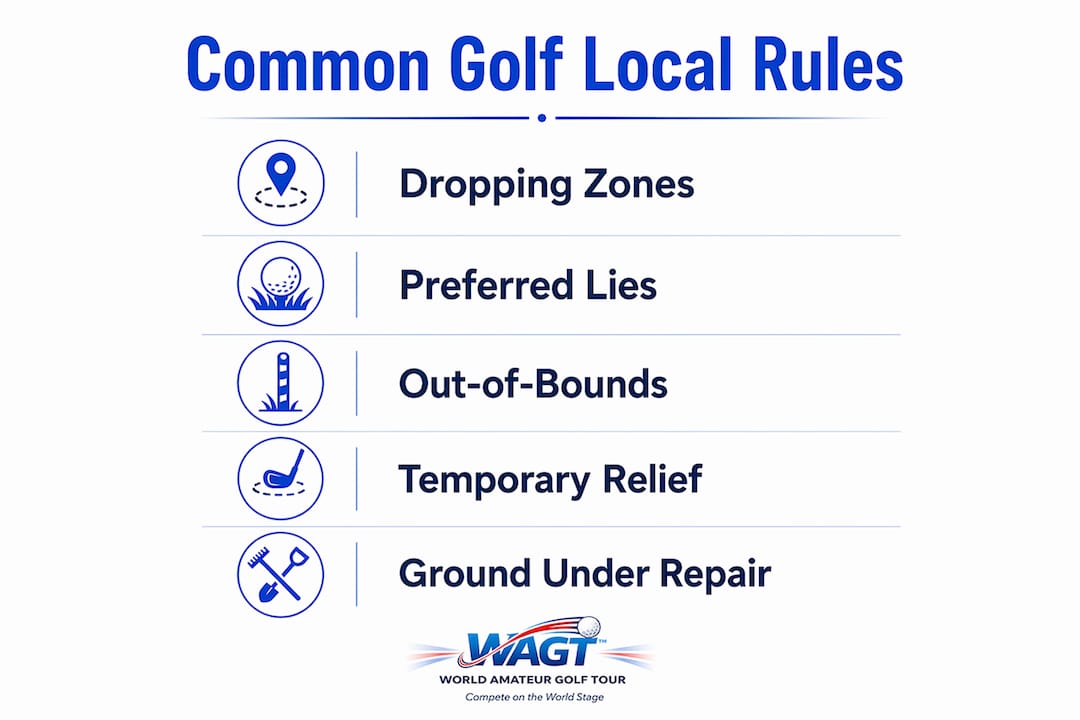
Model Local Rule E-1 covers dropping zones and E-3 covers preferred lies. These two rules appear at more amateur events than any others because weather and course maintenance are the most common reasons a Committee needs to act.
Preferred lies, sometimes called "winter rules," are the most misunderstood local rule in recreational golf. The rule allows a player to lift, clean, and place the ball within a specified distance, typically six inches or one scorecard length, on the fairway. It does not apply in the rough unless the local rule specifically says so. Many players assume it applies everywhere. That assumption is wrong and can cost you two strokes.
Out-of-bounds definitions are another area where local rules do real work. A course might border a public road, a private property line, or another hole. The Committee uses a local rule to define exactly where out-of-bounds begins, often using white stakes or painted lines. Without that definition, disputes are inevitable.
Penalties and player responsibilities under local rules
The standard penalty for breaching a local rule is the General Penalty. That means loss of hole in match play or two strokes in stroke play. The Committee can specify a different penalty, but that is rare. Most of the time, you are looking at a two-stroke hit if you play incorrectly under a local rule.
Players carry a clear responsibility here. You are expected to know the local rules in effect before you tee off. The Committee communicates these rules through several channels:
- Scorecards: The most common location for printed local rules at club events and amateur tournaments.
- Clubhouse notices: Posted on a bulletin board near the pro shop or starter's area, often with more detail than the scorecard allows.
- On-course markers: Physical indicators like ropes, painted lines, colored stakes, or signs that define areas covered by local rules.
Players must check these to fully understand the conditions on the day of play. "I didn't see it" is not a valid defense in a rules dispute.
A common source of confusion arises when physical course markings conflict with the posted rules. Committees must ensure alignment between what is written and what is marked on the course. As a player, if you spot a conflict, ask a rules official before you play your shot. Playing under a misunderstanding and then asking afterward almost always results in a penalty.
Pro Tip: Read the local rules sheet before your practice round, not just before your competitive round. Walking the course with the rules in hand helps you visualize exactly where they apply.
Golf local rules vs. external regulatory event rules
This distinction trips up even experienced organizers. Golf's local rules, set by the Committee, are entirely separate from external regulatory rules imposed by government or aviation authorities during major events.
Here is how they differ in practice:
-
Golf Local Rules are adopted by the competition Committee under the authority of the USGA and The R&A. They govern how the game is played on the course. Examples include preferred lies, dropping zones, and out-of-bounds definitions.
-
Regulatory event rules are legal mandates issued by civil authorities. They govern behavior around the event, not within the game itself. These are enforced by law enforcement, not rules officials.
-
Drone restrictions are a clear example of regulatory rules. At major 2026 golf events, temporary drone no-fly zones were implemented by the FAA and were legally enforced. Violating a no-fly zone is a federal matter, not a golf rules matter.
-
Road closures and parking restrictions follow the same logic. Aronimink hosted the 2026 PGA Championship with daily road closures and drone restrictions managed entirely by local authorities, not the golf committee.
-
Impact on organizers: If you are running an amateur event at a high-profile venue, you may need to coordinate with local authorities on traffic, airspace, and crowd management. Those obligations exist outside the Rules of Golf entirely. Understanding WAGR compliance requirements helps organizers separate these two layers of responsibility clearly.
The practical takeaway is straightforward. A player who accidentally enters a drone-restricted zone faces legal consequences. A player who takes incorrect relief under a local rule faces a two-stroke penalty. These are different systems with different enforcement mechanisms. Knowing which is which protects both players and organizers.
Key takeaways
Golf event local rules are Committee-adopted modifications that address specific course conditions, must conform to USGA and R&A guidelines, and carry a two-stroke General Penalty for any breach in stroke play.
| Point | Details |
|---|---|
| Definition of local rules | A local rule is a Committee-approved addition or modification to the standard Rules of Golf for a specific event or course. |
| About 90 Model Local Rules exist | These templates give committees standardized, compliant language to adopt or adapt for their events. |
| Non-conforming rules invalidate rounds | Local rules that contradict official guidelines can disqualify rounds for handicap and ranking purposes. |
| Players must check before play | Scorecards, clubhouse notices, and on-course markers all communicate local rules you are responsible for knowing. |
| Regulatory rules are separate | Drone no-fly zones and road closures are legal mandates enforced by civil authorities, not golf rules officials. |
Why local rules deserve more respect than they get
I have watched players walk off the 18th green convinced they played a clean round, only to learn they breached a local rule on the third hole and never knew it. That is not bad luck. That is preparation.
Local rules are not fine print. At serious competitions, including WAGR-certified events, they carry the same weight as any rule in the book. The Committee's job is to communicate them clearly. Your job is to read them. Both sides of that equation have to work.
The challenge I see most often with committees is overreach. A well-meaning organizer adds a temporary local rule "just in case" and forgets to remove it when conditions improve. That creates an unfair playing field and, more seriously, can compromise handicap validity for every player in the field. The rule is simple: if the condition is gone, the rule comes off the scorecard.
For players, the biggest mistake is assuming local rules only matter at professional events. They apply at every level. A two-stroke penalty at a club qualifier can cost you a spot in the next round just as surely as it can at a national championship. Treat every local rules sheet like it matters, because it does.
The game rewards preparation. Read the sheet, walk the course, ask questions before you play. That is not overthinking it. That is competing seriously.
— Gene
Play your best at events that take the rules seriously
Understanding golf event local regulations is only half the equation. Playing in events where those rules are applied consistently and fairly is the other half.

Worldamateurgolftour runs WAGR-certified events at championship-caliber courses where local rules are communicated clearly, enforced fairly, and aligned with USGA and R&A standards. Every event in the Worldamateurgolftour schedule is professionally managed, giving junior and amateur competitors the serious competitive environment they need to develop and earn ranking points. If you are ready to compete where the rules are taken as seriously as your game, explore our events and find your next tournament today.
FAQ
What is a golf event local rule?
A golf event local rule is an additional or modified rule adopted by the competition Committee to address specific course or tournament conditions. It supplements the standard Rules of Golf and must conform to guidelines set by the USGA and The R&A.
How many model local rules are available to committees?
Approximately 90 Model Local Rules exist as of 2026, giving committees a wide range of compliant templates to address conditions like preferred lies, dropping zones, and out-of-bounds definitions.
What is the penalty for breaking a local rule?
The General Penalty applies for breaching a local rule: loss of hole in match play or two strokes in stroke play, unless the Committee specifies otherwise.
Can a local rule override the standard rules of golf?
No. A local rule cannot modify a basic Rule of Golf in a way that changes how the game is fundamentally played or scored. Doing so disqualifies the round for official handicap calculation.
Where do players find local rules before a round?
Local rules are communicated through scorecards, clubhouse notices, and physical on-course markers like colored stakes, painted lines, or ropes. Check all three before you tee off.