

Strength of field, called Power in the World Amateur Golf Ranking, is a weighted score of how good a tournament's starting field is, and it directly sets how many ranking points are available at that event. A high-Power field means bigger point totals for every finishing position, even outside the top spot. If you want to climb the WAGR faster, the single biggest lever isn't playing more events. It's choosing the right ones.
TL;DR:
- Playing in events with high Power scores more than doubles your potential ranking points compared to low-power tournaments.
- Professional presence in a field can significantly boost Power, making even top-10 finishes more valuable than wins at weaker events.
- Results from recent high-Power events improve your ranking faster, as old performances lose value over the 104-week scoring cycle.
- Qualifying for and participating in counting events requires meeting specific format and scoring criteria, especially at low-Power tournaments.
- Choosing events with transparent field lists and published Power ratings ensures your efforts genuinely advance your ranking.
Table of Contents
- What WAGR's Power (Strength of Field) Actually Measures
- How Power Changes Ranking Points: Position and Payout
- Event Ageing, Divisors, and the 104-Week Cycle
- Qualification Rules and Inclusion Tests You Need to Know
- Building a Season Plan Around Power
- Where to Find and Verify High-Power Events
- The History Behind Strength of Field in Golf Rankings
- Common Misconceptions About Strength of Field
- How WAGR's Approach Compares to Other Ranking Systems
- How Field Strength Shapes Career Decisions and Strategy
- Why Professionally Run Events Matter for Fair Rankings
- Ready to Play Events That Actually Move Your Ranking?
- Sources
What WAGR's Power (Strength of Field) Actually Measures
Power is calculated from the ranking strength of everyone in the starting field, amateurs and professionals alike. Every ranked amateur contributes their current ranking position to the total, and if professionals are entered, WAGR pulls from OWGR and Rolex Rankings to weight their impact. Even unranked professionals count for something. WAGR assigns them a contributing value just below the lowest-ranked pro in the relevant system, so a field full of unranked club pros still pushes Power higher than an all-amateur lineup would.
A few patterns show up consistently once you start comparing events:
- Field size matters. More entrants generally means more Power, all else equal.
- The concentration of top-ranked players matters more than raw headcount. Ten players ranked in the world's top 200 outweigh a hundred unranked ones.
- Mixed amateur-professional fields almost always outscore amateur-only fields of similar size.
- Small local events often sit around a Power of 10 or lower.
- Strong amateur championships can approach the maximum Power of 1000 reserved for the top amateur fields in the world.
- Events with a meaningful professional presence can push past that range entirely, since pro rankings feed straight into the calculation.
That range, from single digits to four figures, is why two "36-hole tournaments" on paper can be worth wildly different amounts in practice.
How Power Changes Ranking Points: Position and Payout
WAGR doesn't hand out points per round anymore. The Power Method awards points based on your overall finishing position once the event is complete, and Power determines the total pool of points on offer before anyone hits a shot. Play well in a high-Power field, and the payout at every position, not just first place, scales up with it.
The gap between a weak-field win and a strong-field top finish is bigger than most players expect.
By the numbers: Winners of low-Power events (around 10) typically earn roughly 5 to 8 ranking points, while winners at the strongest amateur events, with Power near 1000, can collect up to 25 points for the same result: a first-place finish.
Put that in practical terms:
- A junior who wins a small local invitational might bank 6 points toward their average.
- A collegiate player who finishes fifth at a marquee amateur championship, without winning, can still out-earn that local winner because the field's Power inflates every position's payout.
- A mixed pro-am event with a Power well above 1000 can make a top-10 finish worth more than winning three weaker events combined.
Chasing wins at events nobody else wants to play isn't the strategy. Chasing results in fields that matter is.
Event Ageing, Divisors, and the 104-Week Cycle
WAGR points don't sit still once they're earned. Under the 104-week rolling cycle, points count at full value for the first 52 weeks, then age roughly 2% per week until they fall off the ranking entirely at week 104.
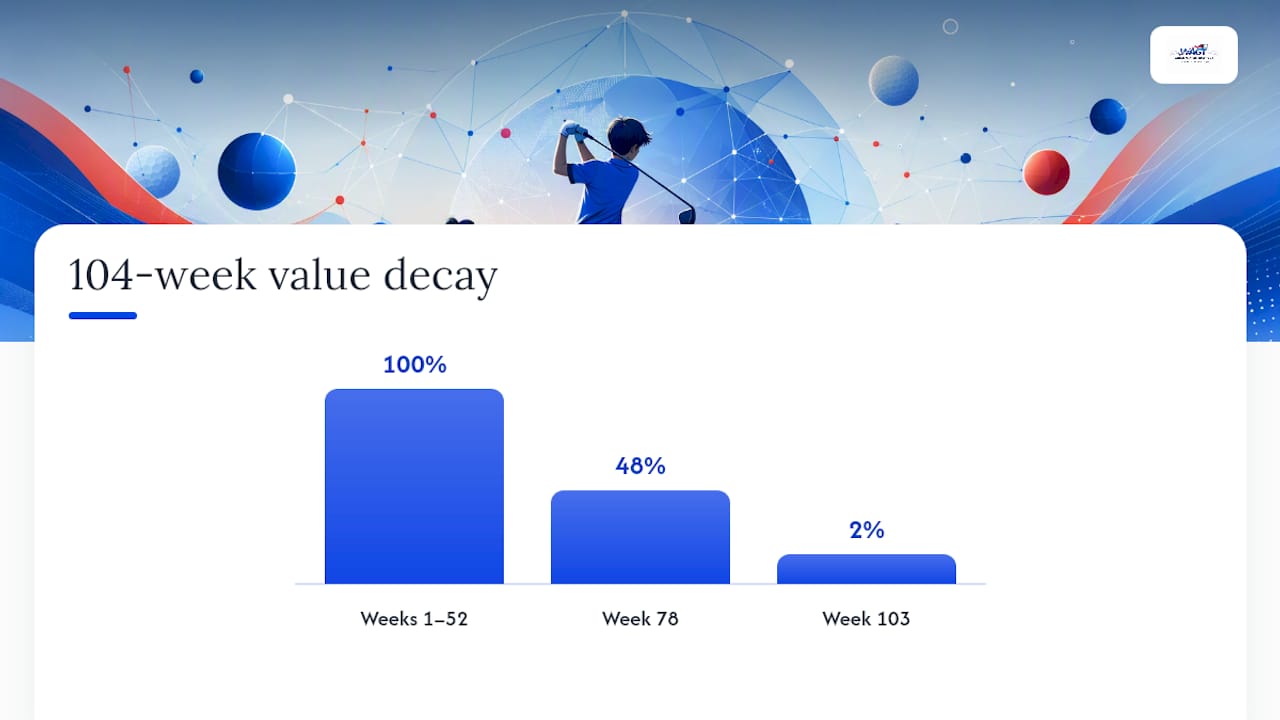
Divisors work on a similar clock. Under the Power Method, divisors are tied to your counting events and age alongside your points, with minimums set at eight for men and seven for women. Because your ranking average is simply points divided by divisor, a recent strong finish at a high-Power event moves that average faster than an old result ever could, even if the old result once looked impressive.
That's the practical upshot for scheduling:
- A great finish from 18 months ago is already losing value, week by week.
- A great finish from last month is still at full strength, and it's doing the heavy lifting in your average right now.
- Waiting on stale results to fall off is a slower path than actively replacing them with fresh, high-Power finishes.
Qualification Rules and Inclusion Tests You Need to Know
Before any of this Power math applies to you, an event has to actually count, and you have to qualify as a ranked player. The thresholds are specific, and missing one can mean a great week produces zero ranking benefit.
- Play at least 36 holes. WAGR requires a minimum of two rounds completed at a counting event before it factors into your record.
- Earn at least 6.5 ranking points in a single counting event to become an officially ranked player for the first time. Anything below that threshold doesn't establish a ranking.
- Pass the scoring test for lower-Power events. For events with a Power of 100 or below, the winner's average score has to fall within par plus 6 strokes for men or par plus 8 for women for the event to count at all. Blow past that margin, and WAGR can exclude the tournament regardless of how it was run.
- Meet format requirements. Counting events need to follow the Rules of Golf, respect amateur status regulations, and use championship-length tees appropriate to the level of play. Learn more about how organizers comply with WAGR rules before entering.
- Watch the format exception. Team match play formats typically don't generate individual WAGR points the way stroke-play or medal formats do, so a loaded team event might not deliver what you expect.
Professionals in the field are the wild card here. Their presence can lift Power dramatically, but it also means the points pool assumes a level of competition your card needs to actually match.
Building a Season Plan Around Power
Here's where the math turns into a calendar. The fastest way to raise your ranking average isn't adding events. It's replacing your weakest counting results with stronger ones, and that means being deliberate about where you tee it up.
Start with a simple filter: target events where a realistic finish for you would beat your current point average. A collegiate player averaging 4.2 points doesn't need ten more mid-major starts. They need two or three events where a top-15 finish would clear that number by a wide margin. Junior golf development guides make the same case: quality of finish against strong competition beats volume of starts against weak competition, every time.

Pro Tip: Before committing to a season schedule, map your last four counting results against their Power. If your best point totals came from your weakest fields, you're winning matches you were supposed to win. That's a sign to move up in competition level, not to keep repeating the formula.
A working checklist for picking events:
- Pull the entry list and check for ranked amateurs or professionals already committed.
- Check the event's Power or grade from a past year if it's a repeat tournament.
- Confirm the format meets Rules of Golf and amateur status standards.
- Read the cancellation and refund policy before paying an entry fee for a high-stakes date.
- Weigh the reward against the variance. Mixed pro-am fields carry huge upside but also a much tougher path to a high finish.
Coaches evaluating a recruit's or player's development path should also weigh factors beyond the ranking number itself, since a strong Power average tells only part of the story about readiness for the next level.
Where to Find and Verify High-Power Events
You can't strategize around Power if you can't see it. Start with the official WAGR event list, which shows counting status and, for past events, the Power that was assigned. Event organizer pages that publish full entry lists are your next best source. A published entry list lets you spot named ranked players or professionals before you commit an entry fee.
A few concrete signals to look for on any event page:
- A field list with recognizable ranked amateurs or touring professionals already committed.
- A stated or historical Power/grade from the same event in prior years.
- Past champions who were, or went on to become, ranked players themselves.
- Clear language confirming the event is a WAGR-counting event, not just an open invitational.
World Amateur Golf Tour calendars and event pages are built around this transparency. Every event listing shows counting status and field details up front, so you're not guessing at Power based on a flyer. Reviewing the best WAGR-counting amateur tournaments for a given year is a fast way to shortcut this research before you build a travel schedule around it.
The History Behind Strength of Field in Golf Rankings
For decades, amateur golf ranking systems leaned on a simpler idea: count rounds, count results, and treat most counting events as roughly equal. That approach had an obvious flaw. A 36-hole win at a thin local field looked identical on paper to a 36-hole finish against a stacked international lineup, even though the two performances weren't remotely comparable.
The R&A's Power Method, introduced for the 2020 ranking cycle, was built specifically to fix that gap. Rather than allocating points round by round, the new method assigns every event a single Power score based on its starting field, then determines the total points pool from that score before finishing positions get calculated. The redesign also shifted weight toward recent form, aging results faster than the old system did, so a player's current ranking reflects who they're beating right now, not who they beat two years ago.
This wasn't a cosmetic update. It changed how players and coaches think about scheduling entirely. Under the old model, playing more events padded a resume. Under the Power Method, playing the right events, ones with real strength of field, does the actual work of moving a ranking average. That shift toward quality over quantity now shapes how junior and collegiate golfers build their entire competitive calendar, not just how they chase a single big result.
Common Misconceptions About Strength of Field
The biggest misconception is treating "strength of field" as a synonym for "big event" or "famous course." Power has nothing to do with prestige, purse size, or how many people attend. It's a mathematical output built entirely from the ranking positions of the players actually entered. A modest-looking regional event with three top-100 amateurs in the field can carry more Power than a glamorous invitational stacked with unranked players.
Another common mix-up: assuming a win always beats a lesser finish, regardless of field. That's only true within the same event. Across different events, a top-10 at a high-Power field routinely outpoints a win at a low-Power one, sometimes by a wide margin, because the entire points pool scales with Power before positions are even assigned.
Players also tend to overestimate how much field size alone matters. A 150-player field of mostly unranked amateurs won't generate much Power, while a tight 60-player field loaded with ranked competitors and a few professionals can score dramatically higher. Size helps, but the ranking quality of who's actually in the field does the heavy lifting.
Finally, some players assume any tournament labeled "WAGR event" automatically counts fully. In reality, lower-Power events still have to clear the scoring-versus-par inclusion test described earlier, and format missteps, like certain team match play setups, can leave a great week generating no individual points at all.
How WAGR's Approach Compares to Other Ranking Systems
WAGR's Power Method sits closer to how professional ranking systems like the OWGR value field strength than it does to older, flatter amateur models. Both WAGR and professional tour rankings recognize that beating a stronger opponent should be worth more than beating a weaker one, and both use the ranking positions of the field itself, rather than a fixed points table, as the input.
Where WAGR's approach stands out is in how directly it folds professional strength into an amateur ranking. Because unranked and ranked professionals both contribute value to an event's Power, a collegiate player entering a mixed field is effectively competing inside a hybrid system that borrows the OWGR and Rolex Rankings as raw inputs. Few other amateur-focused ranking systems build that connection so explicitly into their core calculation.
The rolling 104-week window with graduated ageing is another point of difference. Some ranking systems apply a flat cutoff, where a result counts fully until a fixed date and then disappears all at once. WAGR's gradual, roughly 2% weekly decay creates smoother, more continuous incentive to keep playing strong events rather than coasting on an old result until it suddenly vanishes.
The practical takeaway for a junior or collegiate golfer: don't assume rankings systems reward the same behavior. A scheduling strategy built around a different sport's ranking logic, or an older amateur system's flatter point structure, won't translate cleanly to WAGR. Power rewards recent, high-quality finishes specifically, and the schedule has to be built around that reality.
How Field Strength Shapes Career Decisions and Strategy
For a junior weighing which summer schedule to build, Power isn't an academic detail. It's often the deciding factor between a schedule that produces a meaningful ranking jump and one that produces a busy summer with little to show for it on paper. Committing travel budget and practice time to a high-Power event carries real risk, since a rough week against strong competition can also produce a thin point total. That's the trade every serious competitor eventually has to make.
College coaches read WAGR averages with field strength in mind, even when they're not calculating Power by hand. A recruit with a modest average built entirely from strong-field finishes often reads as more battle-tested than one with a flashier average built from a stack of thin local wins. That distinction shapes recruiting conversations more than most players realize.
For collegiate players managing amateur status and eligibility, strength of field also factors into which off-season events are worth the entry fee and travel cost. A player deciding between a mixed pro-am with real variance and a safer amateur-only field is really deciding how much risk they want to take on for a potentially larger point payout. There's no universally right answer, but ignoring Power when making that call means making it blind.
Why Professionally Run Events Matter for Fair Rankings
World Amateur Golf Tour exists because too many WAGR-eligible players have shown up to events with murky entry lists, inconsistent scoring, or setups that don't match championship standards. Professionally managed events, ones with certified scoring, published entry lists, and championship tees set correctly, remove the guesswork that quietly distorts Power and point outcomes.
When an event follows WAGR's technical criteria closely, players know exactly what they're competing for before they tee off. That transparency protects the integrity of the ranking system itself. If you're choosing between two similar events, favor the one that publishes its entry list and field details in advance. You'll know what you're walking into, and so will your ranking average.
*— Gene
Ready to Play Events That Actually Move Your Ranking?
Some event organizers run WAGR-counting events with published entry lists, certified scoring, and championship-caliber courses, so you know exactly what field you're stepping into before you commit an entry fee.

Events listed on some calendars include counting status up front, which means you can compare field strength before you travel, not after you've already paid to find out. That's the difference between guessing your way through a season and building one around events that genuinely move your average.
Check the current calendar, review entry lists for upcoming dates, and confirm counting status before you register. If you're new to the process, the guide on how to enter World Amateur Golf Tour events walks through registration step by step. Visit the World Amateur Golf Tour landing page to see what's open near you this season.