

The World Amateur Golf Ranking updates every Wednesday at noon (GMT/BST), pulling in every counted event that wrapped by the preceding Sunday. Your ranking sits inside a rolling 104-week window, where results carry full weight for a year before aging out over the second year. The math behind your number is simple: points total divided by divisor total, times 100. The takeaway for your season is just as simple. Chase events where you can beat your current average, not just events where you can tee it up.
TL;DR:
- Playing fewer but stronger-field events optimizes your WAGR score because event power and field strength now weigh more than volume alone.
- Results delay can extend up to a week if organizers report slowly, which can impact your ranking updates before key deadlines.
- Adding mediocre finishes at low-power events can lower your average due to the divisor increase, so targeting quality over quantity is crucial.
- Always verify if an event is officially WAGR-counting and how quickly results are reported to maximize ranking gains.
- The WAGR ranking updates every Wednesday with results from the prior Sunday, so timely results submission is essential for accurate weekly updates.
Table of Contents
- Latest WAGR Ranking Updates: What's Changed
- How WAGR Ranking Updates Actually Work Week to Week
- Breaking Down the WAGR Formula, Points, and Divisors
- Improving Your WAGR Position: Quality Over Quantity
- Where to Track Official WAGR Ranking Updates
- How World Amateur Golf Tour Events Feed Your WAGR Score
- Playing the Long Game With Your WAGR Score
- Sources
Latest WAGR Ranking Updates: What's Changed
The most consistent theme in recent WAGR news isn't a single dramatic overhaul. It's steady refinement of how event Power and Strength of Field get calculated, plus tighter reporting expectations for tournament organizers feeding results into the weekly cycle.
Heading into 2026, the ranking body has continued sharpening how it weighs field strength when assigning available points to a tournament, which affects how many points a win or a top finish is actually worth. That distinction between "played in a big field" and "played in a strong field" keeps mattering more each cycle, because Power is calculated from the quality of entrants, not just the number of them.
Here's what actually shifts for you on the ground:
- Event selection now carries more strategic weight than it did when volume alone moved the needle.
- Reporting speed from organizers has a direct effect on how quickly your result shows up in the live tables.
- Divisor calculations continue to reward players who compete consistently against ranked fields rather than sporadically against soft ones.
Pro Tip: Before committing to a summer schedule, check whether an event's field includes enough ranked players to generate real Power. A stacked leaderboard against unranked amateurs won't move your number much.
How WAGR Ranking Updates Actually Work Week to Week
Every Wednesday at noon GMT/BST, the WAGR system refreshes the men's and women's tables with everything that finished by the Sunday before. Miss that Sunday cutoff by even a day, and your result waits until the following week's cycle.
That lag isn't a flaw. It's built-in processing time for organizers to submit clean, verified scores. Here's the sequence that determines when your finish actually shows up:
- Your event concludes on or before Sunday.
- The organizer submits final results to WAGR for verification.
- WAGR processes and slots the event into the ranking calculation.
- The updated table posts the following Wednesday at noon GMT/BST.
Slow reporting from an organizer can push your result into a second delayed cycle, which matters if you're tracking your ranking ahead of a deadline for college recruiting outreach or championship qualifying. The WAGR FAQs page confirms that timely organizer submission is what keeps the weekly table accurate.
Pro Tip: Always check the "last updated" timestamp at the top of the ranking page before assuming your result has posted. If a full week has passed with no change, it's worth a direct email to the tournament organizer, not WAGR.
Breaking Down the WAGR Formula, Points, and Divisors
Your WAGR number comes from one formula: WAGR Performance = Points total ÷ Divisor total × 100. Points total is every point you've earned across counted events in the current window. Divisor total reflects how many events count toward your average, which grows as you play more.
That divisor is the part most players underestimate. Add a mediocre finish, and your divisor climbs while your points barely move, which drags your average down even though you technically "did more."
Points available per event depend on Power and Strength of Field. According to WAGR's own criteria, a lower-power event might hand the winner around 5.3 points, while a maximum-power amateur event can pay out up to 25 points to the winner. That's nearly a five-fold gap for finishing first, depending entirely on who else was in the field.

Aging works on its own clock. A strong finish from 15 months ago is already worth noticeably less than it was on the day you earned it.
Improving Your WAGR Position: Quality Over Quantity
Playing more events feels productive, but it often works against you. Because the divisor grows every time you add a counted event, a so-so finish at a low-power tournament can lower your average even while padding your schedule.
The smarter play is targeting events where the field is strong enough to make a good finish worth real points, even if that means playing fewer tournaments overall. Before committing to any event, run through this checklist:
- Does the organizer confirm the event is officially WAGR-counting?
- What's the field's typical strength, and who else has committed?
- How quickly does this organizer historically report results?
- Does this event fit a window where you're realistically playing above your current average?
Ranking removal isn't just about aging points. Turning professional pulls you from the amateur list immediately, and the WAGR FAQs note that players must meet initial ranking requirements again if they ever return to amateur status. Falling short of minimum counted events within the 52 week window can also affect your active ranked status.
Pro Tip: Ask organizers directly, "Is this WAGR-counting and how fast do you typically report results?" Their answer tells you as much about your schedule as the golf course does.
For a deeper look at which fields tend to offer the strongest Power ratings, the guide to WAGR-counting amateur tournaments breaks down specific events worth targeting this season.
Where to Track Official WAGR Ranking Updates
Skip the secondhand summaries and go straight to the source. WAGR's own homepage posts weekly winners and news alongside the live men's and women's ranking tables, and every table displays its own "last updated" timestamp so you know exactly which week's results you're looking at.
For the rules behind the numbers, the criteria page and FAQs are the two pages worth bookmarking. Coaches especially should review these each season, since Power calculations and reporting standards get refined periodically.
- WAGR homepage for weekly news and winners
- Men's and women's ranking pages for live tables and timestamps
- Criteria page for the technical rules behind points and Power
- FAQs page for update timing and eligibility questions
How World Amateur Golf Tour Events Feed Your WAGR Score
Every WAGR-counting event on the Worldamateurgolftour calendar exists for one reason: to give junior, collegiate, and amateur golfers a real shot at earning points that actually move their ranking. Strong fields, professionally run 54-hole formats, and respected host venues mean the Power behind these events works in your favor, not against it.
Fast, accurate result reporting matters more than most players realize, and it's a key consideration in how some organizations operate. Getting your scores into the weekly cycle without delay means your ranking reflects your game as quickly as possible, not two or three weeks late.
| What you get | Why it matters for your ranking |
|---|---|
| WAGR-counting events at competitive venues | Access to real Power and Strength of Field |
| Prompt, professional results reporting | Faster inclusion in the weekly WAGR update |
| Player profiles and recruiting tools | Potential tools related to recruiting visibility |
| Consistent, high-quality event calendar | Fewer wasted entries, more strategic scheduling |
- Juniors seek recruiting visibility through WAGR-counting results.
- Collegiate players aim for schedules aligned with their pathways.
- Coaches value timely score reporting compared to delayed results from less organized events.
For a full walkthrough of registration, see how to enter World Amateur Golf Tour events for WAGR points.
Playing the Long Game With Your WAGR Score
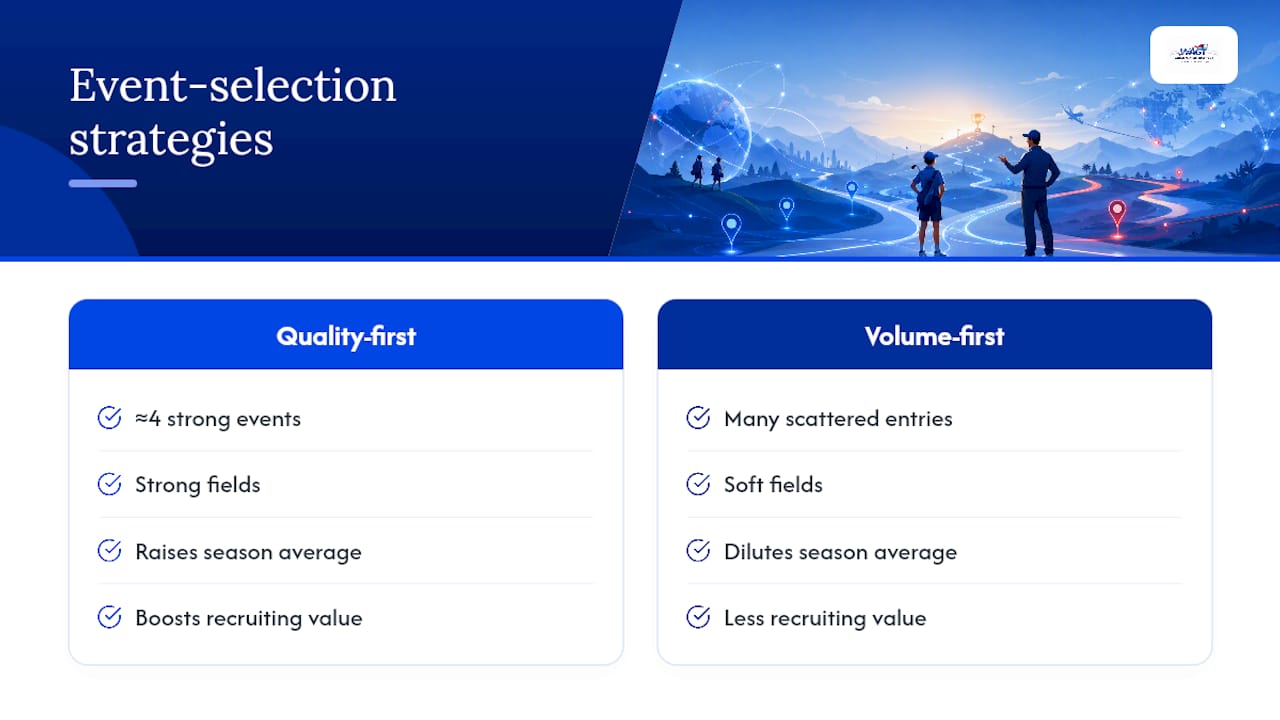
A single great week can lift your number, but it's the pattern across a season that actually builds a ranking worth defending. I'd rather see a junior golfer commit to four strong-field events than scatter entries across a dozen soft ones chasing volume.
Chase peak performance at the right moments. Build your base with steady, well-chosen starts in between. The current cycle rewards exactly that discipline: play fewer events, but make each one count against a field that pushes your average up, not down.
— Gene
Every serious amateur schedule should start with the same question WAGR itself is built around: where can you actually earn points above your average? Worldamateurgolftour exists to answer that with a full calendar of WAGR-counting events, professionally run at courses that give juniors, collegiate players, and amateurs the kind of competitive field that makes a good finish worth something. If your schedule needs events that move your number and your recruiting profile at the same time, memberships for tours offering WAGR-counting events can be beneficial.