

The strongest alternatives to CJGA fall into six clear categories: elite national recruiting tours, WAGR-counting regional tours, grassroots development programs, team-format leagues, state and regional association events, and college showcase circuits. Each serves a different player profile; therefore, the right starting point depends entirely on your junior's current goal.
- College-recruiting pathway: Elite national recruiting tours and WAGR-counting events are the priority. World Amateur Golf Tour runs WAGR-sanctioned tournaments specifically designed to build a junior's ranking profile for college coaches.
- Skill development and fundamentals: Grassroots programs like First Tee and LPGA–USGA Girls Golf, which together operate at 600+ sites worldwide, prioritize access, coaching curriculum, and age-appropriate competition.
- Team experience and fun: PGA Jr. League's two-person scramble format gives younger or recreational players a low-pressure competitive environment with an All-Star pathway for those ready to advance.
- Budget-conscious regional play: State and regional association tours frequently run sanctioned junior events that cost less and require shorter travel than national circuits.
Start by matching your junior's primary goal: college recruiting or skill building. That single decision narrows the field immediately.
Table of Contents
- What are the best CJGA.com alternatives by category?
- How do you pick the right alternative for your junior?
- Why do WAGR-counting events matter, and how does Worldamateurgolftour create that pathway?
- How do junior golf programs handle player safety and event policies?
- Key Takeaways
- What parents often get wrong about junior golf program selection
- Worldamateurgolftour: WAGR-counting junior tournaments built for recruiting visibility
- Useful sources and links to verify rankings, event rules, and find local tours
What are the best CJGA.com alternatives by category?
Because dozens of junior golf platforms compete for overlapping audiences, comparing them brand by brand quickly becomes unmanageable. Grouping by category is more useful.
| Category | Best for | Age range | Ranking/college exposure | Cost model | Event format | Geographic reach | Field strength |
|---|---|---|---|---|---|---|---|
| Elite national recruiting tour | College-bound juniors | 15–18 | High (AJGA PBE, national rankings) | Membership + per-event entry | Individual stroke play | National, high travel | Competitive |
| WAGR-counting regional tour | Serious juniors building international ranking | 15–18 | High (WAGR points) | Annual membership + entry fees | Stroke play events | Regional to national | Competitive to elite |
| Grassroots kids tour | Recreational development, beginners | 5–13 | Low to none | Low per-event or seasonal fee | Scramble, modified formats | Local/regional | Beginner to intermediate |
| Team-format league | Recreational, team experience | 6–13 | Low | Seasonal team fee | Two-person scramble | Local | Beginner to intermediate |
| State/regional association tour | Budget-conscious, accessible competition | 10–18 | Moderate (some carry ranking weight) | Low annual fee + entry | Stroke play, match play | State/regional | Intermediate |
| College showcase circuit | College-bound juniors, recruiting exposure | 15–18 | Moderate to high (recruiting platforms) | Per-event or package | Stroke play | Regional to national | Competitive |
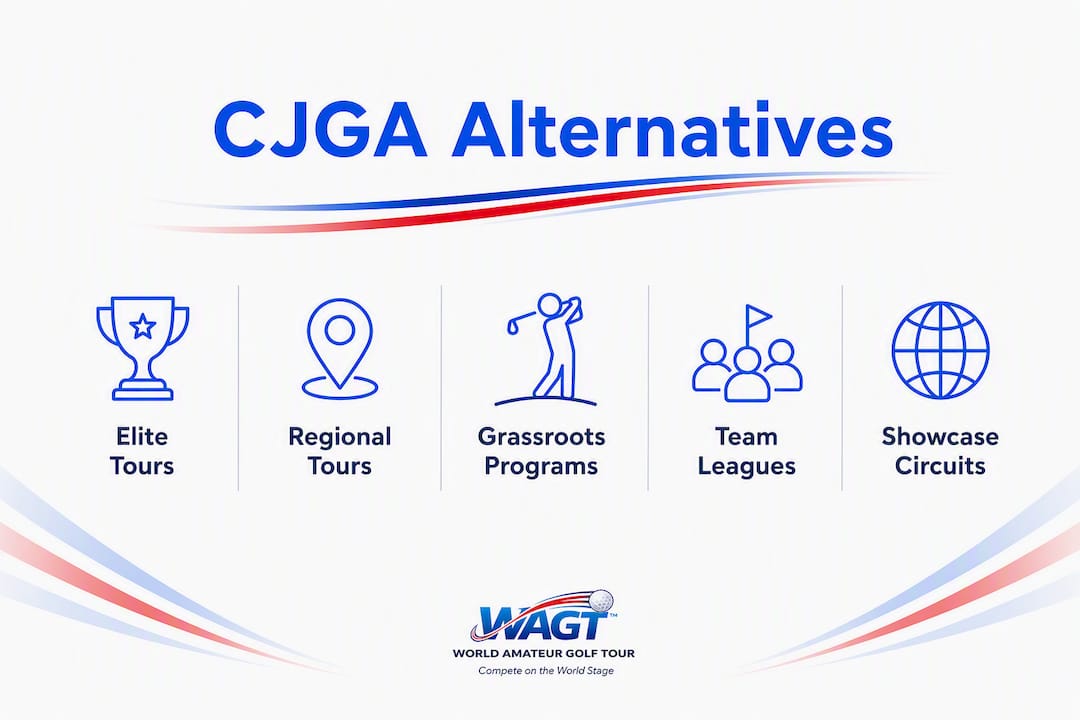
Elite national recruiting tours like the American Junior Golf Association (AJGA) are built around the Performance Based Entry (PBE) system, which ranks players and controls field access. These events draw college coaches and carry real recruiting weight, but the entry bar is high and costs add up quickly between membership, entry fees, and travel.
WAGR-counting regional tours sit at the intersection of serious competition and international ranking visibility. World Amateur Golf Tour operates in this space, offering WAGR-sanctioned events with membership features that include live scoring, player profiles, and recruiting tools. For a junior who is competitive but not yet ready for the AJGA's elite fields, this category often delivers the best ranking-to-cost ratio.
Grassroots programs such as US Kids Golf and First Tee prioritize development over results. US Kids Golf runs age-group events across the country with handicap-based divisions, making them genuinely accessible for players still building consistency. First Tee adds a life-skills curriculum alongside golf instruction, reaching more than 10.5 million young people since its founding.

Team-format leagues are dominated by PGA Jr. League, which officially opens its season on March 1 each year. The two-person scramble format reduces individual pressure and makes the game social, which is exactly right for players aged 6–13 who are still deciding whether competitive golf is for them.
State and regional association tours are the most underrated option on this list. Many parents overlook them, but these organizations run well-organized, sanctioned events that are far more budget-friendly than national circuits. Some carry ranking weight, and the shorter travel radius makes a full season realistic without burning out the family.
College showcase circuits like the Future Collegians World Tour (FCWT) and Junior Golf Hub are built specifically around recruiting exposure. Junior Golf Hub functions as a recruiting platform connecting players with college coaches, while FCWT runs events designed to put competitive juniors in front of college programs. These are most relevant for players aged 15–18 who already have a solid competitive record.
Pro Tip: When researching any event marketed as "elite," pull the published results and check the winning score against course rating. A 72-hole event where the winner shoots even par on a 68.5-rated course is genuinely competitive. One where the winner shoots 20-under on a 65.0-rated layout tells a different story about field strength.
How do you pick the right alternative for your junior?
Pick by primary goal first, then work through the details. A junior chasing a Division I scholarship needs a different program than a 10-year-old who just started playing. Here is a practical checklist to work through before committing to any program.
- Define the primary goal. College recruiting, skill development, team experience, or participation? This determines which category to enter.
- Check age and division fit. Confirm the program has a division appropriate for your junior's age and current scoring average. Mismatched divisions hurt development and confidence.
- Verify ranking and points availability. For recruiting-focused players, confirm whether events carry WAGR points or AJGA PBE credit. Ask the organizer directly and cross-check on the WAGR official site.
- Review a sample event schedule. Look at dates, venues, and frequency. A program that runs four events per year in your region is more sustainable than one requiring eight cross-country trips.
- Estimate total annual cost. Add membership fees, per-event entry fees, and realistic travel costs. National tours can run $3,000–$8,000 per year all-in; regional and state tours are often a fraction of that.
- Evaluate coaching and support resources. Does the program offer practice rounds, on-site coaching, or player development workshops? These details separate development-focused programs from pure event organizers.
- Confirm recruiting exposure tools. For older juniors, check whether the program provides player profiles visible to college coaches, live scoring, and published results history.
Questions to ask any organizer before signing up:
- Are your events WAGR-sanctioned or AJGA PBE-eligible? Can you provide verification?
- What is the average field size, and what is the typical winning score at your events?
- What is your refund and cancellation policy if a player withdraws?
- Is live scoring available, and are full results published and archived?
Red flags to watch for:
- No published results or score history for past events
- Opaque fee structures with vague "additional charges may apply" language
- Events marketed as elite with fields under 20 players
- Inconsistent staging history (events canceled or relocated frequently)
For a junior focused on college recruiting, a realistic season involves 6–10 competitive events per year, a mix of regional and national events, and a clear ranking progression plan. For a recreational or development-focused junior, 4–6 local events per season is plenty. Aligning the program's competitive environment to your junior's actual skill level is the single most important decision you will make.
Why do WAGR-counting events matter, and how does Worldamateurgolftour create that pathway?
WAGR-counting events raise a junior's visibility for college coaches by placing them on a standardized international ranking system that programs across the country actively monitor. When a coach searches for recruits, WAGR ranking provides an objective, comparable data point that transcends regional scoring differences.
The World Amateur Golf Ranking (WAGR) is the official ranking system for elite amateur golfers, jointly administered by the USGA and The R&A. Points are awarded based on field strength and finish position, which means competing in stronger fields earns more ranking credit. For a junior targeting a Division I or Division II program, a WAGR ranking signals competitive credibility in a way that local tournament wins alone cannot.
Worldamateurgolftour runs WAGR-sanctioned tournaments and pairs them with a membership platform that includes live scoring, player profiles, recruiting tools, and an event calendar. Those features matter because college coaches do not just want to see a ranking number — they want to see a full competitive history, consistent results, and a player who has competed in professionally managed events at respected venues.
Parents can verify WAGR event status directly through the USGA's junior golf resources. Any event claiming WAGR status should appear in the official WAGR database. Worldamateurgolftour's membership and fee structure are published on its landing page, so there are no surprises after signup.
How do junior golf programs handle player safety and event policies?
Player safety policies became a serious evaluation criterion after the COVID-19 pandemic, and the standards programs adopted then have largely shaped how they operate today.
Most established junior golf organizations now publish clear health and safety protocols covering event postponement, cancellation, and refund policies. The USGA, which oversees national junior programs, set a standard for transparent communication during disruptions that many regional and national tours have since adopted.
When evaluating any program, check three things. First, does the organizer publish a clear cancellation and refund policy? A program that keeps entry fees for canceled events with no credit or refund option is a financial risk, especially for families traveling long distances. Second, does the program communicate schedule changes proactively, with reasonable advance notice? Third, for outdoor events, is there a weather policy that prioritizes player safety over completing rounds?
PGA Jr. League, AJGA, and US Kids Golf all maintain published policies on their websites. For newer or smaller regional tours, ask the organizer directly and get the answer in writing before paying any fees. Worldamateurgolftour publishes its event management policies and maintains a transparent fee structure, which is the baseline standard any serious program should meet.
Gear and equipment standards are a related safety consideration. Players competing in stroke play events should confirm that equipment meets USGA rules, and parents outfitting a junior for competitive play can find guidance on golf equipment and apparel suited to tournament conditions.
Key Takeaways
The right CJGA alternative depends on your junior's goal: WAGR-counting tours serve college-bound players best, while grassroots and team-format programs are the stronger fit for younger or recreational juniors.
| Point | Details |
|---|---|
| Match program to goal | College-recruiting juniors need WAGR or AJGA PBE events; recreational players benefit more from grassroots or team formats. |
| Verify ranking status | Always confirm WAGR or PBE eligibility directly with the organizer and cross-check on the official WAGR database before committing. |
| Budget realistically | National tour seasons can be costly annually all-in; state and regional tours offer sanctioned competition at a fraction of that cost. |
| Regional tours are underrated | State and regional association events provide accessible, sanctioned competition that many families overlook in favor of national circuits. |
| Worldamateurgolftour pathway | Worldamateurgolftour offers WAGR-counting tournaments with membership features including live scoring, player profiles, and recruiting tools for college-bound juniors. |
What parents often get wrong about junior golf program selection
The conventional wisdom says "start with the biggest name tour you can get into." That advice serves marketing budgets more than it serves junior players.
A 13-year-old who enters an elite national recruiting tour before their game is ready does not get exposure — they get discouragement. College coaches are not scouting 13-year-olds at national events. What they are watching is a junior's trajectory over time: consistent improvement, competitive results in appropriately leveled fields, and a ranking that reflects genuine performance.
The smarter path, especially for players under 15, is to build a strong foundation in regional and state-level competition, accumulate a results history that coaches can actually read, and layer in WAGR-counting events when the scoring average is genuinely competitive. A junior who shoots 75 consistently in strong regional fields is a more credible recruit than one who shoots 85 in a national event and has no regional results history to contextualize it.
For older juniors, 16 and up, the calculus shifts. That is when WAGR ranking and recruiting platform visibility become genuinely important, and when investing in a program like Worldamateurgolftour's WAGR-counting circuit pays off in concrete recruiting conversations. The role of international and WAGR-counting events in college recruiting is well-documented, and the window to build that ranking is shorter than most families realize.
Measure progress by scores in published events, not by how impressive the tour name sounds on a resume.
Worldamateurgolftour: WAGR-counting junior tournaments built for recruiting visibility
For families where the goal is a college golf scholarship or Division I program placement, WAGR ranking is the clearest path to getting noticed. Worldamateurgolftour delivers exactly that: professionally run, WAGR-sanctioned tournaments at championship-caliber venues, paired with a membership platform built around the features college coaches actually use.
Here is what the membership includes for competitive junior players:
- WAGR-counting tournaments with transparent field strength and published results
- Player profiles and recruiting tools visible to college coaches searching for prospects
- Live scoring and full results archives so your junior's competitive history is always accessible
- Event calendar and membership management in one platform, with a rewards program redeemable for gear and entry credits
Membership and event fee details are published on the Worldamateurgolftour site — no hidden costs, no vague pricing. You can verify WAGR event status through the official WAGR database for any event on the calendar.
If your junior is ready to compete at a level that builds a real ranking and puts their name in front of college programs, view the event calendar and membership options at Worldamateurgolftour and register for the next available event in your region.
Useful sources and links to verify rankings, event rules, and find local tours
- Worldamateurgolftour — membership and events — The client's landing page with WAGR-counting event listings, membership signup, live scoring access, and recruiting tool information for junior and amateur golfers.
- XRANKS — cjga.com alternatives — An aggregator listing dozens of junior golf tour alternatives and similar platforms; useful for identifying regional and niche options beyond the major national tours.
- Amateur golf tour comparison factors — A Worldamateurgolftour guide explaining how junior golf tours differ in training intensity, competition structure, and development outcomes.
- Age-appropriate golf competitions for juniors — Practical guidance for matching a player's age and skill level to the right event format and division.
- College golf recruiting and international events — Explains how WAGR-counting and international events influence college recruiting visibility and what families should prioritize by age group.