
Amateur status in golf is defined as the condition of playing the sport without receiving compensation tied to athletic skill, and college golfer amateur status maintenance is the ongoing process of meeting every NCAA and USGA/The R&A requirement that keeps that status intact. Lose it, and you lose your eligibility to compete for your university. The rules governing this process have grown more detailed in 2026, especially with evolving Name, Image, and Likeness (NIL) policies and the aftermath of the House v. NCAA settlement. This guide gives you a clear, practical path through every requirement you need to know.
What are the NCAA eligibility requirements for college golfer amateur status maintenance?
The NCAA Eligibility Center is your first stop. Every college golfer must complete an amateurism certification before competing at the Division I or Division II level. The registration fees are $110 for domestic students and $170 for international students. That fee is not a formality. It opens a formal review of your entire sports history and financial dealings.
Timing matters as much as the fee. Fall enrollees must submit their final certification request starting April 1. Spring and winter enrollees start october 1. Missing these windows delays your eligibility, and no coach can override that.

The NCAA Eligibility Center reviews your application in approximately 10 business days under normal conditions. Delays almost always come from incomplete documentation. You need a detailed, chronological record of every golf competition you have entered, every expense reimbursement you have received, and every interaction with agents or sponsors.
What the NCAA considers permissible vs. prohibited
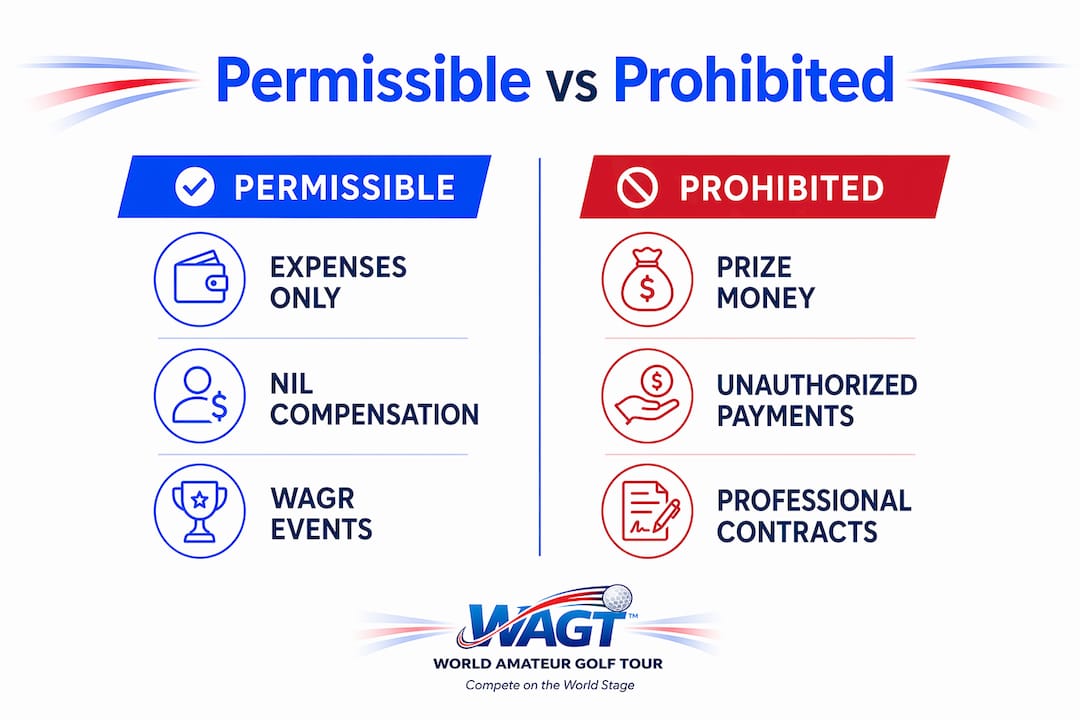
Understanding the line between allowed and disallowed activity is the foundation of maintaining amateur status. Here is how the NCAA draws it:
Permissible activities:
- Competing in amateur tournaments, including those that offer prize money below governing body limits
- Accepting reimbursement for actual and necessary travel and lodging expenses, when properly documented
- Receiving need-based financial aid from your institution
- Entering NIL agreements that meet current NCAA and institutional guidelines
Prohibited activities:
- Accepting any salary, signing bonus, or payment tied to your golf performance
- Signing a professional contract, even if you never play under it
- Receiving prize money above the limits set by USGA and The R&A
- Allowing an agent to negotiate on your behalf without prior approval
Pro Tip: Request your amateurism certification at least 60 days before your first expected competition date. The 10-business-day review window does not account for back-and-forth document requests, which can add weeks.
How do NIL and compensation rules affect your amateur status?
The post-House v. NCAA landscape has changed what college golfers can earn, but it has not eliminated the core amateur status requirements. Signing professional contracts or accepting prohibited prize money still causes immediate loss of amateur status, regardless of NIL revenue you may be earning separately.
NIL compensation is now permitted under specific conditions. You can sign deals with local businesses, appear in advertisements, and earn income from social media, as long as the compensation is not tied directly to your athletic performance on the course. The distinction is critical. A deal paying you to post about a golf equipment brand is generally permissible. A deal paying you a bonus for winning a tournament is not.
The USGA and The R&A have also modernized their amateur rules, removing previous sponsorship limits and simplifying restrictions. Key permitted acts under the updated rules include accepting prize money below the published limit, avoiding paid instruction roles, and not accepting employment from a professional golf club in a playing capacity.
The governing bodies have modernized rules to better reflect today's financial realities, allowing amateurs more flexibility to receive support while safeguarding the game's integrity. That flexibility, however, comes with a clear ceiling. Cross it, and reinstatement is your only path back.
Understanding the impact of sponsorship on amateur status is now a core skill for any serious college golfer. Read every sponsorship agreement carefully before signing.
Which competitions and activities put your amateur status at risk?
Competing in professional events is not automatically disqualifying. The key rule is compensation. You can play in professional events and retain your amateur status as long as you receive no compensation beyond documented actual and necessary expenses. The moment you accept a salary, a signing bonus, or any payment tied to your athletic skill, you permanently lose NCAA eligibility under current rules.
The table below shows the most common situations college golfers face and how each affects their status:
| Situation | Status Impact |
|---|---|
| Playing in a professional event, expenses only | Permissible, status retained |
| Accepting prize money above USGA/R&A limit | Status lost immediately |
| Signing a professional contract | Permanent loss of eligibility |
| Receiving NIL payment for social media content | Permissible under current rules |
| Accepting payment for golf instruction | Prohibited, status at risk |
| Competing in WAGR-certified amateur events | Fully permissible, status retained |
Jackson Koivun's decision after Auburn's national title run illustrates how elite players think about this. Koivun deferred his PGA Tour membership to retain amateur status for the Walker Cup and U.S. Open. That choice reflects a calculated approach: amateur status is not just a restriction. It is a competitive asset that opens doors to prestigious events unavailable to professionals.
If you do lose your status, reinstatement is possible but not guaranteed. The reinstatement process typically requires a waiting period of at least 6 months from your last professional activity before you become eligible to apply. Governing bodies exercise discretion, and the process can take longer depending on the nature of the violation.
Pro Tip: Before entering any event with prize money, check the current USGA and The R&A prize limit for that calendar year. The limit updates periodically, and exceeding it by even a small amount triggers a review.
What best practices help you avoid amateur status violations?
Proactive compliance is far easier than reinstatement. The NCAA monitors amateur status as an ongoing obligation, not a one-time clearance. Your university compliance office is your most important resource, and you should treat every new financial opportunity as a disclosure event.
Follow these steps to stay protected:
-
Keep a dedicated expense log. Record every payment, reimbursement, and gift you receive related to golf. Include receipts, dates, and the source of funds. Failure to document limited compensation is treated the same as receiving prohibited compensation.
-
Disclose every NIL deal before signing. Your compliance office must review and approve NIL agreements. Failure to disclose can lead to retroactive loss of eligibility, meaning wins and records from past competitions can be vacated.
-
Avoid agent contact without prior approval. Any negotiation by an agent on your behalf, even informal conversations, must be disclosed immediately. Clear protocols from your institution protect you here.
-
Understand your institution's sponsorship policy. Each university interprets NCAA guidelines within its own compliance framework. What one school permits, another may flag. Read your institution's specific rules, not just the NCAA's general guidelines.
-
Compete in properly sanctioned amateur events. Choosing tournaments that operate within USGA, The R&A, and NCAA frameworks keeps your participation record clean. Events like those offered through Worldamateurgolftour provide WAGR-certified competition that aligns with amateur status requirements.
Pro Tip: Schedule a compliance check-in with your university's athletic department at the start of each semester. Treat it like a practice session. Regular review prevents small oversights from becoming eligibility crises.
Staying current with college golf rules is not optional. The rules change, and your eligibility depends on knowing the current version, not the one from two years ago.
Key Takeaways
College golfer amateur status maintenance requires continuous compliance with NCAA certification rules, USGA/The R&A amateur standards, and proper disclosure of all NIL deals and financial activity.
| Point | Details |
|---|---|
| NCAA certification fees and timing | Domestic students pay $110; international students pay $170, with windows starting April 1 or October 1. |
| NIL is allowed, but performance bonuses are not | NIL deals tied to content or image are permissible; payments tied to athletic results cause status loss. |
| Documentation is your defense | Keep receipts and expense logs for every reimbursement, especially from non-family sources. |
| Reinstatement takes at least 6 months | Losing status is not permanent, but the waiting period and governing body discretion make it costly. |
| Compliance is ongoing, not one-time | Your university monitors your status continuously; disclose every new deal or agent contact immediately. |
What I've learned watching golfers navigate these rules
The biggest mistake I see college golfers make is treating amateur status as a box they checked at enrollment. They complete the NCAA certification, file the paperwork, and move on. Then a local business offers them a sponsorship deal, a tournament hands them a check, or an agent sends a casual email, and they respond without thinking. That single moment of inattention can end a collegiate career.
The rule changes around NIL have made this more complicated, not less. Yes, you have more freedom to earn money from your name and image. But that freedom created a false sense of security for a lot of players. The line between permissible NIL income and prohibited athletic compensation is real, and it is not always obvious. A deal that looks like a social media partnership can cross into prohibited territory if the payment structure is tied to performance metrics.
What actually works is building a compliance habit. The players I have seen handle this well treat every financial opportunity like a legal document. They run it by their compliance office before responding. They keep records that would satisfy an auditor. They know the current USGA prize limits and the specific rules of every tournament they enter. That level of preparation is not excessive. It is what serious competition demands.
Amateur status is also a strategic asset, not just a restriction. Koivun's decision to defer his PGA Tour card is proof of that. The right amateur events, including WAGR-certified tournaments, build your ranking, your resume, and your reputation before you ever turn professional. Protecting your status protects your options.
— Gene
Compete with confidence through Worldamateurgolftour
Worldamateurgolftour runs WAGR-certified amateur events designed specifically for collegiate and junior golfers who want serious competition without risking their eligibility. Every tournament operates within USGA and The R&A amateur status guidelines, so your participation record stays clean.
Competing in properly sanctioned events is one of the most direct ways to build your World Amateur Golf Ranking while keeping your NCAA eligibility intact. Worldamateurgolftour events are held at championship-caliber courses and run by experienced officials who prioritize fair, transparent competition. If you are ready to compete at the level your game deserves, visit Worldamateurgolftour to see the current event schedule and membership options.
FAQ
What is amateur status in golf?
Amateur status is the condition of playing golf without receiving compensation tied to athletic skill or performance. The USGA and The R&A define and enforce the rules; the NCAA adds its own certification requirements for college athletes.
How much does NCAA amateurism certification cost?
The NCAA charges $110 for domestic students and $170 for international students. Certification must be completed within specific windows before your first collegiate competition.
Can college golfers accept NIL deals and keep their amateur status?
Yes, under current NCAA rules, NIL compensation tied to your name, image, or likeness is permissible. Compensation tied directly to your athletic performance on the course is not.
What happens if a college golfer loses amateur status?
Loss of amateur status results in immediate loss of NCAA eligibility. Reinstatement requires a waiting period of at least 6 months from the last professional activity and is subject to governing body approval.
Do WAGR-certified tournaments affect amateur status?
No. WAGR-certified amateur events, including those run by Worldamateurgolftour, operate within USGA and The R&A guidelines. Competing in them does not threaten your amateur status and actively builds your World Amateur Golf Ranking.