

The fastest way to stay competitive and earn WAGR points in the off-season is to target WAGR-sanctioned events that match your grade profile, confirm field strength meets post-2025 minimums, and register before deadlines close. Three steps get you moving right now:
- Verify WAGR status on the official WAGR calendar or event page before committing to any tournament.
- Check field size and grade — post-2025 criteria require a minimum of 16 players for male/mixed events to count.
- Register early with a prioritized timeline: Grade 1–3 events first, regional Grade 4–5 events as fill-ins.
Pro Tip: Screenshot or download the event's WAGR-counting confirmation page the day you register. If a discrepancy appears in your ranking later, that document is your fastest path to resolution with the R&A.
Key Takeaways
Targeting high-grade WAGR-counting events, verifying field size, and registering early are the three actions that most directly accelerate a college golfer's ranking and PGA TOUR University standing.
| Point | Details |
|---|---|
| Verify before you register | Confirm WAGR grade and field size (minimum 16 players) on every event before paying entry fees. |
| Prioritize Grade 1–3 events | Higher-grade events with strong fields produce the most ranking progress per start. |
| Protect your eligibility | Check the Unauthorized Tournament list and PGA TOUR University deadlines before every off-season entry. |
| Track results immediately | Log finish positions and save event PDFs within 48 hours; discrepancies are easier to fix early. |
| Worldamateurgolftour membership | Provides a verified WAGR-counting event calendar, registration support, and recruiting tools in one place. |
Table of Contents
- What off-season events actually count for WAGR points
- How WAGR points are awarded and how PGA TOUR University uses them
- How to find, verify, and enter WAGR-counting tournaments
- How to build a smart off-season competition schedule
- Registration, eligibility, and rules that protect your status
- Costs, travel, and budgeting for off-season events
- How to track your results and WAGR points reliably
- Why off-season competition produces real career outcomes
- What most college golfers get wrong about off-season competition
- Worldamateurgolftour makes off-season event access straightforward
- Sources
What off-season events actually count for WAGR points
Not every tournament on your schedule earns ranking points. WAGR, administered by The R&A in partnership with the USGA, recognizes specific event categories: national amateur championships, regional stroke-play opens, college/varsity invitationals that have applied for counting status, and certain summer circuits that meet sanctioning criteria.
WAGR grades events on a scale from Grade 1 (the highest-prestige, highest-point events) through Grade 7. Field strength directly adjusts the points available within each grade, so a Grade 3 event with a weak field pays fewer points than the same grade with a strong international draw. For off-season planning, that distinction matters more than the event name.
Before committing to any tournament, run these checks on the event page:
- Confirm the event appears on the official WAGR sanctioned-tournament list at wagr.com.
- Verify the published grade and minimum field size (at least 16 players for male/mixed events under 2025 criteria).
- Check that the organizing body is a recognized national federation or R&A-affiliated association.
- Look for a WAGR event ID or counting-status badge in the entry information.
| Event category | Typical WAGR grade | Notes |
|---|---|---|
| National amateur championships | Grade 1–2 | Highest point potential; limited entry spots |
| Regional stroke-play opens | Grade 3–5 | Most accessible for college players |
| College/varsity invitationals | Grade 4–6 | Must have applied for and received counting status |
| Summer circuits and series | Grade 4–7 | Field strength varies widely; verify before entering |
How WAGR points are awarded and how PGA TOUR University uses them
WAGR and PGA TOUR University share the same point currency but use it differently. WAGR tracks your global amateur standing on a rolling 104-week window; PGA TOUR University converts those same points into a ranking that determines professional tour access for graduating seniors.
WAGR's rolling two-year model means recent results carry more weight than older ones. Tournament grade and field strength set the ceiling on available points, and your finish position within that field determines your share. A top-5 finish at a Grade 2 event moves your ranking far more than winning a Grade 6 event with a thin field.
PGA TOUR University takes your WAGR-equivalent points from Eligible Tournaments, calculates a points average, and multiplies it by 100 to produce your ranking score. The divisor rules mean that playing more eligible events can help or hurt your average depending on your results, so quality over quantity is the right instinct for most college players.
WAGR covers over 7,100 counting events and more than 8,300 players worldwide as of year-end 2025 — the breadth of opportunity is real, but the events that move your ranking fastest are concentrated in Grades 1–3.
Practical implications for your off-season event selection:
- Prioritize Grade 1–3 events whenever travel and eligibility allow.
- Avoid stacking low-grade events just to log starts — they dilute your points average.
- Track your divisor: adding a poor result at a weak event can lower your PGA TOUR University score even if your WAGR holds steady.
How to find, verify, and enter WAGR-counting tournaments
The process is research, verify, register, and document — in that order, every time.
- Search the official WAGR calendar at wagr.com/sanctioned-tournaments and filter by country, date range, and grade.
- Cross-reference with national federations — the USGA, state golf associations, and regional bodies publish their own sanctioned-event lists that often include events not yet visible on the global calendar.
- Check the World Amateur Golf Tour listings for verified WAGR-counting events in your region, particularly for summer and fall circuits.
- Confirm field size and grade directly on the event page or by emailing the tournament director.
- Register through the official entry portal listed on the event page; never assume a third-party registration site carries the same eligibility protections.
- Document everything — save your entry confirmation, the event's WAGR grade listing, and your result PDF immediately after the tournament.
Pro Tip: Contact the tournament director by email before you pay your entry fee and ask them to confirm the event's WAGR grade and counting status in writing. That one email protects you if the event's status changes before play begins.
The 2025 WAGR criteria updates raised minimum field sizes and reduced point awards for low-power events, so events that counted in prior years may no longer qualify. Always verify against current criteria, not last year's schedule.

How to build a smart off-season competition schedule
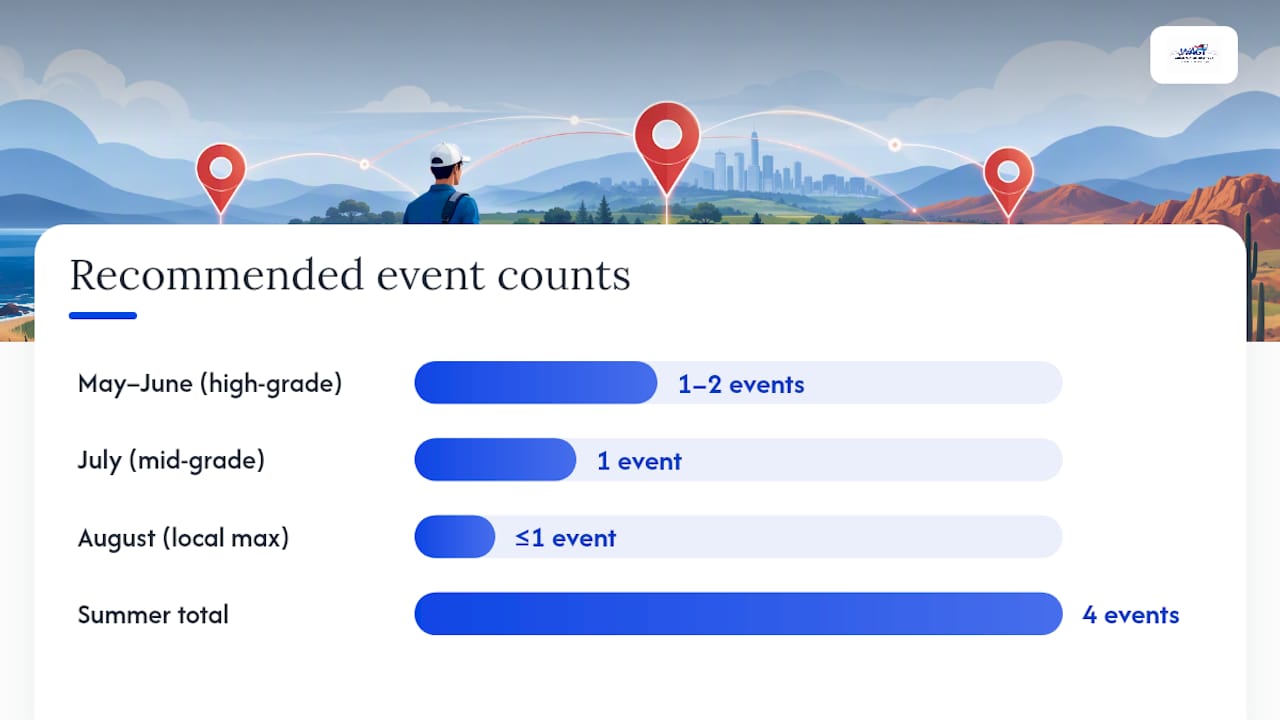
Start with a clear priority order: Grade 1–3 WAGR-counting events first, regional Grade 3–4 events with strong fields second, and targeted invitationals for match-play or championship experience third. Everything else is filler that costs money and time without moving your ranking.
A practical off-season calendar for a college player might look like this:
- May–June: One or two high-grade national or regional amateur championships; use early summer for peak competitive form.
- July: One mid-grade regional event; build in a full recovery week before or after.
- August: Academic prep takes priority — limit travel to one local event maximum.
- December–January: Winter circuit events or a targeted invitational if your academic schedule allows.
Keep these tactics in mind when balancing academics and tournament travel:
- Cluster events geographically to reduce travel days and cost.
- Build a minimum five-day gap between competitive rounds to avoid performance fatigue.
- Communicate your schedule to your coaching staff before the semester starts, not after.
Pro Tip: Four well-chosen events in a summer will do more for your WAGR and PGA TOUR University standing than eight scattered starts at low-grade fields. Selectivity is a competitive advantage.
Registration, eligibility, and rules that protect your status
Before you play any off-season event, verify your amateur status, confirm the tournament is not on any prohibited list, and meet PGA TOUR University registration deadlines. Missing one of these steps can cost you far more than a ranking point.
Critical rules to check before entering any event:
- Confirm the event is not classified as an "Unauthorized Tournament" under PGATU Rules & Regulations.
- Verify the event does not mix amateur and professional fields in a way that violates NCAA amateur status rules.
- Check PGA TOUR University registration deadlines — the rules document lists December 1 as the registration deadline for the 2026 ranking period.
- Understand divisor rules: the number of eligible events you play affects your points average, not just your total.
Warning: Participating in an Unauthorized Tournament under PGA TOUR University rules can result in a one-year period of ineligibility to accept PGA TOUR University membership benefits. That penalty applies even if the event itself seemed legitimate — always verify against the official Eligible Tournaments list before you commit.
Costs, travel, and budgeting for off-season events
Plan for entry fees, travel and lodging, practice rounds, and a contingency buffer. Off-season competition is an investment, and treating it like one means knowing your numbers before you register.
Likely budget line items and ways to reduce them:
- Entry fees: Vary by grade and organization; early-bird registration often saves 10–20%.
- Travel and lodging: Share rooms with teammates or other competitors; cluster events in the same region to cut flights.
- Practice rounds: Budget one practice round per event; skip it only if you know the course well.
- Coach or caddie travel: Factor this in for high-grade events where strategic support pays off.
- Contingency: Keep 15% of your total event budget unallocated for schedule changes or late entry opportunities.
Pro Tip: Rank every event on your shortlist by expected points gain divided by total cost. A regional Grade 3 event two hours from campus often outperforms a Grade 2 event requiring a cross-country flight when you factor in travel fatigue and missed class time.
How to track your results and WAGR points reliably
Use your official WAGR player profile and PGA TOUR University records as your primary sources, and maintain a personal event log as your backup. Results take time to post, and discrepancies do happen.
Your tracking toolkit:
- WAGR player profile at wagr.com — check weekly after each event posts.
- PGA TOUR University record — log in after each eligible event to confirm the result appears correctly.
- World Amateur Golf Tour live-scoring and profile pages — useful for real-time results and a consolidated view of your competitive history.
- Personal event log — a simple spreadsheet with event name, date, grade, field size, finish position, and points earned.
Share results with your coaching staff on this schedule:
- Send a post-event summary within 48 hours of finishing — include your finish position and the event's WAGR grade.
- Share an updated WAGR snapshot at the start of each semester.
- Flag any discrepancy between your personal log and your official WAGR profile within two weeks of the ranking update.
Why off-season competition produces real career outcomes
Consistent off-season competition builds your WAGR ranking, earns invitations to elite amateur events, and positions you for PGA TOUR University consideration. Those are not abstract benefits — they translate directly into scholarships, NIL interest, and professional tour access.
The USGA confirms that a strong WAGR ranking opens doors to scholarships, NIL opportunities, and exemptions into major amateur championships. For college players, those exemptions can mean competing alongside the best amateurs in the world before graduation.
Key pathway outcomes from sustained off-season competition:
- Improved WAGR ranking that attracts college coaching attention and scholarship offers.
- Eligibility for invitations to USGA championships and other elite amateur events.
- PGA TOUR University ranking progress that gives graduating seniors direct access to professional circuits.
- NIL visibility from consistent results on a ranked, publicly tracked platform.
WAGR now covers over 7,100 counting events worldwide — the opportunity to earn points is genuinely broad, but only if you choose events that meet current grade and field-size criteria.
Learn more about why playing amateur events in college pays dividends well beyond the scorecard.
What most college golfers get wrong about off-season competition
Most players treat the off-season as a time to practice and wait. That instinct costs them ranking points, recruiting visibility, and PGA TOUR University progress that cannot be recovered later.
The conventional wisdom says rest and train in the off-season, then compete when the college season resumes. That works for fitness. It does not work for WAGR. The ranking runs on a 104-week rolling window, which means every week without a counting result is a week where older points age out without replacement. A player who competes strategically in three or four high-grade off-season events every year builds a ranking that compounds. One who waits starts each season trying to recover lost ground.
The other mistake is chasing volume over quality. Playing eight low-grade events to stay sharp feels productive. But under the post-2025 criteria, those events pay fewer points and can dilute your PGA TOUR University points average. The players who advance fastest pick fewer events and pick them deliberately — targeting the highest grade their travel budget and academic schedule can support.
Worldamateurgolftour makes off-season event access straightforward
Finding verified WAGR-counting events, confirming field strength, and registering before deadlines close is exactly what Worldamateurgolftour membership is built for. Instead of spending hours cross-referencing the WAGR calendar, national federation pages, and event director emails, you get a curated list of sanctioned events with counting status already confirmed.

Membership includes access to a verified event calendar, streamlined registration, live scoring, player profiles that coaches can view, and a rewards program redeemable for gear and entry credits. For college players protecting NCAA and PGA TOUR University eligibility, the recruiting tools and official event documentation alone are worth the membership. Visit Worldamateurgolftour to review membership options and register for your next WAGR-counting event today.
Sources
Before committing to any off-season event, verify its status directly with official sources. Keep PDFs or confirmation emails for every event you enter.
- The World Amateur Golf Ranking® (WAGR®) | The Official Men's and Women's Amateur Rankings
- What is WAGR?
- How it works: PGA TOUR University Ranking