

Course Rating tells you what a scratch golfer should shoot on a given set of tees, expressed in strokes to one decimal place, like 71.2 or 68.5. Slope Rating tells you how much harder that same course plays for a bogey golfer compared to a scratch golfer, on a scale of 55 to 155, with 113 as the standard middle point. Together, these two numbers do one job that matters to every competitor: they let you convert your Handicap Index into a Course Handicap, the number of strokes you actually get on that specific course from that specific tee.
- Course Rating = expected score for a scratch player (strokes, one decimal)
- Slope Rating = relative difficulty for everyone else, scaled 55–155
Pro tip: A Slope of 155 is the maximum allowed under the USGA Course Rating System, and very few courses ever reach it. Anything north of 140 puts you on a genuinely demanding track.
Key Takeaways
Course Rating measures absolute difficulty for a scratch player, while Slope measures relative difficulty for everyone else, and both numbers together determine your actual Course Handicap.
| Point | Details |
|---|---|
| Two numbers, one job | Course Rating sets the scratch baseline; Slope converts your Handicap Index into a Course Handicap. |
| Ten obstacle factors | Raters score topography, bunkers, trees, and seven other factors for both scratch and bogey player models. |
| Formula depends on gender | Slope equals 5.381 (men) or 4.240 (women) times the gap between Bogey Rating and Course Rating. |
| Slope isn't standalone | A 131 Slope on one course is not equivalent to 131 on another without comparing Course Rating too. |
| Verify before you compete | World Amateur Golf Tour ties every WAGR-counting event to verified tee ratings for fair, accurate handicapping. |
Table of Contents
- How Course Rating and Slope Get Determined
- The Formulas Behind Course Rating and Slope
- Putting Course Rating and Slope to Work on the Course
- Where to Verify Official Course Rating and Slope Numbers
- Common Misconceptions About Slope Rating
- Why Accurate Ratings Matter for Fair Tournament Play
- What Golfers Get Wrong About Slope, and What to Do Instead
- Sources
How Course Rating and Slope Get Determined
Nobody eyeballs these numbers. A trained rating team walks the entire golf course, measures effective playing length (not just the scorecard yardage, but adjustments for roll, elevation change, prevailing wind, dogleg severity, and altitude), and then scores ten separate obstacle factors for two different player models: scratch and bogey.
Those ten obstacles, as defined in the USGA's Appendix G, cover:
- Topography (uneven lies and slopes to the green)
- Fairway width and the penalty for missing it
- Green target size and approach difficulty
- Recoverability and rough severity
- Bunkers
- Crossing obstacles like water or ravines
- Lateral obstacles along the hole
- Trees
- Green surface contour and speed
- Psychological factors that compound the others
A course is rated by teams working under an Authorized Association, feeding every measurement into standardized Course Rating software. This isn't a quick visit. Rating teams collect thousands of data points per course, which is why the USGA's own explainer treats rater training as a real credentialing process, not a checklist. That volume of data is also why small measurement mistakes matter: an overall yardage error of just 22 yards can shift a men's Course Rating by 0.1 stroke, which cascades into every Course Handicap calculated from it.
The Formulas Behind Course Rating and Slope
Once raters finish scoring both player models, the math is fixed. Slope Rating comes from the gap between the Bogey Rating and the Course Rating, multiplied by a constant that differs by gender: 5.381 for men, 4.240 for women, according to Keiser University's College of Golf. That gap reflects a simple truth: obstacles that barely bother a scratch player often wreck a bogey player's round, and the wider that gap, the higher the Slope.
| Value | Formula or Range |
|---|---|
| Course Rating | Expected strokes for a scratch player (e.g., 71.2) |
| Slope Rating range | 55 to 155, with 113 as standard |
| Slope (men) | 5.381 × (Bogey Rating − Course Rating) |
| Slope (women) | 4.240 × (Bogey Rating − Course Rating) |
| Course Handicap | (Handicap Index × Slope Rating) ÷ 113 |
Say your Handicap Index is 12.4 and you're playing a course with a Slope Rating of 128. Multiply 12.4 by 128, then divide by 113, and you get a Course Handicap of roughly 14. That's two extra strokes you didn't have on an easier course, purely because this one plays harder relative to par for a player at your level. The USGA's technical guidance lays out the full Course Handicap formula, including how Course Rating and par factor into playing handicap for stroke play.
Putting Course Rating and Slope to Work on the Course
Knowing the numbers is one thing. Using them correctly during a round or a tournament is where they actually pay off.
- Calculate your Course Handicap before you tee off, not after a bad front nine makes you wish you had.
- Round to the nearest whole stroke; most GHIN-connected apps do this automatically.
- Compare Course Rating and Slope across tee options before choosing where to play in a mixed-ability match, since a lower Slope from a shorter tee can produce a fairer game than muscling through from the tips — as detailed in the Fairway Finder lifestyle guide.
- In stroke play, allocate strokes by hole handicap using your Course Handicap, not your raw Handicap Index.
Pro tip: If you're setting up a member-guest or a mixed-flight event, run both Course Rating and Slope for every tee option before assigning groups. A 4-stroke Slope gap between two tees can flip who wins.
Course conditions change. New bunkers, tree removal, and rebuilt greens can all shift the obstacle scores enough to require action. Organizers who materially alter a course, even temporarily for a tournament setup, need to notify their Authorized Association so ratings stay accurate for handicap purposes.

Where to Verify Official Course Rating and Slope Numbers
Never trust a scorecard blindly; ratings get updated, and printed cards go stale. The USGA's National Course Rating Database is the authoritative source for Course Rating, Bogey Rating, and Slope Rating on any rated set of tees in the country.
- Search by course name or state to pull every rated tee combination.
- Check the Bogey Rating column specifically. It's not always printed on scorecards but it's the number that actually drives the Slope calculation.
- Cross-reference with your GHIN app, which pulls current ratings automatically when you post a score.
- Confirm you're posting from the tee you actually played. Submitting under the wrong tee's rating corrupts your Handicap Index.
Common Misconceptions About Slope Rating
A Slope of 131 or 140 sounds intimidating, and it should get your attention, but it only tells part of the story. Slope reflects difficulty relative to that specific course's own Course Rating, which means two courses with the same Slope can play nothing alike.
- A Slope above 113 means the course punishes bogey golfers more than scratch golfers, relative to standard difficulty.
- Slope is not comparable across courses on its own. As Golf, only Course Rating gives you an absolute measure; Slope is always relative to that course's own scratch baseline.
- A moderate Course Rating paired with a high Slope usually signals forced carries or trouble that punishes misses disproportionately, since Slope isn't tied to par at all.
- If your Course Handicap keeps landing near 30+ from your usual tees, it's worth trying a forward tee. That's not a step down. It's playing the number the rating gave you.
Why Accurate Ratings Matter for Fair Tournament Play
Course Rating and Slope aren't academic numbers for a junior competing in a WAGR-counting event. They determine whether the field is actually playing on equal footing, hole by hole, tee by tee.
Accurate ratings are the backbone of fair competition. When an Authorized Association updates a course's numbers after a redesign or new tee construction, every handicap calculated from that course shifts with it. Organizers who skip that step aren't running a level playing field.
World Amateur Golf Tour builds its events around this principle: verify ratings, confirm the correct tee data, and contact the Authorized Association the moment a host course changes materially. Our guide on tournament handicap management covers the organizer side in more depth.
— Gene
What Golfers Get Wrong About Slope, and What to Do Instead
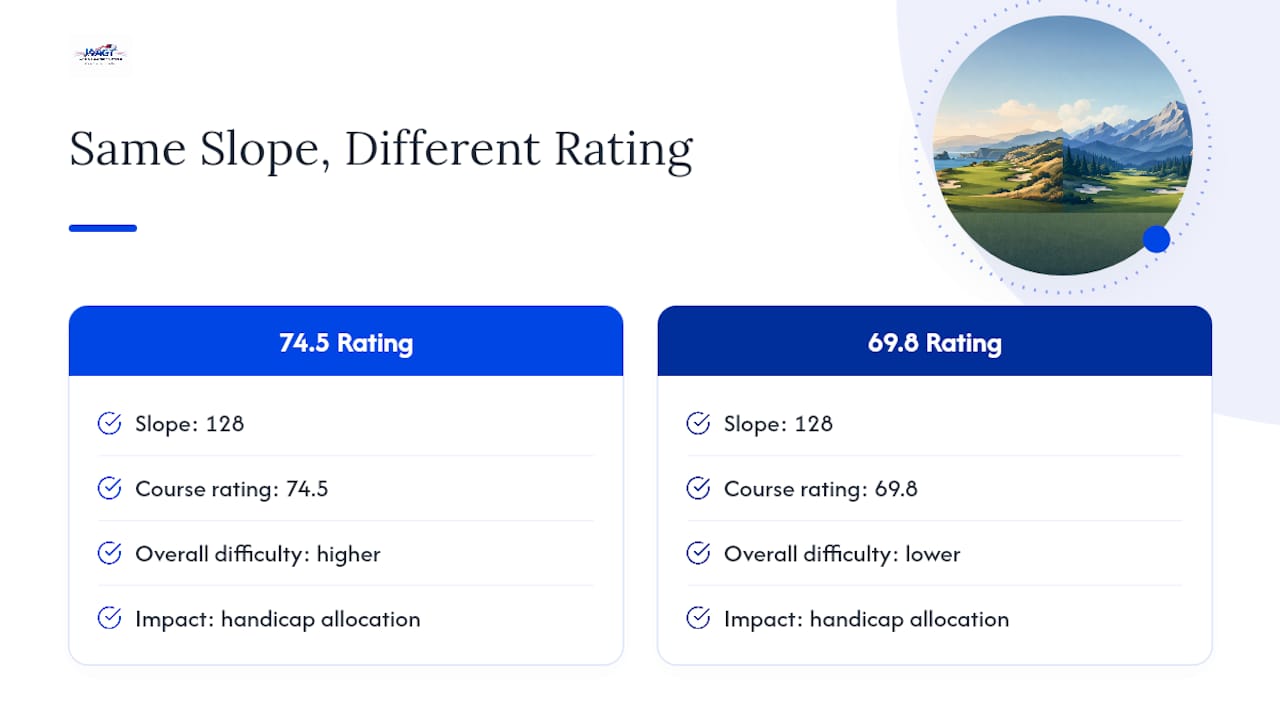
Most golfers treat Slope like a single difficulty score you can rank courses by, the way you'd rank movies by star count. That's the wrong mental model. Slope only measures the gap between how a scratch player and a bogey player experience the same course, which means a 128 Slope course with a 74.5 Course Rating is objectively tougher overall than a 128 Slope course rated 69.8, even though the Slope numbers match.
The conventional advice, "check your Slope before you play," isn't wrong, but it's incomplete. You need both numbers together, and you need the Bogey Rating if you're trying to understand why a course plays the way it does, since that figure rarely makes it onto a printed scorecard.
If you organize junior or amateur events, prioritize verifying tee data over almost anything else on your setup checklist. A misapplied Slope value doesn't just skew one player's round. It distorts the entire field's handicap allocation, and in a WAGR-counting event, that's not a small clerical error. It's a fairness problem with real consequences for a junior's path to college golf.
Where World Amateur Golf Tour Fits In
If you're chasing WAGR points or trying to build a resume for college recruiters, the events you choose matter as much as your scores. World Amateur Golf Tour runs WAGR-counting tournaments built on verified Course Rating and Slope data at every host venue, so your Course Handicap and your finish reflect real, fair competition instead of guesswork on tee selection.

Membership gets you into professionally run events at respected courses, live scoring, a rewards program, and player profiles that college coaches actually look at. Unlike a one-off local event where ratings might be an afterthought, every World Amateur Golf Tour tournament ties back to properly rated tees and transparent handicap allocation. Check the current tournament schedule and membership options to see which events fit your ranking goals this season.
Sources
- Appendix G: The Golf Course, Course Rating and Slope Rating — USGA
- National Course Rating Database — USGA
- Course and slope ratings explained — Keiser University College of Golf