

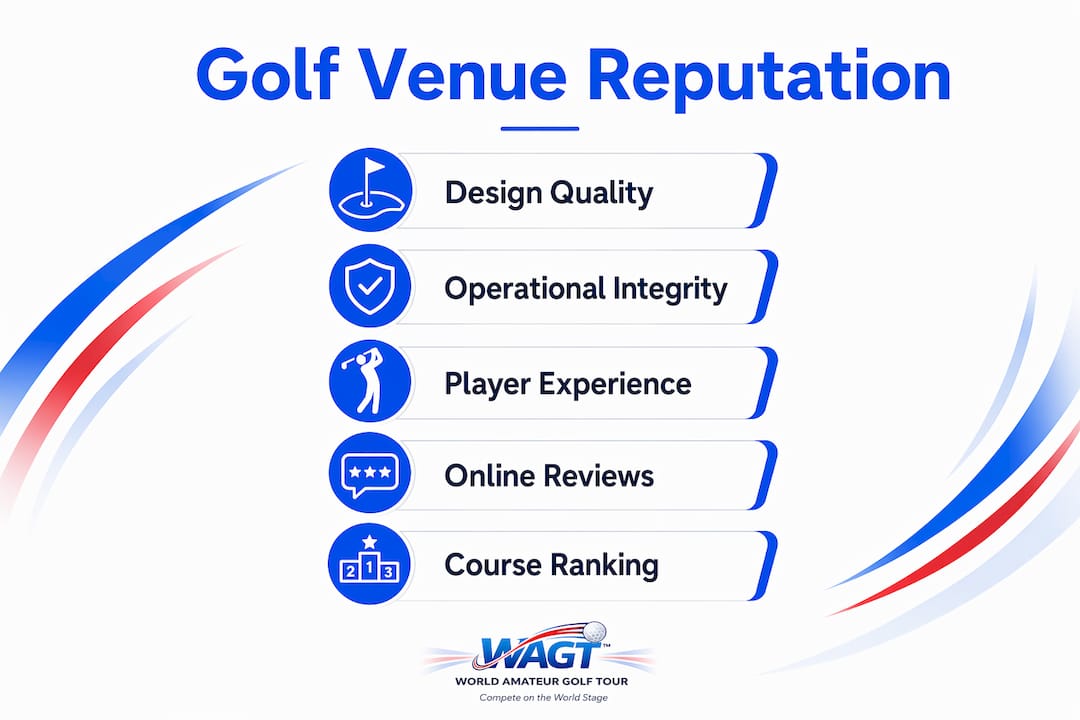
A golf venue's reputation is the collective perception of its quality, design, service, and player experience, and it directly shapes whether golfers choose your course over every other option in the market. It is built from course architecture, online reviews, staff professionalism, facility standards, tournament history, and the consistency of every interaction a golfer has with your club. Reputation is not a single rating or a single review. It is the sum of every touchpoint, from the moment a prospect searches your name online to the moment they walk off the 18th green.
The core components that define a golf venue's reputation include:
- Course design and architectural quality: Layout, challenge level, and integration with the natural landscape
- Online reviews and testimonials: Ratings on Google, golf booking platforms, and social media
- Course conditioning and maintenance: Fairway quality, green speed, and overall presentation
- Customer service and staff professionalism: Response speed, tone, and consistency across all channels
- Amenities and facilities: Clubhouse quality, practice areas, dining, and locker rooms
- Tournament hosting and professional endorsements: Competitive events and recognition from respected figures in the game
- Membership community and social atmosphere: The culture, inclusivity, and energy your club projects
Pine Valley Golf Club in New Jersey stands as perhaps the clearest example of architectural reputation done right. Since its opening in 1918, it has earned universal recognition not through advertising or publicity, but through design excellence and the word of every serious golfer who has played it. That is the power of a reputation built on genuine quality.
Why online reviews shape your golf course's reputation
Online reviews are no longer a secondary concern for golf venues. They are the front door. When golfers search for a course, reviews are among the first things they encounter, and those ratings directly influence whether a tee time gets booked or a membership inquiry gets submitted. A GolfNow consumer insights study found that 52% of golfers check online ratings and reviews before booking a tee time, making reputation a commercial priority, not a marketing side task.

Positive reviews also drive search engine visibility. The more active and positive your review profile, the higher your course ranks on Google and golf-specific platforms. Timely, professional responses signal to both golfers and search algorithms that your venue is attentive and accountable. Venues that ignore their review profiles often find that third-party listing sites outrank their own website, weakening brand control and allowing others to define their story.

Testimonials carry particular weight with new golfers who have no prior experience with your club. Positive feedback from real players acts as social proof, building the kind of trust that no advertisement can replicate. Video testimonials take this further. Encouraging members to record short clips sharing their experience at your club creates personal, credible content that text reviews simply cannot match.
Key review management practices that protect your reputation:
- Respond within 24–48 hours: A 24 to 48-hour response window is the recognized best practice for golf venues, signaling attentiveness to both players and search engines
- Thank every reviewer: Whether the feedback is positive or critical, always open with genuine acknowledgment
- Address concerns directly: Avoid defensive language; every public response reflects your brand to every future reader
- Use negative feedback constructively: Recurring complaints reveal operational gaps worth fixing
- Share positive reviews across channels: Post strong testimonials on your website and social media to amplify credibility
Pro Tip: If you really want to separate your club from the competition, invest in video testimonials. Ask satisfied members to record short clips on the course or at events. A 60-second video from a real golfer carries more persuasive weight than a dozen written reviews.
How course architecture defines a venue's prestige
Architecture is the foundation of long-term golf venue prestige. A course that challenges players fairly, integrates naturally with its landscape, and rewards skilled play earns respect from both casual golfers and serious competitors. That respect compounds over time into a reputation that no marketing budget can manufacture.
Pine Valley Golf Club is the standard-bearer for this principle. Its design philosophy emphasizes fairness, challenge, and purity, with no gimmicks and no arbitrary penalties. Every hazard is visible, every consequence is earned. Arnold Palmer called it "the toughest golf course in the world without a doubt," and Tom Doak, one of the most respected modern architects, has cited Pine Valley as the course he studies most carefully when evaluating design principles. That kind of endorsement does not come from marketing. It comes from a course that delivers exactly what it promises, every single round.
Architectural reputation also depends on how well a venue maintains what was built. A brilliant design undermined by poor conditioning loses credibility fast. The best venues treat maintenance as an extension of the architect's vision, preserving the integrity of every hole through consistent agronomic standards.
Design elements that most influence a course's standing among players and critics:
- Layout and routing: How holes flow across the terrain and how variety is built into the round
- Challenge calibration: Difficulty that tests skill without feeling arbitrary or unfair
- Landscape integration: Using natural features rather than fighting them
- Architectural purity: Avoiding trendy additions that compromise the original design intent
- Historical significance: Courses with a documented legacy earn credibility that newer venues must work harder to establish
Renowned architects and historical significance both contribute to how a course is perceived by rankings media and serious golfers. A venue that communicates its design story clearly, through photography, media engagement, and course guides, gives critics and players the context they need to appreciate what makes it special.
What criteria do golfers and experts use to evaluate a course?
Golfers and professional reviewers assess courses across a consistent set of criteria, and understanding those criteria helps venues identify where their reputation is strongest and where it needs work. Course condition is almost always the top factor in player satisfaction surveys. Lush fairways, true greens, and well-maintained rough signal that a venue takes pride in its product. A course with brilliant architecture but poor conditioning will consistently underperform in rankings and reviews.
Beyond conditioning, evaluators weigh:
- Challenge and playability: Does the course test every part of the game without being unfair to mid-handicap players?
- Aesthetics: Visual beauty, scenic variety, and the overall sensory experience of the round
- Customer service quality: How staff interact with guests from arrival through departure
- Facilities and amenities: Practice range quality, clubhouse standards, food and beverage, and locker room presentation
- Tournament hosting history: Courses that have hosted professional or high-level amateur events carry an implied endorsement of their quality
- Community atmosphere: The culture of the membership and how welcoming the club feels to visitors and new members
- Operational consistency: Whether the experience is reliably excellent or varies depending on the day and the staff member
Professional endorsements carry real weight in how a course is perceived. When a respected tour player or architect speaks positively about a venue, that association elevates the course in the eyes of golfers who follow the game closely. Tournament hosting achieves something similar: a course that regularly hosts competitive events demonstrates that it meets the operational and conditioning standards that elite competition demands.
Ranking organizations and golf publications aggregate these criteria into scores that shape public perception globally. Courses that actively engage with rankings media, provide quality photography and course guides, and communicate their improvements proactively tend to rank higher than equally deserving venues that stay silent.
Best practices for managing golf course reviews
Review management is not a reactive task. The venues with the strongest reputations treat it as a daily operational discipline, the same way they treat course conditioning or tee sheet management. The goal is not just to respond to reviews. It is to create a system that captures feedback early, routes it to the right people, and turns every interaction into a reputation asset.
Pro Tip: Build a simple daily dashboard that shows new reviews, pending responses, and unresolved complaints in one place. When review management lives inside your daily operations rather than in a separate inbox nobody checks, response times drop and nothing slips through.
Practical review management tactics that work:
- Systematize post-round feedback capture: Ask for feedback immediately after play, while the experience is fresh. Real-time feedback systems can increase review generation by up to 68%, giving your venue more data and more public visibility
- Route negative feedback privately first: When a golfer signals dissatisfaction, address it directly before it reaches a public platform. Service recovery handled quickly and personally often converts a detractor into a loyal advocate
- Keep public responses calm and specific: A public reply is read by every future visitor. Stay professional, acknowledge the concern, and demonstrate that the club takes feedback seriously
- Build review requests into your guest journey: Follow-up emails after a round, mobile check-out prompts, and post-event surveys all create natural moments to ask satisfied golfers to share their experience online
- Share strong reviews in your marketing: Positive testimonials on your website, email newsletters, and social channels reinforce credibility and give prospective members a reason to trust your club before they ever visit
- Monitor multiple platforms consistently: Google, Facebook, Yelp, and golf-specific booking platforms all carry reviews that influence your reputation. Fragmented monitoring means missed opportunities and slow responses
For course management strategy to connect with reputation outcomes, the feedback loop needs to be closed. A complaint about pace of play that goes unaddressed in three consecutive reviews is not a review problem. It is an operational problem that reviews are revealing.
How operational integrity shapes reputation in US golf venues
The most underappreciated driver of golf venue reputation is what happens before a single review gets posted. A club's reputation is often damaged through failed operational touchpoints: an inquiry that sits unanswered for three days, a membership prospect who receives a vague or inconsistent reply, a visitor who cannot find clear pricing or booking information on the website. These failures shape trust before any public feedback appears, and they are harder to recover from than a negative review because they leave no visible record to respond to.
Club Prophet's reputation management guidance highlights a pattern that many US golf venues share: clubs lose visibility and trust because they present an inconsistent story across channels. The website says one thing, the email reply says another, and the phone script says something different again. That inconsistency signals disorganization to prospects who are evaluating whether your club is worth their time and money.
Building operational reputation integrity requires tracking the right signals:
- Inquiry response time: How quickly does your club reply to membership and visitor inquiries?
- Response rate: What proportion of incoming inquiries and review comments receive a reply?
- Lead-to-visit conversion: How many inquiries turn into a tour, a trial round, or a membership meeting?
- Issue resolution time: How long does it take to close the loop on a complaint or a low feedback score?
- Sentiment trend: Are the same complaints appearing repeatedly across reviews and private feedback channels?
Reputation management software can boost venue visibility in local searches by more than 70% when it unifies feedback, responses, and follow-up workflows into a single operating system. That kind of gain does not come from responding to more reviews. It comes from eliminating the fragmentation that lets inquiries fall through the cracks and lets dissatisfied golfers reach public platforms before your team even knows there was a problem.
Staff professionalism is the human layer of operational integrity. Every interaction, from the pro shop greeting to the cart attendant's response to a question, contributes to the overall impression a golfer carries away from your venue. Consistent staffing standards and clear communication protocols across your team are what make a great reputation repeatable rather than accidental.
Reputation is the venue's most valuable asset, and it must be actively managed or it will be shaped by uncontrolled third parties. Venues that treat reputation as a system, connecting inquiry handling, review response, member communication, and service recovery into one coherent process, build the kind of trust that sustains growth year after year.
Worldamateurgolftour: compete at venues that earn their reputation

At Worldamateurgolftour, we understand that venue reputation is not just a backdrop to competition. It is part of the competitive experience itself. Every event on the World Amateur Golf Tour is held at championship-caliber courses that meet the conditioning, design, and operational standards that serious amateur golfers deserve. Our WAGR-counting tournaments give junior, collegiate, and amateur players the chance to compete in professionally run events at venues where the reputation of the course matches the ambition of the player.
If you are ready to compete at courses that have earned their standing, join the tour and experience what elite amateur competition at respected venues actually feels like.
Key Takeaways
A golf venue's reputation is built from the consistent delivery of design quality, operational integrity, and player experience across every touchpoint, from the first online search to the final putt.
| Point | Details |
|---|---|
| Reviews drive bookings | 52% of golfers check ratings before booking, making review management a direct revenue factor. |
| Respond within 24–48 hours | A 24 to 48-hour response window is the recognized best practice for golf venue review replies. |
| Architecture builds lasting prestige | Design purity, as demonstrated by Pine Valley Golf Club, earns long-term respect that marketing cannot replicate. |
| Operational failures damage trust first | Reputation damage typically occurs through unanswered inquiries and inconsistent messaging before any public review appears. |
| Software lifts local visibility | Integrated reputation management software can increase local search visibility by more than 70%. |