

Golf event accreditation is the official authorization system that controls access to restricted tournament zones, assigning credentials to players, media, volunteers, and staff based on their role. Understanding what is a golf event accreditation matters because it directly affects your ability to enter specific areas, compete in ranked events, and maintain the security standards that protect every participant on site. Physical credentials like badges, lanyards, RFID chips, and QR codes each serve a distinct function. Worldamateurgolftour builds its events around these same principles, ensuring every participant competes in a fair, verified, and professionally managed environment.
What is a golf event accreditation and how does it work?
Golf event accreditation is a role-based access control system. Accreditation badges for volunteers are typically the size of a playing card and must be worn visibly at all times to gain course access. That single requirement tells you everything about the system's priority: verification first, convenience second.
Each role at a tournament receives a different credential type. Players carry badges that unlock locker rooms, practice facilities, and scoring areas. Media credentials grant access to press tents and designated photography zones. Volunteers receive color-coded lanyards tied to specific operational areas. Staff working in player-only zones carry RFID-enabled badges that log entry and exit automatically.

The credential format matters as much as the credential itself. RFID technology allows instant verification at access points, reducing the risk of unauthorized entry without slowing down foot traffic. QR codes serve a similar function at lower-cost events, scanned at gates by security personnel.
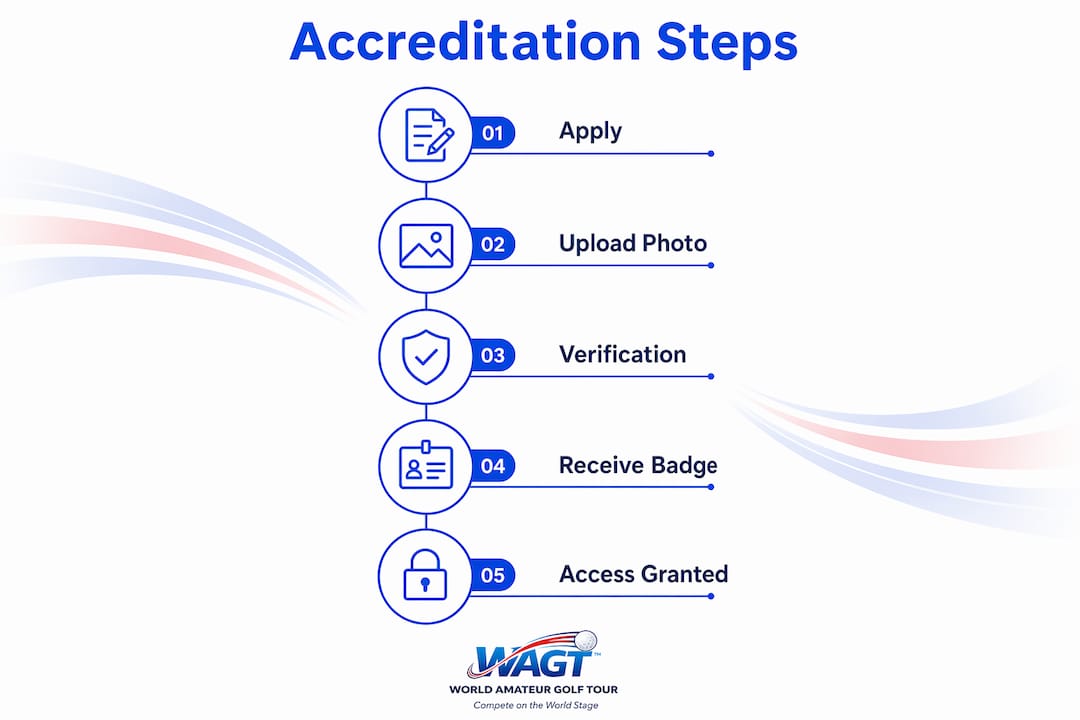
The accreditation process step by step
The process follows a clear sequence regardless of tournament size.
- Submit your application. Players, media, and volunteers complete role-specific forms through the tournament's official accreditation portal. Deadlines are firm and non-negotiable.
- Provide verification documents. Media applicants must submit proof of editorial intent. Freelancers require assignment letters from a recognized publication. Players submit entry confirmations and handicap records.
- Upload a qualifying photo. A high-quality headshot is required for photo ID badge production. Late or poor photo submissions are a leading cause of accreditation delays.
- Await approval and badge issuance. Approval is not guaranteed for every applicant. Media using personal email addresses face additional screening.
- Collect your credential on site. Badges are distributed at designated accreditation desks before the tournament begins. Losing a badge requires immediate reporting to the accreditation office.
Pro Tip: Upload your profile photo the same day you submit your application. Waiting until the deadline is the single most common reason badges are not ready on day one.
What are the benefits of event accreditation for athletes and organizers?
Accreditation does more than control a gate. It protects the integrity of the entire competitive environment.
- Security for player-only areas. Restricted zones like locker rooms and scoring tents stay protected from unauthorized access, giving players a focused preparation space.
- Accurate participant verification. Organizers confirm that every competitor on the course is registered, eligible, and ranked correctly. This matters directly for WAGR status and ranking legitimacy.
- Sponsor and media credibility. Accredited events signal professional management to sponsors. That credibility attracts better coverage and larger prize funds over time.
- Operational efficiency. Centralized accreditation databases let staff resolve access issues in seconds rather than minutes, keeping the tournament schedule on track.
- Safety for all stakeholders. Clear zone boundaries protect spectators, volunteers, and players from accidental entry into hazardous or restricted areas.
"Accreditation is increasingly the first line of defense for tournament security, controlling sensitive area access to protect integrity. Without it, even well-organized events become vulnerable to disruption that no amount of on-site security can fully correct."
The technology behind these benefits is more complex than most participants realize. Accreditation logistics require synchronized hardware including RFID scanners, access gates, and live databases across multiple venue zones. Security requirements consistently override participant convenience, which is why strict protocol compliance is non-negotiable at elite events.
How does golf event accreditation differ from event certification?
These two terms describe completely different things, and confusing them creates real problems for athletes trying to understand tournament legitimacy.
Golf event accreditation is an individual access control system. It assigns credentials to specific people for specific roles at a specific event. Golf event certification, by contrast, is an organizational audit that evaluates how an entire event is planned and managed.
ISO 20121 certification measures overall event management through defined strategies, goals, staff training, and formal audits. It requires annual improvement targets and continuous performance tracking. GEO Certified assesses resource conservation and community engagement at the venue level. Neither certification has anything to do with who gets a badge or which gate they can enter.
| Concept | Purpose | Who It Applies To | Duration |
|---|---|---|---|
| Event accreditation | Controls individual access to tournament zones | Players, media, volunteers, staff | Per event |
| ISO 20121 certification | Audits sustainable event management systems | Tournament organizers | Ongoing, annual review |
| GEO Certified | Assesses venue sustainability and community impact | Golf venues and host clubs | Venue-level, multi-year |
A common misconception is that ISO 20121 certification is primarily an environmental award. It actually focuses on structured management accountability, measurable targets, and documented improvement processes. The Dutch Ladies Open pursued ISO 20121 specifically to build a management framework, not just to reduce carbon output.
For athletes, understanding both concepts matters because certified events tend to operate with greater organizational discipline. That discipline shows up in smoother accreditation processes, clearer communication, and more consistent enforcement of access rules. You can learn more about how successful tournaments are structured to see how certification and accreditation work together in practice.
Practical tips for navigating the accreditation process
Preparation is the difference between walking straight onto the course and spending your first morning at the accreditation desk.
- Complete your profile early. Volunteers who upload a high-quality photo early in the registration process avoid the most common delay in badge production.
- Know your access zones before you arrive. Review the tournament's zone map in advance. Entering the wrong zone, even accidentally, can result in credential suspension.
- Follow media application deadlines strictly. Only established media with verified coverage receive approval. Submitting late or with incomplete documentation puts your application at the back of the queue.
- Use your official email address. Applications submitted from personal email accounts face additional screening and slower processing.
- Carry valid documentation on site. Media applicants should bring their assignment letter and press ID even after receiving approval. Security staff may request secondary verification.
- Report lost credentials immediately. A missing badge is a security event, not just an inconvenience. Notify the accreditation office before attempting to re-enter any zone.
Pro Tip: If you are a junior or amateur golfer competing for the first time, contact the tournament organizer two weeks before the event to confirm your credential status. Early communication prevents last-minute surprises.
Understanding how golf events comply with WAGR rules also helps you see why accreditation and eligibility verification are tightly connected at ranking-level competitions.
Key Takeaways
Golf event accreditation is the role-based credential system that controls tournament access, verifies participant eligibility, and protects the competitive integrity that makes ranking points meaningful.
| Point | Details |
|---|---|
| Accreditation controls access | Badges, RFID, and QR codes assign zone-specific entry rights to every role at a tournament. |
| Photo submission drives timing | Uploading a qualifying headshot early is the single most effective way to avoid badge delays. |
| Media face strict eligibility rules | Freelancers must provide verified assignment letters; personal email applications face extra screening. |
| Certification differs from accreditation | ISO 20121 and GEO Certified audit organizational management, not individual access rights. |
| Accreditation supports ranking legitimacy | Verified participant credentials protect the integrity of WAGR points and competitive standings. |
Why accreditation deserves more respect from serious golfers
Most athletes treat accreditation as an administrative hurdle. I think that framing costs them more than they realize.
The accreditation desk is where tournament integrity begins. Every RFID scan, every badge check, every zone restriction exists because the alternative is a competitive environment where access is uncontrolled and results are questionable. When you compete in an event where accreditation is enforced seriously, you are competing in an event where the results mean something.
I have watched junior golfers arrive at tournaments without their photo submitted, without their documentation ready, and without any understanding of which zones their credential covers. The frustration is real, but it is entirely preventable. The accreditation system is not designed to create obstacles. It is designed to protect the field you are competing in.
The technology side is also more sophisticated than most participants expect. Synchronizing RFID scanners, access gates, and live databases across a multi-zone venue is a genuine logistics operation. When it runs smoothly, you never notice it. When it breaks down, the entire event feels disorganized. That invisible infrastructure is what separates a professionally run tournament from a weekend scramble.
My honest advice: treat your accreditation application with the same discipline you bring to your practice routine. Submit early, submit completely, and follow up if you do not receive confirmation within the stated window. The players who do this consistently are the ones who walk onto the first tee focused, not stressed.
— Gene
Compete in accredited events with Worldamateurgolftour
Worldamateurgolftour runs WAGR-sanctioned tournaments designed specifically for junior, collegiate, and amateur golfers who want to compete in professionally managed events with clear accreditation protocols and verified ranking outcomes.
Every Worldamateurgolftour event is held at championship-caliber courses with structured participant verification, defined access zones, and the operational discipline that serious competition demands. If you are ready to earn WAGR ranking points in an environment built for your development, view upcoming tournaments and register for your next event. The field is competitive, the venues are elite, and your credential gets you exactly where you need to be.
FAQ
What is a golf event accreditation?
Golf event accreditation is the official system that assigns role-specific credentials, such as badges, lanyards, RFID chips, or QR codes, to control access to restricted tournament zones. It applies to players, media, volunteers, and staff at every level of competitive golf.
How do I get golf accreditation as a media professional?
Media accreditation requires an online application with verified editorial intent. Freelancers must submit an assignment letter from a recognized publication, and applications using personal email addresses face additional screening with no guaranteed approval.
What documents do I need for tournament accreditation?
Players typically need entry confirmation and handicap records. Media applicants need press credentials and an assignment letter. All applicants must submit a high-quality headshot for photo ID badge production.
What is the difference between golf event accreditation and event certification?
Accreditation controls individual access to specific tournament zones per event. Event certification, such as ISO 20121 or GEO Certified, audits the overall management and sustainability systems of the organizing body, not individual participant access.
Does accreditation affect my WAGR ranking eligibility?
Accreditation supports ranking legitimacy by verifying that every competitor in a WAGR-counting event is registered and eligible. Competing in properly accredited events protects the integrity of the ranking points you earn.