
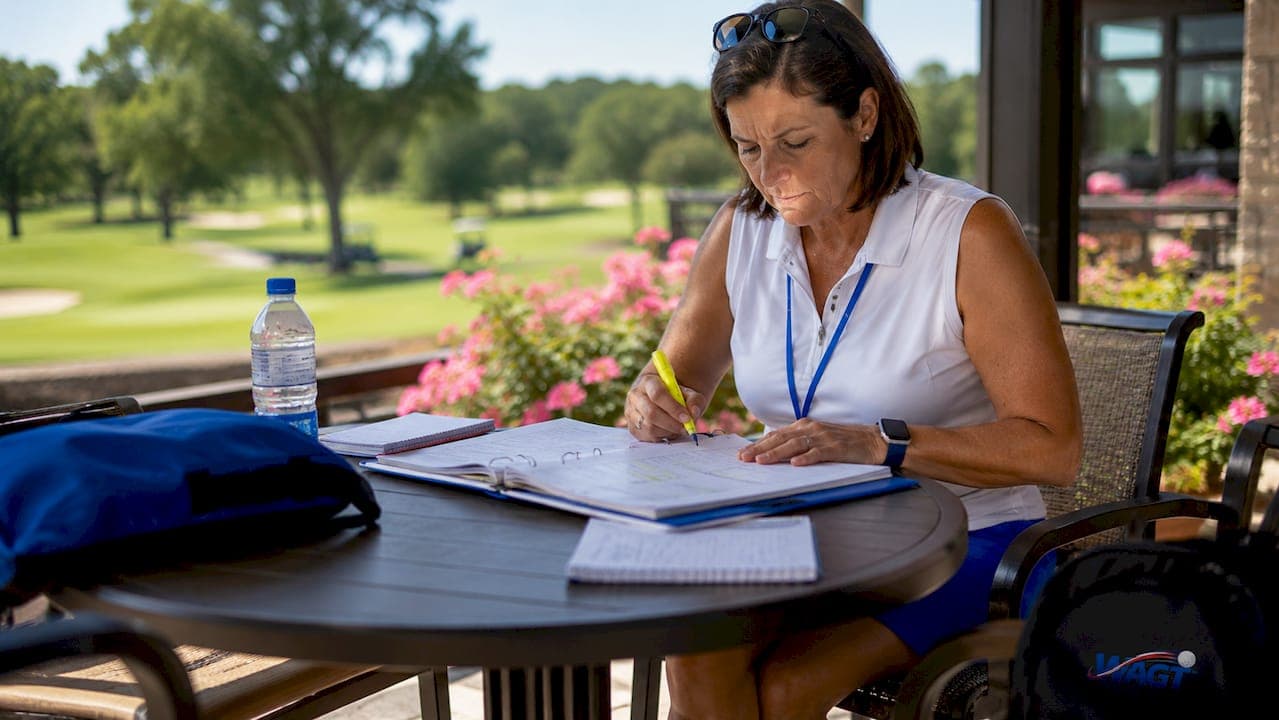
A golf event staffing requirements list is the master document that defines every paid and volunteer role needed to run a compliant, competitive tournament from first tee to final scoring. Without it, even well-funded events collapse under operational gaps. The most successful tournaments balance professional staff and volunteers across six core categories: course operations, scoring, hospitality, spectator management, vendor coordination, and safety. Governing bodies like the USGA set baseline standards for roles such as starters and rules officials, and those standards apply whether you are running a 36-player charity scramble or a 144-player WAGR-certified event.
1. What are the key golf event staff roles you must include?
Every golf tournament employee checklist starts with the same foundational roles. These positions cover the minimum viable staffing structure for any competitive event.
- Tournament Director: Owns the full event plan, budget, and vendor relationships. This is always a paid role.
- Volunteer Coordinator: Recruits, trains, and schedules all volunteers. For large events, this position requires year-round engagement.
- Tournament Starters: Starters manage first-tee operations and require deep knowledge of USGA Rule 5.3, including player introduction protocols and delay communication. This role demands multi-tasking skills and is a recognized career path from volunteer to paid staff.
- Scoring Officials: Verify scorecards, manage digital or paper scoring systems, and resolve disputes under USGA guidelines.
- Gallery Marshals: Control spectator movement and enforce silence during play. This role requires calm authority, not confrontation.
- Hospitality Staff: Serve corporate guests, manage food and beverage stations, and maintain sponsor pavilion standards.
- Sponsor Pavilion Staff: Represent brand partners, distribute materials, and engage attendees in ways consistent with golf etiquette.
- Pro-Am Support Roles: Assist amateur players with pairings, cart assignments, and on-course guidance during pro-am formats.
- Rules Officials: Certified under USGA or R&A standards. These are typically paid or highly experienced volunteers.
Most starters and gallery marshals are volunteer positions at the amateur level. Rules officials and the Tournament Director are almost always compensated. Golf event governance shapes which roles require formal certification and which can be filled by trained community volunteers.
Pro Tip: Source your starters and gallery marshals from local golf clubs and teaching academies. Players and instructors already understand the culture, the rules, and the pace of play. They require far less training than general event volunteers.
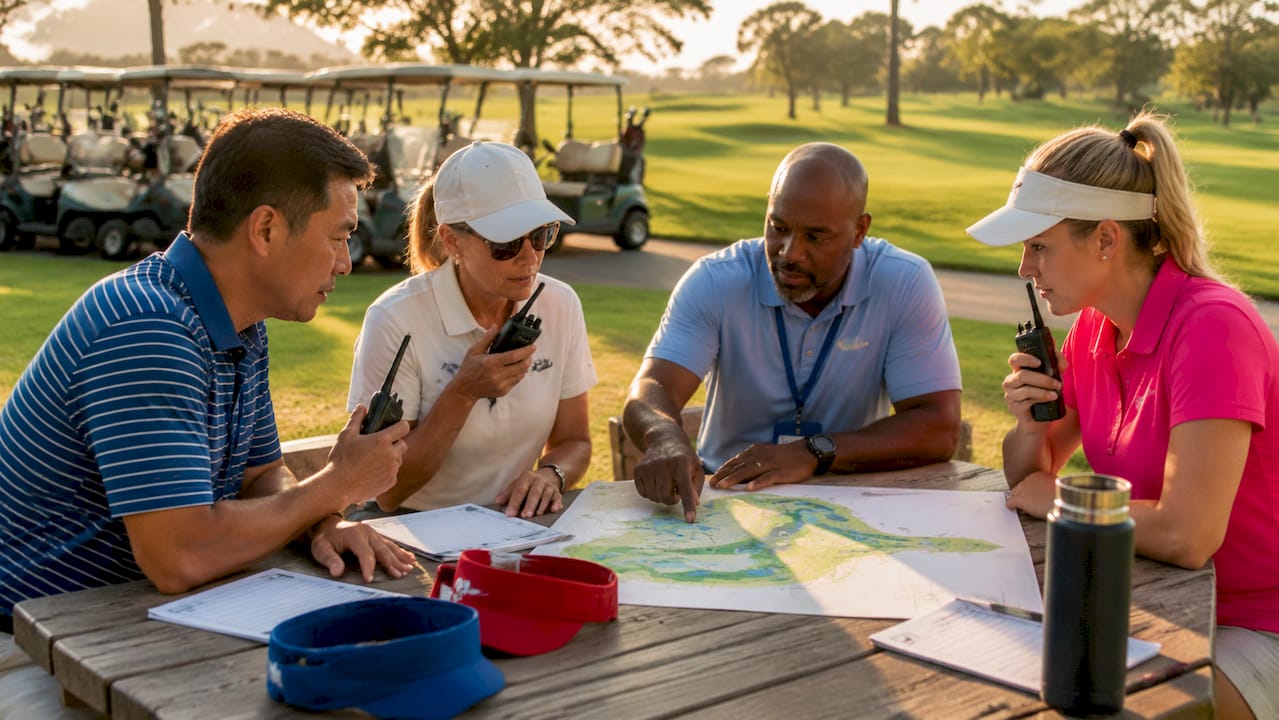
2. How do staffing requirements scale with golf event size?
Event size is the single biggest driver of your staffing checklist for golf events. The numbers shift significantly as your field grows.
Volunteer requirements scale directly with field size. Small events with up to 72 golfers need 10–15 volunteers. Medium events with 72–120 golfers need 15–25. Large events with 120 or more golfers need 25–40 or more volunteers. For a typical 144-golfer fundraiser, 12–18 paid staff members are recommended alongside the volunteer corps.
Complexity adds staffing beyond raw field size. Hole-in-one contests, silent auctions, hospitality villages, and sponsor activations each require dedicated personnel. A 72-player event with five sponsor activations may need more total staff than a 100-player event with minimal extras.
| Event Size | Field Size | Volunteers Needed | Paid Staff Recommended |
|---|---|---|---|
| Small | Up to 72 golfers | 10–15 | 4–6 |
| Medium | 72–120 golfers | 15–25 | 7–12 |
| Large | 120+ golfers | 25–40+ | 12–18 |
Managing a large volunteer corps is itself a full-time job. Event field size directly determines how many team leads you need to keep communications clear and shifts covered.
3. What special operational roles ensure smooth tournament execution?
Specialized operational staff are the difference between a tournament that runs on schedule and one that unravels at the first weather delay. These roles sit above the standard staffing checklist and require specific experience.
Tournament Operations Manager: This role requires 5–8 years of experience plus certifications like PMP or CAPM. Operations managers coordinate vendors across tents, power, signage, and infrastructure, spending up to 90 days pre-event on logistics. Salaries range from $75,000 to $150,000 depending on seniority and tournament scale.
Key operational roles beyond the Tournament Director include:
- Weather Contingency Coordinator: Manages lightning delay horn systems and shelter-in-place protocols. Weather management is legally required and must follow pre-approved delay procedures across wide open terrain.
- Volunteer Management Lead: Handles year-round communications, training schedules, and hospitality for the volunteer corps. Managing 1,000 or more volunteers requires at least one dedicated program manager.
- Vendor Liaison: Reads contracts, enforces delivery schedules, and resolves site conflicts. This person must understand site maps and have authority to make real-time decisions.
- Scoring Technology Lead: Oversees digital scoring platforms, live leaderboard feeds, and backup paper systems.
Pro Tip: Assign your Weather Contingency Coordinator a dedicated radio channel and pre-written communication scripts. When a storm moves in fast, you cannot afford improvised messaging across 18 holes.
Advanced operations teams now apply real-time spectator flow modeling to preempt crowd bottlenecks and adjust staffing deployment on the fly. This approach reduces congestion at hospitality tents and scoring areas without adding headcount.
4. How golf culture shapes your spectator management staffing
Golf audiences hold their events to a different standard than any other sport. Your staffing choices must reflect that culture, or sponsor relationships and player experience both suffer.
Gallery marshals maintain quiet authority to prevent spectator disruption. They manage silence, movement restrictions, and "quiet please" signals during play. This role is unlike any other crowd management position in sports. A marshal who shouts or physically blocks spectators creates more disruption than the behavior they are trying to stop.
The cultural requirements for golf event staff extend well beyond marshals:
- Gallery marshals must know when to act and when to hold position. Intervening at the wrong moment during a backswing is worse than not intervening at all.
- Brand ambassador staff must engage attendees without disrupting play. Conversations happen in designated activation zones, never near the ropes during shots.
- Hospitality staff serve corporate guests who expect luxury service standards. Noise levels, presentation, and timing all matter.
- Sponsor pavilion staff need fluency in golf scoring, player storylines, and basic etiquette. A staff member who cannot explain a birdie or explain the leaderboard loses credibility with serious golf fans.
- Activation zone staff manage specific footprints with defined entry and exit points to keep spectator flow predictable.
"Hiring activation staff directly from the golf community delivers authentic conversations that enhance the fan experience and sponsor ROI. Collegiate players and teaching professionals bring credibility that general event staff simply cannot replicate."
Staffing brand activations with people who already live in the golf world is the single most effective way to protect both sponsor value and tournament atmosphere.
5. What checklist and best practices build a complete staffing plan?
A complete golf tournament employee checklist covers recruitment, training, role clarity, and shift management. Each step compounds the one before it.
Recruitment sources that work:
- Local golf clubs and country clubs
- College golf programs and athletic departments
- Sponsor employee volunteer programs
- Golf teaching academies and PGA section chapters
- Community event volunteer networks
Role description and assignment:
- Write a one-page role description for every position, paid and volunteer
- Include reporting structure, shift times, uniform requirements, and radio protocols
- Assign each volunteer to a named team leader, not just a zone
Training and pre-event communication:
- Hold an in-person or virtual orientation at least two weeks before the event
- Distribute a printed or digital event-day guide covering course layout, emergency procedures, and key contacts
- Run a walk-through for gallery marshals and starters on the actual course
Shift management:
- Schedule 10% more volunteers than you need for each shift to cover no-shows
- Build 30-minute overlap between shift changes so outgoing staff can brief incoming staff
- Assign a dedicated float team of 3–5 experienced volunteers to cover gaps
Pro Tip: Create a shared digital communication channel for all team leads before the event. Real-time messaging between your scoring lead, operations manager, and volunteer coordinator prevents the information gaps that cause delays.
Integrating paid staff and volunteers works best when both groups share the same briefing. Separate orientations create separate cultures, and that divide shows on event day. Tournament planning resources that align marketing, logistics, and staffing into one master checklist reduce last-minute scrambling significantly.
Key Takeaways
A complete golf event staffing requirements list must address role definitions, scaling by field size, operational specialization, cultural fluency, and pre-event training to produce a compliant and competitive tournament.
| Point | Details |
|---|---|
| Scale volunteers to field size | Small events need 10–15 volunteers; large events with 120+ golfers need 25–40 or more. |
| Hire for golf cultural fluency | Starters, marshals, and brand staff must understand USGA rules and golf etiquette, not just event logistics. |
| Assign operational specialists | A Tournament Operations Manager with PMP certification and weather contingency authority is non-negotiable for large events. |
| Build role descriptions first | Every paid and volunteer position needs a one-page brief covering duties, shift times, and reporting structure. |
| Plan for no-shows | Schedule 10% more volunteers per shift and maintain a float team to cover gaps without disrupting operations. |
What I've learned from watching golf events get staffing wrong
The most common mistake I see tournament coordinators make is treating golf event staffing like general event staffing. They pull from their usual volunteer pool, run a single orientation, and assume the golf-specific roles will sort themselves out. They rarely do.
Gallery marshals who have never watched a competitive round in person do not instinctively know when to raise a sign and when to stay still. Starters who lack USGA Rule 5.3 knowledge create first-tee confusion that ripples through the entire field's pace of play. These are not small errors. They affect player experience, sponsor perception, and the integrity of the competition.
The second mistake is under-investing in the volunteer coordinator role. At large events, this person is effectively a full-time project manager for months before the event. Treating the role as a part-time add-on guarantees communication failures on event day.
The trend I find most promising for 2026 is the use of real-time spectator flow data to adjust staffing deployment mid-event. Operations managers who build this capability into their planning can respond to crowd surges at hospitality tents or bottlenecks near scoring without pulling staff from critical positions. That kind of flexibility used to require years of experience reading a course. Now it requires the right data feed and a coordinator who knows how to act on it.
My honest recommendation: start your staffing plan 90 days out, hire your Tournament Operations Manager first, and build every other role around that person's plan. The rest of the checklist follows naturally from there.
— Gene
Worldamateurgolftour and your next tournament
Running a competitive, compliant golf event takes more than a venue and a field. It takes a staffing structure built around player experience, sponsor expectations, and operational precision. Worldamateurgolftour has spent years building that structure for WAGR-certified amateur events across Florida, and the lessons from those tournaments apply directly to your planning process.
Whether you are organizing a 54-hole junior event or a multi-day amateur championship, the Worldamateurgolftour event platform gives you access to professionally managed tournament frameworks, staffing coordination resources, and a community of serious golfers who expect elite competition. Visit Worldamateurgolftour to learn how our event management approach can support your next tournament from staffing checklist to final scoring.
FAQ
What is a golf event staffing requirements list?
A golf event staffing requirements list defines every paid and volunteer role needed to run a compliant tournament, covering positions from starters and gallery marshals to hospitality and vendor liaisons.
How many volunteers does a golf tournament need?
Small events with up to 72 golfers need 10–15 volunteers, medium events need 15–25, and large events with 120 or more golfers need 25–40 or more, plus 12–18 paid staff for the largest fields.
What qualifications does a Tournament Operations Manager need?
Tournament Operations Managers typically require 5–8 years of experience, PMP or CAPM certification, and working knowledge of weather tracking systems like DTN or Baron for delay management.
Do gallery marshals need golf knowledge?
Yes. Gallery marshals must understand USGA etiquette standards, know when to display "quiet please" signals, and manage spectator movement without disrupting play or confronting fans directly.
How early should golf event staffing planning begin?
Operations managers typically spend up to 90 days pre-event coordinating vendors and logistics. Staffing recruitment and role assignments should begin at the same time to allow adequate training and orientation.