

A golf event prize structure is the system that allocates prize money or awards to players based on their finishing positions in a tournament, defining who gets paid and how much. Every serious competition, from the PGA Tour's Memorial Tournament to a Worldamateurgolftour 54-hole event, runs on this framework. Get it right, and players compete harder, trust the process, and come back next year. Get it wrong, and disputes follow. This guide breaks down every model you need to know, including percentage-based payouts, ratio methods, tie procedures, and non-monetary awards, so you can build a structure that rewards performance and builds community.
What is a golf event prize structure?
A golf event prize structure is the formal system that determines how a tournament's total prize purse gets divided among finishers. It sets the percentage or dollar amount each finishing position receives, the number of players who get paid, and the rules for special situations like ties. Without a published structure, players have no way to gauge what they are competing for, and organizers have no defense against post-event complaints.
Prize structures exist on a spectrum. At the professional level, the PGA Tour uses a steep, top-heavy model. At the amateur level, organizers often choose flatter distributions to keep more players engaged. Worldamateurgolftour events, which target junior, collegiate, and amateur golfers pursuing WAGR ranking points, require structures that balance competitive incentive with the realities of a developing player's budget and motivation.
The three core elements of any structure are the total purse, the number of paid positions, and the percentage assigned to each position. Every other decision flows from those three numbers.
How are golf prizes awarded? common payout methods
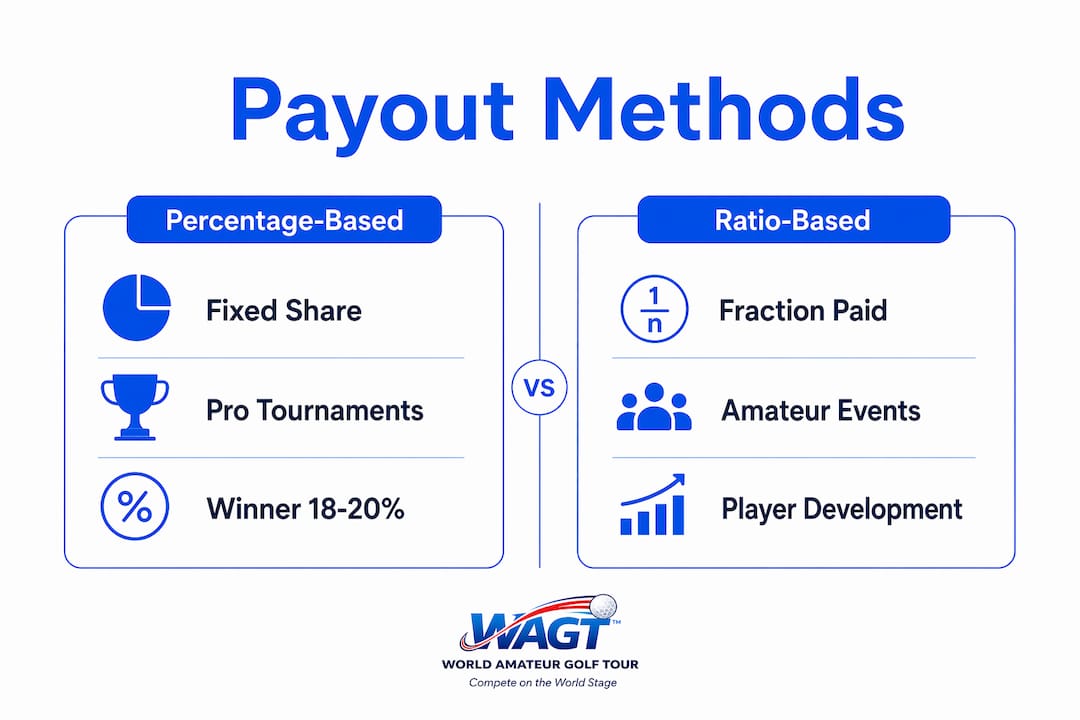
Two primary payout methods dominate golf from professional tours down to local amateur leagues: percentage-based and ratio-based.
Percentage-based payouts
The percentage-based method assigns a fixed share of the total purse to each finishing position. Professional golf tournaments allocate about 18–20% of the total prize purse to the winner, with tiered declining percentages for every subsequent place. That top-heavy design creates maximum pressure at the top of the leaderboard, which is exactly what elite competition demands.
The 2026 Memorial Tournament illustrates this clearly. With a $20 million purse, the winner received 20%, or $4 million. Percentages then decline steeply, with second place receiving roughly 12%, third around 7.5%, and amounts shrinking through the full paid field. That steep decline is intentional. It rewards the best performance disproportionately, which drives elite players to compete aggressively rather than play it safe.
Ratio-based payouts
Amateur events often use a ratio-based payout system, where the number of paid positions is calculated as a fraction of the total field. A common formula: Number of Paid Places = Number of Players / Payout Ratio. A 1-in-4 ratio in a 60-player field pays 15 players. This method keeps more participants in contention for a prize, which matters when your field includes junior golfers competing in their first serious events.
The ratio method works well for Worldamateurgolftour-style events because it acknowledges that player development depends on positive reinforcement, not just winner-take-most economics. A junior golfer who finishes 12th in a 60-player field and earns a modest payout is far more likely to register for the next event than one who walks away with nothing.
Skins payouts
A third format, the skins game, assigns a cash value to each hole. The player who wins a hole outright claims that hole's prize. Skins work best as a supplemental contest within a larger event, adding excitement on a hole-by-hole basis without replacing the main tournament structure.
Pro Tip: Publish your full payout chart, including the exact percentage for every paid position, at least two weeks before your event. Players who know what they are competing for arrive more focused and more committed.
How are ties handled in golf tournament payouts?
Ties are the most misunderstood part of any golf competition payout structure. The standard professional and amateur solution is the pooled distribution method.
Here is how it works step by step:
- Identify the tied positions. If three players tie for second place, those players occupy positions 2, 3, and 4.
- Add the prize money for all tied positions. Combine the dollar amounts assigned to 2nd, 3rd, and 4th place.
- Divide equally. Each tied player receives the same share: Payout Per Tied Player = (Sum of Prize Money for tied positions) / Number of Players tied.
- Advance the next paid position. The player in 5th place receives the prize originally assigned to 5th, not 4th.
- Document and publish the formula. Post it in your event rules before the first round begins.
This method prevents the perception that any player received an unfair advantage. It also removes any incentive for players to question the math after the fact, because the formula is public and verifiable.
One common mistake organizers make: paying tied players the prize for the lowest of their tied positions rather than the average. That approach underpays players and creates legitimate grievances. The pooled method is the recognized standard.
Professional events add another layer: a guaranteed minimum payout for players who make the cut but finish near the bottom of the paid field. At the 2026 PGA Championship, players who made the cut received a guaranteed minimum of $4,300. That floor exists to cover travel and entry costs for professionals who invest significant resources to compete. Amateur events with smaller purses can adopt a similar principle by guaranteeing at least a return of entry fees for players who make a cut line.
Transparency of prize distribution and clear pre-event communication are the single most effective tools for preventing disputes. Publish the rules. Stick to them.
What non-monetary awards matter in golf events?
Cash is not the only currency in competitive golf. Non-monetary awards serve a distinct purpose: they recognize values that scoreboards cannot measure.
- Sportsmanship awards honor players who demonstrate integrity, respect for competitors, and commitment to the rules. The Nicklaus-Jacklin Award, awarded since the 2021 Ryder Cup, recognizes players who exemplify integrity and teamwork beyond just winning. Tommy Fleetwood won the award at the 45th Ryder Cup. That recognition carries weight precisely because it cannot be bought with a lower score.
- Closest-to-the-pin and long-drive contests add excitement for players who are not in contention for the overall title. These side prizes keep the full field engaged through the final round.
- Inclusivity and community awards recognize players from underrepresented groups or those who contribute to the event's culture. Sustainability and inclusivity awards can boost participation without requiring large cash prizes, making them a practical tool for events with limited budgets.
- Performance milestone awards celebrate achievements like a first birdie, a hole-in-one, or a personal best score. For junior golfers, these moments are formative. Recognizing them publicly builds the kind of positive association with competition that keeps young players in the sport.
Pro Tip: Pair every monetary prize tier with at least one non-monetary recognition. A trophy, a certificate, or a public announcement costs almost nothing but creates a memory that a check alone cannot.
Awards focusing on character shift tournament culture positively, complementing cash prizes and building the kind of community that sustains a tour over multiple seasons.
How should organizers design a golf competition payout structure?
Designing a prize structure that works requires balancing four variables: total purse size, number of paid positions, distribution shape, and non-monetary components. Here is a practical framework.
Determine your purse size first
Golf prize money economics combine sponsorship revenue, entry fees, and media rights. Smaller events must balance purse size against operational costs including venue fees, scoring systems, and staff. Calculate your total available prize budget only after covering operational expenses. A $5,000 purse distributed well beats a $10,000 purse that leaves the event in debt.
Choose your distribution shape
| Distribution Type | Best For | Winner's Share | Paid Positions |
|---|---|---|---|
| Top-heavy (PGA style) | Elite competitive events | 18–20% | Top 30–40% of field |
| Moderate taper | Serious amateur events | 12–15% | Top 40–50% of field |
| Flat distribution | Community and junior events | 8–10% | Top 50–60% of field |
A top-heavy structure maximizes competitive pressure. A flatter structure keeps more players motivated through the final round. For Worldamateurgolftour events, a moderate taper often works best: it rewards genuine performance while keeping junior golfers engaged even when they are not in contention for the top spot.
Build in non-monetary awards
Combining monetary and non-monetary awards serves two goals. It stretches the perceived value of your event beyond the cash purse, and it builds community. Players who win a sportsmanship award or a closest-to-the-pin prize talk about the event. That word-of-mouth drives future registrations.
Use technology to reduce errors
Payout calculators help organizers quickly and accurately assign prizes, preventing human error and ensuring fairness. These tools are common in professional tours, amateur events, and friendly games alike. Tools like the Golf Payout Calculator at CalculatorsHub allow you to input field size, purse total, and distribution method, then generate a complete payout chart in seconds. That chart becomes your published record and your defense against any post-event dispute.
You can also review successful tournament examples to see how other organizers have structured their prize distributions for maximum player engagement.
Using calculated percentage distributions rather than uniform payouts prevents major prize imbalances and nurtures competitive incentives. Uniform payouts, where every paid player receives the same amount, remove the incentive to compete for position once a player has secured a paying spot. Avoid them.
Key takeaways
A well-designed golf event prize structure combines tiered percentage payouts, clear tie procedures, and non-monetary awards to drive both competitive performance and lasting player engagement.
| Point | Details |
|---|---|
| Use tiered percentage payouts | Assign 18–20% to the winner and decline steeply to reward performance at every level. |
| Apply the pooled tie method | Combine tied positions' prize money and split equally to prevent disputes and maintain fairness. |
| Publish rules before the event | Post the full payout chart at least two weeks out to build trust and eliminate post-event complaints. |
| Add non-monetary awards | Sportsmanship and milestone awards boost engagement without requiring additional cash budget. |
| Match distribution shape to audience | Use flatter distributions for junior and community events; steeper tapers for elite amateur competition. |
What i've learned about prize structures after years in tournament golf
I have watched organizers spend months perfecting a course setup and then spend about 20 minutes on the prize structure. That imbalance costs them. Players remember how they were paid long after they forget the course conditions.
The biggest mistake I see is assuming that a uniform payout, where every paid player gets the same amount, feels fair. It does not. Players who finish second resent earning the same as players who finish tenth. Uniform payouts kill competitive drive in the final round, which is the worst possible outcome for an event trying to build a reputation.
The second mistake is keeping the payout structure private until after the event. I have seen this create genuine anger, even when the actual numbers were reasonable. Players who do not know what they are competing for cannot make informed decisions about their strategy or their commitment level. Transparency is not just ethical. It is a competitive advantage for your event.
What actually works is a structure that combines a meaningful winner's premium, a moderate taper through the paid field, a published tie formula, and at least two or three non-monetary recognitions. That combination tells players you take their effort seriously at every level of the leaderboard. For junior golfers especially, that message matters more than the dollar amounts.
I also advocate strongly for season planning that builds prize structure decisions into the early stages of event design, not as an afterthought. The structure shapes the competitive culture of your event. Design it with the same care you give to course selection and scheduling.
— Gene
Take your tournament to the next level
Building a prize structure is one piece of a larger event management puzzle. If you are organizing or competing in amateur golf events and want to maximize both performance and opportunity, GoD1Golf.com offers an all-in-one platform built specifically for junior golfers pursuing D1 recruiting and competitive development.
GoD1Golf.com connects performance data, recruiting visibility, and tournament preparation in one place. For junior golfers competing in events like those run by Worldamateurgolftour, where WAGR ranking points are on the line, having the right support system off the course is just as important as the prize structure on it. Visit GoD1Golf.com to explore how the platform supports your competitive goals and helps you get noticed by college programs.
FAQ
What is a golf event prize structure?
A golf event prize structure is the system that distributes prize money or awards to players based on their finishing positions in a tournament. It defines the total purse, the number of paid positions, and the percentage or dollar amount each position receives.
How are golf prizes awarded in amateur events?
Amateur events typically use either a percentage-based method or a ratio-based method, where the number of paid positions equals the field size divided by a set ratio, such as 1 in 4 players receiving a prize.
How does a golf tournament handle ties in prize money?
Tournaments use the pooled distribution method: the prize money for all tied positions is combined and divided equally among the tied players, so no one receives an unfair advantage.
What is the winner's share in a professional golf tournament?
Professional golf tournaments typically award 18–20% of the total purse to the winner. At the 2026 Memorial Tournament, the winner received $4 million from a $20 million purse.
Why do golf events include non-monetary awards?
Non-monetary awards like the Nicklaus-Jacklin Award recognize integrity and teamwork that scores alone cannot capture. They build community, boost participation, and create a tournament culture that attracts players beyond pure prize money seekers.