
A golf event field size is defined as the total number of players authorized to compete in a given tournament. That number shapes everything from tee time scheduling to competitive integrity. As of 2026, the PGA Tour reduced its standard maximum field size to 144 players, down from 156, with some events capped at 132 or 120 depending on daylight and pace of play. For anyone planning or entering a golf tournament, understanding field size is the first step toward building a great competitive experience.
What is a golf event field size, and how is it set?
A golf event field size is the official count of players entered to compete, and it is set before registration closes based on course capacity, format, and available daylight. The number is not arbitrary. Tour directors, club managers, and event organizers calculate it to keep rounds moving, protect competitive fairness, and satisfy logistical constraints like tee time windows and marshal coverage.
At the professional level, field size caps vary by event prestige and operational conditions. Standard PGA Tour events now run at 120, 132, or 144 players. That reduction from the old 156-player cap reflects a deliberate push to improve pace and reduce course congestion. Majors like the U.S. Open still hold at 156, where tradition and prestige justify the larger field.
Field size also signals an event's character. A 30-player field at the TOUR Championship tells you this is an elite, season-ending showdown. A 144-player field at a regular Tour stop signals broad access with strong competition. Both are correct. They just serve different purposes.
What are the current professional golf tournament field sizes?
Professional field sizes span a wide range, and the reasons behind each cap are specific and deliberate.
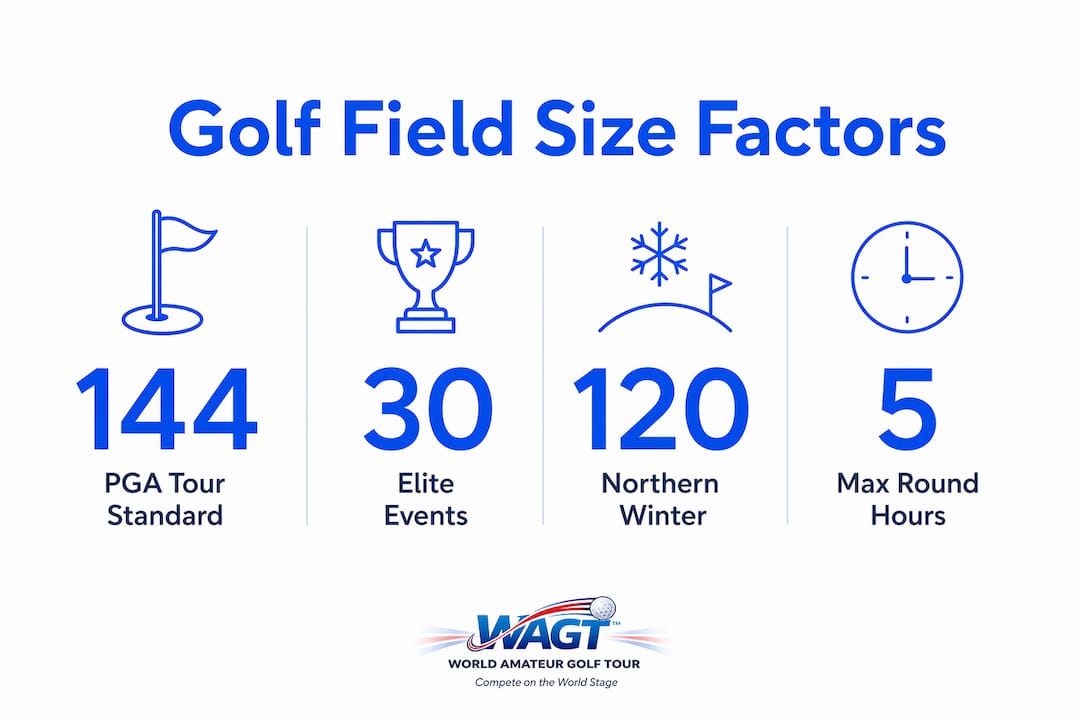
- PGA Tour standard events: Capped at 144 players for most full-field events in 2026, with some events at 132 or 120 based on available daylight hours.
- TOUR Championship: Restricted to 30 players, featuring only the top FedExCup points earners. This creates an elite, focused competition with maximum broadcast value.
- LIV Golf: Expanded to 57 players in 2026, comprising 52 team players plus 5 wildcards. The team format justifies a different structure than traditional stroke play.
- U.S. Open and majors: Held at 156 players, reflecting the prestige and multi-day infrastructure that major championships command.
- The Players Championship: Adjusted to 123 players in 2026, up from 120, to round out threesome groupings. This shows that field sizes are dynamic, not fixed.
The rationale behind these numbers comes down to four factors: daylight availability, pace of play, competitive integrity, and broadcast and sponsor demands. A 144-player field in Florida in january plays differently than the same field size in Seattle in november, because available daylight hours differ significantly.
Pro Tip: If you are organizing a tournament in a northern location during fall or winter, reduce your target field size by 10–15% to account for shorter daylight windows and avoid play-over situations.
How do formats and course logistics shape field capacity?
Tournament format is the single biggest variable in determining how many players a course can handle in a single day.
- Stroke play: Requires the smallest fields relative to course capacity. Every player completes every hole, so pace is tightly linked to the number of groups on the course at once. Competitive stroke play events work best with controlled, smaller fields.
- Scramble format: Supports larger fields because four-person teams play as one unit. The ball is always in play, reducing the time each group spends on a hole. Charity events and corporate outings use scrambles specifically because they can accommodate more participants without sacrificing pace.
- Match play: Field size is determined by bracket structure. A 64-player bracket is standard, a 32-player bracket is common for smaller events. The format naturally limits field size to powers of two for clean bracket management.
- Shotgun start: Allows larger fields to start simultaneously from different holes. This compresses the event timeline and is a common tool for amateur and charity events that need to finish within a fixed window.
Daylight hours heavily impact field sizes. Winter events at northern latitudes often restrict fields from 144 to 120 players to prevent groups from finishing in darkness. Course length and difficulty also matter. A long, demanding layout slows average group pace, which means a smaller field is needed to keep rounds within an acceptable window.
Pro Tip: Before setting your field size, calculate your expected pace per group and multiply by the number of groups. If the total exceeds your available daylight window by more than 30 minutes, cut the field.
For a detailed look at how tournament formats influence field size in amateur and club events, the format breakdown for 2026 is worth reviewing before you finalize your registration cap.
What should amateur organizers consider when setting field size?
Amateur event organizers face a different set of pressures than Tour directors. You are balancing inclusivity, budget, venue constraints, and the goal of keeping every participant happy from the first tee to the 18th green.
The most common mistake is overbooking. Overbooking leads to bottlenecks on par-3 holes and approach shots, which pushes rounds past five hours. A five-hour round frustrates players and undermines the entire event experience.
Here is a practical framework for amateur field size decisions:
- Social scramble events: 100–144 players is manageable with a shotgun start and experienced marshals. Beyond 144, pace degrades noticeably.
- Competitive stroke play: Keep fields at 72 players or fewer for single-day events. This allows clean tee time intervals and keeps rounds under four and a half hours.
- Junior and collegiate events: Smaller fields of 36–72 players allow for proper scoring, WAGR-eligible conditions, and focused competition. Worldamateurgolftour structures its events within these parameters to protect competitive integrity.
- Mixed skill-level events: Use a handicap-adjusted format and a moderate field size. Mixing scratch golfers with high-handicap players in a large stroke play field creates uneven pace and frustration.
Matching format to field size is not just a logistical choice. It is a competitive fairness decision. When the format and the field size align, every player has a fair shot and the event runs on time.
The 2026 guide to building an amateur tournament schedule covers participant number planning and event logistics in detail, and it is a useful reference before you open registration.
How does field size affect player experience and broadcast value?
Field size decisions ripple outward into every part of a tournament's quality, from how players feel on the course to how sponsors evaluate their investment.
Smaller fields improve pace of play directly. Fewer groups on the course means fewer backups at par-3 tees and approach zones. Players spend more time playing and less time waiting. That shift in experience is significant. A round that flows well keeps players engaged and competitive. A slow round drains focus and energy.
Field size reductions on the PGA Tour in 2026 were driven partly by pace of play goals and partly by broadcast scheduling. Television windows are fixed. A 144-player field finishing in a predictable time window is far more valuable to a broadcast partner than a 156-player field that regularly runs into darkness. Sponsors pay for visibility, and visibility requires a broadcast that ends on time.
Qualification pathways and sponsor expectations jointly shape field sizes at every level. A smaller field increases the prestige of each entry. It signals that earning a spot means something. For junior and amateur golfers, competing in a properly sized, well-run event carries more weight than playing in an oversized field where the competition is diluted.
For organizers, the takeaway is clear. A well-sized field protects your event's reputation. Reviewing examples of successful hosted tournaments in 2026 shows a consistent pattern: the best-reviewed events ran fields that matched their course, format, and daylight window precisely.
Key Takeaways
Golf event field size is the most consequential planning decision an organizer makes, because it determines pace, competition quality, and participant satisfaction simultaneously.
| Point | Details |
|---|---|
| Professional field size benchmarks | PGA Tour standard events cap at 144 players in 2026; elite events like the TOUR Championship cap at 30. |
| Format drives capacity | Scrambles support larger fields; competitive stroke play requires smaller, controlled participant numbers. |
| Daylight is a hard constraint | Winter and northern latitude events reduce fields from 144 to 120 to prevent play running into darkness. |
| Amateur events risk overbooking | Keeping stroke play fields at 72 or fewer players protects pace and prevents bottlenecks on the course. |
| Field size signals event prestige | A well-sized, competitive field raises the value of each entry and strengthens the event's reputation. |
Gene's take on getting field size right
Most organizers I have seen get field size wrong in the same direction. They go too big. The instinct makes sense. More players means more entry fees, more energy, and a fuller-looking leaderboard. But a field that is 20% too large for the course and format creates a cascade of problems that no amount of marshaling can fix.
The number I keep coming back to is five hours. If your projected round time exceeds five hours, your field is too large for your format. That is not a guideline. It is a ceiling. Players who finish a five-and-a-half-hour round do not come back next year.
What I find works consistently is building the field size backward from the course. Start with the number of tee times or shotgun positions available. Multiply by your group size. Then subtract 10% as a buffer for slow groups, weather delays, and last-minute no-shows. That number is your field size. It feels conservative, and it is. That is the point.
The other mistake I see is treating field size as fixed once registration opens. The Players Championship adjusted from 120 to 123 players to balance threesome groupings. That kind of flexibility is smart management, not indecision. Build a small buffer into your registration cap and use it deliberately.
For junior and amateur events specifically, a tighter field creates a better competitive environment. Worldamateurgolftour events are structured with this principle at their core. The goal is not to fill every tee time. The goal is to give every player a fair, fast, and memorable round.
— Gene
Worldamateurgolftour and well-structured amateur events
If you are a junior, collegiate, or amateur golfer looking for events that get field size right, Worldamateurgolftour builds its tournaments around exactly these principles.

Every event on the Worldamateurgolftour calendar is designed with competitive field sizes that protect pace, fairness, and WAGR eligibility. These are not oversized charity scrambles or undersized club days. They are professionally run tournaments at championship-caliber venues, structured to give serious players the competitive environment they need to develop and earn ranking points. Whether you are chasing a WAGR amateur ranking or preparing for collegiate golf, the right field size makes the competition count. Check the current event schedule and find a tournament that fits your game.
FAQ
What is a standard golf event field size?
A standard PGA Tour event in 2026 caps its field at 144 players, with some events restricted to 132 or 120 depending on daylight and pace of play. Amateur events vary widely based on format and course capacity.
How many players compete in elite professional events?
The TOUR Championship restricts its field to 30 players, featuring only the top FedExCup points earners. LIV Golf events run with 57 players, combining 52 team members and 5 wildcards.
How does format affect how many players can enter a tournament?
Scramble formats support larger fields because four-person teams play as one ball, reducing time per hole. Competitive stroke play requires smaller fields to maintain pace and fairness across all participants.
Why do field sizes change between events on the same tour?
Daylight hours, course difficulty, and broadcast scheduling all cause field size to vary. Winter events and northern latitude venues often reduce fields from 144 to 120 players to prevent rounds from running into darkness.
What field size works best for amateur golf events?
Competitive stroke play amateur events run best with 72 players or fewer for a single-day format. Social scramble events can accommodate up to 144 players with a shotgun start and active course management.