
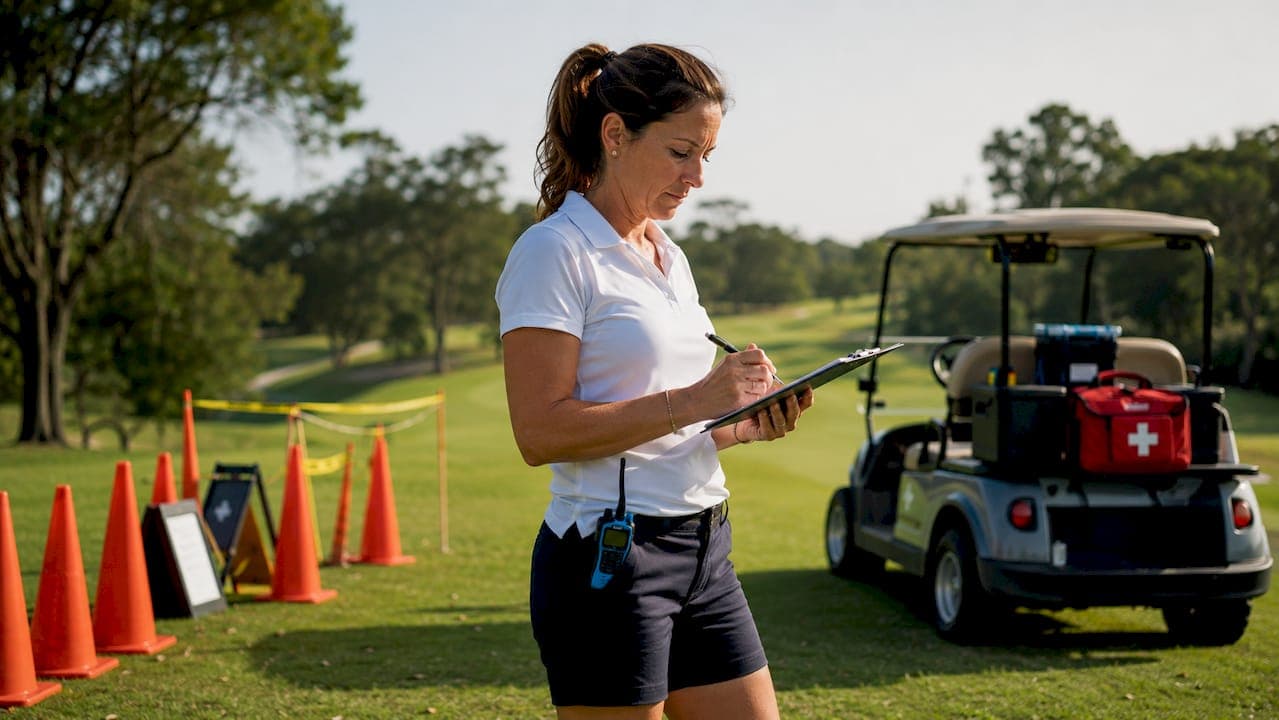
Running a golf tournament means more than booking tee times and printing scorecards. Your event's success depends on a safety framework that protects players, volunteers, spectators, and staff from the first practice round to the final putt. The golf event safety protocols list below gives you a practical, pre-event reference built around 2026 PGA TOUR standards and International Golf Federation medical guidelines.
Before your event opens, confirm each of the following is in place:
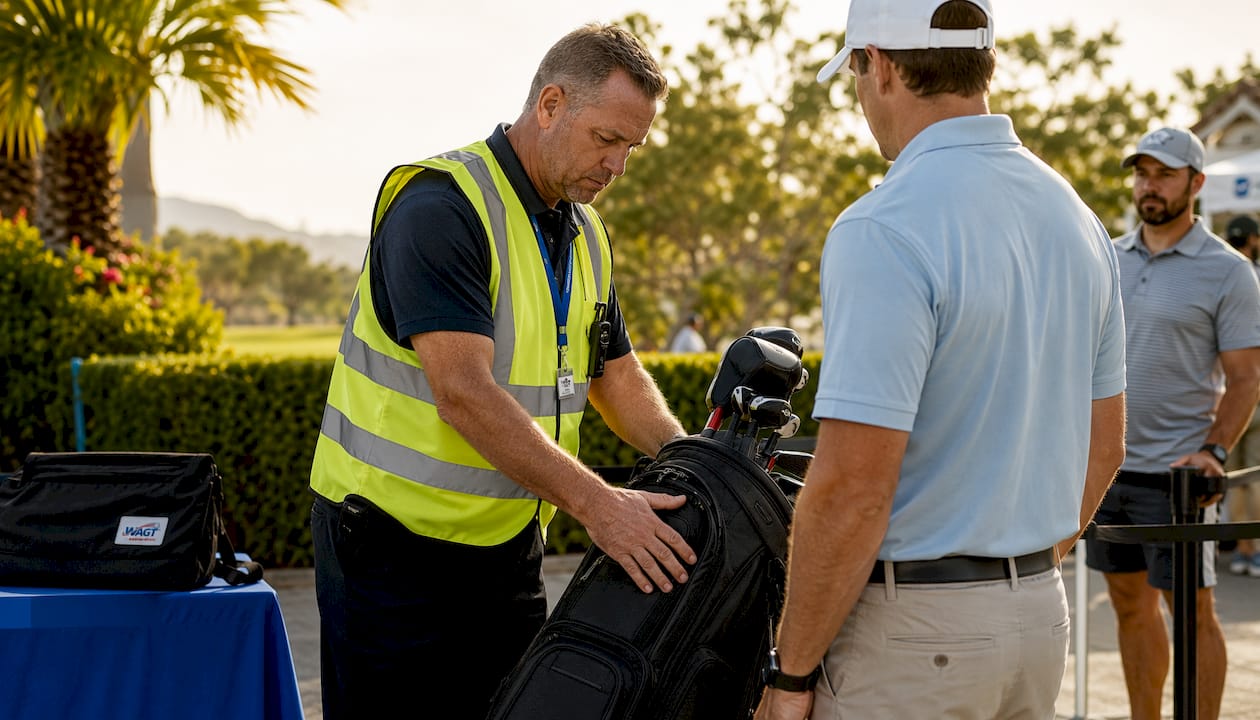
- Security screening: Bag checks, metal detector access points, and a prohibited items list posted at all entry gates
- Volunteer PPE: Close-toed slip-resistant shoes, sunscreen, hats, and ergonomic training for all staff
- Medical coverage: Separate first-aid stations for athletes and spectators, with ambulance access and an emergency action plan finalized at least 3 months before the event
- Evacuation plan: Documented routes for all attendees, including persons with reduced mobility
- Weather protocols: Lightning suspension procedures, heat management stations, and severe weather communication channels
- Course etiquette enforcement: "Fore" call policy, safe group spacing, and prohibited roughhousing rules
- Golf cart safety: Trained operators only, visible safety signage on every cart, and restricted access zones
- Crowd and traffic management: Layered access control zones, directional signage, and coordination with local law enforcement
- Communication plan: Dedicated radio channels for medical services, backup systems for large crowds, and a command center contact list
- Food and water safety: Hygiene monitoring, secure supply lines, and protocols for any declared food-related illness
- Disease prevention: Social distancing options, sanitation stations, and communicable disease response procedures
- Accessibility accommodations: Accessible pathways, designated viewing areas, and mobility-specific evacuation routes
- Signage: Hazard warnings, emergency exit markers, and prohibited items notices at all key locations
Each category below breaks down the specific requirements your team needs to execute these protocols at a championship level.
1. What security screening and prohibited items policies should you enforce?
Security screening is the first line of defense at any golf tournament, and getting it right means knowing exactly what stays outside the ropes. PGA TOUR events use a layered approach: bag checks at perimeter entry points, walk-through or handheld metal detectors at primary gates, and secondary screening zones for credentialed staff and media.
Common prohibited items at golf events include:
- Weapons of any kind, including concealed firearms unless permitted by local law
- Large bags, backpacks, or hard-sided coolers (most events allow soft-sided bags no larger than 6" x 6" x 6")
- Unauthorized drones or remote-controlled aircraft
- Laser pointers and air horns
- Banners, signs, or flags on poles
- Outside alcohol and glass containers
- Professional camera equipment without media credentials
- Selfie sticks and tripods in spectator areas
Your tournament planning checklist should include a pre-event walkthrough of all entry points to confirm screening equipment is operational and staffed. Coordinate with local law enforcement on any jurisdiction-specific rules around lawful carry, and document those agreements in writing before event day.
2. What PPE and operational rules keep volunteers safe on the course?
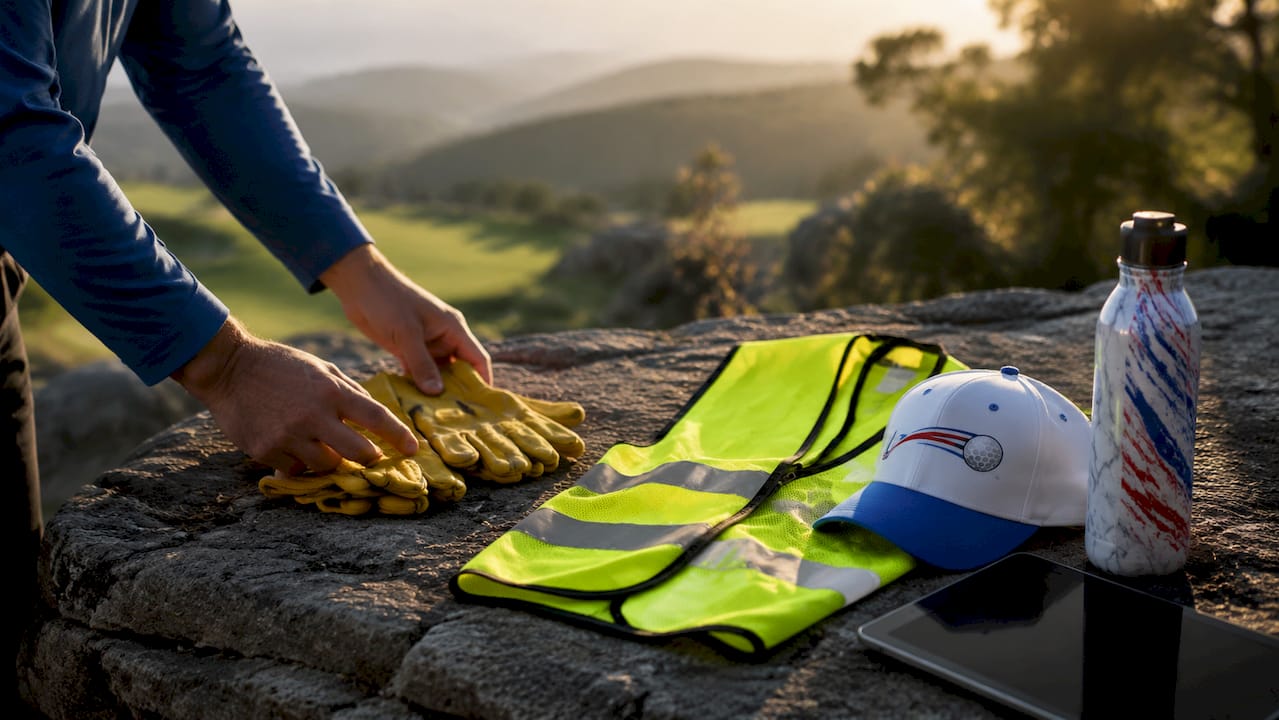
Volunteer safety is the backbone of a well-run golf event. The 2026 Truist Championship volunteer safety guidelines are direct: volunteers must wear close-toed, slip-resistant footwear, sunscreen use, and head protection during outdoor assignments. No volunteer may operate machinery, vehicles, or powered equipment without documented training and supervisor authorization.
Core volunteer safety requirements:
- Close-toed, slip-resistant footwear for all outdoor assignments
- Sunscreen (SPF 30 or higher) and a hat or visor during outdoor shifts
- Hydration access every 30 minutes during warm-weather events
- Proper lifting technique: bend at the knees, keep loads close to the body, and ask for help with anything over 35 lbs
- No operation of golf carts, forklifts, or powered equipment without prior training
- Immediate reporting of any unsafe condition to a supervisor, not just a verbal mention
Pro Tip: Volunteers who actively identify and report hazards before an incident occurs are your most valuable safety asset. Build a brief hazard-spotting exercise into your pre-event volunteer orientation so the habit starts on day one.
According to PGA TOUR volunteer safety training, safety is a shared responsibility that extends well beyond designated security personnel. Every marshal, scorer, and hospitality volunteer is part of your safety network. Pair new volunteers with experienced staff for the first two hours of their shift, and make sure everyone knows the radio channel or contact number for reporting issues.
For a full breakdown of staffing roles and safety responsibilities, the golf event staffing guide covers position-specific protocols in detail.
3. How does golf course etiquette function as a safety protocol?
Course etiquette is not just about courtesy. It is a primary injury-prevention tool, and treating it as optional puts players and spectators at real physical risk. A golf ball traveling at speed can cause serious injury, and the "Fore" call is the only warning system available when a shot goes off-line.
Etiquette rules that directly prevent injury:
- All players must shout "Fore" immediately when a shot may endanger anyone on the course
- Groups must maintain safe spacing, never playing until the group ahead is clearly out of range
- No throwing clubs, equipment, or any object under any circumstances
- Players and spectators must stay behind designated ropes and boundary markers at all times
- Roughhousing, running, or horseplay in active playing areas is prohibited
- Caddies and support staff must remain in designated zones during play
Golf etiquette enforcement reduces the risk of flying ball and club injuries in active playing areas. Your marshals play a key role here. Position them at blind corners, elevated tee boxes, and any hole where spectator viewing areas overlap with ball flight zones. Brief them specifically on when to hold gallery movement and when to signal "all clear."
The local rules guide includes safety-related course rules that every player must acknowledge before teeing off. Make that acknowledgment part of your registration process, not an afterthought at the first tee.
4. How should you build your emergency medical and evacuation plan?
Medical planning is where most amateur event organizers underinvest, and the gap shows when something goes wrong. The International Golf Federation's Event Coverage Guidelines are clear: emergency and safety plans must be developed at least 3 months before the event. That timeline exists because coordinating with local hospitals, licensing visiting physicians, and securing ambulance access all take time.
Required medical coverage elements:
- At least one first-aid station near the clubhouse with direct ambulance access
- Separate medical headquarters for athletes and spectators to prevent overloading either post
- Automated external defibrillators (AEDs) at the clubhouse and at starter boxes on the 1st and 10th tees
- A dedicated event pharmacy with secure medication storage compliant with local law
- A written Emergency Action Plan distributed to all staff before the event opens
- A documented evacuation plan that specifically addresses persons with reduced mobility
The separation of athlete and spectator medical posts is a detail many organizers miss. Mixing the two creates bottlenecks during high-volume incidents and means professional athletes may not receive the specialized care their conditions require.
| Resource | Small Event (under 1000 attendees) | Large Event (1000+ attendees) |
|---|---|---|
| First-aid stations | 1 near clubhouse | 2+ including course outposts |
| AEDs | 1 at clubhouse | 1 per 200 attendees, minimum |
| Ambulance access | On-call, confirmed in writing | On-site during all play |
| Medical staff | Certified first-aider per 200 attendees | Physician or paramedic on site |
| Athlete medical post | Combined with spectator post | Physically separate facility |
| Evacuation coordinator | 1 designated staff member | Dedicated team with radio access |
Your communication plan must be part of the medical plan, not a separate document. The IGF guidelines specify that larger events require a dedicated radio channel for medical services, with the Event Medical Manager also connected to the general staff network. For smaller events, mobile phones and landlines may work, but identify backup systems in advance since mobile networks can fail in large crowds.
5. How do you manage safety signage, crowds, and staff communication?
Crowd management at a golf event is a different challenge than at a stadium or arena. The playing field is spread across hundreds of acres, spectators move freely between holes, and emergency access routes must stay clear at all times. Layered access control is the standard approach used at major tournaments, and it works at the amateur level too.
Signage requirements:
- Prohibited items notices at every entry gate, at eye level
- Emergency exit markers on all hospitality structures, restroom facilities, and grandstands
- Hazard warnings at water features, cart crossings, and elevated terrain
- Directional signage at every major intersection of spectator pathways
Crowd flow and communication:
- Use physical barricades to separate spectator corridors from cart paths and player walkways
- Designate access zones by credential type: public, volunteer, media, and player
- Station marshals at high-traffic pinch points, particularly around the 18th green and scoring areas
- Assign a dedicated traffic and crowd coordinator who reports directly to the event director
For event traffic management at large golf events, multiple checkpoints and directional controls are the standard for smooth ingress, egress, and emergency vehicle access. Coordinate with local law enforcement and neighboring residents well before event day. Document those agreements and share them with your command center team.
Radio communication is your primary tool. Assign dedicated channels by function: one for medical, one for security, one for operations. Make sure every channel supervisor has a backup contact method, whether a cell phone or a designated runner, in case radio coverage drops in low-signal areas of the course.
6. What disease prevention measures apply to golf events in 2026?
Communicable disease protocols remain part of the standard safety checklist for golf events, even as the acute phase of COVID-19 has passed. The PGA's Back2Golf Operations Playbook established a tiered framework that still informs current best practices, and the IGF medical guidelines explicitly require organizers to address epidemic and endemic situations in their event medical plans.
The practical measures for 2026 events focus on hygiene infrastructure and flexible response capacity rather than blanket restrictions. Place hand sanitizer stations at all entry points, restroom facilities, food service areas, and high-touch locations like scoring tables and registration desks. Clean shared surfaces, including cart steering wheels, flagstick holders, and scoring equipment, at least once per hour during active play.
For cart operations, the Back2Golf framework recommended single riders per cart or approved exceptions for same-household pairs, and spacing carts a minimum of ten feet apart at staging areas. Those spacing principles remain good practice for any event where participant density is a concern. Pre-place all common touch-point items on carts before participants arrive to reduce shared handling.
Your medical plan should include a documented protocol for any declared outbreak of food-related or communicable illness during the event. Identify the local public health authority contact in advance, and make sure your Event Medical Manager knows the reporting threshold and escalation steps. Facial coverings for staff in roles where social distancing is not possible remain a recommended option, particularly for food service and scoring personnel.
7. What golf cart safety procedures should every operator follow?
Golf carts are involved in a disproportionate share of on-course incidents at amateur events, and most of those incidents are preventable. The 2026 Truist Championship safety guidelines prohibit any volunteer or staff member from operating a cart without prior training and supervisor authorization. That rule applies to every cart on the property, including utility vehicles and beverage carts.
Mandatory cart safety procedures:
- Only trained, authorized operators may drive any cart or utility vehicle
- Every cart must display visible "THINK SMART!" safety alerts and current safety signage
- Carts must stay on designated paths and away from broadcast sight lines and spectator corridors
- No passengers may ride on the outside of a cart or on the cargo area
- Maximum speed on course paths is walking pace in spectator zones
- Carts must be kept away from tee boxes and greens during active play
- Operators must perform a pre-shift inspection: check brakes, tires, and battery or fuel level before each use
- Carts involved in any incident must be taken out of service until inspected by a supervisor
Untrained repairs are explicitly prohibited. If a cart breaks down on the course, the operator contacts the equipment coordinator and waits. Attempting field repairs without authorization creates additional liability and safety risk. Your pre-event training session should cover these rules with every cart operator, and a signed acknowledgment form should go into each operator's volunteer file.
8. What food safety and hygiene standards apply to event catering?
Food safety at a golf event is more complex than it looks. You are managing multiple service points spread across a large outdoor venue, often in warm weather, with supply chains that may include outside vendors and caterers unfamiliar with your specific site. The IGF Event Coverage Guidelines require that safe and adequate nutrition be provided to all stakeholders, with particular attention to hygiene and protection against contaminated food supplies.
Core food safety requirements:
- All food vendors must hold current health department permits and provide documentation before the event
- No buffet-style or self-service food in high-density areas where cross-contamination risk is elevated
- Hot foods must be held at 140°F or above; cold foods at 40°F or below, monitored with calibrated thermometers
- Shared serving utensils must be replaced or sanitized at least once per hour
- A documented protocol for any food-related illness outbreak must be in the medical plan
- Athlete catering must account for anti-doping compliance, avoiding hormone-treated meats and unverified supplements
- Special dietary and cultural needs must be identified in advance and confirmed with the catering team
Water safety deserves specific attention. Provide information to all participants and staff about the safety of tap water at the venue, particularly for events in locations where water quality may vary. Bottled water should be available at all first-aid stations and athlete areas regardless of tap water status. Your catering plan should be shared with team managers and individual athletes before the event so they can flag any concerns about specific ingredients or supply sources.
9. How do you make your golf event safe and accessible for disabled attendees?
Accessibility is both a legal requirement under the Americans with Disabilities Act and a practical safety obligation. An attendee who cannot reach an emergency exit or navigate an evacuation route is at greater risk than anyone else on the course. Your safety plan must address this group specifically, not as an afterthought.
The IGF medical guidelines explicitly call out the need for a dedicated evacuation plan for persons with reduced mobility. That plan should identify accessible evacuation routes from every spectator area, designate staff members responsible for assisting mobility-impaired attendees, and confirm that those routes are free of obstacles before the event opens.
Accessibility and safety requirements:
- Accessible parking with direct, paved pathways to entry gates and primary spectator areas
- Designated viewing areas with clear sight lines and space for wheelchairs and mobility devices
- Accessible restroom facilities within a reasonable distance of all spectator zones
- Evacuation routes that accommodate wheelchairs, walkers, and other mobility aids
- At least one staff member per major spectator zone trained in mobility assistance and evacuation support
- Accessible first-aid station access, with medical staff briefed on common mobility-related medical needs
- Clear signage in accessible formats, including large print and pictogram-based emergency instructions
Pre-event site walks with an accessibility lens catch problems that standard walkthroughs miss. Bring a wheelchair or mobility device and test every route yourself. Uneven turf, temporary fencing, and cable crossings are the most common barriers, and all of them are fixable before the first spectator arrives.
10. How should you handle weather and environmental hazards at golf events?
Weather is the most unpredictable safety variable at any outdoor golf event, and lightning is the most dangerous. The standard protocol, consistent with guidance from the United States Golf Association and adopted across professional and amateur tours, requires suspending play at the first sign of lightning or thunder. Play resumes only after a 30-minute thunder-free interval, regardless of how clear the sky appears.
Weather and environmental safety protocols:
- Designate a weather monitor responsible for tracking forecasts from the morning of the event through the final group's finish
- Establish a clear lightning suspension signal, typically one long horn blast, and communicate it to all players, caddies, and spectators before play begins
- Identify shelter locations on the course map and brief marshals on directing spectators to the nearest safe structure
- Avoid isolated trees, water features, and elevated terrain during lightning delays
- For extreme heat, set up cooling stations with water, electrolyte drinks, and shade at regular intervals across the course
- Monitor air quality if the event is held in an area prone to wildfire smoke or high pollution; the IGF references WHO Air Quality Guidelines as the applicable standard
- Have a severe weather communication plan that reaches all staff simultaneously, not just those near the clubhouse
Heat illness is a real risk at summer events, particularly for volunteers standing in the sun for extended shifts. Assign a rotation schedule so no volunteer stands in direct sun for more than 90 minutes without a break. Your medical team should know the signs of heat exhaustion and heat stroke and have a rapid response protocol ready before the event starts.
Pro Tip: Post the lightning suspension signal and shelter locations on the event app, the course map, and at every marshal station. Players and spectators who know the plan in advance respond faster and more calmly when a horn sounds.
Why Worldamateurgolftour events are built on these standards
At Worldamateurgolftour, every WAGR-counting tournament we run is designed around the same safety framework you have just read. Our events at championship-caliber courses across Florida follow 2026 industry medical guidelines, PGA TOUR volunteer safety standards, and full accessibility compliance. We do not treat safety as a box to check. It is the foundation that makes serious competition possible.
Junior, collegiate, and amateur golfers deserve events where the only variable is their game. When you compete with Worldamateurgolftour, you are stepping into a professionally managed environment where medical coverage, course safety, and volunteer training are handled before you ever reach the first tee. That is what elite amateur competition looks like.
Ready to compete at the highest amateur level? Visit Worldamateurgolftour to explore upcoming WAGR-counting events and secure your spot in the field.
Key Takeaways
A golf event safety protocols list is only as strong as the planning behind it. Finalize every protocol at least 3 months before your event, document all corrective actions in writing, and train every volunteer before the first attendee arrives.
| Point | Details |
|---|---|
| Plan 3 months ahead | Emergency and safety plans must be finalized at least 3 months before the event to allow time to resolve hazards. |
| Separate medical posts | Athlete and spectator medical headquarters must be physically distinct to prevent overloading and ensure tailored care. |
| Volunteers drive safety culture | Every volunteer is a safety advocate; trained hazard reporting reduces incidents across the entire event. |
| Lightning protocol is strict | Suspend play at the first sign of lightning or thunder; resume only after a 30-minute thunder-free interval. |
| Accessibility requires a dedicated plan | Evacuation routes for persons with reduced mobility must be documented and tested before the event opens. |