

Play lower, take more club, and swing smoother. That's the whole formula for golf in wind: knock your trajectory down so gusts have less to grab, add roughly one club for every 10 mph of headwind, and stay smooth through impact instead of forcing it. Swing harder into a headwind and you'll only add spin and balloon the ball. Discipline beats power every time the flag starts snapping.
TL;DR:
- Swing smoother, take about one club more per 10 mph of headwind, and keep your shots low to minimize wind's impact on ball flight.
- Adjust your setup with ball back, wider stance, and forward weight to reduce dynamic loft and control trajectory better in windy conditions.
- Practice knocking down shots with a low setup and abbreviated swing to reliably counteract gusty weather during actual rounds.
- Focus on course management by aiming for wider landing areas and accepting wider miss zones rather than fighting wind for precision.
- Rely on technique and pre-shot wind calibration rather than equipment changes mid-round to maintain consistency and control in breeze conditions.
Table of Contents
- Your 60-Second Wind Checklist Before You Swing
- How Does Wind Actually Change Ball Flight?
- Setup and Swing Changes That Lower Your Ball Flight
- What Club Adjustments Work Best in Wind?
- How to Hit a Knockdown Shot Step by Step
- Adjusting Your Short Game and Putting for Wind
- Practice Drills to Master Wind on the Range
- Smart Course Management on Windy Days
- Do Golf Balls and Clubs Really Matter in Wind?
- The Biggest Mental Mistake Golfers Make in Wind
- How Competitive Golfers Prepare for Windy Tournament Rounds
- An Editorial Note on Learning to Love a Breezy Round
- Sources
Your 60-Second Wind Checklist Before You Swing
You don't need a weather app to play smart golf in wind. You need a quick routine you run before every shot that matters.
- Read the wind properly. Check the flag, watch the treetops, and glance at cloud movement, not just the grass at your feet, since ground-level puffs rarely match what's happening at ball height.
- Confirm direction and gustiness. A steady 15 mph crosswind plays very differently than gusty 10 to 20 mph conditions.
- Club up and swing down. Take about one extra club per 10 mph of headwind and plan a controlled three-quarter swing, not your full-send driver swing.
- Adjust your setup. Move the ball back slightly, widen your stance, choke down, and lean your weight forward.
- Pick a landing zone, not a pin. Commit to a target area big enough to absorb a miss.
Run through this list on every tee box and it becomes second nature by your back nine.
How Does Wind Actually Change Ball Flight?
Wind does its damage at the top of your shot's arc, not at ground level, which is why a shot that peaks at 90 feet suffers far more than one that peaks at 50. A higher launch spends more time exposed to stronger wind aloft, and that's the mechanism behind almost every piece of wind advice you'll hear.

Headwind acts like a magnifier on backspin. It steepens your descent angle and can shave 10 to 20 percent off your normal carry distance. Tailwind does the opposite, flattening the flight and adding rollout, which is why downwind approach shots so often skip through the green. Crosswind is the trickiest of the three: it doesn't just push the ball sideways, it amplifies whatever sidespin is already on the shot, so a slight fade can turn into a real slice under a stiff breeze. The practical takeaway is simple. Lower launch and lower spin shrink your exposure to all three effects at once.
Setup and Swing Changes That Lower Your Ball Flight
Cutting trajectory starts before you ever take the club back. A few small setup tweaks do most of the work, and none of them require rebuilding your swing.
- Ball position: move it 1 to 2 inches back of your normal spot to reduce dynamic loft at impact.
- Stance: widen it slightly for a more stable base and a naturally shorter swing arc, as advised in Chiropractic for Golfers: Performance and Injury Guide to promote balance and injury-safe practice in windy conditions.
- Grip: choke down a half inch to a full inch for better control and feel.
- Weight: favor your front foot at address and keep the shaft leaning forward through impact.
- Tempo: stay smooth, and let your finish come up shorter than usual instead of a full release.
Pro Tip: Rehearse the abbreviated finish on the range before you ever try it on the course. If your finish position feels incomplete, you're probably still swinging too hard for the shot you're trying to hit.
What Club Adjustments Work Best in Wind?
The starting rule almost every top instructor teaches: take roughly one extra club for every 10 mph of wind blowing into you. A 150 yard shot into a 20 mph headwind plays like 170, so that's a two-club jump, then swing at 80 percent effort with your new club.
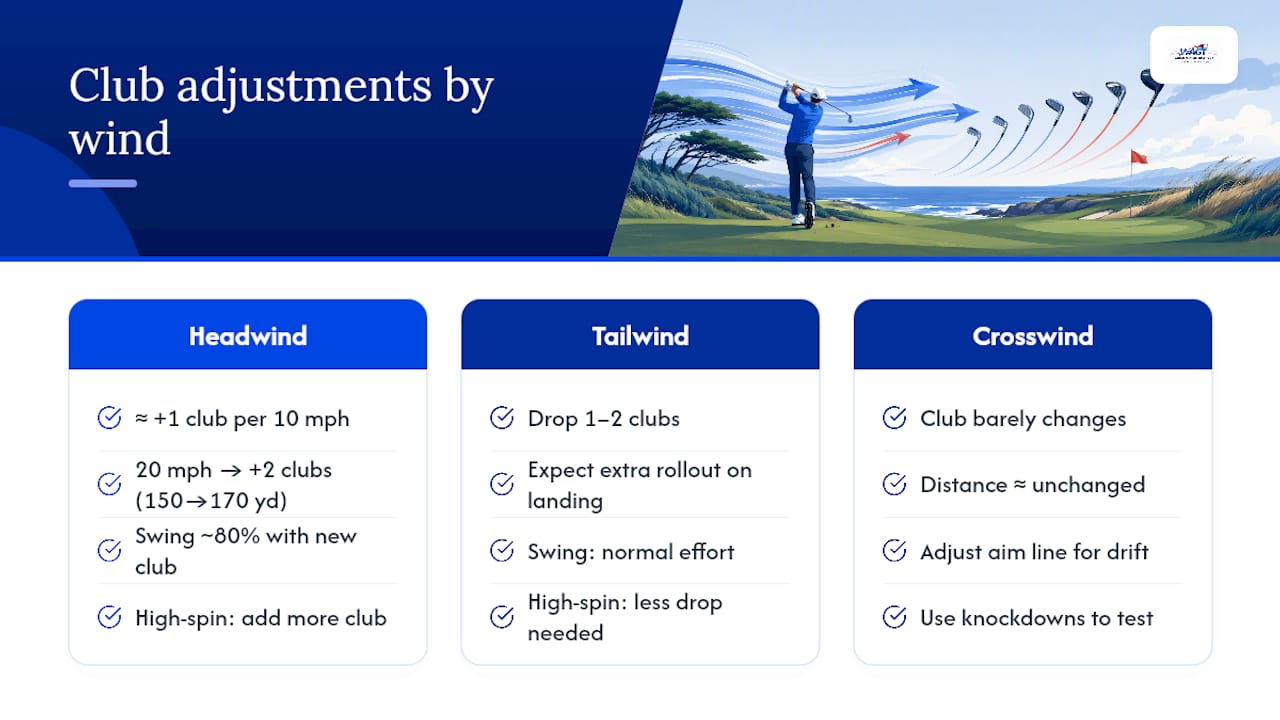
That baseline shifts depending on your ball flight. Players with high-launch, high-spin swings need to add even more club, since their shots suffer more in wind. Low-spin players can often get away with adding slightly less. Downwind is the mirror image: drop one to two clubs and expect extra rollout once the ball lands. In crosswinds, the club barely changes, but your aim line does, since lateral drift matters more than distance loss. The best way to nail these numbers for the day is to calibrate on the range before you tee off, hitting a few knockdowns and a few normal shots to the same target and watching what actually happens.
How to Hit a Knockdown Shot Step by Step
The knockdown is the single most useful shot in your windy-day arsenal, and it's simpler than it looks.
- Set up low. Ball back in your stance, hands choked down, weight forward, feet slightly narrower than normal.
- Take it back three-quarters. A shorter backswing limits the clubhead speed that creates unwanted height and spin.
- Accelerate through, don't lunge. Controlled speed beats maximum speed here.
- Finish short with hands ahead. Keeping your hands leading the clubhead through impact preserves low dynamic loft and keeps spin down.
For mid-irons this shot typically flies 10 to 15 yards shorter than your normal shot with the same club. The most common fault is an early release, where the hands flip through impact and the ball balloons right back up. If that's happening, feel like your hands stay ahead of the ball all the way to your abbreviated finish.
Adjusting Your Short Game and Putting for Wind
Around the green, height is your enemy just as much as it is on full shots. Favor the bump-and-run and low chip over a high, soft pitch whenever the lie allows it, since a ball rolling on the ground doesn't care how hard the wind is blowing.
- Choose lower-lofted clubs for chips and accept more rollout in exchange for predictability.
- On putts, prioritize speed control over precise lines, since gusts can nudge a slow-rolling ball just enough to matter on longer putts.
- Stay aware of gusts specifically on putts over 20 feet, where the ball is exposed to wind for longer.
- Drill this at home: alternate low chips and higher pitches into a breeze from the same spot and watch how differently each one reacts once it lands.
Practice Drills to Master Wind on the Range
Confidence in wind comes from calibration, not guesswork. A short, repeatable range routine fixes that fast.
- Knockdown versus normal drill. Hit two knockdowns and two normal shots to the same target and note the yardage gap for each club.
- Flag and landmark drill. Pick a target well off your intended line and practice trusting the wind to carry the ball back, the same approach many pros use in a stiff crosswind.
- Short chip drill. Hit 20 to 30 low chips or bump-and-runs from the same spot to learn how much a breeze changes your rollout.
- Early re-check on course. Confirm the wind's real direction and strength during your first few holes rather than assuming it matches the forecast.
Building this routine into your pre-round warm-up pays off far more on a gusty day than extra time on the practice putting green.
Smart Course Management on Windy Days
Aim at the widest safe landing area, not the flag. That single mental shift prevents more bad numbers than any swing change ever will. In crosswinds specifically, aim well offline in the direction the wind is coming from and let the breeze carry the ball back toward your target, rather than trying to shape a shot against it.
Dispersion widens considerably in strong crosswind compared to calm air, so give yourself more margin than usual on both sides of your target. Pick conservative landing spots when carry and roll are hard to predict, and treat any hole with trouble on one side as a hole where you take the safer miss even if it costs a few yards.
Do Golf Balls and Clubs Really Matter in Wind?
Gear helps at the margins, technique does the heavy lifting. Lower-spinning golf balls reduce ballooning, and hybrids often outperform long irons for a lower, more controllable flight in gusty conditions. Teeing the driver a touch lower into a headwind helps too. What you shouldn't do is overhaul your bag mid-round chasing a fix. That's a range decision, not a back-nine decision.
The Biggest Mental Mistake Golfers Make in Wind
The instinct to swing harder is the single most damaging habit in windy golf, since more clubhead speed adds spin and height instead of distance. Pick your plan, commit fully, and accept a wider miss than you'd tolerate on a calm day. Before each shot: breathe, confirm your club and line, and swing smooth.
How Competitive Golfers Prepare for Windy Tournament Rounds
Serious players don't leave wind strategy to chance. They rehearse knockdowns and course management on the range long before tee time, then run early-round calibration shots to confirm how the wind is actually playing that day. At Worldamateurgolftour events, that preparation habit is part of what separates players who protect their scores from those who don't, and it's the same discipline we emphasize across our player development resources for junior, collegiate, and amateur competitors chasing WAGR points.

An Editorial Note on Learning to Love a Breezy Round
Windy rounds reward acceptance over panic. Players who stop fighting the conditions and start rehearsing them tend to shoot lower scores by season's end. Build one windy-day practice session into your week, and pair it with structured habits from Worldamateurgolftour's guidance on lifelong skill-building if you want a real framework instead of guesswork.
— Gene
Sources
The rules and drills above draw on instruction from Golf.com, Golf Digest, and Pga. For structured competitive play, visit Worldamateurgolftour.
- Top teacher shares 3-step guide for playing golf in the wind
- Playing golf in the wind? Focus on these 3 things to save your score