

What are the key steps to schedule golf tournament tee times?
Getting your tee times right is the foundation of any well-run golf tournament. Whether you're organizing a junior event or a full amateur competition, the scheduling process follows a clear sequence that keeps play fair, efficient, and professional.
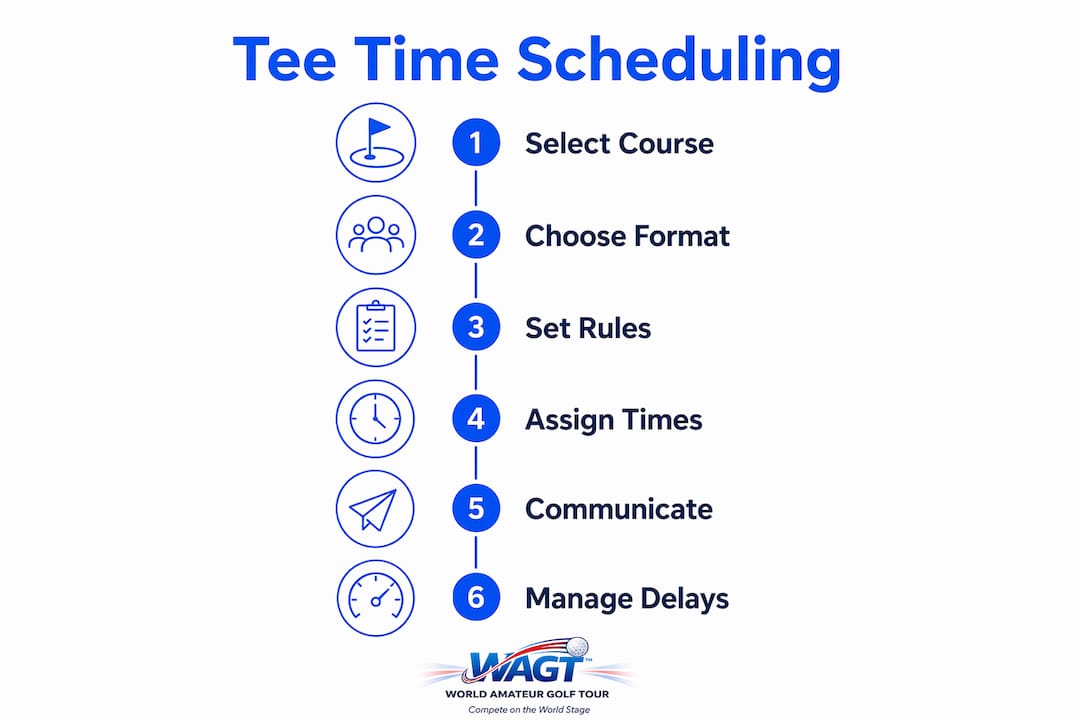
Here are the core golf tournament tee time scheduling steps every organizer needs:
- Select your course and name the event — confirm venue availability and establish the official tournament identity.
- Set the event date and estimate tee time count — base the number of slots on your expected field size.
- Choose your start format — standard sequential, crossover, or shotgun, depending on field size and course layout.
- Configure eligibility and registration windows — define who can enter and when registration opens and closes.
- Set tee time assignment rules — decide whether players self-select or organizers assign pairings automatically.
- Handle booking permissions and partner requests — control who can book for whom to reduce manual corrections.
- Communicate the schedule and manage changes — use automated notifications to keep every participant informed.
- Publish finalized tee times — distribute the confirmed schedule to all players before event day.
Each step builds on the last. Skip one, and you'll feel it on tournament morning.
Table of Contents
- How to set up your tournament and choose the right start format
- How to configure tournament software and tee time assignment rules
- Why integrated communication and unified platforms matter
- How Worldamateurgolftour applies these scheduling principles
- How do you keep tee time scheduling fair and optimized?
- How to allocate tee times based on skill level or category
- What to do when weather or delays disrupt your tee times
- How to coordinate with golf course management and staff
- Your final checklist for publishing tee times to participants
- Worldamateurgolftour: built for serious junior tournament competition
- Key Takeaways
How to set up your tournament and choose the right start format
The first decisions you make shape everything that follows. Tournament scheduling begins with selecting a course that matches your field size and competitive level, then naming the event and locking in your dates.
Once your dates are confirmed, estimate how many tee times you need by dividing your expected field by your group size, typically three or four players per pairing. Add buffer slots for late registrants and staff groups. Getting this count right early prevents the scramble of adding tee times the week before play.
Your start format choice has a direct impact on pace of play and logistics:
- Standard sequential start — groups tee off from hole 1 in order, ideal for smaller fields on a single course.
- Crossover start — players begin on both hole 1 and hole 10 simultaneously, cutting total round time for mid-size fields.
- Shotgun start — all groups begin at the same time from different holes, best for large fields where a simultaneous finish is preferred.
Wave scheduling is another option worth knowing. AM/PM wave pairings split your field into morning and afternoon groups, which works well for multi-round or multi-course events. Before generating wave pairings, you need to add your rounds, players, courses, and divisions to the system. The tee time interval between groups, typically 8–10 minutes, should be set at this stage as well.
How to configure tournament software and tee time assignment rules
Once your format is set, the software configuration stage is where scheduling gets precise. Tournament platforms let you work through each registration card to define eligibility criteria, field size, registration dates, fees, and cancellation rules before a single player signs up.
The tee time selection setup within your software typically offers these options:
- Player self-selection — players choose their own slot during registration, which increases buy-in but requires more oversight.
- Organizer assignment — the system assigns tee times automatically based on handicap index, random draw, or fixed groupings.
- Booking permissions — set whether a golfer can book for any player, partners only, or themselves only. Precise booking permissions reduce the manual corrections that pile up when players book incorrectly.
- Post-registration updates — allow players to adjust their tee time after registering, with a defined cutoff date and an automatic email notification when that window opens.
Expert tournament planners treat tee time scheduling as a combinatorial optimization problem. Genetic algorithms can generate mathematically optimal, non-repeating pairings instantly, handling last-minute swaps and absences without disrupting the broader schedule. Manual spreadsheets simply cannot match that adaptability at scale.
Pro Tip: Automate your pairing rules from the start. Setting handicap-based or random grouping logic inside your platform before registration opens eliminates hours of manual work and keeps your pairings consistent and defensible.

Why integrated communication and unified platforms matter
Scheduling is only half the job. Keeping players, parents, and staff aligned throughout the event is where many tournaments lose control. Automated email confirmations and reminder notifications, sent directly from your scheduling platform, reduce the volume of pro shop calls and last-minute confusion dramatically.
Integrated platforms that connect your tee sheet, registration system, and point-of-sale tools prevent data silos that cause errors. Unified tournament systems capture player demographics and payment information accurately, so fee collection at check-in is automatic rather than manual. When a player's registration data flows directly into the POS, your staff spends less time searching for green fees and more time welcoming competitors.
Real-time leaderboards and mobile access add another layer of participant experience. Players and parents can check group assignments and scores without calling anyone. For junior events especially, that visibility builds trust and keeps families engaged throughout the day. You can find a deeper look at how these systems connect in this golf event results guide.
How Worldamateurgolftour applies these scheduling principles
The World Amateur Golf Tour puts these scheduling steps into practice at every event it runs for junior, collegiate, and amateur golfers across the United States. Eligibility criteria are defined clearly before registration opens, and the tour uses transparent, unified platforms that connect registration, tee time management, and fee processing in one place.
What sets the tour apart is its commitment to fairness and player development at every scheduling stage:
- Tournament eligibility and registration windows are communicated well in advance, giving junior golfers and their families time to plan.
- Tee time assignments prioritize competitive fairness, grouping players by skill level and division.
- Schedule changes and cancellations are handled through integrated notification systems, so parents receive updates without chasing down organizers.
- Every event contributes ranking points toward WAGR status, making the scheduling process part of a larger pathway to collegiate and professional golf.
The tour's approach to tournament scheduling reflects the same principles covered in this guide, applied consistently across championship-caliber venues.
How do you keep tee time scheduling fair and optimized?
Fairness in scheduling means no player gets an unfair advantage from their tee time. Early morning slots on a dewy course play differently than afternoon slots on a firmed-up surface. Rotating groups across AM and PM waves across rounds addresses this directly.
The deeper challenge is pairing variety. In multi-round events, players should not repeatedly compete in the same group. Solving this manually becomes exponentially harder as field size grows. Algorithmic scheduling tools handle this by generating non-repeating pairings across all rounds while respecting fixed constraints like a player who must tee off first to catch a flight.
Transparency is the other side of fairness. When players and parents can see how pairings were generated, trust in the process holds even when someone dislikes their assigned slot.
How to allocate tee times based on skill level or category
Grouping players by skill level produces better competition and a more accurate pace of play. The standard process works like this:
- Segment your field by division, handicap index, or age category before generating pairings.
- Assign the most competitive groups, typically the lowest handicap players, to the featured tee times where visibility is highest.
- Use your platform's handicap-based pairing logic to keep groups within a defined index range.
- For junior events, separate age brackets into distinct waves to avoid mismatches in both competition and pace.
This club preparation workflow offers useful context on how player categories affect pre-round preparation, which connects directly to how you structure your tee time groups.
What to do when weather or delays disrupt your tee times
Weather is the variable no schedule survives without a plan. Build your contingency framework before the event, not during it.
A practical approach includes designating a clear decision timeline: if play is suspended, organizers communicate a specific restart window rather than leaving players waiting indefinitely. Shotgun formats are easier to restart cleanly because all groups are already distributed across the course. Sequential formats may require recalculating which groups have completed enough holes to post a score.
Keep a backup tee sheet ready with compressed intervals, typically 7 minutes instead of 10, to recover lost time without extending the day past sunset. Your integrated platform should allow you to push updated tee times to all registered players via SMS or email in a single action.
How to coordinate with golf course management and staff
Your course superintendent and pro shop staff are scheduling partners, not just vendors. Bring them into the planning process at least 60 days before the event. Confirm maintenance windows, cart path restrictions, and any course closures that could affect your tee sheet before you publish a single slot.
Assign a tournament liaison who communicates directly with the starter throughout the event day. The golf event staffing guide covers the specific roles needed to keep communication clean between the pro shop, starter, and tournament committee. When the starter and pro shop share the same live tee sheet, pace-of-play issues surface in real time rather than after the round.
Your final checklist for publishing tee times to participants
Before you send the schedule to players, run through this sequence:
- Confirm all registered players appear in the correct division and flight.
- Verify pairing group sizes match your declared format (three-ball or four-ball).
- Check that tee time intervals are consistent and no slots overlap.
- Cross-reference the tee sheet against your point-of-sale system to confirm fee assignments are accurate.
- Send a test notification to one group to confirm the email or SMS delivery works correctly.
- Publish the finalized tee times at least 48 hours before the event, giving players time to plan travel and warm-up.
- Set an automated reminder to go out 24 hours before the first tee time.
Once published, lock the tee sheet against further player edits and route any change requests through a single tournament contact. That single point of control prevents conflicting updates from creating scheduling errors on event day.
Worldamateurgolftour: built for serious junior tournament competition

If you're a junior golfer or a parent looking for tournaments where the scheduling, fairness, and competitive environment are already built to this standard, Worldamateurgolftour is where that competition lives. Every event on the tour runs with the structured tee time management, transparent registration, and integrated communication that this guide describes, applied to WAGR-ranked competition at championship-caliber courses across the United States.
The tour is specifically designed for junior, collegiate, and amateur golfers who want more than a casual round. You get professionally run events, ranking points that count toward WAGR status, and a community of serious competitors at every level. Registration is straightforward, tee times are assigned fairly, and every update reaches you directly.
Check upcoming events and register at worldamateurgolftour.com to secure your spot in the next tournament.
Key Takeaways
Effective golf tournament tee time scheduling requires systematic setup, automated pairing logic, integrated communication, and a published checklist reviewed at least 48 hours before the event.
| Point | Details |
|---|---|
| Start format selection | Choose standard, crossover, or shotgun based on field size and course layout before configuring any software. |
| Automated pairing logic | Handicap-based or algorithmic pairing tools generate fair, non-repeating groups that manual spreadsheets cannot replicate at scale. |
| Integrated platforms | Connecting your tee sheet, registration, and point-of-sale system prevents data errors and speeds up check-in on event day. |
| Contingency planning | Prepare a compressed backup tee sheet and a clear communication protocol before weather or delays occur, not during them. |
| Worldamateurgolftour | Runs WAGR-ranked junior tournaments with transparent scheduling, fair pairings, and integrated notifications at every event. |